
Blog
Leadership Action Verbs: Copyable Bullets That Replace “Helped With”
Leadership action verbs are precise words like “spearheaded,” “orchestrated,” or “mentored” that show you drove a result instead of just being present for it. Swap weak openers such as “responsible for” or “helped with” for a targeted leadership verb, then attach a number that proves what happened. Below, we group the strongest verbs by the kind of leadership claim you want to make, hand you a bullet formula, and give you copy-ready templates.
Key Takeaways:
- Build each bullet with a specific action verb, the scope you controlled, and a measurable outcome; without numbers, show team size, budget, or geography.
- Match verbs to your actual contribution and leadership type, choosing terms such as mentored, negotiated, or streamlined instead of inaccurate language.
- ATS tools tend to match nouns and skills in job postings more than verbs, so mirror those terms and tie them to credible results.
- Keep resume and LinkedIn claims consistent, use present tense for current roles and past tense for previous roles, and vary verbs by achievement.
Table of Contents
- 1. Categorized leadership action verbs for every resume claim
- 2. How to turn a job duty into a hireable achievement bullet
- 3. Weak verbs and phrases to cut from your resume
- 4. Copyable leadership bullets and templates by role
- 5. Why this advice holds up
- 6. Tailoring leadership verbs to a specific job description and ATS
- 7. How leadership verbs affect ATS rankings and recruiter impressions
- 8. Using leadership action verbs on LinkedIn
- 9. Common mistakes that undercut strong leadership verbs
- 10. Power modifiers and quantifiers that strengthen leadership verbs
- 11. Should you edit your own resume or hire professional help?
- 12. How Resume Wiz helps you put leadership verbs to work
- FAQ
- Sources
1. Categorized leadership action verbs for every resume claim
Picking the right verb starts with knowing what you’re actually claiming. A verb that fits a strategy win won’t fit a people-management story, and using the wrong one makes a strong accomplishment sound generic. University career centers group leadership vocabulary the same way for this reason: by function, not by how impressive the word sounds. The Action Words Handout from the University of Illinois Career Center organizes dozens of leadership verbs this way, and that structure makes it faster to find the word that matches your claim instead of scrolling a flat alphabetical list.
Use the groups below as a working bank. Pull three or four candidates per bullet, then pick the one that most literally describes what you did.
Strategic and vision leadership. Use these when you set direction, shaped a plan, or made a call that others executed against.
- Spearheaded, orchestrated, formulated, championed, pioneered, charted, devised, envisioned, architected, steered, shaped, directed, strategized, forged, established
Team leadership and people development. Use these for coaching, managing, or growing people, not just supervising them.
- Mentored, coached, developed, cultivated, onboarded, trained, empowered, guided, elevated, nurtured, promoted, unified, motivated, retained, supervised, built
Operational execution and process improvement. Use these when the win was making something run better, faster, or cleaner.
- Streamlined, standardized, optimized, automated, overhauled, restructured, consolidated, accelerated, simplified, implemented, executed, administered, coordinated, systematized, resolved
Change and transformation. Use these for turnarounds, migrations, or any shift from an old way of working to a new one.
- Transformed, modernized, revamped, reengineered, transitioned, launched, piloted, integrated, overhauled, rebuilt, repositioned, converted, redesigned
Stakeholder influence and negotiation. Use these when the achievement involved persuading, aligning, or closing a deal with people outside your direct reporting line.
- Negotiated, persuaded, aligned, brokered, liaised, influenced, partnered, advocated, mediated, consulted, collaborated, secured, cultivated, represented
Hiring and resourcing. Use these for building teams or managing headcount and budget decisions.
- Recruited, hired, staffed, interviewed, onboarded, allocated, budgeted, sourced, selected, scaled
Crisis and risk management. Use these when the story is about preventing a problem or containing one.
- Mitigated, resolved, stabilized, averted, safeguarded, diagnosed, contained, de-escalated, troubleshot, remediated
When two verbs from different groups both seem to fit, default to the more specific one. “Grew” a revenue line is more precise than “led” a revenue line, even though both are technically accurate, because “grew” tells a recruiter the direction of the outcome before they even reach your metric.
2. How to turn a job duty into a hireable achievement bullet
Most resumes list duties. Interview-generating resumes list achievements, and the difference is almost entirely about structure, not vocabulary. The Yale Office of Career Strategy recommends building every leadership bullet around three parts: an action verb, the scope of what you controlled, and a measurable outcome.
- Action verb: the specific leadership word that signals ownership (led, spearheaded, restructured).
- Scope: the size or reach of what you were responsible for (team of 12, $2 million budget, three regional offices).
- Measurable outcome: the number that proves it worked (percent increase, dollars saved, time reduced).
Pro Tip: Draft the outcome first, then work backward to the verb and scope. It’s easier to find the right action word once you know exactly what result you’re proving.
Here’s that formula applied across common leadership scenarios:
Before: Responsible for managing a customer support team. After: Directed a 14-person support team across two time zones, cutting average ticket resolution time by 32%.
Before: Helped improve the onboarding process for new hires. After: Redesigned new-hire onboarding for a 40-person department, reducing ramp-up time from six weeks to three.
Before: Worked on reducing department costs. After: Negotiated vendor contracts across procurement, saving $180,000 annually without cutting service levels.
Before: Led a product launch with other teams. After: Coordinated a cross-functional launch spanning engineering, design, and marketing, bringing the product to market two weeks ahead of schedule.
Before: In charge of training new employees. After: Built and delivered a training curriculum adopted by three regional offices, raising first-90-day retention by 18%.
Before: Managed a budget for the marketing team. After: Owned a $1.4 million marketing budget, reallocating spend toward paid search and lifting qualified leads by 27%.
The verb only earns its keep when the metric backs it up. Yale’s OCS notes that a leadership bullet is only as persuasive as the evidence attached to it, since the verb has to logically connect to whatever number follows. “Spearheaded” a project that had no measurable result is a weaker bullet than “coordinated” a project that saved real time or money. When you’re short on hard numbers, use scope instead: team size, budget size, number of stakeholders, or geography all count as proof that the responsibility was real.
3. Weak verbs and phrases to cut from your resume
Certain openers show up on nearly every resume we see, and recruiters read past them without registering anything. They describe presence, not ownership, which is exactly the opposite of what a leadership bullet needs to do.
- “Responsible for” says you had the job, not that you did it well. Replace with “owned,” “directed,” or “managed” plus a result.
- “Helped” or “assisted with” hides your actual contribution behind someone else’s effort. Replace with the specific action you performed, like “co-led” or “supported through” only when another verb genuinely doesn’t fit.
- “Worked on” is too vague to signal leadership at all. Replace with “developed,” “executed,” or “delivered.”
- “Involved in” implies participation without ownership. Replace with the verb that names what you actually controlled.
- Repeating the same verb across multiple bullets (three bullets that all start with “managed”) flattens your resume. Vary the verb by scope, not just by synonym; one bullet should be about people, another about process, another about budget.
4. Copyable leadership bullets and templates by role
Use these as starting templates, then swap in your own numbers, team size, and timeframe. Keep the verb, scope, and outcome structure intact.
People manager
- Coached a team of 8 account managers to a 95% client retention rate over 12 months.
- Promoted two direct reports to senior roles within 18 months through structured development plans.
- Resolved recurring team conflict by restructuring reporting lines, improving engagement survey scores by 22%.
Project lead
- Directed a $500,000 infrastructure project from scoping through delivery, finishing three weeks under deadline.
- Orchestrated weekly cross-team syncs that cut project delays by 40% over two quarters.
- Piloted a new project tracking system now used by four departments.
Cross-functional program lead
- Aligned engineering, sales, and support teams around a single product roadmap, reducing handoff errors by 30%.
- Negotiated scope changes with three external vendors, protecting the launch timeline.
- Championed a shared dashboard that cut status-meeting time by half.
Product delivery
- Launched two major feature releases in one quarter, driving a 15% increase in active users.
- Streamlined the QA handoff process, shortening release cycles from four weeks to two.
- Spearheaded user research that shaped the product roadmap for the following fiscal year.
Operations lead
- Standardized inventory tracking across five warehouse locations, cutting stock discrepancies by 25%.
- Automated monthly reporting, saving the operations team roughly 10 hours per week.
- Negotiated supplier contracts that reduced shipping costs by 12% annually.
Pro Tip: When adapting any template for an ATS or LinkedIn, keep the verb and the outcome in the same sentence; some systems parse bullets as single units, and splitting the claim across two lines can bury the metric.
5. Why this advice holds up
This list draws on recruiting work from Resume Wiz founder Kim Taynor, who has spent over 10 years placing candidates and reading resumes from the hiring side of the desk. Every verb was checked against three criteria: it has to be common enough for an applicant tracking system to recognize it, specific enough to support a real metric, and strong enough to register with a recruiter skimming in seconds. We cross-referenced verb groupings against published career-center resources, including lists from the University of Illinois, UC Davis, and Whitman College.
6. Tailoring leadership verbs to a specific job description and ATS
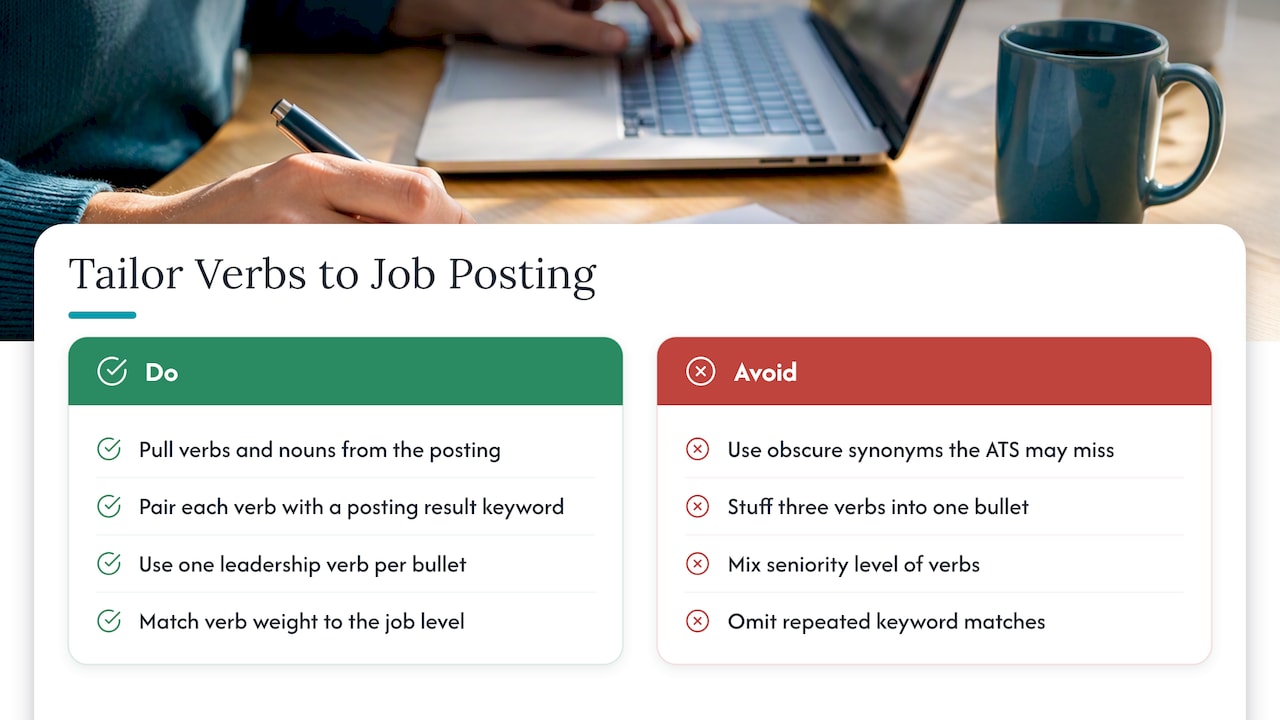
Start by pulling the verbs and skill nouns straight out of the job posting. If the listing says “cross-functional collaboration,” use that phrase or a close variant like “coordinated across teams” rather than a synonym the system might not match. The University of Illinois Action Words Handout recommends favoring common, specific verbs over obscure synonyms for exactly this reason: an unusual word choice can read well to a person but miss a keyword match entirely.
Pair each verb with a result keyword that also appears in the posting, whether that’s “retention,” “revenue,” or “efficiency.” Doing this twice, once in a bullet and once in your summary, reinforces the match without looking repetitive, since the phrasing around the keyword still varies.
Avoid stuffing a single bullet with three leadership verbs to cover multiple keywords at once. One verb per bullet keeps the sentence readable and keeps the scope and metric attached to a single, clear claim. If a posting emphasizes two different leadership competencies, like “change management” and “team development,” give each its own bullet with its own verb from the matching category above.
Finally, check your resume against the actual job title level. A director-level posting expects verbs like “spearheaded” or “architected,” while a first-time team lead role reads more naturally with “coordinated” or “guided.” Matching verb weight to seniority avoids sounding either underqualified or overstated.
7. How leadership verbs affect ATS rankings and recruiter impressions
Applicant tracking systems typically scan for keyword matches between your resume and the job description, which means the verb itself usually matters less to the software than the noun or skill it’s attached to. Where the verb matters most is the few seconds after a resume clears the system and lands in front of a person. A recruiter skimming dozens of resumes a day registers “spearheaded a product relaunch” faster and more favorably than “was responsible for a product relaunch,” even though both describe the same work.
Replacing a passive phrase with a specific, measurable leadership verb is one of the more reliable ways to raise perceived impact during that screen, according to career strategy guidance built around this exact conversion effect, see the UC Davis resume verbs resource. The verb sets the tone for the sentence, but the scope and metric that follow are what actually convince a recruiter the claim is real rather than inflated.
In practice, that means the verb and the keyword need to work together. A strong verb attached to a vague outcome still reads as filler, while even a moderate verb attached to a specific, well-scoped result reads as credible. Prioritize getting the scope and number right first, then choose the verb that most accurately describes how you achieved it.
8. Using leadership action verbs on LinkedIn
Your LinkedIn headline and About section are the first places a recruiter checks after your resume clears initial screening, so the same verb discipline applies there. Open your About section with a verb-led sentence describing the kind of leadership you practice, rather than a job-title restatement like “experienced manager with a background in operations.”
In the Experience section, mirror your resume bullets rather than rewriting them from scratch. Consistency between the two builds trust, and a recruiter who spots a mismatched number between your resume and your profile will often ask about it in a screening call, if they don’t just move on. Use the same action verb, scope, and outcome structure here, though LinkedIn gives you more room to add context, like naming the specific tools or stakeholders involved.
Skills endorsements and the headline both benefit from leadership nouns tied to your verbs, like “Team Leadership” or “Change Management,” since LinkedIn’s own search surfaces profiles partly by these tagged skills. Keep your headline specific to your actual leadership scope rather than a generic title. “Director of Operations | Scaled Teams from 10 to 40” tells a recruiter more in one line than “Operations Leader” ever will.
9. Common mistakes that undercut strong leadership verbs
The most frequent mistake is pairing a strong verb with a vague or missing outcome, which leaves the reader with a claim they can’t evaluate. “Spearheaded a major initiative” says nothing without a number or a defined scope attached.
A second common mistake is using the same verb repeatedly across a resume. Three bullets that all open with “managed” flatten your experience and suggest a limited vocabulary rather than limited achievements. Vary the verb to match the specific type of leadership each bullet describes.
A third mistake is choosing a verb that overstates your actual role. Calling yourself the person who “spearheaded” a project you supported as one of five contributors can create a credibility gap in an interview when someone asks you to walk through exactly what you did. Match the verb’s weight to your real level of ownership, and save the strongest words for the achievements where you genuinely drove the outcome.
Finally, watch for verb-tense inconsistency. Current roles should use present tense (“leads,” “manages”), while past roles use past tense (“led,” “managed”). Mixing the two within the same resume reads as careless, even when the content itself is strong.
10. Power modifiers and quantifiers that strengthen leadership verbs
A strong verb gets sharper when it’s paired with the right modifier or quantifier, as long as the number is real and specific. Vague intensifiers like “significantly” or “greatly” add length without adding proof, so swap them for an actual figure wherever one exists.
Contemporary resume guidance consistently points to this kind of numeric detail as a stronger attention driver than adjectives alone, a point echoed in practical guidance on quantifying resume bullets from career-focused resources built around exactly this problem.
Scope modifiers work alongside quantifiers to show the size of what you controlled: “cross-functional,” “enterprise-wide,” “multi-site,” or “global” all signal reach without needing a number attached. Use one scope modifier and one quantifier per bullet at most. Stacking several in a single sentence buries the verb and makes the bullet harder to skim, which defeats the purpose of using strong language in the first place.
11. Should you edit your own resume or hire professional help?
If you’re applying for an individual-contributor or early management role on a flexible timeline, self-editing with the formula above usually gets you most of the way there. Once the role, budget, or narrative gets more complex (a director-level search, a career pivot, or a tight deadline) a professional set of eyes tends to catch positioning gaps and ATS formatting issues that are hard to see in your own writing.
Kim
12. How Resume Wiz helps you put leadership verbs to work
Picking the right verb is one piece of a resume that actually converts into interviews. If you want a second set of eyes on positioning, formatting, and the overall narrative, our packages are built around exactly that work.

- Evolution combines a resume rewrite with LinkedIn optimization, so your leadership verbs and metrics stay consistent across both documents.
- Elevate pairs resume development with broader career support. Visit the page for details.
- Elevate and Land adds managed applications and outreach on top of resume work.
- Once your bullets are sharp, Elevate helps you turn those achievement statements into confident interview answers.
Every package draws on over 10 years of recruiting experience, so the verbs and metrics you've just revised get built into a document and LinkedIn profile designed to hold up under a recruiter's actual screening process. Explore our services to find the right starting point.
Want a recruiter in your corner for your next senior role? Book a free call with Resume Wiz and we will map out your next move together.
FAQ
What are powerful words to use in a resume?
Powerful resume words are specific action verbs that show ownership of a result, such as “spearheaded,” “negotiated,” “restructured,” or “mentored,” rather than passive phrases like “responsible for.” The strongest ones are paired with a measurable outcome, like “negotiated vendor contracts that saved $180,000 annually.”
What are 20 strong verbs?
Strong resume verbs include led, spearheaded, orchestrated, negotiated, restructured, streamlined, mentored, launched, automated, championed, directed, transformed, recruited, mitigated, coordinated, accelerated, developed, resolved, optimized, and secured. Each fits a different type of leadership claim, so choose based on what you actually did rather than which word sounds most impressive.
Which words are action verbs?
Action verbs describe a specific, completed action rather than a state of being, so words like “managed,” “built,” “reduced,” and “launched” qualify, while phrases like “was involved in” or “responsible for” do not. On a resume, an action verb should be the first word of a bullet and should describe something you actively did, not a duty you simply held.
How to word leadership skills on a resume?
Describe leadership skills through specific achievement bullets rather than a skills list alone, using the formula of an action verb, the scope of what you led, and a measurable outcome.
Sources


Executive career coaching, resume optimization, and done-for-you job search helping professionals from entry-level to C-suite land interviews faster. Founded by Kim Taynor.

