
Blog

How to Get Referred for Leadership Roles in 2026
How to Get Referred for Leadership Roles in 2026
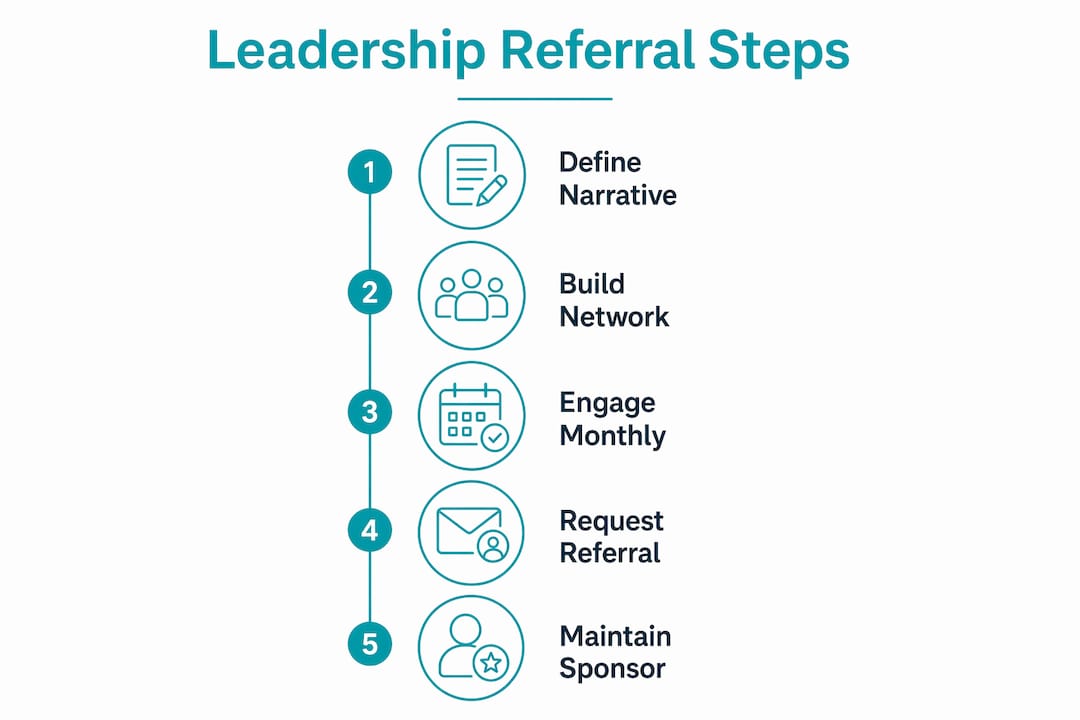
Getting referred for leadership roles is the single most effective way to access positions that never appear on job boards. Leadership roles are predominantly filled through confidential searches, succession planning, and referral-based vetting rather than public postings. That means your resume alone will not get you there. The professionals who consistently land senior positions build deliberate relationships long before a role opens, position themselves as credible leaders in their networks, and ask for advocacy the right way. This guide covers exactly how to do all three.
How to get referred for leadership roles: the foundation
Before anyone refers you for a leadership role, they need a clear, specific answer to one question: “What problem does this person solve?” Vague leadership branding fails in the hidden executive market. You need to define your leadership value in concrete terms, such as scaling a team from 10 to 80, recovering a margin from 12% to 28%, or turning around a struggling product line.
Your LinkedIn profile, resume, and verbal pitch must all tell the same story. Inconsistency across these channels creates doubt. A potential sponsor who reads your LinkedIn and hears a different story in conversation will hesitate to put their reputation on the line for you.
Here is how to build that foundation before you ask anyone for a referral:
- Quantify your leadership impact. Replace vague claims like “led cross-functional teams” with specific outcomes: “Led a 12-person cross-functional team that reduced time-to-market by 30%.”
- Align your narrative with organizational needs. Research the leadership gaps at your target companies. Frame your value around those specific gaps, not a generic list of competencies.
- Update your LinkedIn headline and About section. These are the first things a sponsor reads before deciding whether to recommend you. Write them for the role you want, not the role you have.
- Prepare a two-minute leadership narrative. Practice articulating your leadership story out loud. Sponsors need to be able to repeat your story to others accurately.
- Identify the decision-makers. Know who holds hiring authority for the roles you want. This helps you map which relationships matter most.
Pro Tip: Ask a trusted colleague to read your LinkedIn profile and describe your leadership specialty in one sentence. If their answer surprises you, your profile needs work before you start asking for referrals.
How do you build a network that actually generates leadership referrals?
Networking for leadership referrals works best as a tiered system with different engagement levels matched to relationship closeness. Most professionals treat their network as a flat list of contacts. That approach produces weak results because it applies the same low-effort engagement to everyone.
The three-tier model works like this:
- Inner circle (5–10 people). These are your active sponsors and close advocates. They know your work deeply and will actively promote you. Engage with them at least once a month through direct conversation, project collaboration, or a substantive message.
- Middle ring (20–50 people). These are warm contacts: former managers, respected peers, and industry colleagues. Reach out quarterly with something of value, such as a relevant article, a congratulatory note on a promotion, or a short update on your work.
- Weak ties (broader network). These are LinkedIn connections, conference contacts, and professional association members. Engage through public content, comments, and group participation. Weak ties are often the source of unexpected referrals because they connect you to networks you do not already have.
Consistent engagement means reaching out monthly to advocates and quarterly to wider contacts. That cadence keeps you top of mind without feeling intrusive.
LinkedIn plays a specific role in this system. Posting original content about leadership challenges, industry trends, or lessons from your work builds visibility with people who do not yet know you well. Commenting thoughtfully on posts from senior leaders in your field signals your perspective and expertise to their networks.
Cross-functional projects inside your current organization serve double duty. They expand your internal network and create direct evidence of your leadership capability. Internal advocacy through skip-level relationships is one of the highest-leverage tactics available. A brief monthly conversation with a leader two levels above you carries more weight than dozens of LinkedIn connections.
Pro Tip: Set a recurring calendar reminder for each tier of your network. Treat relationship maintenance like a standing meeting, not a task you get to when you have time.

How do you ask for a referral or sponsorship for a leadership role?
The most important distinction in getting recommended for leadership is the difference between a mentor and a sponsor. Sponsorship is distinct from mentorship in that sponsors actively use their political capital to promote your advancement rather than simply advising you. Mentors give guidance. Sponsors make calls, send emails, and put their name behind yours.
You build sponsorships by delivering results that matter to the sponsor’s priorities, not by asking for favors. Approaching sponsors requires demonstrated value over time rather than direct requests. Sponsors risk their credibility when they advocate for you, so the relationship must be genuine and performance-based.
When the time comes to make a specific referral request, frame it as a business proposal, not a personal favor. Here is what that looks like in practice:
- Be specific about the role. “I’m targeting VP of Operations roles in mid-size manufacturing companies” is far more useful to a sponsor than “I’m looking for leadership opportunities.”
- Provide evidence. Share a one-page leadership summary or a brief document outlining your key results. Make it easy for your advocate to represent you accurately.
- Connect to their priorities. If your sponsor cares about a particular industry challenge, show how your background addresses it. Referrals feel natural when they serve the advocate’s interests too.
- Use warm introductions. Ask your contact to introduce you directly rather than simply passing along your resume. A warm introduction carries significantly more weight at the senior level.
- Time your ask well. The best moment to request a referral is after you have delivered a visible result or contributed meaningfully to a shared project.
“For senior leadership roles, cold referrals rarely succeed. Success depends on cultivating a sponsor well before a role exists who can advocate based on demonstrated value. Warm introductions and peer conversations outperform mass outreach at every senior level.”
What mistakes undermine leadership referral success?
The most common mistake professionals make is treating networking as a reactive activity. Job seekers who focus less than 80% of their time on strategic networking reduce their chances of accessing high-impact roles filled largely via referrals. Most people only reach out to their network when they are actively job searching. By then, it is too late to build the depth of relationship that produces a genuine referral.
Other pitfalls that consistently derail leadership referral efforts include:
- Relying on mass applications. Sending 50 applications to posted roles is not a strategy for leadership positions. Passive candidates with strong network visibility get accessed earlier and evaluated faster than active applicants who rely on job boards.
- Approaching sponsors too soon. Asking someone to advocate for you before you have demonstrated meaningful value to them damages the relationship. Build the track record first.
- Neglecting internal relationships. Many professionals focus entirely on external networking and ignore the skip-level relationships inside their own organization. Internal advocacy often produces the fastest path to a leadership promotion.
- Inconsistent follow-through. Reaching out once and then disappearing does not build trust. Consistency over months and years is what converts a contact into an advocate.
- Failing to make the ask explicit. Some professionals assume their network knows they are open to leadership opportunities. State it directly and specifically when the relationship is ready.
Pro Tip: Start building your sponsor relationships at least 12 months before you plan to make a move. The professionals who get referred fastest are the ones whose advocates have been watching their work for a long time.
Key Takeaways
Getting referred for leadership roles requires sustained relationship investment, a clear leadership narrative, and the ability to cultivate sponsors who will advocate for you before a role ever opens.
| Point | Details |
|---|---|
| Build your leadership narrative first | Define the specific problems you solve before asking anyone to refer you. |
| Use a three-tier network model | Engage inner-circle sponsors monthly and broader contacts quarterly to stay top of mind. |
| Cultivate sponsors, not just mentors | Sponsors use political capital to advocate for you; build these relationships through demonstrated results. |
| Make referral requests specific | Name the role type, provide evidence of your impact, and frame the ask around your advocate’s priorities. |
| Start networking before you need it | Relationships that produce leadership referrals take months or years to develop. |
What I have learned about leadership referrals that most guides miss
After more than a decade working in recruiting and career services, the pattern I see most clearly is this: the professionals who get referred for leadership roles are almost never the ones who asked for referrals at the right moment. They are the ones who made themselves genuinely useful to the right people over a long period of time.
The subtlest mistake I see is confusing visibility with value. Posting on LinkedIn every day does not make someone a referral candidate. What makes someone referable is having a specific, well-documented track record that a sponsor can describe in 30 seconds to a hiring committee. Niche expertise matters enormously here. A professional who is known as the person who fixes broken supply chains in the consumer goods sector is far easier to refer than someone who describes themselves as a “results-driven operations leader.”
Patience is the hardest part of this process to accept. I have worked with clients who built the right relationships, did the right work, and still waited 18 months for the right referral to materialize. That is not failure. That is how senior hiring actually works. The professionals who succeed are the ones who treat relationship-building for leadership roles as a permanent career practice, not a job search tactic.
The other thing I tell every client: do not wait until your resume is perfect to start building these relationships. Your resume supports the referral. It does not create it.
— Kim
How Resumewiz supports your leadership referral strategy
Securing a leadership referral is only part of the equation. When that referral leads to a conversation, your resume and LinkedIn profile need to confirm everything your sponsor said about you.
Resumewiz specializes in executive resume development and LinkedIn profile optimization for managers, directors, and senior leaders who are targeting high-impact roles. The platform builds leadership-focused profiles that document your results clearly, pass ATS screening, and give your sponsors the evidence they need to advocate for you with confidence. If you are serious about advancing into a leadership role, your professional brand needs to match the level you are targeting.
FAQ
Why are most leadership roles never publicly posted?
Senior roles are filled through confidential searches and succession planning rather than public job boards. Organizations use referrals and warm introductions to vet candidates before a position is ever announced.
What is the difference between a mentor and a sponsor?
A mentor gives career advice, while a sponsor uses political capital to actively promote your advancement to decision-makers. Sponsorships are built through demonstrated performance, not by asking for them directly.
How often should I reach out to my network for leadership referrals?
Engage your closest advocates at least once a month and your broader contacts quarterly. Consistent, low-intensity interaction keeps you visible without feeling transactional.
How do I ask someone to refer me for a leadership role?
Be specific about the role type, provide a brief document summarizing your leadership results, and frame the request around how your background serves the advocate’s priorities. Vague asks produce vague results.
How far in advance should I start building referral relationships?
Start at least 12 months before you plan to make a move. Long-term relationship depth consistently outperforms last-minute outreach when it comes to accessing senior leadership opportunities.
Recommended


Executive career coaching, resume optimization, and done-for-you job search helping professionals from entry-level to C-suite land interviews faster. Founded by Kim Taynor.

