
Blog
Imposter Syndrome in Your Senior Job Search
Imposter Syndrome in Your Senior Job Search
Imposter syndrome is defined as the persistent belief that you are not truly qualified for your role, despite clear evidence of success. Senior professionals experience this at rates that would surprise most people. 71% of US CEOs report symptoms of imposter syndrome, compared to 33% of early-career professionals. That gap proves seniority does not cure self-doubt. It amplifies it. For executives navigating an imposter syndrome senior job search, that internal friction can quietly undermine every application, interview, and networking conversation.
How does imposter syndrome show up differently for senior professionals?
Self-doubt at the executive level looks nothing like it does at the start of a career. Early-career professionals fear they lack skills. Senior professionals fear they lack the right to express uncertainty. That shift is subtle but significant.
Seniority changes the shape of imposter syndrome rather than eliminating it. The anxiety moves from “Can I do this job?” to “Am I allowed to not have all the answers?” That internal question becomes louder during a senior career transition, when the stakes feel highest and the audience is most scrutinizing.

The triggers at this level are also different. 57% of senior leaders cite new roles as the most common trigger for imposter feelings, not failure. Promotions, board-level visibility, and lateral moves into unfamiliar industries all activate the same response. Success itself becomes the trigger.
The behaviors that follow are visible to teams, even when executives think they are hiding them:
- Over-preparing for meetings to avoid being caught without an answer
- Reluctance to delegate because delegating feels like exposing gaps
- Hesitating on decisions that fall within clear authority
- Seeking excessive validation before acting on sound judgment
- Downplaying accomplishments in interviews to avoid sounding arrogant
Pro Tip: If you catch yourself rehearsing answers to questions no one has asked yet, that is imposter syndrome preparing your defenses. Redirect that energy toward documenting what you have already achieved.
What psychological and environmental factors make it worse?
Imposter syndrome does not live only inside the individual. The environment feeds it. High-achievement cultures set standards that are, by design, never fully met. That perpetual gap between current performance and the next benchmark creates fertile ground for self-doubt.
Environments that lack clear signals of belonging amplify imposter feelings significantly. Senior leaders often operate in organizational hierarchies where peer support is scarce. There is no one at the same level to say, “I feel this way too.” That isolation makes the doubt feel personal rather than structural.
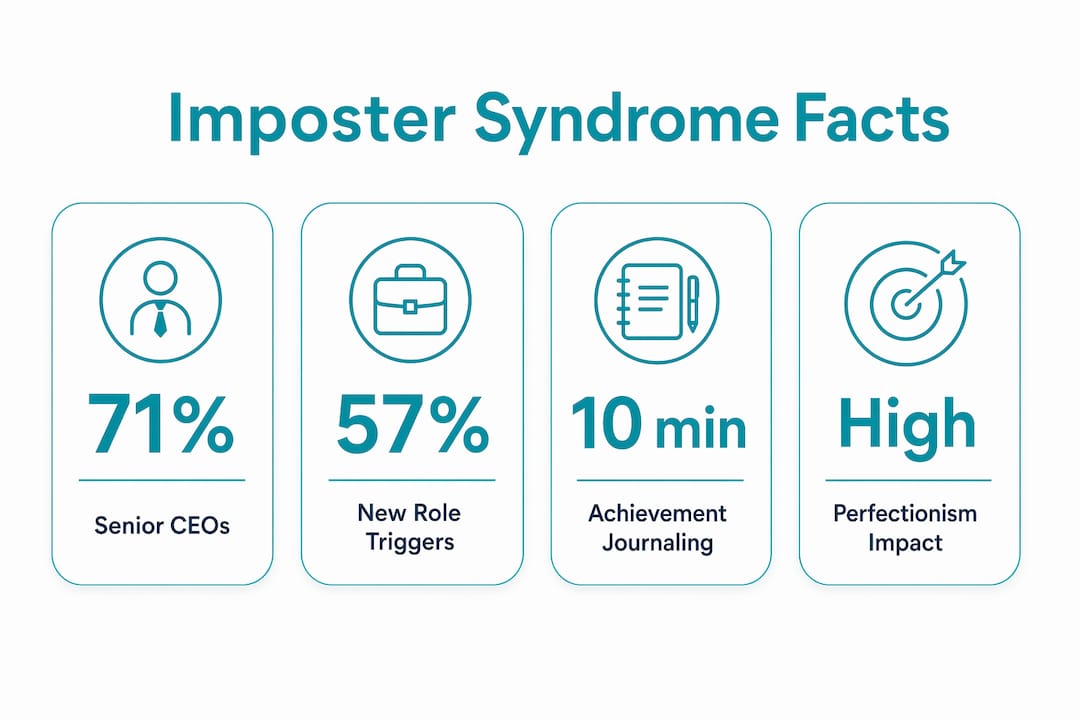
Perfectionism compounds the problem. Overworking and procrastination are both documented responses to imposter-linked perfectionism. Both behaviors worsen job search anxiety. The executive who rewrites a cover letter twelve times and the one who delays applying for three weeks are responding to the same underlying pressure.
Structural factors also matter, particularly for professionals from underrepresented groups. Executives who are the first in their demographic to hold a particular role face an additional layer of scrutiny, real and perceived. That added weight intensifies the feeling of being an outsider, even when the track record says otherwise.
The job search environment itself is a pressure multiplier. Rejection is frequent, feedback is rare, and the process rewards confidence in self-presentation. For a senior professional already managing self-doubt, that combination is genuinely difficult.
What strategies actually work for overcoming imposter syndrome?
Practical strategies exist, and the research on what works is clear. The key is moving from subjective feeling to objective record.
-
Document your achievements in writing. Achievement journaling is the top psychologist-recommended strategy for countering imposter syndrome. Write down specific outcomes you produced, with numbers where possible. “Led a team” becomes “Led a 14-person team that reduced operating costs by 22% in 18 months.” The specificity is what matters. Feelings cannot argue with documented facts.
-
Find an external peer group or mentor. Mentorship providing evidence-based feedback normalizes imposter feelings and builds confidence in ways internal hierarchies cannot. A peer group of other senior professionals gives you access to honest comparison. You will quickly discover that the executives you admire are managing the same doubts.
-
Separate competence from the performance of confidence. Separating competence from confidence allows leaders to make decisions without feeling fully certain first. Confidence is a behavior, not a feeling. You can act decisively in an interview before the internal certainty arrives.
-
Close context gaps with modern tools. The context vacuum in new senior roles creates anxiety that professionals mistake for incompetence. It is a structural problem, not a personal one. AI tools, industry briefings, and LinkedIn research can close that gap faster than any previous generation of job seekers could manage.
-
Reframe imposter feelings as a signal, not a verdict. Feeling uncertain in a new context is a normal response to real demands. It signals that you are paying attention and that the role matters to you. That reframe does not eliminate the feeling, but it stops the feeling from making decisions on your behalf.
Pro Tip: Before any senior-level interview, read through your achievement journal for 10 minutes. You are not reviewing it to memorize answers. You are reminding your nervous system that the evidence is on your side.
How should you prepare for interviews when self-doubt is loud?
Interview preparation for senior professionals dealing with self-doubt requires a specific approach. Generic advice about “being yourself” does not address the real problem.
The most effective preparation method is building an evidence library before the interview begins. Identify six to eight specific situations from your career where you produced a measurable result. Structure each one using the Situation, Task, Action, Result format. The specificity of that structure gives you something concrete to reach for when imposter-driven anxiety tries to blank your memory mid-answer.
Negative self-talk during interviews follows predictable patterns. Recognizing those patterns in advance reduces their power:
- “They are going to ask something I cannot answer” — countered by knowing your achievement library cold
- “I am not as qualified as the other candidates” — countered by remembering that you were selected for this conversation
- “I sound like I am bragging” — countered by understanding that specific evidence is not bragging, it is proof
Framing uncertainty as a leadership strength is also a genuine option in senior interviews. Saying “I have not managed that specific situation, but here is how I would approach it” demonstrates judgment and intellectual honesty. Hiring managers at the senior level value that more than false certainty.
Structured preparation builds factual confidence. The more clearly you can recall what you have done, the less room imposter syndrome has to fill the silence with doubt.
Key Takeaways
Imposter syndrome is more prevalent among senior professionals than early-career ones, and managing it during a job search requires moving from subjective feelings to documented, objective evidence.
| Point | Details |
|---|---|
| Prevalence at senior levels | 71% of US CEOs report imposter syndrome symptoms, far exceeding early-career rates. |
| Triggers shift with seniority | New roles and promotions, not failures, are the most common imposter syndrome triggers for senior leaders. |
| Environment amplifies doubt | Isolation in hierarchies and perfectionism worsen self-doubt during an executive job search. |
| Documentation is the top fix | Writing down specific, numbered achievements moves self-assessment from feeling to fact. |
| Confidence is a behavior | Separating the performance of confidence from internal certainty lets you act before the doubt clears. |
What I have learned working with senior professionals
After more than a decade placing executives and senior leaders, I can tell you that the most accomplished professionals I have worked with are often the ones most convinced they do not belong in the room. That is not false modesty. It is a real pattern.
The mistake I see most often is hiding the doubt and overcompensating with bravado. That combination reads as arrogance to interviewers and exhausts the person performing it. The leaders who manage imposter syndrome well do the opposite. They name it privately, seek honest feedback from people outside their organization, and treat uncertainty as a normal part of operating at a high level.
Imposter feelings do not disappear when you reach the C-suite. They change shape. The goal is not to eliminate them. The goal is to stop letting them make your career decisions. The executives I have seen succeed in senior job searches are not the ones who feel the most confident. They are the ones who act despite the doubt, and who have built enough of an evidence record that the facts can speak louder than the fear.
— Kim
How Resumewiz helps senior professionals move forward with confidence
Senior professionals managing self-doubt during a job search need more than a polished resume. They need a process that validates their achievements and presents them with authority.
Resumewiz works specifically with executives, managers, and career changers to build ATS-compliant resumes, sharpen LinkedIn profiles, and develop personalized outreach that reaches the right decision-makers. The process is built around your documented achievements, which means every application starts from a position of evidence rather than anxiety. Kim Taynor’s recruiting background means the guidance comes from someone who has sat on both sides of the hiring table. If job search anxiety is slowing you down, that experience matters.
FAQ
What percentage of senior leaders experience imposter syndrome?
71% of US CEOs report imposter syndrome symptoms, according to the Korn Ferry Workforce 2024 report. That rate is more than double the 33% reported among early-career professionals.
What triggers imposter syndrome in a senior job search?
New roles and career transitions are the most common triggers. 57% of senior leaders identify starting a new position as the point where imposter feelings peak, not failure or poor performance.
Does imposter syndrome go away with more experience?
Seniority does not eliminate imposter syndrome. It changes the nature of the self-doubt, shifting from questions about skill to questions about the right to express uncertainty in leadership roles.
What is the most effective strategy for dealing with self-doubt during a job search?
Psychologists rank achievement journaling as the top strategy. Writing down specific, numbered outcomes moves your self-assessment from subjective feeling to objective record, which is harder for doubt to override.
How do you handle imposter syndrome in a job interview?
Build an evidence library of six to eight specific career achievements before the interview. Structured preparation gives you concrete facts to recall when anxiety tries to blank your memory, and it reduces the space imposter-driven negative self-talk can occupy.
Recommended


Executive career coaching, resume optimization, and done-for-you job search helping professionals from entry-level to C-suite land interviews faster. Founded by Kim Taynor.

