
Blog

Is Applying Online a Waste of Time for Senior Roles?
Is Applying Online a Waste of Time for Senior Roles?
For senior professionals, applying online is largely a waste of time as a primary job search strategy. The majority of executive and director-level positions never appear on public job boards at all. 70%–80% of senior roles are filled through networking, referrals, and retained search firms before a listing ever goes live. That means the moment you see a posting, you are already competing against candidates who were referred weeks ago. This article breaks down why online applications deliver such poor results at the senior level and what actually works instead.
Is applying online a waste of time at the senior level?
The short answer is yes, for most senior professionals, cold online applications are a poor use of time. The structural problems run deeper than most people realize.
AI-powered applicant tracking systems, commonly called ATS, are the first barrier. These tools screen resumes before any human sees them. AI screening tools prioritize standardized keyword matches over nuanced executive accomplishments. A 20-year career with cross-functional leadership, board exposure, and P&L ownership does not compress neatly into keyword fields designed for mid-level roles. The result is that highly qualified senior candidates get filtered out before a recruiter ever reads their name.

The second problem is ghost jobs. Approximately 21% of senior-level postings are ghost jobs, meaning they have no immediate intent to hire. Companies post them to build talent pipelines, satisfy internal HR requirements, or gauge market compensation. One in five applications you send to a senior posting goes nowhere by design.
The third problem is response rate. Cold online applications yield response rates of only 2%–3%, and the average senior job search stretches three to six months when built primarily around online applications. That is a brutal return on a significant time investment.
Why the math does not work for senior professionals
- Ghost job exposure: 1 in 5 senior postings has no real opening behind it.
- ATS filtering: Complex career histories are penalized by systems built for standardized profiles.
- Low response rates: Cold applications return 2%–3% responses, meaning 97 out of 100 applications produce nothing.
- Time cost: Tailoring a resume and cover letter for a senior role takes two to four hours per application. At a 2%–3% response rate, the math is punishing.
The core problem: Online applications were built for volume hiring at mid-levels. Senior roles require trust, cultural fit, and strategic alignment. None of those qualities survive an ATS filter.
How networking and referrals dominate executive hiring
The hidden job market is not a myth. It is where most senior hiring actually happens. Networking and referrals account for roughly 60% of executive placements, with retained search firms handling a substantial portion of the remainder. That leaves a very small slice of senior roles genuinely open to cold applicants.
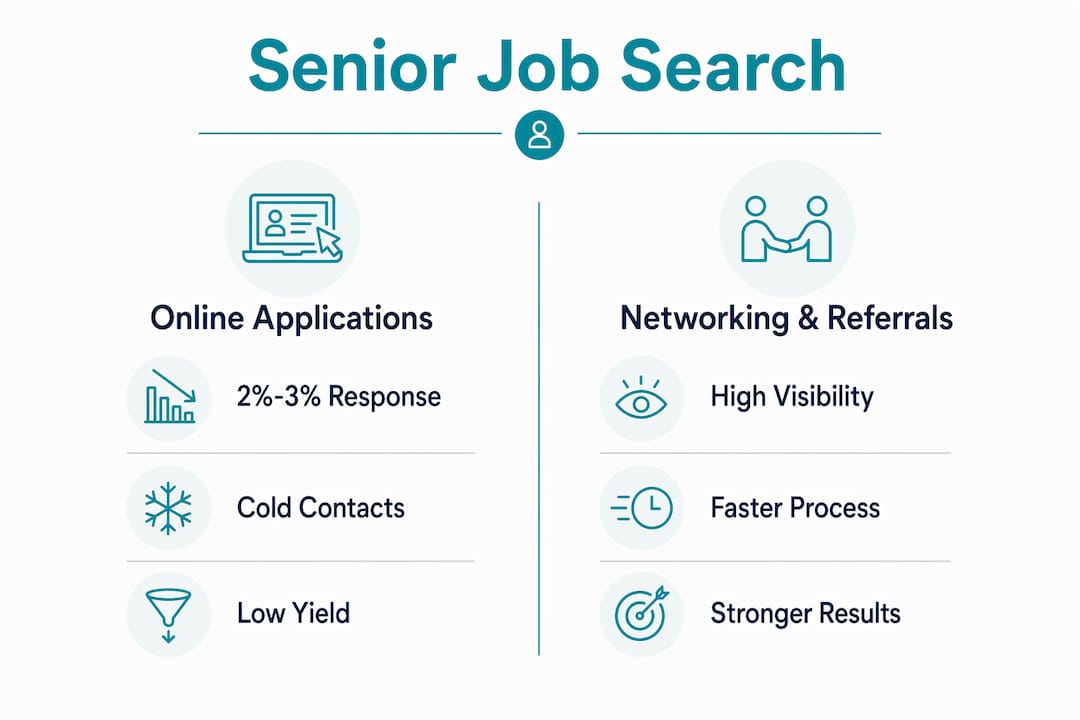
Referrals do more than get your resume seen. 90% of hiring managers say referrals speed up the hiring process, and 80% prefer interviewing referred candidates over equally qualified strangers. A referral does not just open a door. It changes how you are perceived the moment you walk through it.
Retained search firms operate differently from job boards. A retained firm is hired exclusively by the company and paid regardless of outcome. They maintain private shortlists of senior candidates built through years of relationship development. If you are not on a retained firm’s radar, you are invisible to a significant portion of the executive hiring market.
The practical implication is clear. Your time is better spent building relationships with decision-makers, reconnecting with former colleagues, and getting introduced to retained search partners than refreshing job board listings.
- Former colleagues and managers: These are your warmest referral sources. A direct message from a past collaborator carries more weight than any cover letter.
- Board members and investors: At the VP and C-suite level, board members often influence or initiate searches. Getting on their radar matters.
- Retained search partners: Firms that specialize in your function and industry are worth cultivating proactively, not just when you are actively searching.
- LinkedIn connections: Second-degree connections at target companies can facilitate warm introductions that bypass the ATS entirely.
“Senior candidates’ key value lies in the strategic problems they prevent and solve. That value is nearly impossible to convey through keyword matching.”
Why tailoring resumes for ATS is a flawed strategy at the senior level
Many senior professionals respond to low response rates by tailoring their resumes more aggressively for ATS keyword filters. This approach is understandable but counterproductive.
AI screening algorithms fail to appreciate senior candidates’ unique career narratives, favoring standardization over complexity. Stuffing a resume with keywords to pass a filter does not solve the underlying problem. It makes a rich, complex career look generic. The resume that passes the ATS is often not the resume that wins the interview.
The volume approach compounds the problem further. Mass applying beyond 10–15 roles at the senior level produces diminishing returns. Candidates who focus on fewer, well-targeted roles see response rates of 30%–40% instead of the standard 2%–3%. The difference is not luck. It is the quality of the targeting and the presence of a warm introduction or credible angle.
Automation tools that enable mass applications create an additional risk: getting flagged or blacklisted by ATS platforms for duplicative or low-quality submissions. At the senior level, that kind of reputational damage is hard to recover from.
Here is the better framework for thinking about your resume and outreach:
- Build 3–5 high-impact stories. Effective senior narratives consist of outcome-driven stories, not keyword lists. Each story should show a problem you identified, the action you took, and the measurable result.
- Use those stories in direct outreach. A concise, compelling message to a decision-maker that references a specific business challenge lands far better than a tailored resume sent cold.
- Apply online only when you have a referral or a clear angle. An online application backed by a warm introduction has a fundamentally different success rate than a cold submission.
- Stop treating the ATS as the audience. The human hiring manager is the audience. Write for them, not for the filter.
Pro Tip: Before applying to any senior role online, spend 30 minutes identifying one person at that company who can introduce you or at least validate your interest. That single step changes your odds more than any resume revision.
Practical strategies for senior professionals beyond online applications
The most effective senior job searches treat online applications as a last resort, not a first move. The following approaches consistently outperform cold applying.
Build career intelligence before openings appear
Knowing companies’ strategic needs before formal openings are posted is one of the most underused advantages available to senior professionals. Follow target companies’ earnings calls, press releases, and leadership changes. When a company announces a new market entry, a restructuring, or a leadership departure, a senior role is almost always created within 60–90 days. Reaching out at that moment, before the posting goes live, puts you in a completely different position than applicants who respond to a job board listing weeks later.
Use warm introductions and direct outreach
Direct outreach to a VP, SVP, or C-suite contact at a target company is more effective than any application. Keep the message short. Reference a specific business challenge or recent company development. Offer a concrete perspective or insight, not just a request for a meeting. This approach respects the recipient’s time and demonstrates the kind of thinking they are hiring for.
Prioritize quality over quantity in every application
| Approach | Response rate | Time per application | Best for |
|---|---|---|---|
| Cold online application | 2%–3% | 2–4 hours | Entry and mid-level roles |
| Targeted application with referral | 30%–40% | 4–6 hours | Senior and executive roles |
| Direct outreach to decision-maker | Varies, typically higher | 1–2 hours | C-suite and VP roles |
The table above makes the time management case clearly. A targeted application with a referral takes more preparation but returns ten to twenty times the response rate of a cold submission.
Pro Tip: Limit your active applications to 10–15 roles at any time. For each one, identify a referral path before you apply. If you cannot find one, spend your time building toward one rather than submitting cold.
Reconnect with your existing network systematically
Most senior professionals underestimate the size and reach of their existing network. A former direct report who is now a VP at a target company is a warmer introduction than any recruiter. Map your network against your target company list and prioritize outreach to second-degree connections who can make a genuine introduction.
Key takeaways
For senior professionals, the most effective job search strategy centers on relationships and targeted outreach, not online application volume.
| Point | Details |
|---|---|
| Online applications are low-yield | Cold applications return 2%–3% response rates at senior levels, making volume applying inefficient. |
| Most senior roles are never posted | 70%–80% of executive positions are filled through networks and retained search firms before public listing. |
| Ghost jobs waste your time | Roughly 21% of senior postings have no real opening, meaning 1 in 5 applications goes nowhere by design. |
| Referrals change the math | Targeted applications with a referral return 30%–40% response rates versus the 2%–3% cold average. |
| Narratives beat keyword lists | Three to five outcome-driven stories used in direct outreach outperform ATS-tailored resumes sent at scale. |
What I have learned after 10 years of watching senior searches fail
I have spent over a decade working in recruiting and career services, and the pattern I see most often is this: talented senior professionals apply to 50 or 60 roles online, get almost no responses, and conclude that the market is against them. The market is not against them. Their method is.
The executives who move fastest are not the ones with the most polished ATS-optimized resumes. They are the ones who pick up the phone, send a direct message to a former colleague, or reach out to a retained search partner they met at a conference two years ago. They treat their job search like a business development effort, not a form-filling exercise.
The uncomfortable truth about senior hiring is that companies do not post their most important roles publicly. They call someone they trust, or they call a search firm they trust. If you are not in either of those conversations, you are competing for the leftovers.
The other thing I have seen consistently is that senior professionals undervalue their own story. They try to compress 20 years of impact into a two-page keyword document and wonder why it does not resonate. The real work is identifying the three to five moments in your career where you changed the trajectory of a business, and learning to tell those stories in a way that makes a hiring manager lean forward. That is what gets you hired at the senior level. Not a perfectly formatted resume.
Patience matters too. A well-targeted senior search built on relationships typically produces offers in four to twelve weeks. A broad online application campaign can drag on for six months or more with far worse results. The slower-feeling approach is actually faster.
— Kim
How Resumewiz supports senior professionals in their search
Senior job searches require a different approach than what most career services offer. Resumewiz was built specifically for executives, directors, and senior managers who need more than a reformatted resume.
Resumewiz founder Kim Taynor brings over 10 years of recruiting experience to every engagement. The senior career services at Resumewiz include ATS-compliant resume writing focused on high-impact career narratives, LinkedIn profile optimization, personalized outreach templates for direct decision-maker contact, and a fully managed job search process with guaranteed interview placements. The goal is to get you into the conversations that matter, not just into an ATS queue. If you are ready to move beyond cold applications and into a search that actually fits your level, Resumewiz is built for exactly that.
FAQ
Is applying online a waste of time for senior-level roles?
For most senior professionals, cold online applications are a poor primary strategy. With 70%–80% of executive roles filled through networks and retained search firms, and cold applications returning only 2%–3% response rates, online applying alone rarely produces results at this level.
What response rate should senior professionals expect from online applications?
Cold online applications at the senior level return response rates of 2%–3%. Targeted applications backed by a referral or warm introduction return rates of 30%–40%, making the quality of your outreach far more important than the volume.
How do ghost jobs affect senior job seekers?
Roughly 21% of senior-level job postings are ghost jobs with no real opening behind them. Applying to these listings wastes time that could be spent on direct outreach and relationship building with actual decision-makers.
How many roles should a senior professional apply to at once?
Applying to more than 10–15 roles at a time produces diminishing returns at the senior level. A focused list of well-targeted roles, each with a clear referral path or direct outreach angle, consistently outperforms high-volume cold applying.
What works better than online applications for senior job searches?
Direct outreach to decision-makers, warm introductions through your existing network, and proactive engagement with retained search firms all outperform cold online applications. Building career intelligence about target companies before roles are posted gives you the best possible timing advantage.
Recommended


Executive career coaching, resume optimization, and done-for-you job search helping professionals from entry-level to C-suite land interviews faster. Founded by Kim Taynor.

