
Blog
Reframe Your Experience for a New Field: A Career Pro's Guide
Reframe Your Experience for a New Field: A Career Pro’s Guide
Put a one-paragraph Bridge Narrative and a “Relevant Projects” section at the top of your resume, above your chronological history, and you immediately answer the question every hiring manager asks in the first 10 seconds: Why does this person belong here? That single structural move does more than any cover letter rewrite. Here is what to do this afternoon:
- Rewrite your professional summary into a 3 to 4 line Bridge Narrative (origin + catalyst + transferable value + one proof point)
- Reframe three of your strongest bullets using the target role’s verbs and metrics
- Add one documented project that mirrors the target role’s core responsibility
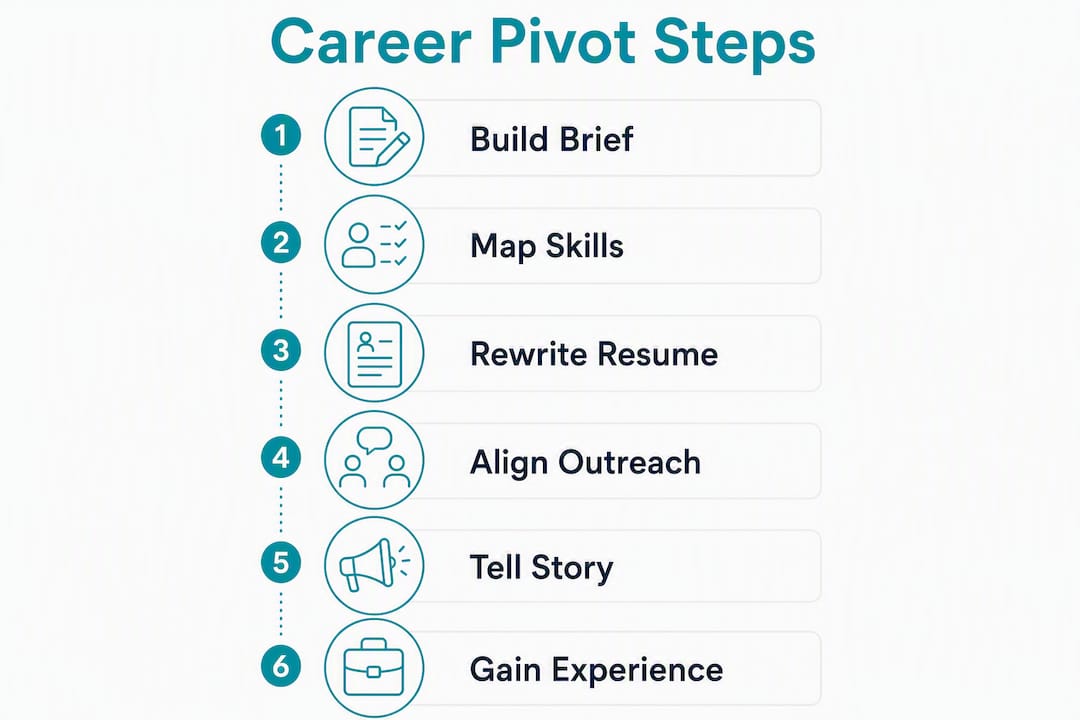
The rest of this guide walks you through every step, from building a hiring brief to handling the “why are you switching?” question in an interview room.
Table of Contents
- How do you figure out what hiring managers actually want?
- How do you map your transferable skills to a new role?
- How do you rewrite resume bullets so recruiters in the new field understand them?
- How do you build a “Relevant Projects” section when you lack direct experience?
- How do you align your LinkedIn, cover letter, and outreach for a career pivot?
- How do you tell your story in interviews without sounding like you are apologizing?
- What are the fastest ways to gain relevant experience in 1 to 12 weeks?
- What does an ATS-friendly resume look like for a career changer?
- How Resumewiz helps career changers reframe and prove their experience
- Key Takeaways
- What hiring managers actually see when you pivot
- Resumewiz gets career changers to interviews faster
- Useful sources and platforms to keep moving
How do you figure out what hiring managers actually want?
Before you reframe a single bullet, you need a clear target. Applying to every open role in a new field wastes time and produces generic materials that convert poorly. Pick one role title and build what recruiters internally call a hiring brief: a short list of the 3 to 5 priorities that define success in that position.
Here is how to build one in under an hour:
- Pull 3 to 5 job postings for your target role from LinkedIn, Indeed, or company career pages. Use postings from companies you would genuinely consider.
- Read each posting and highlight the verbs and metrics that repeat. Words like “analyze,” “coordinate,” “present to stakeholders,” or “manage a $2M budget” that appear in three of five postings are the real requirements, not the ones buried at the bottom.
- List the top 5 repeated skills or tools. These become your keyword map and your translation targets.
- Note what “success in 90 days” looks like based on the language used. Postings that say “you will own” or “you will lead” signal autonomy expectations; ones that say “you will support” signal a more collaborative entry point.
- Rank the 5 skills by how much existing evidence you already have for each. That gap list tells you exactly where to build proof.
Skills-based hiring is increasingly how employers evaluate candidates, which means the hiring brief exercise is not just useful for your resume. It is the lens through which every piece of your application should be written.
How do you map your transferable skills to a new role?
A skill audit sounds formal. The actual process takes about 45 minutes and a spreadsheet. Start by listing every recurring task from your last two or three roles, then name the underlying skill each task required. “Prepared monthly reports for the VP” is not a skill. “Synthesized complex data into executive-ready narratives” is.
Group your skills into five categories: judgment (decisions you made and their stakes), execution (projects you ran from start to finish), communication (who you influenced and how), technical fundamentals (tools, systems, platforms), and leadership (teams, budgets, or processes you owned). Most career changers have depth in two or three of these and gaps in one or two. Knowing which is which lets you write honestly and target your proof-building where it counts.
The table below maps the process from keyword to evidence:
| Target keyword (from job postings) | Your past-role example | Where it appears |
|---|---|---|
| Data analysis | Built monthly sales dashboards in Excel for 12-person team | Resume bullet + Relevant Projects |
| Stakeholder communication | Presented quarterly results to C-suite; drove 2 policy changes | Professional summary + bullet |
| Project management | Led 6-month ERP migration across 3 departments | Relevant Projects section |
| Budget oversight | Managed departmental budget; consistently came in 8% under for 3 years | Resume bullet |
| Cross-functional collaboration | Coordinated between legal, ops, and marketing on product launch | Cover letter + LinkedIn summary |
A useful shorthand: review 30 postings, extract 30 keywords, then prioritize the 30 that appear most often and where you have the strongest evidence. You will not use all 30 everywhere, but having the full list means you can tailor each application without starting from scratch. Keyword mapping from multiple job descriptions consistently produces stronger results than resumes that keep old-role jargon intact.
How do you rewrite resume bullets so recruiters in the new field understand them?
Translation, not reinvention. The goal is to keep every claim factually true while reframing it toward the outcomes the target role cares about. Four rules govern every rewrite:
- Keep the truth. Never inflate scope, team size, or dollar amounts. Recruiters verify.
- Reframe toward target outcomes. A teacher who “managed classroom behavior” actually “designed and enforced structured behavioral frameworks for groups of 28, reducing disruption incidents by 40%.” The fact is the same; the frame is new.
- Add context and scope. Numbers without context mean nothing. “$500K project” is weak. “Led a $500K curriculum redesign affecting 1,200 students across 4 schools” is a resume bullet.
- Insert target verbs and metrics naturally. Pull verbs directly from the job postings in your hiring brief.
Before and after examples:
Operations background targeting project management: Before: “Oversaw daily warehouse operations and managed staff schedules.” After: “Directed daily operations for a 22-person team, coordinating cross-shift schedules and reducing fulfillment errors by 18% over two quarters.”
Education background targeting instructional design or L&D: Before: “Taught 9th-grade English to 30 students.” After: “Designed and delivered differentiated learning programs for 30 learners; assessed outcomes quarterly and iterated curriculum based on performance data.”
Customer support background targeting customer success or account management: Before: “Answered customer questions and resolved complaints.” After: “Managed a portfolio of 85 accounts, resolving escalations within 4 hours and maintaining a 94% satisfaction score over 18 months.”
Finance background targeting business operations or strategy: Before: “Prepared monthly financial reports.” After: “Built monthly financial models tracking $3.2M in departmental spend; identified a $180K cost-reduction opportunity adopted by senior leadership.”
For LinkedIn, the same logic applies to your headline and summary opener. Instead of “Finance Manager | 8 Years in Banking,” try: “Finance Manager Transitioning to Business Operations | Turning Data into Decisions That Stick.” Your summary should open with the Bridge Narrative: one sentence on where you come from, one on what you bring, and one on where you are headed.
Pro Tip: Keep your reverse-chronological work history intact. Place the “Relevant Projects” section above it, not instead of it. A purely functional resume that hides chronology raises red flags for both ATS systems and recruiters who want to verify your timeline.
How do you build a “Relevant Projects” section when you lack direct experience?
Short, verifiable projects often carry more weight than extra certificates because they show capability in action rather than knowledge in theory. The format for each entry is simple:
Where to find projects worth doing:
- Catchafire.org: Connects professionals with nonprofits for short, skills-based volunteer engagements. A data analyst candidate can run a donor-segmentation analysis for a nonprofit in 2 to 3 weeks and walk away with a real deliverable.
- Bootcamp capstones: Programs like General Assembly, Springboard, or Coursera’s professional certificates include capstone projects designed to mirror real job tasks.
Present these projects the way you would present any professional work: with scope, outcome, and tools. “Analyzed 3 months of sales data for a nonprofit using Excel and Tableau; identified a $12K revenue gap in their donor retention cycle” reads as professional evidence. “Worked on a data project” does not.
How do you align your LinkedIn, cover letter, and outreach for a career pivot?
Consistency across every touchpoint matters because hiring managers and recruiters often check LinkedIn before they read your resume. If the two tell different stories, you lose credibility before the conversation starts.
LinkedIn headline templates:
- “[Current strength] | Transitioning to [Target Role] | [One proof point]”
- “[Target role title] | [Industry] | [Signature skill or result]”
LinkedIn summary opener (2 to 3 lines): “After [X years] in [origin field], I bring [core transferable skill] to [target field]. My work in [specific example] produced [result]. I am now focused on [target role type] where that combination of [skill A] and [skill B] creates real value.”
Cover letter opener: “My background in [origin field] gave me [specific skill]. At [Company or Project], I applied that skill to [specific outcome]. I am applying to [Target Role] at [Company] because [one sentence connecting your proof to their stated priority].”
Cold outreach message (for informational conversations): Subject: Quick question from a [origin field] professional moving into [target field] “Hi [Name], I am transitioning from [origin field] into [target field] and came across your work at [Company]. I would value 20 minutes of your perspective on [specific question]. Happy to work around your schedule.”
Consistency checklist:
- Resume summary and LinkedIn summary tell the same Bridge Narrative
- LinkedIn headline reflects the target role, not the old title
- Cover letter references at least one project from the Relevant Projects section
- Outreach message matches the tone and focus of the target role, not the old one
How do you tell your story in interviews without sounding like you are apologizing?
The biggest mistake career changers make in interviews is spending too much time explaining why they left their old field and not enough time proving they belong in the new one. Flip that ratio.
Your Bridge Narrative for verbal delivery is two sentences: “I spent [X years] in [origin field] building [core skill]. That work gave me [specific capability], and I am now focused on [target role] because [one concrete reason tied to their business].”
Use that as your opener in every networking conversation and as the first 30 seconds of your interview answer to “Tell me about yourself.”
For behavioral questions, compress STAR to what matters:
- Situation: One sentence. Set the stakes, not the backstory.
- Task: Frame it in the target role’s language, not your old role’s language.
- Action: Lead with the skill the interviewer cares about.
- Result: Quantify or scope it. Then connect it explicitly to the role you are interviewing for.
Three sample pivots:
- Operations to project management: “I led a warehouse consolidation that affected 3 sites and 40 staff. I built the project plan, managed vendor timelines, and brought it in 2 weeks early. That same planning discipline is what I would apply to your product launch roadmap.”
- Teaching to instructional design: “I redesigned a 9-week curriculum for struggling readers, tracked outcomes weekly, and improved pass rates by 31%. I used the same iterative design process your L&D team uses.”
- Customer support to customer success: “I managed 85 accounts simultaneously, prioritized by churn risk, and reduced escalations by 22% in one quarter. That is the same account-health model your CS team runs.”
When an interviewer asks directly about your experience gap, do not deflect. Acknowledge it, bridge it, and prove it: “You are right that I have not held the title of [target role]. What I have done is [specific project or result that mirrors the role’s core responsibility]. I built that deliberately to close that gap.”
For informational interviews, your outreach script is the one above. Once in the conversation, ask: “What does someone in [target role] need to demonstrate in their first 90 days to be considered successful?” That answer feeds directly back into your hiring brief and your next round of bullet rewrites.
What are the fastest ways to gain relevant experience in 1 to 12 weeks?
Gaining practical experience through short-term engagements often moves the needle faster than enrolling in another degree program. The question is which project to pick first.
Prioritize by four criteria: visibility to hiring managers (can you link to it or describe it concisely?), measurable outcome (does it produce a number or a deliverable?), short completion time (can you finish it in under 8 weeks?), and domain alignment (does it mirror a core task in your target role?).
- Week 1 to 2: Volunteer micro-project via Catchafire or a local nonprofit. Scope it tightly: one deliverable, one outcome metric.
- Week 2 to 4: Freelance gig on Upwork or Contra. Even a $50 project produces a real client, a real brief, and a real result.
- Week 3 to 6: Internal secondment or side project at your current employer. Ask to join a cross-functional initiative outside your usual scope.
- Week 4 to 8: Bootcamp capstone. Programs like Springboard’s data analytics track or General Assembly’s UX design course include structured capstones built around real datasets or client briefs.
- Week 6 to 12: Mini research or analysis with a public write-up. Pick a problem in your target industry, analyze it using publicly available data, and publish a short piece on LinkedIn. A hiring manager who Googles your name and finds a thoughtful industry analysis remembers it.
The career transition timeline for most mid-career pivots runs 3 to 6 months from first application to offer, which means starting your proof-building now, not after you apply, is the move that compresses that window.
What does an ATS-friendly resume look like for a career changer?
The formatting rules for career changers are the same as for anyone else, with one critical addition: you need a front-loaded proof block that ATS can parse and humans can find in under 10 seconds.
- File type: Submit as a .docx or PDF unless the posting specifies otherwise. PDF preserves formatting; .docx is safer for older ATS systems. When in doubt, .docx.
- Fonts and layout: Use standard fonts (Calibri, Arial, Georgia). No tables, text boxes, or headers/footers for key content. ATS often cannot read text inside those elements.
- Section order: Professional Summary → Relevant Projects → Work Experience (reverse-chronological) → Education → Skills. This order puts your proof where both ATS and humans look first.
- Keyword placement: Mirror the exact phrasing from the job posting in your summary and in the first bullet of each relevant role. ATS matches strings, not synonyms.
- Avoid pure functional resumes. A functional resume that groups skills without dates is one of the fastest ways to trigger recruiter skepticism. Reverse-chronological structure with a front-loaded relevant-projects block reduces ATS confusion while still foregrounding your proof.
- Vague summaries kill applications. “Results-driven professional seeking new opportunities” tells a recruiter nothing. A targeted summary that acknowledges the pivot, states transferable value, and includes one quantifiable achievement performs measurably better.
- Do not keyword-stuff. Listing 40 skills in a row, or repeating “project management” seven times, triggers spam filters in modern ATS and reads as padding to human reviewers. Use each keyword once or twice, in context.
How Resumewiz helps career changers reframe and prove their experience
Resumewiz was built specifically for mid- to senior-level professionals who need more than a template. For career changers, the engagement covers every layer of the pivot:
- Bridge Narrative development: A recruiter-reviewed summary that connects your origin, transferable value, and target role in 3 to 4 lines.
- Relevant Projects packaging: Structured entries written to read as professional evidence, not personal experiments.
- ATS-compliant resume formatting: Clean, keyword-mapped documents that pass automated screening and hold a recruiter’s attention.
- LinkedIn profile optimization: Headline, summary, and featured section rewritten to mirror the hiring brief.
- Tailored outreach templates: Personalized messages for cold contacts, referral asks, and informational interviews.
- Interview coaching: STAR story development and Bridge Narrative rehearsal, including how to handle the experience-gap question.
- Managed job search: For senior-level clients, a fully managed process with tailored applications and outreach.
The typical engagement for a mid-career changer runs from a discovery call through skills mapping, resume and LinkedIn rewrite, proof packaging, and outreach coaching. Most clients have polished, ATS-ready materials within two weeks of starting. The process is built around the hiring brief you create in step one of this guide, which means every deliverable is targeted to a real role, not a generic job category.
Key Takeaways
Reframing your experience for a new field works when you lead with a Bridge Narrative and one documented project, then translate every bullet into the target role’s language using a keyword map built from real job postings.
| Point | Details |
|---|---|
| Build a hiring brief first | Extract 3 to 5 repeated skills from real job postings before rewriting a single bullet. |
| Front-load your proof | Place the Bridge Narrative and Relevant Projects above your chronological history so both ATS and recruiters see fit immediately. |
| Translate, don’t reinvent | Keep every claim factually true; reframe it using the target role’s verbs, metrics, and outcomes. |
| Build one visible project now | A short, documented project with a measurable outcome often outweighs an extra certificate. |
| Resumewiz accelerates the process | Resumewiz provides Bridge Narrative development, ATS resume writing, LinkedIn optimization, and interview coaching tailored to career changers. |
What hiring managers actually see when you pivot
Most career change advice focuses on what you say. The real problem is usually what you lead with.
A hiring manager reviewing 80 resumes in a Tuesday afternoon does not read for potential. They scan for pattern recognition: does this person’s summary match what I wrote in the job posting? Does the first project or bullet tell me they have done something close to this before? If the answer is no in the first 10 seconds, the resume goes to the “maybe later” pile, which is usually the “never” pile.
The Bridge Narrative is not a soft, storytelling device. It is a positioning statement that does the recruiter’s job for them. It says: here is where I come from, here is what I built there, and here is exactly why that maps to what you need. When it is written well, the hiring manager does not have to work to see the connection. That is the whole point.
What most career changers underestimate is how much a single, well-documented project shifts perception. A candidate who lists “Relevant Projects: Donor Segmentation Analysis for [Nonprofit], March 2026, using Tableau and Excel, reduced lapsed-donor outreach costs by 19%” is no longer a career changer in the recruiter’s mind. They are a data analyst with a portfolio. The title history becomes context, not the headline.
The other thing worth saying plainly: skills-based hiring is not a trend that benefits everyone equally. It benefits the people who do the translation work. Employers are increasingly open to non-traditional backgrounds, but they are not going to do the translation for you. That is your job, and this guide gives you the tools to do it.
Resumewiz gets career changers to interviews faster
Career pivots stall when the materials are not speaking the new field’s language. Resumewiz closes that gap with a done-for-you process built around your specific target role: a recruiter-reviewed Bridge Narrative, ATS-formatted resume, LinkedIn rewrite, and outreach templates that get responses.
For mid- to senior-level professionals, the managed job search option goes further: Resumewiz handles the targeting, application strategy, and outreach coordination with tailored applications and decision maker outreach. You bring your existing resume, 2 to 3 job postings you are targeting, and any project artifacts you have built. Resumewiz does the rest. See Elevate and Land for details.
If you are ready to stop applying and start getting called back, start with Resumewiz and book a discovery call to see which package fits your pivot.
Useful sources and platforms to keep moving
- Catchafire.org: The most direct way to find short, skills-based volunteer projects with nonprofits. Filter by skill type and time commitment. A completed project here is resume-ready in 2 to 3 weeks.
- Coursera: Professional certificate programs with capstone projects that produce documented, portfolio-ready work. Google’s Project Management Certificate and IBM’s Data Analyst Certificate are two of the most recognized by hiring managers in their respective fields.
- Career Transition Timeline Explained | ResumeMatch: Practical breakdown of how long pivots realistically take and how to sequence your actions to compress the timeline.
- Skills-Based Job Matching Guide | ResumeMatch: Explains how employers are using skills-based matching to evaluate candidates, and how to position your transferable skills to rank higher in that process.
- Resumewiz templates and guides: Free resources including resume templates, LinkedIn guides, and outreach scripts designed specifically for career changers and executives in transition.
Want a recruiter in your corner for your next senior role? Book a free call with Resume Wiz and we will map out your next move together.
Recommended


Executive career coaching, resume optimization, and done-for-you job search helping professionals from entry-level to C-suite land interviews faster. Founded by Kim Taynor.

