
Blog

Why tailoring resumes matters each application for career success
Why tailoring resumes matters each application for career success
You have roughly 11 seconds to make a first impression before a hiring manager moves on, and AI tools now shape which parts of your resume they even see. That reality makes why tailoring resumes matters each application one of the most important things a career-minded professional can understand. A generic resume does not fail because it lacks information. It fails because the right information is buried, out of order, or framed for nobody in particular. Tailored resumes fix that at the structural level, before a human eye ever lands on your name.
Table of Contents
- How tailoring your resume improves recruiter and ATS impact
- Debunking myths: tailoring does not mean rewriting your entire resume
- Why tailoring matters especially for executives and managers
- Best practices for tailoring: balancing content and ATS-safe formatting
- Putting tailoring into practice: a step-by-step approach for career-minded professionals
- The hidden power behind resume tailoring: mindset and system
- Enhance your job search with expert resume tailoring tools
- Frequently asked questions
Key Takeaways
| Point | Details |
|---|---|
| Tailoring increases visibility | Tailored resumes show your most relevant skills immediately to recruiters and ATS systems. |
| Only 15% changes needed | Adjusting summary, skills order, and a few bullets is enough for effective tailoring. |
| Formatting impacts ATS parsing | ATS-friendly layouts avoid tables and complex designs that can hide key information. |
| Executives must prove specific value | Tailoring highlights leadership impact aligned with role priorities to make fit obvious. |
| Modular approach saves time | Building a master resume toolkit enables fast, repeatable tailoring without burnout. |
How tailoring your resume improves recruiter and ATS impact
Most professionals assume resumes go straight to a recruiter. They do not. Before a human reads a single line, applicant tracking systems (ATS) parse your document, extract data, and rank you against other candidates. The recruiter often sees a scored profile before they see your actual resume. That means your formatting and keyword choices are doing more work than your experience alone.
Poor formatting is a silent killer. Columns, text boxes, unusual fonts, and embedded graphics can scramble the data an ATS extracts. You might have 15 years of executive leadership experience, but if the ATS reads garbled output, good candidates get lost before a recruiter sees anything. Tailoring forces you to confront both issues at once: content relevance and structural integrity.
When you tailor for a specific role, you naturally pull the most relevant keywords to the top. That is exactly where ATS systems and recruiters look first. As the 11-second scan window research confirms, AI tools influence what surfaces during that initial review. Tailoring ensures your best evidence is front and center, not buried in a third page no one reaches.
Here is what proper tailoring does for your ATS and recruiter performance:
- Aligns your summary with the specific language used in the job description
- Places the most role-relevant skills at the top of your skills section
- Replaces generic bullet points with achievement-focused language tied to the employer’s stated priorities
- Ensures ATS-safe formatting that parses cleanly across different systems
- Removes irrelevant roles or details that dilute your signal-to-noise ratio
The importance of customized resumes is not a soft benefit. It changes where you rank in a filtered candidate pool before any human judgment enters the picture. If you are applying at the executive level, executive resume guidance that accounts for both ATS and human review is worth building into your process from day one.
“Tailoring your resume is not about changing who you are. It is about making it effortless for the right employer to recognize that you are exactly who they need.”
Debunking myths: tailoring does not mean rewriting your entire resume
The biggest reason professionals skip tailoring is a false belief that it requires hours of work per application. It does not. Effective tailoring requires only about 15% of your resume to change, primarily your summary, the order of your skills, and one or two experience bullets. The rest stays consistent.
Think of your resume as a modular toolkit, not a finished document. You keep a master version that contains every achievement, role description, and skill you might ever want to reference. For each application, you pull the most relevant pieces forward and push less relevant ones back. That is it.
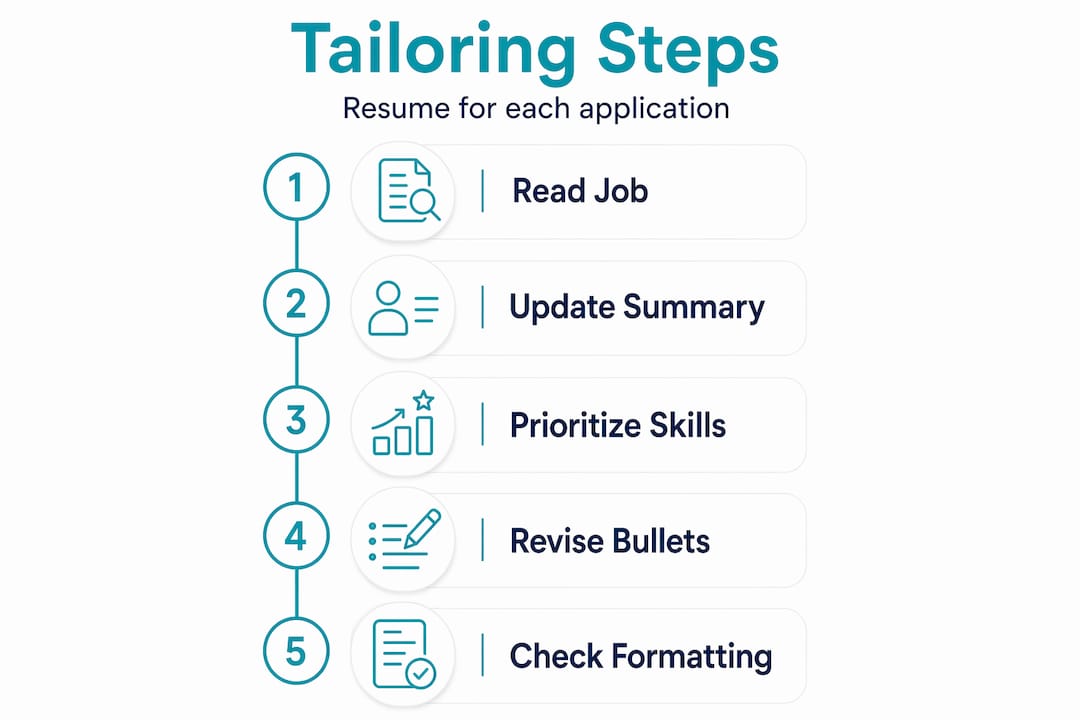
Here is a repeatable process for fast, focused tailoring:
- Read the job description carefully. Highlight the top five to seven requirements, including technical skills, leadership qualities, and outcomes the employer mentions.
- Update your professional summary. Rewrite two to three sentences to reflect the role’s language and your most fitting experience. This takes about five minutes.
- Reorder your skills section. Move skills that match the job description to the top. Do not add skills you do not have. Just reprioritize.
- Swap one or two bullet points. Find bullets in your experience section that most directly address the employer’s priorities. Replace any that feel generic or off-target.
- Do a final ATS check. Confirm your formatting is clean, your section headings are standard, and no critical keywords are missing.
Done well, this process takes 10 to 15 minutes. That is a small investment relative to the impact on your interview rate. The key is having your master resume ready and organized so you are selecting and adjusting, not creating from scratch.
Pro Tip: Keep a dedicated document with 8 to 10 pre-written summary variants and 20 or more achievement bullets organized by theme (growth, operations, leadership, revenue). When a job posting lands, you are assembling, not writing. This single habit cuts your tailoring time dramatically and makes applying for jobs effectively feel sustainable rather than exhausting. Explore tailoring strategies that work specifically for leadership-level applications.
Why tailoring matters especially for executives and managers
At the executive level, the stakes around tailoring go up significantly. Senior roles attract smaller, more competitive candidate pools, and the bar for a “good fit” is higher. A VP of Operations position is not looking for someone who managed operations in general. It is looking for someone who managed operations in a way that maps directly to their specific priorities, whether that is cost reduction, digital transformation, or rapid team scaling.

Generic resumes force recruiters to do interpretive work. They have to read between the lines and assume your experience translates to their context. Most recruiters will not do that work. The clearer the alignment, the faster a recruiter can confirm fit and move you forward.
Here is what tailored executive resumes consistently do better:
- Lead with quantified impact that speaks directly to the employer’s biggest challenges
- Frame leadership accomplishments using the vocabulary of the target company’s sector
- Eliminate board-level or operational details that are impressive but irrelevant to the specific role
- Surface industry or functional expertise that directly matches the job’s stated requirements
- Create an immediate “yes, this person gets it” reaction rather than a “maybe, let me keep reading” hesitation
The impact of personalized resumes at the executive level is disproportionate. When a recruiter is evaluating 50 applicants for a Chief Revenue Officer role, the candidate whose resume reads like it was written for that exact job gets the first call. Everyone else gets a polite rejection. For deeper insight into how executives can position themselves effectively, resources like executive resume insights offer valuable perspective on how senior professionals can articulate their value more precisely.
Pair that positioning with executive resume alignment principles and you are not just getting past the ATS. You are giving the hiring committee a reason to prioritize you.
“Do not leave the employer to connect the dots between your background and their needs. Every tailored resume should make the answer to ‘why this person?’ obvious in seconds.”
Best practices for tailoring: balancing content and ATS-safe formatting
Tailoring the right content means nothing if your formatting prevents the ATS from reading it. This is where many professionals unknowingly self-sabotage. They spend time on language but use a visually impressive template that completely breaks ATS parsing.
The safest and most effective resume formats share a few common characteristics:
- Single-column layout. Multi-column designs may look polished in Word or PDF, but ATS systems often read columns out of order or merge content incorrectly.
- Standard section headings. Use labels like “Work Experience,” “Education,” and “Skills.” Creative alternatives like “Where I’ve Made an Impact” confuse parsing algorithms.
- No tables or text boxes. Content inside these elements is frequently skipped entirely by ATS parsers.
- No headers or footers for key information. Contact details in headers or footers are sometimes ignored. Put them in the main body of the document.
- Standard date formats. Write “January 2023 to Present” or “01/2023 to Present” consistently throughout.
Here is a quick comparison of formatting approaches and their ATS compatibility:
| Resume element | ATS-safe choice | ATS risk |
|---|---|---|
| Layout | Single column | Two or more columns |
| Contact info | In document body | In header or footer |
| Section labels | Standard (e.g., “Skills”) | Creative or unusual labels |
| Skill display | Plain text list | Icons, bar graphs, visuals |
| File type | .docx or plain PDF | Scanned image PDF |
| Fonts | Arial, Calibri, Georgia | Decorative or custom fonts |
ATS parsing failures caused by tables, footers, or unusual symbols are more common than most professionals realize, and the candidate never knows it happened. They just never hear back.
Pro Tip: After tailoring, paste the text of your resume into a plain text document (Notepad on Windows or TextEdit on Mac in plain text mode). If the content looks jumbled, out of order, or missing sections, your original formatting has ATS problems that need fixing before you submit. Check ATS-friendly resume tips to understand exactly what changes make the biggest difference.
Putting tailoring into practice: a step-by-step approach for career-minded professionals
Understanding the theory of tailoring is one thing. Building it into a repeatable, low-friction routine is another. Here is how career-minded professionals can make tailoring a consistent part of applying for jobs effectively without burning out.
Start with your master resume. This is your full, unedited career document. Include every role, every achievement, every skill. Nothing is too niche or too granular. This is your personal library.
Then follow this application process for each role:
- Analyze the job description. Identify the three to five skills or outcomes the employer mentions most frequently. These are the keywords your tailored resume needs to reflect. Reading the job listing carefully and reflecting its language in your summary, skills, and bullets is one of the highest-ROI actions in any job search.
- Match your summary to the role. Write two to four sentences that speak directly to the employer’s stated needs. Use their language, not generic career-speak.
- Reorder your skills list. Place the skills most relevant to this specific job at the top. Bury or remove skills that have no relevance to the role.
- Select your best-fit bullets. From your master resume, choose the two to three bullets per role that most clearly demonstrate the outcomes the employer cares about. Replace anything generic or unrelated.
- Run your ATS formatting check. Use the plain text test described earlier. Confirm no critical information is lost in the formatting.
- Read it as the recruiter would. Skim your own resume in 10 seconds. Is the most important information visible immediately? If not, move it up.
This process becomes faster with each application because you are reusing and rotating pre-written content, not generating it fresh each time. The resume tailoring process gets more efficient as your master document grows richer.
The hidden power behind resume tailoring: mindset and system
Here is what most career advice misses: the biggest barrier to consistent tailoring is not time. It is how professionals mentally frame their resume. Most people treat it as a fixed, finished document, something they update every few years and send out as-is. That framing makes tailoring feel like a burden.
The shift that actually works is treating your resume as an evidence map. Your career is full of results, decisions, and outcomes. The evidence map is the curated selection of that evidence, organized to answer one question: “Why is this person exactly right for this specific role?” Every version of your resume is a different selection from the same pool of evidence.
When you treat your resume as an evidence map, you stop feeling like you are distorting your story for different employers. You are simply choosing which part of your true story is most relevant right now. That is not dishonest. It is the kind of communication clarity that strong communicators use in every professional context.
There is also a practical outcome that does not get discussed enough: tailoring reduces application burnout. Professionals who send 50 generic applications and hear nothing back feel demoralized. Those who send 15 well-targeted applications with a 40% response rate feel energized. The math is not about volume. It is about match quality. High-fit applications through strategic resume framing consistently outperform high-volume generic ones.
The system matters too. Build your master document now. Organize your bullets by theme. Write five to six summary variants for different role types. Do that work once, and every future application takes minutes, not hours.
Enhance your job search with expert resume tailoring tools
Understanding why tailoring resumes matters each application is the first step. Executing it at a level that consistently wins senior-level interviews is where professional support makes a measurable difference.
At Resume Wiz, we work with executives and managers who are serious about landing high-fit roles faster. Our approach combines ATS-optimized formatting, modular resume frameworks, and executive branding expertise built on over 10 years of recruiting experience. Whether you need a complete resume overhaul or a targeted tailoring system you can use independently, our Resume Wiz services are designed to get you into the right conversations quickly. Explore our executive resume solutions and see how a professionally tailored resume changes what hiring managers see first.
Frequently asked questions
Is tailoring my resume really necessary for every job application?
Yes. Tailored resumes improve shortlisting odds by making your relevance immediately clear to recruiters who often have seconds, not minutes, to evaluate each candidate.
How much of my resume should I change when tailoring?
Around 15% needs to change per application, mainly your summary, skills order, and one or two bullets, while the rest of your resume stays consistent.
Can complex resume designs hurt my chances with ATS systems?
Yes. Complex formats cause parsing problems that cause well-qualified candidates to be ranked poorly or missed entirely before a human ever reviews their application.
How can I balance tailoring with applying to many jobs efficiently?
Build a master resume with pre-written bullets and summary variants organized by theme; a modular toolkit enables tailoring in as little as 10 minutes per application without starting from scratch each time.
Recommended


Executive career coaching, resume optimization, and done-for-you job search helping professionals from entry-level to C-suite land interviews faster. Founded by Kim Taynor.

