
Blog

Why Experienced Professionals Struggle to Get Hired
Why Experienced Professionals Struggle to Get Hired
Qualified candidates with decades of experience are being rejected before a single human reads their resume. This is the defining hiring challenge of 2026, and it explains why experienced professionals struggle to get hired at rates that defy logic. Automated Applicant Tracking Systems (ATS) filter out senior applicants based on formatting signals, not merit. Hiring managers then compound the problem with budget fears and risk aversion. The result: a system that consistently sidelines the most capable people in the applicant pool.
Why experienced professionals struggle to get hired in 2026
The core problem is structural, not personal. 88% of hiring managers admit that ATS reject qualified, highly skilled candidates before any human sees their application. That statistic means the majority of experienced professionals never get a fair shot, regardless of how strong their background is.
ATS platforms use keyword matching and pattern recognition to score resumes against job descriptions. A resume that scores below a threshold gets discarded automatically. Senior candidates often score lower because their resumes are dense with context, leadership narrative, and broad accomplishments rather than the narrow keyword strings that ATS algorithms reward.

The problem goes deeper than formatting. Highly qualified professionals have submitted over 10,000 applications across 18 months and received no feedback at all. That silence is not random. It is the predictable output of automated rejection loops that never route applications to a human reviewer.
Common ATS triggers that eliminate senior applicants
ATS systems flag specific resume elements as signals to filter candidates out. The most common triggers include:
- Graduation dates that reveal age or a long career span
- Old email domains such as AOL or Hotmail, which ATS interprets as a dated candidate profile
- Job histories spanning 20 or more years, which exceed the system’s expected career length
- Inconsistent formatting, such as tables or columns, that ATS cannot parse correctly
- Keyword mismatches between the resume and the exact language in the job posting
ATS often interpret graduation dates and old email domains as age signals, triggering silent auto-rejection of senior candidates. The candidate never knows this happened.
Pro Tip: Remove your graduation year from your resume unless you graduated within the last five years. Switch to a Gmail address, use a clean single-column format, and mirror the exact language from the job posting in your skills and summary sections.
What employer biases actually cost senior candidates
Bias in hiring is rarely explicit. The word “overqualified” carries most of the weight. Hiring managers use “overqualified” as a euphemism for two separate concerns: ageism and budget control. Both operate below the surface of any official hiring policy.
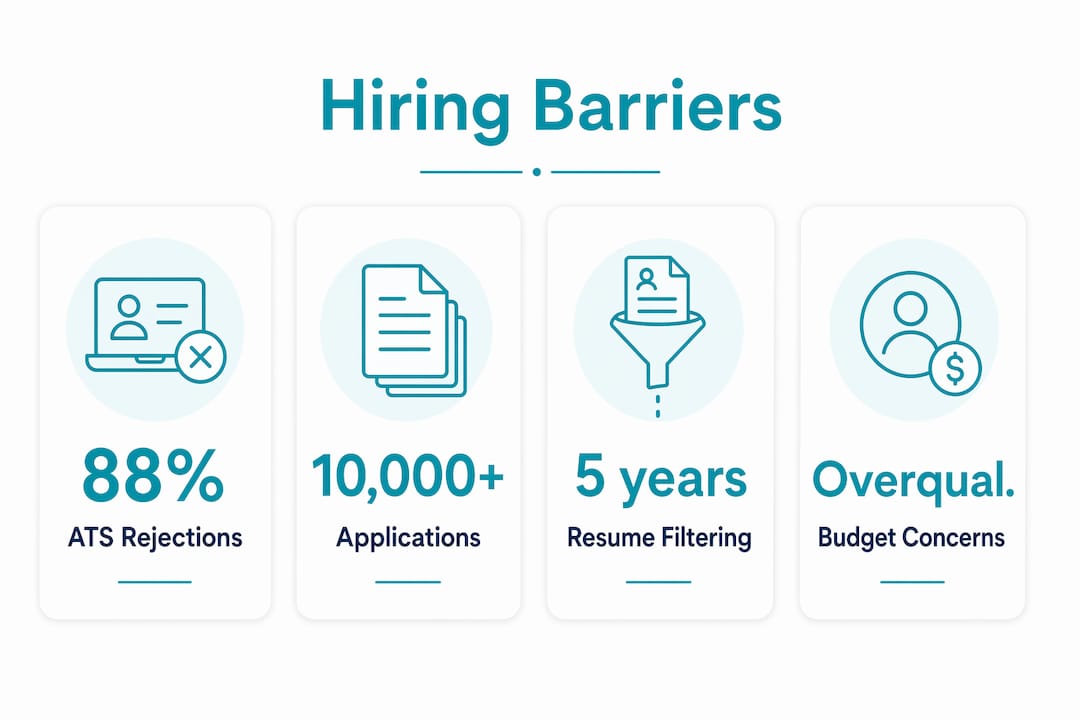
The budget concern is straightforward. A senior candidate commands a higher salary. A hiring manager working within a fixed headcount budget sees that as a financial risk, not an asset. The ageism concern is more psychological. Hiring managers often view highly experienced candidates as a threat to their own authority or as a flight risk who will leave the moment a better offer appears.
These fears produce a predictable pattern in hiring decisions:
- Senior candidates get screened out early to avoid salary negotiation conversations
- Hiring managers favor candidates they can mentor and direct over those who may challenge their decisions
- Exact-match profiles win over broad experience because they feel lower risk
- Perceived cultural fit, which often correlates with age, overrides demonstrated competence
The result is a hiring process that systematically disadvantages the most experienced applicants in the pool. Understanding this pattern is the first step toward countering it.
How employer priorities shifted in 2026
The 2026 hiring market rewards a specific type of candidate: someone who can solve a defined business problem immediately with minimal ramp-up time. Modern hiring managers prioritize candidates with immediate capacity to solve business problems over deep aspiration and broad experience. That shift directly disadvantages senior professionals whose value is often strategic, contextual, and long-term.
The contrast between what experienced candidates offer and what 2026 employers want is stark:
| What experienced candidates bring | What 2026 employers prioritize |
|---|---|
| Broad cross-functional expertise | Narrow, exact-match skill sets |
| Long-term strategic thinking | Immediate problem-solving capacity |
| Deep industry knowledge | Fast ramp-up with low training cost |
| Leadership and team development | Individual contributor output |
| Aspirational career growth | Stable, low-risk hire |
The more experienced the candidate, the harder the job search becomes in a market biased toward exact-match resumes and low ramp-up time. This is not a reflection of the candidate’s ability. It reflects a hiring system optimized for short-term risk reduction rather than long-term organizational strength.
Senior professionals who understand this shift can reframe their applications to speak directly to immediate business impact rather than career trajectory.
Strategies that actually work for seasoned job seekers
The challenges for seasoned job seekers are real, but they are not insurmountable. The candidates who break through share three consistent behaviors: they tailor every application, they build visible credibility outside the application process, and they communicate impact in concrete terms.
Tailor every resume to the specific role
Generic resumes fail ATS and bore human reviewers. Every application needs a version of your resume that mirrors the language in the job posting. Pull the exact phrases from the job description and use them in your summary, skills section, and bullet points. This is not dishonest. It is the minimum requirement for ATS compliance.
Resumes that fail to demonstrate measurable senior leadership impact consistently struggle in the 2026 hiring market. Replace vague accomplishment statements like “led a team” with proof statements: “led a 12-person team that reduced operational costs by 18% over two quarters.”
Build a career narrative that hiring managers can follow
Experienced professionals often lose interviews because they fail to convey a clear career narrative and executive presence in their applications. A career narrative is not a biography. It is a one-paragraph explanation of who you are, what you do best, and why this specific role is the logical next step. Write it in plain language. Make it specific to the company you are targeting.
Use targeted search methods to find the right roles
Broad job board searches produce high-volume, low-quality results for senior candidates. A more effective approach uses sector-focused searching to identify companies with real hiring needs.
- Identify the industries where your experience creates the most direct value
- Use NAICS codes to find companies in those sectors that are actively growing
- Research those companies directly on LinkedIn and their careers pages
- Reach out to hiring managers and department heads before a role is posted
- Build relationships with recruiters who specialize in your sector
Sector-focused searching and NAICS codes help experienced candidates target companies actively hiring, improving visibility beyond ATS filters. This approach shifts the search from reactive to proactive.
Pro Tip: LinkedIn’s “Open to Work” feature is visible to recruiters even when set to private. Update your headline and About section to reflect the specific role type you are targeting, not your current or most recent title. Recruiters search by role, not by career history.
Key Takeaways
Experienced professionals face systemic hiring barriers rooted in ATS filtering, employer bias, and a 2026 market that rewards exact-match skills over broad expertise.
| Point | Details |
|---|---|
| ATS filters eliminate senior candidates silently | 88% of hiring managers confirm ATS reject qualified candidates before human review. |
| “Overqualified” signals budget and authority concerns | Hiring managers use the term to mask ageism and fear of salary costs. |
| 2026 employers prioritize immediate impact | Exact-match skills and fast ramp-up beat deep experience in current hiring decisions. |
| Tailored resumes outperform generic ones | Mirror job posting language and include measurable proof statements for every claim. |
| Proactive outreach bypasses ATS entirely | Targeting companies directly through sector research reaches decision-makers before roles are posted. |
What I’ve learned after a decade of watching this system fail great candidates
The part that frustrates me most is the silence. I have worked with executives who spent 20 years building real expertise, only to submit hundreds of applications and hear nothing back. Not a rejection. Not a request for more information. Nothing. That silence is not feedback. It is a system failure, and it takes a real psychological toll on people who have spent their careers being recognized for results.
What I tell every client is this: the system is not evaluating you. It is filtering you. Those are two completely different things. An ATS does not know that you turned around a struggling division or built a team from scratch. It knows whether your resume contains the right keywords in the right density.
The mindset shift that changes everything is moving from “why won’t anyone hire me” to “how do I get my resume in front of a human.” Once you accept that the first battle is technical, not personal, you stop taking the silence personally and start solving the actual problem.
The broader societal cost of this system is real. Companies are passing over the candidates most capable of solving their hardest problems because those candidates do not fit a narrow algorithmic profile. That is a loss for organizations, not just for job seekers. The professionals who adapt fastest are the ones who learn to speak the language of the system while preserving the substance of their real experience.
— Kim
How Resumewiz helps experienced professionals cut through the noise
Experienced professionals deserve a job search process built for their level, not a generic template designed for entry-level applicants.
Resumewiz specializes in ATS-compliant resume development, LinkedIn profile optimization, and executive branding for senior professionals, managers, and career changers. Kim Taynor brings over 10 years of recruiting experience to every engagement, which means your resume is built by someone who understands exactly what hiring managers look for and how ATS systems score applications. The platform also offers personalized outreach templates and interview coaching designed to get you in front of decision-makers faster. If you are a seasoned professional ready to stop sending applications into silence, Resumewiz offers the tools and expertise to change that outcome.
FAQ
Why do ATS systems reject experienced candidates?
ATS systems use keyword matching and pattern recognition that penalizes long job histories, old email domains, and graduation dates. These elements trigger age-related filters that eliminate senior candidates before a human reviewer sees the application.
What does “overqualified” really mean to a hiring manager?
“Overqualified” typically signals budget concerns and fear of flight risk. Hiring managers worry that senior candidates will demand higher salaries or leave quickly for a better opportunity.
How can experienced professionals improve their callback rate?
Tailor every resume to mirror the exact language in the job posting, remove graduation dates, and replace vague accomplishments with measurable proof statements tied to business outcomes.
Does networking still work for senior professionals in 2026?
Networking remains one of the most effective ways to bypass ATS entirely. Direct outreach to hiring managers and sector-focused research through NAICS codes connects experienced candidates to roles before they are publicly posted.
Why do less experienced candidates sometimes get hired over senior ones?
The 2026 hiring market favors exact-match skill sets and fast ramp-up time over broad experience. Less experienced candidates often fit narrowly defined job descriptions more precisely, which scores higher in ATS systems and reduces perceived hiring risk.
Recommended


Executive career coaching, resume optimization, and done-for-you job search helping professionals from entry-level to C-suite land interviews faster. Founded by Kim Taynor.

