
Blog

Why You're Being Overlooked for Leadership Roles
Why You’re Being Overlooked for Leadership Roles
Being overlooked for leadership roles is defined by a gap between how well you execute today and how ready decision-makers believe you are for tomorrow. This gap is rarely about competence. It is about visibility, strategic influence, political navigation, and whether your professional narrative matches what senior leaders expect. Mid-level professionals who understand why you’re being overlooked for leadership roles can close that gap deliberately. The barriers to leadership advancement are real, but most are fixable once you know where to look.
Why you’re being overlooked for leadership roles
The most common reason high performers miss leadership promotions is the competence trap. Over-delivering becomes a ceiling when it anchors your reputation to your current role. Decision-makers see you as indispensable where you are, not ready for where you want to go. That is the trap: your greatest strength becomes the reason you stay put.

Experts describe this as a shift that must happen before any title change. High performers must move from tactical contributors to strategic leaders who tolerate ambiguity and lead from authority, not approval. Execution is valued. Strategic influence is promoted.
The behaviors that signal leadership readiness look different from the behaviors that signal execution excellence. Here is where most mid-level professionals lose ground:
- Solving every problem yourself signals you are a great individual contributor, not a leader who develops others.
- Waiting to be recognized signals passivity. Leadership candidates make their impact visible before anyone asks.
- Avoiding conflict signals risk aversion. Senior leaders are expected to hold unpopular positions and make hard calls.
- Measuring success by output signals a task mindset. Leadership is measured by influence, direction, and team outcomes.
Pro Tip: Start demonstrating leadership behaviors at least six months before a promotion cycle opens. Volunteer to lead cross-functional projects, present findings to senior stakeholders, and mentor junior colleagues. These actions build the perception of readiness before the conversation begins.
Overdelivering is often relational, linked to being liked and staying safe. At senior levels, that pattern becomes unsustainable. Leaders must be willing to be disliked. That shift is not comfortable, but it is required.
How visibility and sponsorship determine who gets promoted
Silent hard work does not get people promoted. Leadership promotions are driven by visibility, political navigation, and demonstrated readiness, not just delivery. If the people making promotion decisions do not see your impact, your impact does not count.
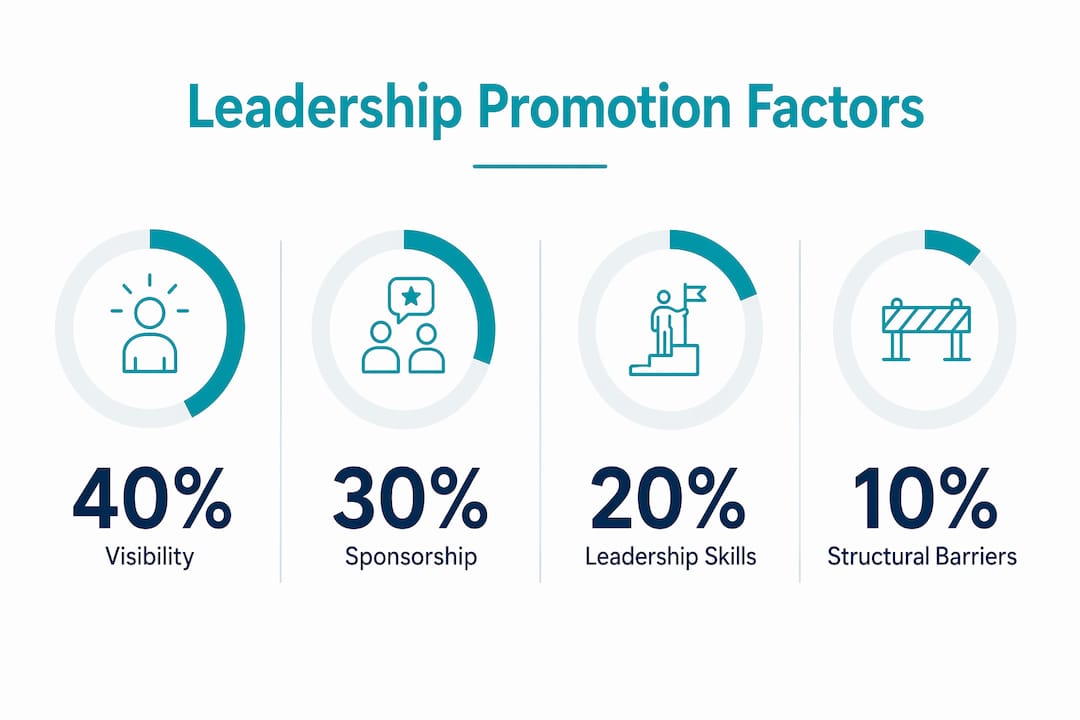
The distinction between mentorship and sponsorship matters here. A mentor gives advice. A sponsor uses their political capital to advocate for you in rooms you are not in. Formalizing sponsorship increases diversity and success in leadership pipelines. Sponsorship is not luck. It is a relationship you build deliberately.
Here is how to build the visibility and relationships that move leadership candidacy forward:
- State your leadership ambition clearly. Tell your manager and key stakeholders directly that you are targeting a leadership role. Ambiguity about your goals gives decision-makers no reason to advocate for you.
- Translate your work into business impact. Many overlooked professionals do not connect their output to revenue, risk reduction, or organizational priorities. Learn to speak in those terms.
- Identify two or three senior sponsors. These are leaders who know your work, believe in your potential, and will say your name in promotion conversations.
- Participate in high-visibility projects. Seek assignments that put you in front of senior leaders and cross-functional teams. Presence in these spaces builds political capital.
- Manage your leadership narrative. Craft a consistent story about where you are headed and why you are ready. Hiring managers value clarity in professional stories and cultural fit.
Pro Tip: Schedule a quarterly conversation with your manager specifically about your leadership development. Bring examples of your strategic contributions, not just your task completions. Frame the conversation around where you are going, not just what you have done.
True leadership is demonstrated before formal recognition arrives. Professionals who act like leaders before they hold the title are the ones who get the title. That is not a cliché. It is how promotion decisions actually get made.
What structural barriers block leadership advancement in 2026
Systemic barriers are a significant factor in why leaders are chosen over others, and the data in 2026 makes this clear. These are not personal failures. They are structural problems that require deliberate navigation.
| Barrier | Data point | What it means |
|---|---|---|
| Women’s executive representation | Below 31% as of early 2026 | Stagnation signals systemic failure, not a pipeline problem |
| Senior women’s burnout | 60% report frequent burnout vs. 50% of men at the same level | Burnout affects perceived leadership sustainability |
| Generational opt-out | Millennials and Gen Z increasingly reject traditional management paths | Leadership pipelines are thinning from below |
| Feeder role access | Leadership progression depends heavily on presence in feeder roles | Without access to the right roles, political capital cannot build |
Women’s executive representation has stagnated below 31%. That number reflects leadership systems built around outdated assumptions, not a shortage of qualified women. The burnout gap compounds the problem. When 60% of senior-level women report frequent burnout compared to 50% of men at the same level, the perception of leadership sustainability becomes a barrier before a promotion conversation even starts.
Younger professionals are opting out of traditional management paths at growing rates. They seek autonomy and meaningful work over hierarchical authority. This generational shift is thinning leadership pipelines and creating a vacuum that organizations have not yet addressed.
The path through these barriers runs through sponsorship and feeder roles. Leadership progression outweighs technical skill at higher levels when political capital and role access are factored in. Seek out the roles that put you in the leadership pipeline, not just the roles that match your current expertise.
Does your leadership style match what your organization actually promotes?
A mismatch between your personal leadership style and your company’s culture is one of the most overlooked reasons for missing leadership roles. Hiring managers value clarity in professional stories and cultural fit. If your story is unclear or your style conflicts with how leadership is practiced in your organization, you will be passed over regardless of your performance record.
The difference between managing and leading shows up in how you frame your own work. Managers complete tasks and hit targets. Leaders define priorities, shape direction, and build the capacity of others. If your self-description sounds like the former, decision-makers will not picture you in a leadership role.
Executive presence is the visible expression of leadership readiness. It includes how you communicate in senior meetings, how you handle pressure, and how clearly you project confidence without arrogance. These behaviors affect how hiring managers and senior leaders perceive your readiness, often more than your actual results.
To align your style with your organization’s leadership expectations:
- Study who gets promoted. Look at the leaders two levels above you. Identify the behaviors, communication styles, and relationships they share.
- Audit your professional narrative. Can you describe your leadership vision in two sentences? If not, decision-makers cannot picture you in the role.
- Seek feedback on executive presence. Ask a trusted senior colleague how you come across in high-stakes meetings. The gap between self-perception and external perception is often significant.
- Adapt without losing authenticity. Cultural alignment does not mean becoming someone else. It means understanding the unwritten rules and choosing when to work within them.
Advancing to executive roles requires a shift from solving problems to defining priorities. That shift must show up in how you talk about your work, not just how you do it.
How to improve your leadership candidacy starting now
Closing the gap between your current role and a leadership position requires a shift in how you think about your work, your relationships, and your visibility. These steps address the most common factors in leadership role selection.
- Reframe your identity from executor to influencer. Stop measuring your value by tasks completed. Start measuring it by decisions shaped and people developed.
- Communicate your impact in business terms. Every significant contribution you make should be translated into revenue protected, costs reduced, or risk managed. Speak the language of the leaders above you.
- Build political awareness. Understand who holds influence in your organization, what they care about, and how decisions actually get made. Political savvy is a leadership skill, not a character flaw.
- Pursue feeder roles actively. Identify the roles and projects that historically produce leaders in your organization. Request them. Make the case for why you belong there.
- Monitor your energy and sustainability. Sustainable leadership progression requires long-term identity development and practicing new behaviors under real conditions. Burnout signals that your current approach is not sustainable at a higher level.
The professionals who get promoted to leadership are not always the most technically skilled. They are the ones who have made their readiness visible, built the right relationships, and positioned themselves as the obvious choice before the decision is made.
Key Takeaways
Being overlooked for leadership roles is almost always a visibility and positioning problem, not a competence problem.
| Point | Details |
|---|---|
| Escape the competence trap | Stop over-delivering in your current role and start demonstrating strategic influence across the organization. |
| Make your impact visible | Translate your contributions into business outcomes and communicate them directly to decision-makers. |
| Build sponsorship deliberately | Identify senior leaders who will advocate for you in promotion conversations and cultivate those relationships now. |
| Navigate structural barriers | Seek feeder roles, manage burnout proactively, and understand the systemic factors that affect leadership selection. |
| Align your narrative | Craft a clear, consistent leadership story that matches your organization’s culture and what senior leaders expect. |
What I’ve learned after a decade of watching promotions go to the wrong person
After more than 10 years working in recruiting and career services, I can tell you the most consistent pattern I see: the person who gets the leadership role is rarely the most talented person in the room. They are the person whose name comes up first when the decision-makers talk.
That sounds unfair. It is also completely predictable once you understand how promotion decisions actually work. They happen in conversations you are not part of, based on impressions formed long before the role opens. The professionals who win those conversations are the ones who have been building visibility and relationships for months, sometimes years, before the opportunity appears.
The hardest shift I see mid-level professionals resist is moving from being liked to being respected. Overdelivering feels safe. It earns appreciation. But appreciation does not get you promoted. Respect for your judgment, your vision, and your ability to lead through uncertainty does. That shift requires tolerating discomfort, and most people avoid it until they have been passed over one too many times.
If you are reading this and recognizing yourself in the competence trap, that recognition is the starting point. The path forward is not working harder. It is working differently, more visibly, more politically, and with a much clearer story about where you are going and why you belong there.
— Kim
How Resumewiz helps you position yourself for leadership
Getting passed over for a leadership role often comes down to how your experience is presented, not just what that experience is. Resumewiz specializes in helping mid-level professionals translate their execution track record into a leadership narrative that decision-makers actually respond to.
Kim Taynor and the Resumewiz team bring over 10 years of recruiting experience to every engagement. The focus is on executive resume positioning that reflects strategic thinking, not just task history. From ATS-compliant formatting to LinkedIn profile optimization and personalized outreach, Resumewiz builds the full picture that hiring managers and executive search teams need to see. If you are ready to stop being the best-kept secret in your organization, Resumewiz gives you the tools to change that.
FAQ
Why do high performers get passed over for leadership roles?
High performers are often passed over because their reputation is anchored to execution, not strategic influence. Decision-makers see them as indispensable in their current role rather than ready for the next level.
How does visibility affect leadership promotion decisions?
Visibility is a primary factor in leadership selection. Professionals who do not make their impact and intentions known to senior decision-makers are consistently overlooked, regardless of their results.
What is the competence trap in leadership advancement?
The competence trap occurs when over-delivering in a current role makes a professional appear irreplaceable where they are, blocking upward movement. Breaking out requires shifting focus from output to influence.
How can women overcome systemic barriers to executive roles?
Women can navigate systemic barriers by actively seeking sponsorship, pursuing feeder roles that build political capital, and managing burnout before it affects their perceived leadership sustainability.
What does executive presence mean for leadership candidacy?
Executive presence is the visible expression of leadership readiness, including how you communicate under pressure, how clearly you project confidence, and how consistently your behavior matches senior leadership expectations.
Recommended


Executive career coaching, resume optimization, and done-for-you job search helping professionals from entry-level to C-suite land interviews faster. Founded by Kim Taynor.

