
Blog
Why Is My Resume Not Getting Interviews?
Why Is My Resume Not Getting Interviews?
You’ve sent out dozens of applications and heard almost nothing back. If you’re asking why your resume is not getting interviews, the answer is rarely “the job market is bad” or “you’re not qualified enough.” The real problem is almost always structural. Your resume is hitting two walls before a human ever reads it: automated tracking systems that filter by format and keywords, and recruiters who spend just 6 to 11 seconds deciding whether to keep reading. Fix those two walls, and your callback rate will shift fast.
Table of Contents
- Key takeaways
- Why your resume is not getting interviews: the ATS problem
- What recruiters actually look for in resumes
- How to tailor your resume for every application
- Other common mistakes hurting your interview rate
- Testing your resume before you apply
- My honest take on why most resume advice misses the point
- How Resumewiz helps you land more interviews
- FAQ
Key takeaways
| Point | Details |
|---|---|
| ATS rejects most resumes first | About 75% of resumes never reach a human reviewer due to formatting and parsing failures. |
| Keywords must match exactly | Mirror the exact phrasing from job descriptions, especially in your summary and skills sections. |
| Recruiters scan, not read | Your job title, company name, dates, and measurable results must be instantly visible. |
| Tailoring beats templates | A generic master resume reduces your chances; customizing for each role increases ATS scores and relevance. |
| Diagnose before applying | Run your resume through an ATS parser and verify the output before sending a single application. |
Why your resume is not getting interviews: the ATS problem
Before a recruiter sees your resume, software reads it. Applicant Tracking Systems pull text from your file, sort it into fields like name, employer, and skills, then score your match against the job. If the parsing fails, your score tanks before a person ever looks at you.
The most damaging formatting mistakes include:
- Multi-column layouts. ATS reads left to right, top to bottom. Columns get scrambled into nonsense.
- Text boxes and graphics. Text inside shapes is often invisible to parsers.
- Headers and footers. Contact info placed in headers gets skipped entirely, which can lead to automatic disqualification.
- Decorative fonts. Symbols and ornamental typefaces cause misreads. Arial, Calibri, and Helvetica are safe choices.
- Inconsistent date formats. Mixing “January 2023” with “1/2023” confuses the system’s timeline logic. Pick one date format like “Jan 2024” and use it everywhere.
Beyond structure, keywords drive your ATS score. Exact phrase matching from the job description matters more than you think. If the posting says “project management” and your resume says “project oversight,” the system may not connect those as equivalent. Use the precise language from the requirements section, not a synonym you prefer.
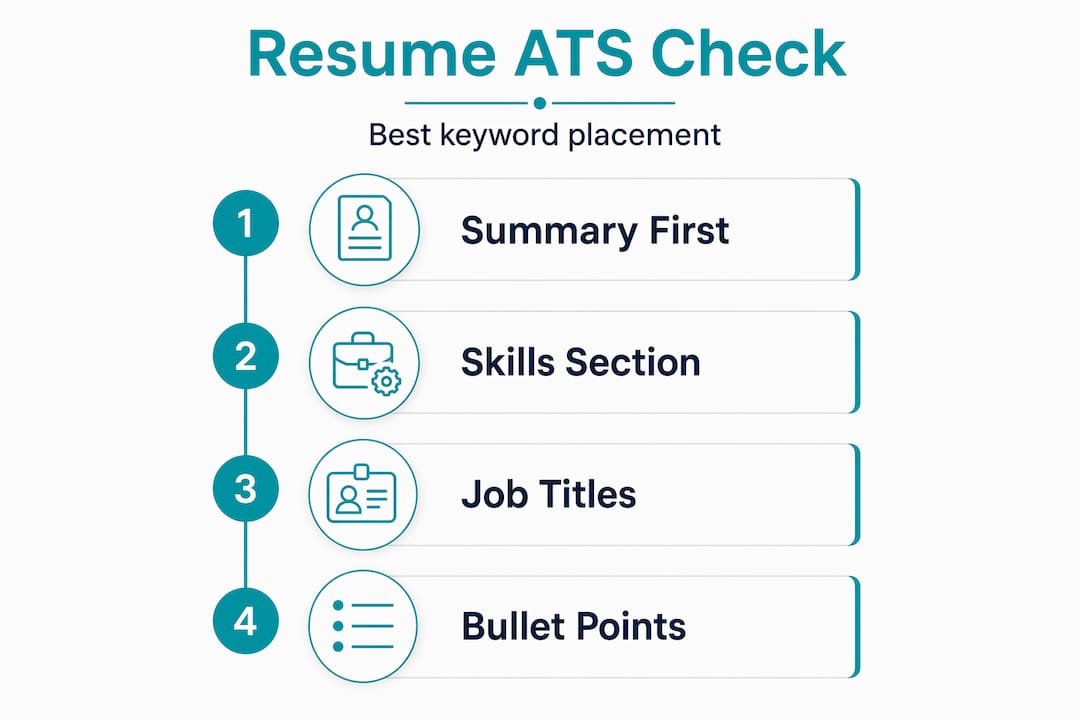
Keyword placement matters too. ATS systems weight your summary and skills sections more heavily than most candidates realize. Mentioning a skill once in a bullet point buried in a 2018 job entry will not score as well as mentioning it in your summary, your skills list, and a recent experience bullet.
Pro Tip: Paste your resume text into a plain text editor and read it as if you were a robot. If information looks out of order or fields seem garbled, your formatting is likely causing ATS parsing errors.
What recruiters actually look for in resumes
Even if your resume passes the ATS filter, it still needs to pass a human scan that lasts under 10 seconds. Recruiters focus on fast-to-locate signals rather than reading your full work history. They look at your current or most recent job title, the company name, your employment dates, and any numbers that pop off the page.

Your summary paragraph is mostly ignored on the first pass. Recruiters skim to your most recent role first. If that role does not match the seniority level or function they need, they move on. This means your latest position’s title and company carry enormous weight upfront.
What stops a quick scan cold:
- Vague bullet points. “Responsible for managing a team” tells a recruiter nothing about your actual impact.
- Duty-focused writing. Listing what your job required rather than what you accomplished makes you interchangeable with every other applicant.
- Wall-of-text summaries. A five-sentence paragraph of generic claims wastes the only seconds you have.
- Inconsistent formatting. Mismatched fonts, random bolding, or varying bullet styles make the resume look careless and slow down scanning.
The fix is quantification. Numbers stop the eye. “Reduced onboarding time by 40% for a team of 12” is processed faster and remembered longer than any job description rewrite. If you work in a role where hard numbers are tricky to find, use percentages, team sizes, timelines, or budget figures.
Pro Tip: Rewrite your three most recent job bullets with this formula: Action verb + specific task + measurable result. Do that for every role and your resume will read entirely differently to a recruiter.
How to tailor your resume for every application
One of the clearest reasons for a low interview rate is sending the same resume to every job. Using a single generic resume reduces your relevance score with both ATS software and the humans reading it.
Tailoring does not mean rewriting everything from scratch. Here is a practical process:
- Pull the job description and highlight every repeated term. Words that appear two or more times in requirements are almost certainly weighted in the ATS.
- Compare those terms to your current resume. Note which ones are missing entirely and which ones appear but use different phrasing.
- Update your summary and skills section first. These sections score highest in ATS rankings, so your keyword updates go furthest here.
- Adjust two or three bullet points in your most recent roles. Swap in the exact language from the job post where it reflects real experience.
- Check your LinkedIn profile matches your resume. Recruiters cross-reference both, and inconsistencies create doubt.
When reviewing a posting, you do not need to match every single requirement. Applying when you meet roughly 70 to 80 percent of what is listed gives you a realistic shot. Applying when you meet 40 percent or less is where issues with your resume become irrelevant because the targeting problem is bigger.
For deeper guidance on resume keyword strategy, reviewing how keyword density works across sections will help you prioritize which terms matter most. Spreading high-priority terms across your summary, skills, and at least two experience bullets gives you the keyword repetition that ATS systems reward with higher rankings.
Pro Tip: Create a base resume with your best bullets, then keep a separate running list of your strongest quantified achievements. When tailoring, you can swap bullets in and out of your base document in minutes instead of starting over.
Other common mistakes hurting your interview rate
Some of the most damaging issues on a resume have nothing to do with keywords. These problems are easier to miss because they feel minor until you realize they are silently disqualifying you.
- Contact information errors. A misspelled email address or outdated phone number means callbacks go nowhere. Check this every single time.
- Unexplained employment gaps. Gaps themselves rarely disqualify you. Leaving them completely silent with no context is what raises flags.
- Overloaded design. Icons, tables, shaded boxes, and custom graphics look polished on screen but break ATS parsing and confuse automated systems.
- Wrong file format. Unless the posting specifically asks for a PDF, many older ATS platforms parse Word documents more reliably.
- Sending the wrong version. Applying to a senior role with a resume that still carries an older title or outdated skills list signals a disconnect immediately.
| Resume element | Common mistake | Better approach |
|---|---|---|
| Contact info | Placed in header or footer | Place in main document body |
| Date format | Mixed formats throughout | Use uniform format, e.g., “Jan 2024” |
| Design | Tables, icons, text boxes | Clean single-column, plain text formatting |
| File type | Sending PDF to ATS that prefers .docx | Follow submission instructions exactly |
| Job targeting | Same resume for all roles | Customized version per application |
Pro Tip: Always send yourself a copy of your submitted resume and reply to that email. If your own email bounces or the file looks wrong, you have just found the problem before a recruiter does.
Testing your resume before you apply
Most job seekers send a resume and wait. A better approach is to run diagnostics before submitting anything.
- Use a free ATS parsing tool. Several platforms let you upload your resume and show exactly how the system reads it. Check whether your name, contact info, job titles, and dates parsed correctly.
- Verify section recognition. Confirm the tool identified your Experience, Education, and Skills sections properly. Mislabeled sections are one of the top reasons for the resume not getting responses.
- Read the parsed output like a recruiter. Does your most recent role appear at the top? Are your strongest achievements visible in the first half of the page?
- Run a keyword gap check. Paste the job description and your resume text side by side and manually compare terms. Better yet, use a tool that scores the match.
- Get a second opinion. A peer, mentor, or professional reviewer will catch things you are too close to see. Fresh eyes notice things that feel obvious once pointed out.
Diagnosing your resume against each gate, ATS parsing, keyword fit, bullet impact, and role targeting, is the most reliable way to understand why your resume is not getting interviews rather than guessing at the problem.
Pro Tip: Print your resume and read it from the bottom up. This breaks your pattern recognition and forces you to notice typos, date inconsistencies, and formatting issues your brain normally skips over.
My honest take on why most resume advice misses the point
I’ve spent over 10 years working inside recruiting, and the single biggest thing I’ve seen is that job seekers blame the market when the real problem is a fixable document. That’s not criticism. It’s genuinely hard to see your own resume clearly when you’re under the pressure of a job search.
What I’ve learned from working with executives and career changers is that most resume problems come down to one thing: treating the resume as a career history instead of a targeted sales document. Your resume is not a record of what you’ve done. It’s an argument for why you are the right person for this specific role.
The other misconception I run into constantly is that once a resume is “good,” it’s done. It isn’t. Every application is a test. If you track your apply-to-interview rate and it’s below 10 to 15 percent, something in your resume process needs adjustment. I’ve watched clients go from one callback in two months to three interviews in a single week just by fixing their ATS formatting and adding numbers to their bullets. That’s not luck. That’s diagnostics applied consistently.
In 2026, ATS systems are smarter but exact phrase matching still rules. Don’t let anyone tell you synonyms are good enough. Mirror the language from the job description. Do the keyword gap analysis every single time.
— Kim
How Resumewiz helps you land more interviews
If you’ve done the self-diagnosis and still aren’t seeing results, you may need more than a checklist. Resumewiz was built specifically for professionals who are serious about landing the right interviews, not just more rejections.
At Resumewiz, every resume is built for ATS compliance from the ground up, with keyword targeting matched to your specific roles, quantified achievement bullets, and formatting that holds up in any system. Kim Taynor’s decade-plus of recruiting experience means your resume is written by someone who knows exactly what hiring managers stop for. Whether you need a full resume overhaul, LinkedIn profile optimization, or a completely managed job search, Resumewiz delivers a process that gets results. Start with the resources available on the site, or reach out for a personalized consultation.
FAQ
Why is my resume not getting any interviews?
Your resume is likely being filtered out by ATS software before a recruiter sees it, or it is not passing the recruiter’s quick scan. Common causes include formatting errors, missing keywords from the job description, and bullet points that describe duties instead of measurable results.
How do I know if my resume is ATS compatible?
Use a free ATS parsing tool to upload your resume and review the output. Check that your name, contact details, job titles, and dates are all read correctly and that your Experience and Skills sections are properly identified.
What do employers look for in resumes?
Recruiters focus on your most recent job title, the company you worked for, employment dates, and quantifiable accomplishments. Clarity and visible highlights matter far more than length or design complexity.
How often should I tailor my resume for each job?
Every single application. At minimum, update your summary and skills section to mirror the exact keywords from the job posting, and adjust one or two experience bullets to reflect the most relevant accomplishments for that specific role.
Does resume length affect interview chances?
Length matters less than density of relevant information. A two-page resume packed with quantified results outperforms a one-page resume full of generic duties every time. Cut what doesn’t support the role you’re targeting, not what makes the resume shorter.
Recommended


Executive career coaching, resume optimization, and done-for-you job search helping professionals from entry-level to C-suite land interviews faster. Founded by Kim Taynor.

