One Page Hypothesis Driven 30-60-90 Plan for Final Round Interviews
Bring a one-page 30-60-90 day plan to a final-round interview, not to a first screen, and frame it as a proposal instead of a signed agreement. Build it around a few measurable goals per phase, one visible early win, and two or three named assumptions that invite the interviewer to push back. If you are earlier in the process or short on context, skip the document and keep the headlines ready to talk throughout.
Key Takeaways:
- A 30-60-90 day plan should be a proposal, focusing on measurable goals, early wins, and assumptions that invite collaboration and correction.
- Focus on learning, owning a project, and delivering results in each phase, ensuring goals are tied to specific metrics relevant to the role.
- Research the company’s priorities thoroughly before writing the plan to ensure alignment, using public statements, recent moves, and team output as sources.
- Keep the plan flexible by clearly labeling assumptions and leaving room for feedback, showing adaptability rather than presenting a fixed blueprint.
- Present the plan during final rounds as a live conversation, using it to demonstrate understanding, collaborative attitude, and willingness to revise based on interviewer feedback.
Table of Contents
- What a 30-60-90 day plan is and when to use it in interviews
- The three phases: what belongs in days 1-30, 31-60, and 61-90
- How to write a plan hiring managers can actually evaluate
- How and when to hand the plan over in the room
- Common mistakes that weaken an otherwise strong plan
- A one-page template and a short example you can adapt
- Why a hypothesis-driven plan works better than a polished one
- Customizing the plan for different industries and job functions
- Researching the company and role before you write anything
- Aligning the plan with what the company and team actually need
- Showing flexibility instead of a fixed script
- Handling questions and pushback about the plan in real time
- What most advice about interview plans gets wrong
- Get your plan and delivery ready before the final round
- Where this guidance comes from
- Sources
- FAQ
What a 30-60-90 day plan is and when to use it in interviews
A 30-60-90 day plan is a short document, usually one page or a few slides, that lays out what you intend to learn, build, and deliver in your first three months on the job. The format is standard across most guides: three phases, each with a few concrete goals written to the SMART framework.
It works best for mid-level and senior hires in roles with measurable outputs, sales, operations, marketing, product, and management positions where success can be tied to a number or a deliverable. It matters less for early-career roles or highly technical individual contributor jobs where ramp time looks different.
The plan changes the conversation. Instead of the interviewer guessing whether you understand the job, you show your operating logic on paper.
- Signals you have done real homework on the role and the company.
- Shifts the discussion from your resume to how you would actually perform.
- Gives the hiring manager something concrete to react to and correct.
The three phases: what belongs in days 1-30, 31-60, and 61-90
Each phase has a different job. Getting the sequence right matters more than any single bullet point inside it.
- Days 1-30: learn and listen. Map key stakeholders, read the metrics and documents that define the role, and land one small, visible win that proves you can move without breaking anything. Best Practice Institute frames this phase as earning the right to act before you try to change anything big.
- Days 31-60: own something end to end. Take one scoped project from start to finish, define the leading indicator you will track, and start small, iterative improvements based on what you learned in the first month.
- Days 61-90: ship and set the next bet. Deliver a measurable outcome, then publish your goals for the next six months along with how often you will report progress. Best Practice Institute describes this as the point where you set the next bet rather than declaring victory.
Every phase should answer the same five questions: what does success look like, what are the three goals, what metric proves it, what are you assuming, and what is the one early win. That checklist keeps the plan tight and keeps you from listing tasks instead of outcomes.
How to write a plan hiring managers can actually evaluate
Format discipline matters as much as content. The Coursera guide to writing a 30-60-90 day plan recommends sketching goals straight from the job description, then tightening each one into a SMART statement before you ever open a slide deck.
Keep it to one page or three sections that a reader can scan in under ninety seconds. Long paragraphs get skipped, so use headlines and short phrases instead of full sentences wherever you can.
- Write each goal as a SMART statement tied to one leading indicator and a measurement cadence, not a vague intention.
- List two or three assumptions per phase so the interviewer has something specific to correct.
- Build a micro scorecard with one or two signals per phase and how you plan to measure them, such as stakeholder meetings held in month one or a shipped deliverable by month three.
- Label the whole document a proposal or a draft, never a commitment, so it reads as a starting point instead of a promise.
Calling it a “30-60-90 proposal” out loud, before you hand it over, does real work. It tells the interviewer you expect to revise it, which is exactly the impression you want to leave.
Pro Tip: Ask for edits before you ask for the job. “What would you change here?” gets you further than any polished slide.
How and when to hand the plan over in the room
Timing decides whether the plan helps or hurts. Bring it to a final round or when an interviewer explicitly asks for one; save it for later rounds if you are still in a first screen where you lack enough context to be specific.
- Hand over the one page, then walk through each phase headline in twenty to thirty seconds rather than reading it word for word.
- Pause after each phase and ask which assumption feels most off base from the interviewer’s point of view.
- Bring paper copies for an in-person panel or a simple three-to-five-slide deck for a video call, and keep font sizes large enough to read at a glance.
- Treat pushback as the point of the exercise. Revising a goal on the spot shows the kind of collaborative thinking hiring managers are actually trying to test.
Presenting it this way turns a static document into a live conversation, which is what separates a plan that lands from one that just sits on the table.
Common mistakes that weaken an otherwise strong plan
The biggest trap is what Michael Watkins calls the action imperative: promising sweeping changes in the first thirty days before you have earned the standing to make them. Watkins’ transition research warns that rapid, disruptive moves early on tend to backfire, while a disciplined listening period builds the relationships that make later change possible.
- Swap task lists for testable hypotheses. “Meet the team” becomes “hold one-on-ones with five stakeholders and identify their top priority by day 20.”
- Cut anything that does not fit on one page. Length signals unfinished thinking more than thoroughness.
- Skip the formal document entirely if you do not yet understand the role well enough to be specific, and offer headlines instead.
- Never present the plan as a locked contract. Ask a Manager notes that a shallow or misaligned plan can read as naive, so quality and timing matter more than simply having a document.
A one-page template and a short example you can adapt
A workable template has three columns, one per phase, with the same five rows underneath each: success definition, three goals, one metric, two assumptions, and one early win. That structure keeps the document consistent and easy to scan regardless of the role.
Here is a headline-only example for a marketing manager candidate:
- Days 1-30: Success means understanding the current funnel. Goals include auditing the last two campaigns, mapping stakeholder priorities, and shadowing one customer call. Metric: number of stakeholder interviews completed. Assumption: the biggest funnel drop is at the demo stage. Early win: a one-page audit summary delivered by week three.
- Days 31-60: Success means owning one campaign end to end. Goals include launching a scoped test, defining a leading indicator, and reporting weekly. Metric: conversion lift on the tested segment. Assumption: existing lead scoring is directionally correct. Early win: a completed A/B test with a documented result.
- Days 61-90: Success means a shipped, measurable result. Goals include scaling what worked, setting the next-quarter targets, and establishing a reporting cadence. Metric: quarter-over-quarter pipeline growth. Assumption: budget for scaling is available. Early win: a presented plan for the next two quarters.
To adapt this to your own interview, pull three specific signals straight from the job posting, pick one early win you could realistically deliver, and write down two assumptions you are making about the team or the tools.
Why a hypothesis-driven plan works better than a polished one
An experienced interview coach built the approach to treating a 30-60-90 plan as a hypothesis rather than a finished pitch based on over a decade of recruiting experience. Recruiters and hiring managers read confidence differently than candidates expect: a plan that invites correction reads as more senior than one that claims to have all the answers.
Resume Wiz’s interview coaching work centers on refining the metrics inside a plan and rehearsing the delivery, so the document holds up once the questions start.
Customizing the plan for different industries and job functions
A 30-60-90 plan for a finance leader looks nothing like one for a customer success manager, and pretending otherwise is one of the fastest ways to sound generic in an interview. The three-phase structure stays the same, but the content inside each phase has to reflect how that function actually measures success.
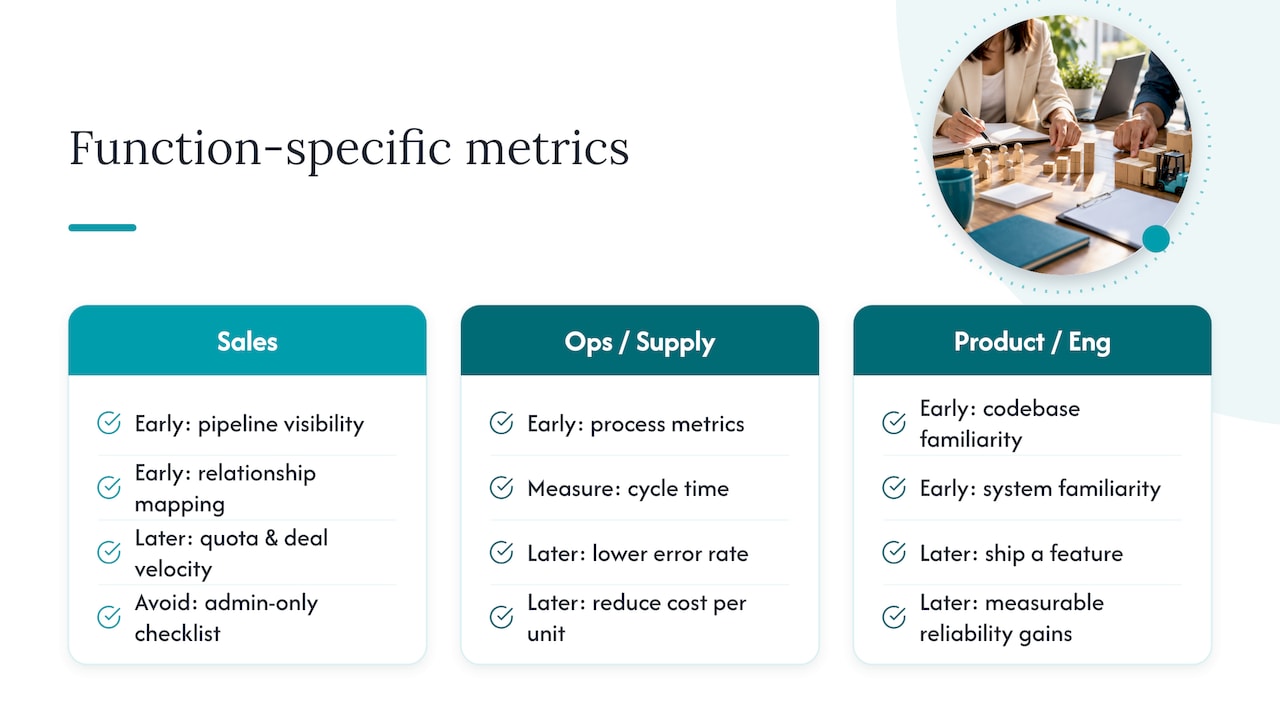
In sales and revenue roles, early goals tend to center on pipeline visibility and relationship mapping, with later goals tied to quota attainment or deal velocity. A role-specific onboarding checklist for sales development reps shows how quickly a plan can become a list of administrative tasks instead of outcomes, which is exactly the trap to avoid when a metric like calls made or meetings booked is available to use instead.
In operations or supply chain roles, the plan usually leans on process metrics: cycle time, error rate, or cost per unit. In product or engineering roles, the first thirty days often focus on codebase or system familiarity, with the sixty and ninety day marks tied to a shipped feature or a measurable reliability improvement.
The adaptation work is simple even when the content varies: identify the two or three metrics that function actually reports on internally, then build your goals around moving those specific numbers. A plan built on generic goals like “build relationships” or “learn the systems” fails the same test in every function, because it never says what the candidate will actually be judged on.
Researching the company and role before you write anything
The quality of a 30-60-90 plan is almost entirely a function of how well you researched the role before you started writing. A plan built on guesses reads as a guess, no matter how clean the formatting looks.
Start with the job description itself and pull out every metric, tool, and responsibility mentioned explicitly. Those details become your goals and your assumptions almost verbatim. Next, look at the company’s recent public moves: earnings statements for public companies, product launches, leadership changes, or funding announcements for private ones. These tell you what the business is prioritizing right now, which should shape your ninety-day goals more than your thirty-day ones.
Talk to anyone in your network who has worked at the company or in a similar role at a competitor, and treat their input as a source of assumptions to test rather than facts to repeat verbatim. If you have had earlier interview rounds, mine them for detail. Every question an interviewer asked you is a clue about what they actually care about, and a good plan reflects those clues back to them.
Finally, read the team’s public output where it exists: a sales team’s case studies, an engineering team’s blog, a marketing team’s campaigns. This kind of research turns a generic plan into one that references specifics the interviewer will recognize, which is the difference between a plan that feels tailored and one that feels templated.
Aligning the plan with what the company and team actually need
A technically well-built 30-60-90 plan can still miss the mark if it optimizes for the wrong thing. The goals inside the plan need to trace back to something the company or team has already said matters, not just to what looks impressive on paper.
Start by identifying the team’s current priorities, which usually surface in the job posting itself, in public statements from the company, or in something an interviewer mentioned earlier in the process. If a company’s recent messaging emphasizes customer retention over new logo growth, a plan built entirely around acquisition metrics will read as tone deaf even if the goals themselves are well written.
Once you know the priority, build backward from it. If the team’s stated goal is reducing churn, your ninety-day outcome should tie directly to a churn-related metric, and your thirty and sixty day goals should be the visible steps that lead there. This kind of alignment also gives you language to use directly in the interview: you can say the plan is built around what the team has already identified as the priority, which signals that you listened rather than arrived with a pre-built script.
Where you are uncertain about the team’s actual priorities, say so inside the plan itself as one of your assumptions. That turns a potential misalignment into a question you are explicitly inviting the interviewer to answer, which is a stronger move than guessing and hoping you guessed right.
Showing flexibility instead of a fixed script
The plan that impresses interviewers is not the one with the most detail. It is the one that visibly leaves room to change. A document presented as finished, with no acknowledged gaps, tends to read as either naive or inflexible, and both readings work against you.
Build flexibility into the plan structurally rather than trying to add it verbally afterward. Label assumptions clearly as assumptions, not as facts, so the interviewer sees exactly where you expect to be corrected. Leave one goal per phase slightly open-ended, phrased as a direction rather than a fixed number, so there is an obvious spot for the interviewer to weigh in.
During the conversation, respond to any pushback by updating the plan out loud rather than defending the original version. If an interviewer says your thirty-day stakeholder list is missing someone important, the strongest response is to add that name to the plan on the spot and ask a follow-up question about their priorities, not to explain why your original list was reasonable.
This matters more in fast-changing industries or early-stage companies, where the interviewer may push back simply because the situation on the ground has already shifted since the job was posted. Treating that pushback as new information rather than a challenge to your competence is what actually demonstrates adaptability, far more than any line in the document itself.
Handling questions and pushback about the plan in real time
Every plan will get challenged, and how you respond matters more than how polished the plan looked before the pushback started. The goal is to treat every question as useful information rather than as an attack on your preparation.
If an interviewer says a thirty-day goal seems unrealistic given team capacity, acknowledge the constraint directly and ask what a more realistic version would look like from their seat. That single question turns a critique into a collaborative moment and often surfaces information you genuinely need.
If someone challenges an assumption, for instance, that your priority metric is actually the team’s top priority, resist the urge to defend it. Ask what they would prioritize instead, and note it as a revision to the plan in front of them. This is precisely the kind of exchange Best Practice Institute points to when it describes strong plans as conversation starters rather than finished proposals.
If the pushback reveals that your research missed something significant, say so plainly. “That’s a gap in what I had. Can you tell me more about how that’s currently handled?” reads as more credible than pretending you already knew. Interviewers are not scoring you on whether the plan survives contact with reality untouched. They are scoring how you handle finding out it was wrong.
What most advice about interview plans gets wrong
The conventional advice treats a 30-60-90 plan like a deliverable to be perfected before the interview, polished until every number looks confident and every goal sounds ambitious. That instinct is backwards. A plan that arrives looking finished actually tells the interviewer less about you than one that arrives clearly unfinished, because a finished-looking plan gives them nothing to react to.
What gets underestimated is how much the assumptions section is doing the real work. Anyone can write three SMART goals per phase. Far fewer candidates are willing to write down, in front of a hiring manager, exactly where they might be wrong. That willingness is the actual signal being tested, more than the goals themselves.
If you take one thing from this guide, prioritize the assumptions over the goals. Spend more time deciding what you are genuinely unsure about than polishing language you are already confident in. The goals prove you can read a job description. The assumptions prove you can be trusted with ambiguity, which is closer to what the job actually requires.
Kim
Get your plan and delivery ready before the final round
Resume Wiz builds the interview materials that turn a rough outline into a plan you can actually defend in the room, without the guesswork of doing it alone against a deadline.

The Elevate program pairs resume and LinkedIn work with hands-on coaching, including help tightening the metrics and assumptions inside a 30-60-90 plan so it holds up under real questions. For candidates who need something faster, Elevate also offers focused interview prep built specifically for final-round preparation, including mock panels where you practice handing over the plan and handling pushback out loud.
- Elevate covers resume, LinkedIn, and coaching support; see the Elevate page for current pricing.
- Elevate offers a package focused on final-round readiness, including plan refinement and mock interviews; see the Elevate page for current pricing.
- Both options include direct feedback on the metrics, assumptions, and delivery script inside your one-page plan.
Request a template review or book a session through Resume Wiz before your next final round.
Where this guidance comes from
This guide draws on the 30-60-90 day plan frameworks published by Best Practice Institute, Coursera, The Muse, and Indeed, along with Michael Watkins’ research on early leadership transitions.
Want a recruiter in your corner for your next senior role? Book a free call with Resume Wiz and we will map out your next move together.
Sources
- The Muse: 30-60-90 day plan instructions, template, and example
- Best Practice Institute: The 30/60/90-Day Impact Plan
- Coursera: How to write a 30-60-90 day plan
- Indeed: How to create a 30-60-90-day plan for a new job
FAQ
How do you answer the 30-60-90 day plan interview question?
Walk through the job description’s key priorities, then describe what you would learn in the first 30 days, own by day 60, and deliver by day 90, using two or three measurable goals per phase. Frame it as your best current thinking and invite the interviewer to correct any assumption that seems off, which the Best Practice Institute framework treats as the strongest way to present it.
What is the 30-60-90 rule in an interview?
It refers to structuring your first three months into three phases: roughly the first 30 days for learning and listening, the next 30 for owning a scoped project, and the final 30 for delivering a measurable result. Indeed’s guide labels these phases learn, apply, and lead.
Can you give an example of a 30-60-90 day plan?
A marketing manager example might include auditing recent campaigns and mapping stakeholders in the first 30 days, launching and testing one campaign by day 60, and presenting next-quarter targets backed by a measured result by day 90. Each phase should include three to five specific, measurable goals rather than general intentions.
What is the biggest red flag when being interviewed?
Presenting a plan that promises sweeping changes in the first 30 days, before you have enough context to know what actually needs to change, tends to read as a warning sign rather than ambition. Ask a Manager notes that a shallow or poorly timed plan can hurt a candidacy more than having no plan at all, so timing and humility matter as much as the content itself.
