Applied to Jobs No Response? The Executive Reality
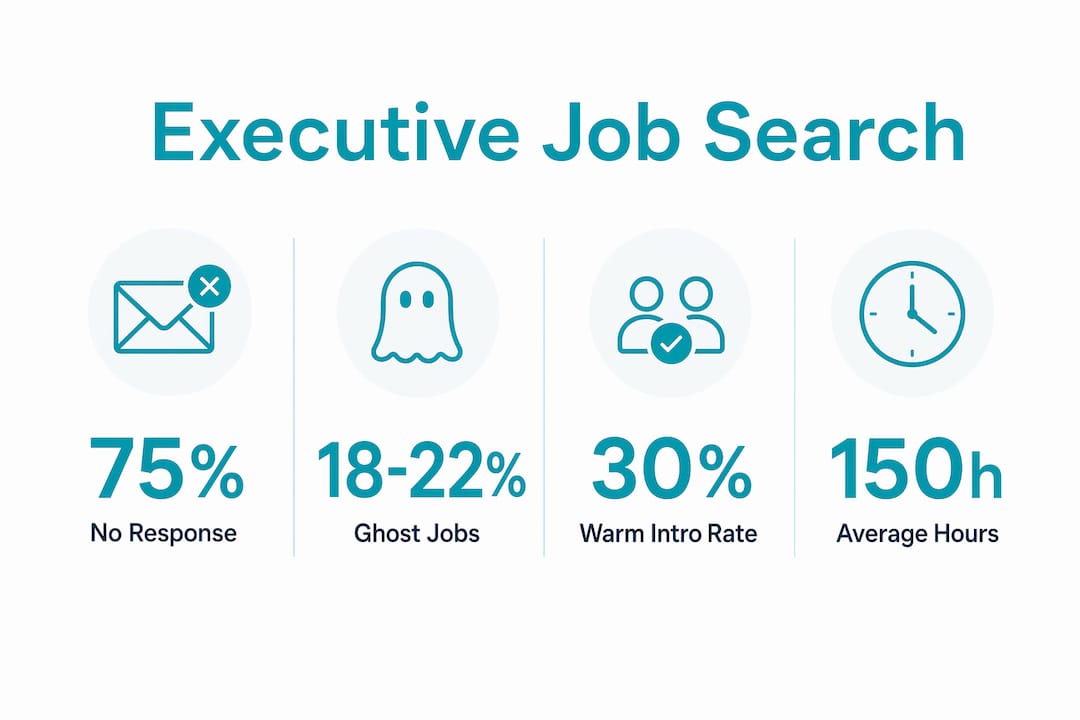
Executive job application silence is the most misunderstood problem in senior-level hiring. If you have applied to jobs no response executive level and felt confused, the problem is almost never your qualifications. The real issue is a structural mismatch between how executives apply and how executive hiring actually works. 75% of job applications receive zero response from employers, and only about 2.4% reach the interview stage. At the executive level, that gap widens because the rules are fundamentally different.
Why applied to jobs no response executive level is a structural problem
The silence you are experiencing is not random. It is built into the system.
Executive hiring does not work like mid-level hiring. Most senior roles fill through internal promotions, retained search firms, or direct referrals before a job posting ever goes live. When a posting does appear, it often exists for compliance or benchmarking purposes rather than active recruitment. Between 18 to 22% of job postings are ghost jobs with no real intent to hire. Applying to those roles produces silence by design.
Applicant Tracking Systems, known as ATS, create a second filter. These platforms screen resumes automatically before any human reads them. An executive resume that uses the wrong keywords, an unusual format, or a non-standard section title gets filtered out before a recruiter ever sees it. The ATS does not know you led a $200 million division. It only knows whether your document matches its parsing rules.
The legal environment reinforces the silence. U.S. employers face no legal obligation to respond to applicants. Silence protects companies from discrimination claims because a non-response cannot be quoted or challenged. Automated rejection systems allow companies to process thousands of applications without a single human decision. That is not a flaw in the process. It is the process.
| Factor | Impact on executive applications |
|---|---|
| Ghost job postings | 18 to 22% of listings have no active hiring intent |
| ATS keyword filtering | Resumes rejected before human review |
| No legal response requirement | Employers face zero obligation to reply |
| Internal/referral hiring | Most roles fill before public posting |
Pro Tip: Before applying to any executive role, search LinkedIn to see if the company has posted the same role multiple times in the past year. Repeated postings often signal a ghost job or a role with unrealistic expectations.
What mistakes are executives making that kill response rates?
The most common executive job search mistake is treating a senior search like a mid-level one.
Applying to large volumes of roles feels productive. It is not. Applying to 300 executive roles can consume 150 hours and yield only 2 to 3 interviews. That math exposes the core problem: volume without precision wastes time and signals poor targeting to the few recruiters who do see your application.
The second mistake is a resume that reads like a career obituary. Most executive resumes list titles, dates, and responsibilities. Recruiters at the senior level are not looking for a history lesson. They are looking for evidence that you can solve the specific problem their organization faces right now. Executives who recite career history instead of positioning with measurable business outcomes consistently fail to gain traction.
Three other patterns consistently reduce response rates at the executive level:
- Generic positioning. A resume that works for three different industries signals you are not the right fit for any of them. Senior roles require a clear, specific value proposition tied to the company’s current challenges.
- Weak LinkedIn presence. Recruiters and board members search LinkedIn before they ever look at a resume. A profile that mirrors a resume rather than telling a leadership story loses the first impression.
- Ignoring the network. Most executive roles fill via referrals and internal networks, not job boards. Executives who skip relationship-building and rely on blind applications are bypassing the channel where most opportunities actually exist.
Pro Tip: Audit your last 20 applications. If fewer than 30% came through a warm introduction or direct recruiter relationship, your channel mix is the problem, not your resume.
Is recruiter silence actually a rejection?
Recruiter silence mid-process is rarely a personal rejection. It is almost always organizational noise.
Recruiter silence often signals internal uncertainty such as budget freezes, leadership changes, or strategic pivots, not a decision about your candidacy. A hiring manager who was championing your application may have left the company. A board may have paused the search while reconsidering the role’s scope. None of that gets communicated to candidates because there is no internal clarity to share.
Understanding this distinction matters for your mental state and your next move. Here is how to interpret silence at different stages:
- No response after applying. This is almost always ATS filtering or a ghost job. It is not a signal about your qualifications.
- Silence after a recruiter reached out. The search may have been paused or the recruiter’s priorities shifted. One polite follow-up is appropriate.
- Silence after an interview. This is the most disorienting scenario. 61% of job seekers were ghosted after interviews in 2026, up from 52% in 2024. Internal decisions stall, budgets get cut, and candidates are left waiting.
- Silence after multiple follow-ups. At this point, the silence is the answer. Continuing to follow up damages your reputation with that organization.
Professional norms support one or two polite follow-ups after an application or interview. Beyond that, excessive contact leaves a lasting negative impression on hiring stakeholders. Move your energy to active opportunities instead.
How can executives get more responses from job applications?
The shift from no responses to consistent callbacks requires changing the approach, not just the volume.
Rebuild your resume around business outcomes
Stop listing what you did. Start showing what changed because of you. A strong executive resume answers one question for the reader: “What specific problem will this person solve for us?” Replace responsibility statements with outcome statements. “Led global operations” becomes “Reduced global supply chain costs by $14 million over 18 months by restructuring vendor contracts.” Shifting from chronology to solving current business challenges is the single most effective repositioning move an executive can make.
Activate your network before you apply
Reach out to former colleagues, board members, and industry peers before a role is posted. Let them know you are open to new opportunities and be specific about the type of role and company you are targeting. A referral from inside a company bypasses the ATS entirely and puts your name in front of a decision-maker directly.
Target fewer roles with higher precision
| Approach | Volume | Typical outcomes |
|---|---|---|
| Broad application strategy | 100+ applications | 1 to 3 interviews, low fit |
| Targeted, relationship-driven | 15 to 25 applications | Higher response rate, stronger fit |
The targeted approach takes more preparation per application. It produces better results because each application is tailored to the company’s specific context, challenges, and leadership gaps.
Craft a value-driven narrative for each role
Research the company before applying. Read their earnings calls, press releases, and LinkedIn activity. Identify the challenge they are trying to solve with this hire. Then write a cover note or email that speaks directly to that challenge. This approach is rare at the executive level. It gets noticed.
- Identify the company’s top three priorities from public sources.
- Map your specific experience to each priority with a concrete example.
- Lead with the business problem, not your career history.
Key Takeaways
Executive job search silence is a structural and strategic problem, not a reflection of your qualifications, and fixing it requires precision, positioning, and relationship-driven outreach rather than higher application volume.
| Point | Details |
|---|---|
| Silence is structural | Ghost jobs, ATS filtering, and legal protections cause most non-responses before any human reviews your application. |
| Volume hurts more than it helps | Applying to 300 roles yields 2 to 3 interviews; targeted applications to 15 to 25 roles produce better outcomes. |
| Resumes must show outcomes | Replace responsibility lists with measurable business results tied to the specific company’s current challenges. |
| Recruiter silence is often internal | Budget freezes and leadership changes cause most mid-process silence, not candidate failure. |
| Follow up twice, then move on | One or two polite follow-ups is the professional standard; more than that damages your standing. |
What I have learned after a decade of watching executive searches stall
After more than 10 years working in recruiting and career services, the pattern I see most often is this: executives who are genuinely qualified keep getting no responses, and they assume the market has passed them by. That assumption is almost always wrong.
The real issue is that they are applying like job seekers instead of positioning like leaders. A mid-level candidate can afford to cast a wide net. An executive cannot. At the senior level, your application is a signal about your judgment. Applying to 80 roles in 60 days tells a recruiter you are not selective. Being selective is part of the job.
The emotional weight of silence is real. I have worked with executives who spent six months applying and heard nothing, then repositioned their resume and LinkedIn profile around a specific business problem and received three callbacks in two weeks. The qualifications did not change. The framing did.
The hardest mindset shift is moving from “I need a job” to “I solve a specific problem for a specific type of organization.” That shift changes everything: the roles you target, the language you use, the conversations you have. Silence stops feeling like rejection and starts feeling like useful information about fit.
If you are in the middle of an executive search that has gone quiet, do not increase your application volume. Pause. Audit your positioning. Then go back out with a sharper message and a shorter, more targeted list.
Kim
How Resumewiz helps executives break through the silence
Executives who are not getting responses often need more than a polished resume. They need a complete repositioning of how they present their leadership value to the market.

Resumewiz specializes in exactly that. Kim Taynor and the Resumewiz team work directly with executives to build ATS-compliant resumes that lead with measurable business outcomes, LinkedIn profiles that attract recruiters before you apply, and outreach templates that open doors through your network. The process is built around your specific target roles, not a generic template. If you are ready to move from silence to scheduled interviews, Resumewiz offers a fully managed search with tailored applications and outreach.
Want a recruiter in your corner for your next senior role? Book a free call with Resume Wiz and we will map out your next move together.
FAQ
Why do executive job applications get no response?
75% of all applications receive no response, and executives face additional barriers including ATS filtering, ghost job postings, and roles that fill through internal referrals before public applications are reviewed.
How many times should I follow up after applying for an executive role?
One or two polite follow-ups is the professional standard. Excessive follow-ups leave a negative impression on hiring stakeholders and rarely change the outcome.
Does recruiter silence mean I was rejected?
Not necessarily. Recruiter silence mid-process most often reflects internal organizational uncertainty such as budget changes or leadership shifts, not a decision about your candidacy.
What is the most effective change an executive can make to get more callbacks?
Shifting from a chronological resume to one that leads with measurable business outcomes tied to the target company’s specific challenges produces the strongest improvement in response rates.
How many jobs should an executive apply to at once?
Precision outperforms volume at the executive level. A focused list of 15 to 25 highly targeted roles, supported by relationship-based outreach, consistently yields better results than applying to hundreds of positions.
