Your Board Membership Application Checklist for 2026
Prepare five items before you contact anyone: a two-page board-ready CV, a one-page board bio, a tailored cover note of 250 to 350 words, a reference list with confirmed contact permissions, and a signed consent for background screening. Those five documents are your send-ready packet. Your next move, within 48 to 72 hours, is a warm outreach to a sitting director you know, a nominating committee chair, or a partner at an executive search firm.
File your materials this way before sending:
LastName_BoardCV.pdfLastName_BoardBio.pdfLastName_CoverNote.pdfLastName_References.pdfLastName_BackgroundConsent.pdf
PDF format only. Use standard fonts (Garamond, Calibri, or Georgia at 11pt minimum). Send as separate attachments unless the recipient specifies a single file.
Pro Tip: Brief your references before you send anything. A referee caught off guard by a call from a nominating committee is a liability, not an asset.
Key Takeaways
A complete board membership application checklist requires five core documents, a prioritized outreach plan to sitting directors and search firms, and thorough due diligence on indemnification and D&O coverage before you accept any nomination.
| Point | Details |
|---|---|
| Assemble five core documents | Board CV, one-page bio, cover note, reference list, and signed background-check consent are required before any outreach. |
| Request D&O and board packages | Ask for indemnification agreements, Side A D&O coverage details, and 12 months of board packages before advancing. |
| Activate your director network | Most seats open via recommendation from sitting directors, CEOs, or search firms: warm outreach beats cold applications. |
| Register with search firms | Send your board CV, bio, and skills summary to two to three sector-specific search firms and follow up every 90 days. |
| Resumewiz board packet service | Resumewiz provides board CV rewrites, bios, cover notes, and interview prep for executives targeting director seats. |
Table of Contents
- What does a complete board membership application checklist include?
- How do you write a board-ready CV and bio that pass nominating-committee review?
- What due-diligence documents should you request before accepting a nomination?
- How are board candidates found, and how do you get recommended?
- How should you prepare for board interviews?
- What background checks should you expect, and how do you prepare?
- What credentials and experience actually move nominators?
- What time commitment and compensation should you expect?
- Step-by-step application checklist you can follow right now
- U.S. legal and regulatory points every applicant should know
- What most executives get wrong when preparing board materials
- Resumewiz helps you build a board-ready packet from scratch
- Authoritative resources to read next
- Sources
What does a complete board membership application checklist include?
Every packet a nominating committee or search firm receives should contain these items, verified before you hit send:
- Board-ready CV (two pages; governance-first structure)
- One-page board bio (third-person, 300 to 400 words)
- Tailored cover note (250 to 350 words; committee-specific)
- LinkedIn update summary (note confirming your profile reflects governance credentials)
- Reference list (four to six names with titles, relationship context, and confirmed availability)
- Disclosure summary (potential conflicts, significant holdings, related-party relationships)
- Signed background-check consent
- Sample board package request (drafted and ready to send upon advancement)
For public-company applications, your cover note should reference your review of the company’s proxy statement via SEC EDGAR. If you hold an NACD Directorship Certification, list it prominently on both the CV and bio. Resumewiz can help you structure all of these materials so they pass search-firm filters on first review.
Pro Tip: Name every file with your last name first. Search firms receive hundreds of documents; unnamed files like “BoardCV_Final2.pdf” get lost.
How do you write a board-ready CV and bio that pass nominating-committee review?
The first half-page of your board CV does the heaviest lifting. Lead with a three-to-four line governance value proposition: the specific oversight skills you bring, the committee seats you can fill (audit, compensation, nominating/governance, risk), and your broadest oversight achievement quantified. Boards scan for fit in under 30 seconds.
Structure the full CV in this order:
- Board value proposition (3 to 4 lines; governance skills, committee eligibility, independence status)
- Board and advisory experience (current and prior seats, committee roles, governance outcomes)
- Relevant oversight roles (C-suite or senior positions where you oversaw budgets, M&A, regulatory compliance, or enterprise risk)
- Select operating achievements (only those that translate to oversight: P&L scale, audit committee work, crisis management)
- Credentials and education (NACD Directorship Certification, CPA, JD, or sector-specific licenses)
Cut day-to-day operational tasks entirely. A board CV is not a job resume. According to Odgers Berndtson’s first board position guide, search firms filter out candidates quickly when governance contributions are buried under operational detail.
Your one-page bio mirrors the CV but reads in third person and is written for a board room introduction. Keep it under 400 words. Your LinkedIn summary should open with the same governance value proposition and list your NACD certification, committee experience, and any published thought leadership in the “About” section.
Pro Tip: Your board CV headline is not your job title. Write it as a governance statement: “Independent Director | Audit & Risk Committee | $2B+ Oversight Experience.”
What due-diligence documents should you request before accepting a nomination?
Ask for these before your first substantive interview, per standard candidate practice recommended by Holland & Knight:
- Complete board packages from the past 12 months (assess information quality and management transparency)
- All committee charters (understand scope, authority, and workload)
- Annual meeting schedule (confirm time commitment against your calendar)
- Director compensation policy (understand retainer, equity, and committee fees)
- Indemnification agreement (confirm advancement of defense costs, not just reimbursement)
- D&O insurance summary (verify Side A coverage and policy limits)
For public companies, pull the proxy statement (DEF 14A) on SEC EDGAR to review the board skills matrix, committee composition, director tenures, and recent shareholder vote results. Governance controversies show up in the proxy before they show up anywhere else.
Prospective directors should verify indemnification provisions and D&O insurance, including Side A coverage and whether defense costs are advanced or reimbursed. A gap in Side A coverage or a D&O policy up for renewal with no confirmed successor is a red flag worth escalating before you accept.
| Document | What it reveals | Red flag to escalate |
|---|---|---|
| Board packages (12 months) | Information flow, management candor | Thin packages, late delivery |
| Committee charters | Scope, authority, workload | Vague or outdated language |
| Indemnification agreement | Personal liability protection | Reimbursement-only; no advancement |
| D&O insurance summary | Coverage limits, Side A | Renewal gap, low limits |
| Proxy / DEF 14A | Governance history, shareholder votes | High withhold votes, auditor changes |
How are board candidates found, and how do you get recommended?
Most director appointments begin with a recommendation from a sitting director, the CEO, or an executive search firm, not an open application. Your outreach plan should reflect that reality.
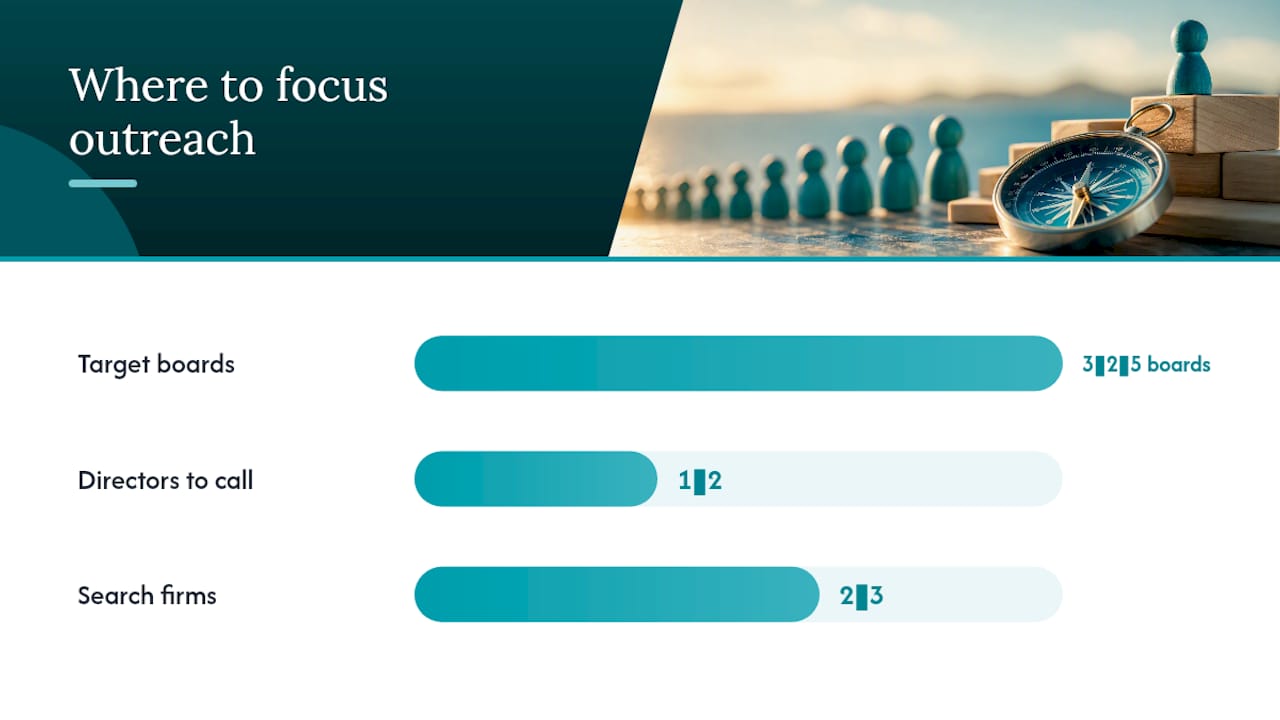
- Identify three to five target boards and map their current directors. Use SEC proxy filings, LinkedIn, and Spencer Stuart’s published board research to find sitting directors you have a second-degree connection to.
- Request a 20-minute informational call with one or two sitting directors. Send a short value note (150 words maximum) that names the specific skill gap you fill, not a general interest letter.
- Send your formal materials only after a warm conversation. Attach your board CV and bio with a one-paragraph note referencing what you discussed. Ask explicitly whether they would be comfortable recommending you to the nominating committee or a search partner.
For search firms, register with two or three that specialize in your sector. They expect your board CV, bio, and a one-page skills summary on first contact. Follow up every 90 days with a brief update on new governance activity.
90-second elevator pitch template: “I’m a [title] with [X years] of [sector] experience, including [specific oversight achievement]. I’m looking for an independent director seat where I can contribute to [audit/compensation/risk] committee work. I’d welcome the chance to learn whether [Company/Board] has a skills gap I could fill.”
Pro Tip: Publishing one governance-focused article or speaking at one sector conference per quarter makes you findable by search firms before you ever reach out to them.
How should you prepare for board interviews?
The typical sequence runs: search firm screening call, nominating committee chemistry interview, then a conversation with the full board or CEO. Each stage tests something different.
- Search firm screen: Confirms your CV claims, probes independence, and assesses communication style.
- Nominating committee interview: Tests cultural fit, governance philosophy, and whether you’ll ask hard questions without being disruptive.
- Full board or CEO conversation: Assesses whether you’ll add to the room, not just to the skills matrix.
Treat the interview as a two-way assessment. Ask the lead independent director directly: “How does the board handle disagreement with management?” and “What does onboarding look like for a new director?” Those two questions reveal board culture faster than any proxy statement.
Questions to ask before accepting:
- What is the expected annual time commitment beyond scheduled meetings?
- Has the board reviewed its indemnification agreements in the past two years?
- What governance training does the board support for new directors?
Pro Tip: Brief your references with the specific committee role you’re being considered for. A reference who speaks to your audit committee fit is worth three who speak to your general leadership.
What background checks should you expect, and how do you prepare?
Expect verification of education credentials, employment history, litigation and regulatory records, credit history (where relevant to the role), global watchlist screening, and a public social-media review. Inconsistencies between your CV and public records can end a candidacy at this stage.
Prepare these documents in advance:
- Degree verification contacts (registrar phone numbers and email addresses)
- Employment dates confirmed against your CV to the month
- A list of any litigation, regulatory inquiries, or settlements with brief factual summaries
- Disclosure language for significant equity holdings or related-party relationships
- Notarized documents if the company’s vendor requires them
Sample conflict disclosure wording: “I currently serve as a director of [Company X], which operates in [sector]. I do not believe this creates a material conflict with [Target Board], but I disclose it for the committee’s consideration.” Keep it factual and brief. Search firms expect one paragraph, not a legal brief.
What credentials and experience actually move nominators?
Boards prioritize demonstrated senior leadership and oversight first. Credentials augment that foundation; they don’t replace it. The highest-value additions, ranked by impact:
- NACD Directorship Certification (complete within 12 months of targeting your first seat; signals governance commitment to search firms)
- Financial literacy (CPA, CFO experience, or audit committee service; audit committee seats are the most common entry point)
- Cybersecurity or AI strategy expertise (board-level demand has grown sharply; even a recognized certification helps)
- Nonprofit board service (select a role with real fiduciary responsibility, a budget over $5M, and a committee seat)
For nonprofit service, choose strategically. A finance committee chair role at a regional health system or a major arts institution carries more weight with corporate nominators than a general board seat at a small local charity. Document the budget you oversaw, any M&A or capital campaign you guided, and measurable governance outcomes on your CV.
ZRG Partners recommends an 18 to 36 month plan combining governance education, nonprofit service, and proactive search-firm engagement for executives pursuing their first corporate seat. If you're starting from zero, that timeline is realistic.
Pro Tip: If you’re targeting a healthcare startup advisory board as a stepping stone, structuring that advisory role correctly from the start gives you a governance credential worth citing on your board CV.
What time commitment and compensation should you expect?
Public-company outside directors typically spend a significant amount of time per year on board responsibilities, including preparation, travel, and committee work. Committee chairs spend more. Private-company and nonprofit boards vary widely in their annual time commitments.
Compensation on public company boards typically combines a cash retainer with equity grants; committee chairs receive additional fees. Private boards may offer equity only, a modest cash retainer, or nothing. Nonprofits generally reimburse expenses and may offer a small honorarium; compensation is rarely negotiable there.
| Board type | Estimated annual hours | Compensation structure | Negotiable? |
|---|---|---|---|
| Public company | ~250 hours | Cash retainer + equity | Rarely |
| Private company | a significant amount of time | Equity or modest retainer | Sometimes |
| Nonprofit | a significant amount of time | Expense reimbursement / honorarium | Rarely |
The timeline from first contact to seated director runs 4 to 12 months for private and nonprofit boards. Public-company searches typically take longer, often 12 to 24 months, because they require a shareholder vote. Get your employer's written approval for outside board service before you advance past the first interview. Most employment agreements require it, and a rescinded offer at the final stage because of an employer conflict is avoidable.
Step-by-step application checklist you can follow right now
Use this sequence as your working task list. Assign each item to yourself, an executive assistant, or Resumewiz, and set a hard deadline.
- Day 0: Confirm your board CV, bio, cover note template, and reference list exist in final PDF form. If any are missing, that is your first task.
- Day 1 to 3: Brief all references. Confirm they are available and know which committee role you're targeting.
- Day 1 to 3: Identify three to five target boards. Pull their proxy statements from SEC EDGAR. Note skills gaps and director tenures.
- Week 1: Send warm outreach to one or two sitting directors or search firm partners. Attach your board CV and bio only after a response.
- Week 1: Register with two to three executive search firms that cover your sector. Send board CV, bio, and a one-page skills summary.
- Month 1: Request board packages, committee charters, and D&O summary from any board that advances you to a substantive conversation.
- Month 1: Complete or enroll in NACD Directorship Certification if not already held.
- Ongoing: Follow up with search firms every 90 days. Update your LinkedIn summary after each new governance activity.
Pro Tip: Copy this list into Asana, Notion, or a simple spreadsheet. Board searches run long; a written tracker prevents warm leads from going cold.
U.S. legal and regulatory points every applicant should know
Public-company directorships carry a different risk profile than private or nonprofit seats. The differences matter before you accept.
- Proxy process: Public-company directors are subject to a shareholder vote. Your name, biography, and committee assignments appear in the DEF 14A proxy statement filed with the SEC. Review past proxies on SEC EDGAR to understand how the company presents its board.
- Material transaction disclosure: U.S. federal securities law requires disclosure of material related-party transactions. Surface any potential conflicts to the nominating committee early; a conflict discovered after nomination can rescind the offer.
- D&O and indemnification: Confirm indemnification language covers advancement of defense costs, not just reimbursement after the fact. Side A coverage protects you personally when the company cannot indemnify. Get legal advice on any indemnification agreement with unusual carve-outs or limits.
- Private boards: No proxy process, no SEC filings, but fiduciary duties still apply. Review the operating agreement or bylaws for indemnification scope.
- When to get counsel: Complex indemnification language, multi-state regulatory exposure, or a potential conflict involving a significant equity position all warrant a 30-minute conversation with a corporate attorney before you sign anything.
For a comparative view of how director duties are structured in another common-law jurisdiction, this overview of director duties under Australian corporate law illustrates how governance obligations differ across markets.
What most executives get wrong when preparing board materials
The three mistakes I see most often at Resumewiz: submitting an executive resume with a “Board of Directors” label slapped on top, burying governance outcomes under operational bullet points, and sending references who haven’t been briefed on the specific role.
A board CV is a different document from an executive resume. It leads with what you can oversee, not what you have managed. The nominating committee is not hiring you to run anything. They are asking whether your judgment, your network, and your specific expertise will make their board stronger. Every line of your CV should answer that question.
Reference preparation is the most underestimated step in the process. A reference who can speak specifically to your conduct in a boardroom, your behavior under pressure in a governance crisis, or your ability to challenge management constructively is worth more than three general character references.
Resumewiz helps you build a board-ready packet from scratch
Assembling a board-ready packet takes more than reformatting your executive resume. Resumewiz offers a dedicated service bundle for executives pursuing board seats: a full board CV rewrite, one-page bio, tailored cover note template, reference briefing guide, and interview preparation coaching, all built around your specific target boards and committee goals.

Kim Taynor brings over 10 years of recruiting experience to every engagement, which means your materials are written to pass search-firm filters, not just look polished. If you’re ready to move from executive to director, visit Resumewiz to start building your board application packet today.
Authoritative resources to read next
- SEC EDGAR: DEF 14A proxy filings: Search any public company to pull its proxy statement. Look for the board skills matrix, committee charters, director tenures, and shareholder vote results on director elections.
- Spencer Stuart: Getting a seat at the table: Practical guidance on how search firms identify and vet director candidates, and what they expect to see.
- Spencer Stuart: Preparing for a board opportunity: Covers the interview process, two-way fit assessment, and candidate questions to ask.
- NACD Directorship Certification: The standard governance credential for U.S. corporate directors. Review current program formats and enrollment timelines.
- Mondaq: What prospective directors should know: Detailed guidance on candidate due diligence, including what to look for in proxy statements and how to evaluate D&O coverage.
- Resumewiz: Board CV rewrites, one-page bios, outreach templates, and interview coaching for executives preparing their board application packet.
Want a recruiter in your corner for your next senior role? Book a free call with Resume Wiz and we will map out your next move together.
