
Get $10,000 to $50,000 Signing Bonuses and Better Clawbacks for Executives
Negotiate after you receive a written offer, not before, and never in a series of scattered asks. Submit one comprehensive written counter that covers sign-on bonus, bonus mechanics, equity, clawback terms, and relocation together. Base salary is often the least flexible line item at the executive level. Everything else usually has more room than candidates assume.
Key Takeaways:
- Most negotiable value at the executive level lies in sign-on bonuses, bonus mechanics, equity grants, severance terms, and relocation support, not base salary.
- Present a single, comprehensive written counteroffer with justified asks, deadlines, and clear language on clawback provisions to maximize leverage.
- Tie sign-on bonuses to specific, documented losses, and request pro-rated repayment terms, carve-outs for termination without cause, and net-of-tax language.
- Negotiate larger relocation packages by requesting extended housing, full household shipment, vendor choice, and tax gross-ups on large payments.
- Timing is critical; negotiate after receiving a written offer and before signing, ensuring all elements are documented and justified for maximum benefit.
Table of Contents
- Which Compensation Elements Actually Move for a Bonus Negotiation Executive Package
- When Should You Negotiate a Signing Bonus or Bonus Package?
- How to Negotiate Sign-On Amounts and Clawback Terms
- Relocation and Tax Items Worth Pressing On
- How to Word Your Written Counter Offer
- Why Most Executives Undernegotiate Their Own Offers
- Get Help Building Your Executive Counter Offer
- Sources
- FAQ
Which Compensation Elements Actually Move for a Bonus Negotiation Executive Package
Base pay tends to sit inside a rigid band tied to internal equity and comp committee rules, which is exactly why executive negotiation strategy shifts toward everything surrounding it. Recruiters and hiring managers usually have real discretion over sign-on amounts and relocation packages. Equity grants and severance terms typically require sign-off from a compensation committee or the board, so those asks take longer and need stronger justification.
Here’s what’s actually in play at the executive level:
- Sign-on bonus: a one-time payment, often used to offset what you’re leaving behind at your current employer.
- Target bonus percentage and mechanics: whether your annual bonus is formula-driven against revenue or EBITDA targets, or left to a discretionary committee decision.
- Equity or long-term incentive (LTI) grants: the size of the grant, the vesting schedule, and whether unvested equity from your old employer gets any acknowledgment in the new offer.
- Severance and notice terms: what happens if the role ends within the first 12 to 24 months.
- Relocation support: often the most underused lever in the entire package.
At senior levels, most of the negotiable value sits outside base pay entirely. If a recruiter tells you salary is fixed, that’s usually true and also beside the point. The real conversation happens in bonus structure, equity terms, and sign-on math.
When Should You Negotiate a Signing Bonus or Bonus Package?
Timing matters as much as the ask itself. Move too early and you’re negotiating against an offer that doesn’t exist yet. Wait too long after signing and you’ve lost your leverage entirely.
- Request the offer in writing. Never negotiate off a verbal summary from a recruiter. Get every number, every vesting date, and every bonus formula on paper first.
- Take two to five business days to review it. This is standard, expected, and gives you time to build your case without looking hesitant.
- Quantify what you’re forfeiting. Add up unvested equity you’ll lose, any bonus you’d miss by leaving mid-cycle, and moving costs you’ll absorb. This number anchors your entire counter.
- Check for band language. If HR mentions salary bands early, that’s your signal to redirect the conversation toward sign-on, bonus structure, and relocation instead of pushing on base.
- Draft one complete counter. List every ask, a short justification for each, and a reasonable response deadline. Send it by email so there’s a written record.
Pro Tip: Never send your asks one at a time. A single consolidated counter is harder for a hiring team to pick apart than four separate emails spread across two weeks, and it signals that you’ve done real preparation rather than testing the waters.
How to Negotiate Sign-On Amounts and Clawback Terms
Sign-on requests land better when they’re tied to a specific, documented loss rather than a round number pulled from a salary survey. If you’re forfeiting a $40,000 bonus payout by leaving before your current cycle closes, say that explicitly and ask for a sign-on that matches it. Companies frequently prefer sign-on bonuses over base increases precisely because a signing bonus doesn’t disturb internal pay bands, so frame your ask that way when a recruiter pushes back on salary.
Signing bonuses are the most common form of executive bonus program, and executive sign-on amounts commonly range from $10,000 to more than $50,000 depending on seniority and industry. That range gives you a starting anchor, not a ceiling.
Clawback language is where most executives leave money and protection on the table:
- Ask for pro-rated repayment tied to your tenure, not a flat repay-in-full clause if you leave in month 11 of a 12-month window.
- Request a carve-out for termination without cause, so you’re not repaying a bonus for a decision the company made.
- Push for net (after-tax) repayment language, since repaying the gross amount after taxes were already withheld leaves you underwater.
Clawback windows commonly run 12 to 24 months, and negotiating proration inside that window is standard practice, not an aggressive ask. Converting part of a sign-on into base salary can raise your lifetime earnings if bonus targets and future raises compound off a higher base. It rarely makes sense if the company has firm salary bands, since a bump there just gets clawed back into next year’s comparability math.
Relocation and Tax Items Worth Pressing On
Relocation is where executive packages diverge sharply from mid-level offers, and it’s the line item most candidates negotiate the least. Executive relocation packages are typically far larger and more flexible than standard employee packages, often including services most candidates never think to request.
Items worth asking for by name:
- Temporary housing extended beyond the standard 30 or 60 days.
- Full household goods shipment, not a capped allowance.
- A mortgage bridge loan if you’re carrying two homes during the transition.
- Vendor choice, rather than being locked into the company’s preferred moving contractor.
- Executive transition coaching or spousal career support, which larger companies sometimes fund quietly if asked.
Signing bonuses and relocation reimbursements are both taxable income, which means a $30,000 relocation check can shrink meaningfully once it hits your paycheck. Ask explicitly for a tax gross-up on any one-time payment large enough to bump you into a higher bracket for that pay period.
Pro Tip: Get vendor billing and payment timing written into the offer letter, not just discussed verbally. If the company pays a moving vendor directly rather than reimbursing you, you avoid the cash flow gap and reduce your own tax exposure on that portion.
How to Word Your Written Counter Offer
Structure matters more than tone here. A confident, well-organized email reads as professional. A demanding one reads as risky to hire.
- Open with enthusiasm and a clear signal. State that you’re excited about the role and sending one comprehensive set of requested adjustments for their review, not a negotiation in stages.
- List each ask with a short, quantified justification. “I’m requesting a $35,000 sign-on to offset the bonus I’ll forfeit by leaving my current employer before our fiscal year closes on March 31” lands better than a vague request for “more sign-on.”
- Include your clawback language up front. If you want pro-rated repayment or a carve-out for termination without cause, write the actual proposed clause rather than asking them to draft it.
- Close with a deadline and flexibility. Give them five business days, invite questions, and avoid ultimatums. “I’m flexible on structure if the total value works” keeps the door open without conceding your position.
Quantifying what you’re giving up, whether it’s unvested equity or a deferred bonus, and asking for a first-year guarantee where appropriate, gives the hiring team something concrete to take to their own approval chain. For readers negotiating equity at an earlier-stage company, understanding how startup equity compensation actually vests matters just as much as the headline grant size.
Why Most Executives Undernegotiate Their Own Offers
The biggest mistake I see in executive compensation isn’t asking for too much. It’s asking for the wrong things, or asking for them too politely and too late. Candidates fixate on base salary because it’s the number that feels most personal, then accept whatever bonus formula and clawback language gets handed to them without a second read. That’s backward. Base is usually locked. Bonus mechanics, sign-on math, and clawback terms are where a written counter actually changes outcomes.
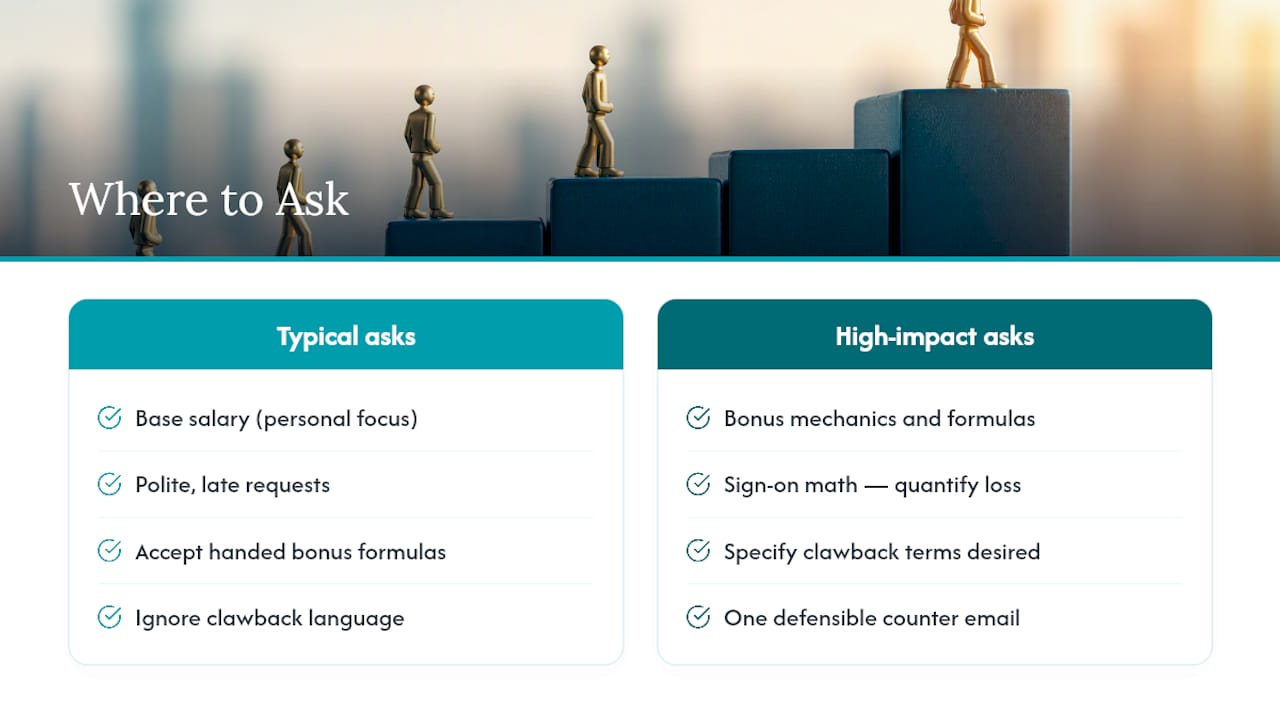
An approach built around this gap helps executives with a documented resume history and clear record of past compensation justify a sign-on ask, as the number is supported by what they’re actually leaving on the table. Our approach shaped by recruiting experience encourages clients to frame a counter by quantifying the loss, naming the clawback terms they want, and sending one email, not five.
The strongest negotiators aren’t the loudest ones. They’re the ones who show up with a number they can defend.
Kim
Get Help Building Your Executive Counter Offer
Knowing what to ask for is only half the job. Presenting it with the confidence and documentation a hiring committee takes seriously is the other half, and that’s where most executives run out of time or nerve. Resumewiz builds the materials and coaching that back up a strong written counter, from the resume history that justifies your sign-on ask to the interview and negotiation coaching that gets you comfortable saying the number out loud.

If you’re heading into an offer review right now, Elevate gets you rehearsal and negotiation coaching fast. For a fuller rebuild of your executive positioning before you’re even in active conversations, Evolution covers resume and LinkedIn work that documents the track record your comp ask depends on. Executives managing a longer transition can look at the Elevate packages, or the fully managed Elevate and Land options if you want outreach handled alongside your applications. Start by reviewing what fits your timeline at Resumewiz.
Want a recruiter in your corner for your next senior role? Book a free call with Resume Wiz and we will map out your next move together.
Sources
- Signing-bonus negotiation 101 | PON
- Negotiating an executive job offer | JOH Partners
- How to negotiate a signing bonus | TryJobHunter
- Relo
FAQ
When Should You Negotiate a Signing Bonus?
Negotiate after you’ve received the offer in writing and before you sign it, never based on a verbal number from a recruiter. This gives you a documented starting point and preserves your leverage for the entire package, not just the bonus line.
Can You Negotiate Clawback Terms on a Signing Bonus?
Yes. Common requests include pro-rated repayment tied to tenure, a carve-out for termination without cause, and net after-tax repayment language instead of gross repayment. Clawback windows typically span 12 to 24 months, and proration inside that window is standard, not aggressive.
Should You Convert a Sign-On Bonus Into Base Salary?
It depends on whether the company has rigid salary bands. Converting sign-on into base can raise lifetime earnings when future raises and bonus targets compound off a higher number, but it often gets rejected outright if internal pay equity rules cap your band.
What Is a Tax Gross-Up and When Should You Ask for One?
A tax gross-up is an added payment that covers the tax bill on a one-time bonus or relocation reimbursement, preserving its net value. Ask for one explicitly whenever a signing bonus or relocation payment is large enough to push you into a higher tax bracket for that pay period.
Does Resumewiz Help With Executive Compensation Negotiation?
Salary negotiation coaching is offered alongside executive resume and LinkedIn services, helping document the track record that backs up a sign-on or bonus ask. Current pricing and package details for services like Elevate are listed on the provider’s site.
