Career Advancement Strategy for Executives in 2026
A career advancement strategy for executives is a deliberate, proactive plan that accelerates your progression into higher leadership roles by aligning your capabilities with real organizational needs. Most executives who stall do so not because of poor performance, but because they treat advancement as a reward rather than a discipline. The executives who reach the C-suite fastest build written plans, cultivate sponsors, and time their moves around critical milestones. This article breaks down the exact components of a high-impact executive advancement plan, the leadership development frameworks that work, and the mistakes that quietly derail even strong performers.
What are the foundational components of a career advancement strategy for executives?
A career advancement strategy is not a vague aspiration. It is a written, milestone-driven plan that maps your current capabilities to the scope of the role you want next.
Timing is the first variable most executives underestimate. Making a strategic jump into a role with greater P&L responsibility between years two and three of an executive path accelerates title progression and increases total compensation by about 25%. Missing key milestones within a five-year window measurably decreases your advancement chances. That means the window is narrow, and waiting for the right moment to appear is not a plan.
The foundational components of a strong executive advancement plan include:
- A written career plan. Executives with written, proactive career plans achieve their goals more consistently than those relying on reactive, ad hoc advancement strategies. Writing it down forces clarity and creates accountability.
- A defined leadership vision. You need a specific picture of the role you want, the scope it carries, and the business problems it solves. Vague ambition produces vague results.
- A 30-60-90 day executive framework. Effective 30-60-90 day plans for executives focus on listening tours, establishing a strategic point of view, and communicating execution plans rather than operational tasks. This signals leadership readiness to boards and CEOs from day one.
- Sponsorship and internal advocacy. Promotion decisions at the executive level are rarely made in a vacuum. You need decision-makers in the room who advocate for you when your name comes up.
- Ownership of next-level problems. High performance alone does not guarantee promotion. Executives must demonstrate ownership of broader business challenges and next-level scope to be seen as ready.
Pro Tip: Write your career plan as if you are presenting it to your board. Include target roles, timelines, capability gaps, and the names of two or three sponsors you plan to cultivate. Specificity is what separates a plan from a wish list.
How can executives build a personalized leadership development plan?
A leadership development plan documents the skills, behaviors, and experiences you need to perform at the next level before you are given the title. The goal is to close the gap between who you are today and who the organization needs you to be tomorrow.
The most proven framework for structuring this development is the 70-20-10 model. It allocates 70% of learning to on-the-job experience, 20% to relationships like mentoring and coaching, and 10% to formal training programs. This distribution matters because it tells you where to invest your time. Formal courses and certifications feel productive, but they account for only a fraction of real leadership growth.
Here is how to execute a leadership development plan that actually moves your career forward:
- Audit your capability gaps. Compare your current skills against the job description and performance expectations of your target role. Be specific. “Needs better communication” is not a gap. “Has not led a cross-functional team through a product launch” is.
- Pursue stretch assignments. Volunteer for cross-functional projects, turnaround situations, or initiatives with board visibility. These assignments build the experience base that formal training cannot replicate.
- Build internal thought leadership. Publishing internal whitepapers, presenting at town halls, and leading working groups increases executive visibility and promotion prospects. This is what some leadership experts call building digital political capital inside your organization.
- Execute a 30-60-90 day plan with strategic intent. In the first 30 days, listen and map the political landscape. In days 31 to 60, form a point of view on the biggest business challenges. By day 90, communicate a clear execution plan to key stakeholders. This approach demonstrates alignment and stakeholder management at the leadership level.
- Schedule quarterly development reviews. Treat your leadership development plan like a business plan. Review it every 90 days, adjust for new information, and track progress against specific milestones.
Pro Tip: Ask your current manager or a trusted board member to name the one capability gap that would hold you back from the next role. Their answer is more valuable than any self-assessment tool.
What role does networking and sponsorship play in executive promotions?
Sponsorship is the single most underused tool in executive career growth. Most executives invest in mentors, which is useful but insufficient. A mentor gives you guidance. A sponsor gives you their political capital.
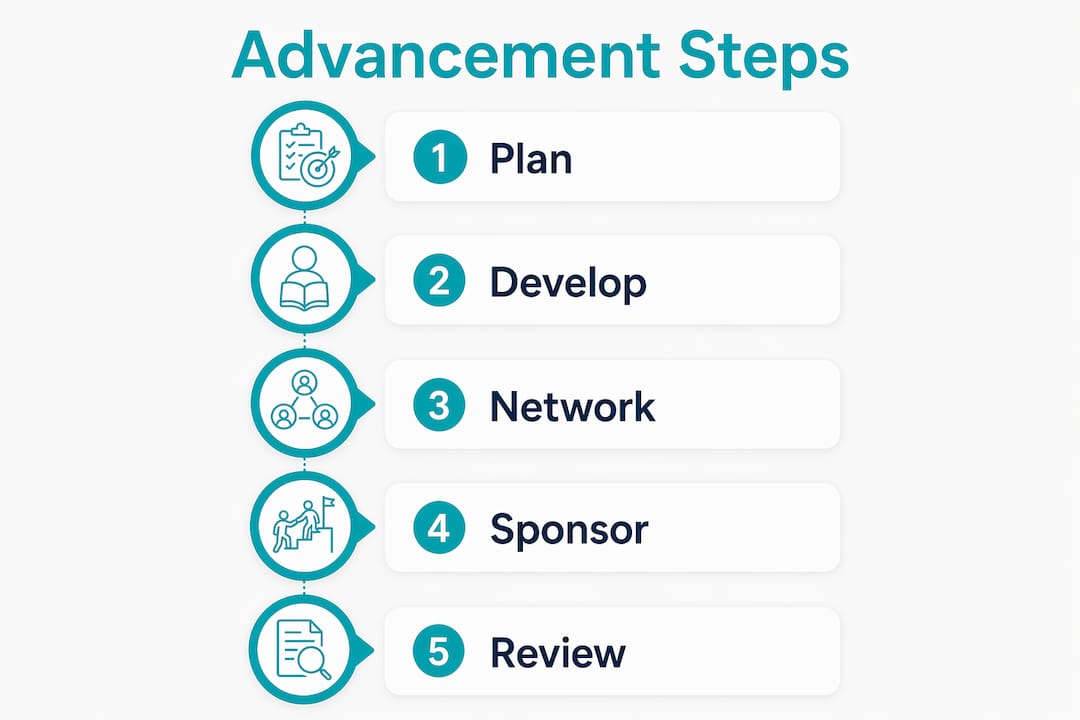
Sponsorship involves decision-makers who actively advocate for you in rooms you are not in. That distinction matters enormously at the executive level, where promotion decisions happen in small groups of senior leaders who already have opinions about who is ready. If no one in that room is speaking for you, your performance record alone rarely closes the deal.
Building a sponsorship network requires a systematic approach, not casual relationship building. Effective strategies include:
- Map your internal influence network. Identify the five to seven people whose opinions carry the most weight in promotion decisions for your target role. Then build genuine working relationships with each of them over time.
- Position yourself as a solution. When you engage with senior leaders, frame your contributions around the business problems they care about most. Executives who fit a real organizational need get promoted faster than those who simply perform well in their current lane.
- Build external relationships proactively. Proactive planning includes developing relationships with recruiters, board members, and CEOs outside your current organization. This expands your options and gives you negotiating leverage internally.
- Negotiate early, not at the offer stage. Bring up your advancement expectations before a role is formally offered. Late-stage negotiation signals that you were not thinking strategically about the move.
- Avoid reactive career moves. Jumping at an opportunity because it appeared, rather than because it fits your plan, is how executives end up in roles that stall their trajectory. Written plans with proactive relationship development prevent this pattern.
The executives who advance fastest are not always the best performers in the room. They are the ones who have made it easy for the right people to say yes.
What mistakes do executives make in their advancement strategies?
The most common executive career mistakes are not dramatic failures. They are quiet errors of omission that accumulate over time.
“Reactive career management is risky and ineffective compared to a deliberate written career plan that includes networking and strategic moves.” Leadership development research, 2026
Here are the five mistakes that most reliably derail executive advancement:
- Believing performance is enough. Strong execution in your current role proves you belong where you are. It does not prove you are ready for the next level. Promotion requires demonstrating readiness for a scope you have not yet been given.
- Delaying career conversations. Executives who wait until they are passed over to discuss advancement have already lost ground. The conversation about your next role should start at least 12 to 18 months before you want the promotion.
- Misaligning with organizational needs. Pursuing a role because it is the logical next step on paper, without confirming that the organization actually needs that role filled, leads to stalled searches and missed windows.
- Skipping the written plan. A career plan that exists only in your head is not a plan. Written career plans also prepare executives to adapt when market conditions shift, including disruptions from AI automation and restructuring.
- Staying operational in a new role. The biggest trap after a promotion is continuing to do the work of your previous role. Senior executives who focus on operational tasks instead of strategic leadership signal to the organization that they were promoted too soon.
Avoiding these mistakes requires the same discipline as building the plan itself. Check your behavior against this list every quarter.
Key Takeaways
A career advancement strategy for executives succeeds when it combines written planning, milestone timing, sponsorship, and demonstrated readiness for next-level scope before the title is offered.
| Point | Details |
|---|---|
| Timing milestones matter | Pursue P&L responsibility between years two and three to accelerate title and compensation growth. |
| Write the plan down | Executives with written career plans consistently outperform those using reactive, ad hoc approaches. |
| Sponsorship beats mentorship | Sponsors advocate for you in promotion decisions; mentors only advise you from the sideline. |
| Demonstrate next-level scope | Show ownership of broader business challenges before you hold the title, not after. |
| Avoid the operational trap | After promotion, shift focus to strategic leadership immediately or risk signaling you were promoted too soon. |
What I have learned about executive career growth after a decade in recruiting
The executives I have worked with who advanced the fastest shared one trait that had nothing to do with their resume. They treated every promotion as a platform to build new influence, not as a finish line. The ones who stalled treated each new title as proof they had arrived.
The second pattern I keep seeing is that executives dramatically underestimate how political the promotion process is. Not political in a cynical sense, but in the sense that decisions are made by people with relationships, preferences, and organizational agendas. Your job is to understand that system and work within it deliberately. Waiting to be discovered is not a career strategy.
I also want to push back on the idea that thought leadership is just for people who want to build a personal brand outside their company. Internal thought leadership, presenting at town halls, writing position papers, leading cross-functional working groups, is one of the fastest ways to build the visibility that sponsors need to advocate for you. Most executives skip this because it feels like extra work. It is actually the work that gets you promoted.
The executives who thrive in 2026 are the ones who treat their career with the same rigor they apply to a business unit. That means quarterly reviews, written goals, and honest gap assessments. It means having the uncomfortable conversation with your manager 18 months before you want the promotion, not the week after someone else gets it.
Kim
How Resumewiz supports your executive advancement plan
Executives who have a clear advancement plan still need their external materials to match the level they are targeting. A resume or LinkedIn profile that reflects your current role, rather than your next one, signals the wrong level to every recruiter and board member who finds you.
Resumewiz specializes in executive resume development and LinkedIn profile revamps built specifically for leaders targeting senior and C-suite roles. Kim Taynor brings over 10 years of recruiting experience to every engagement, which means your materials are built to pass ATS screening and land in front of the decision-makers who matter. Resumewiz also offers personalized career roadmaps and outreach templates that position you as the solution to the roles you are targeting. If your materials are not working as hard as your plan, that is the gap to close first.
Want a recruiter in your corner for your next senior role? Book a free call with Resume Wiz and we will map out your next move together.
FAQ
What is a career advancement strategy for executives?
A career advancement strategy for executives is a written, proactive plan that maps your capabilities to the scope of your target leadership role and includes milestone timing, sponsorship development, and demonstrated readiness for next-level responsibilities.
How long does it take to advance to a C-suite role?
The five-year post-MBA window is widely cited as the critical period for executive advancement. Missing key milestones within 60 months measurably decreases your chances of reaching senior leadership on a competitive timeline.
What is the difference between a sponsor and a mentor for career advancement?
A sponsor is a decision-maker who actively advocates for you in promotion conversations. A mentor provides guidance and advice. Both are useful, but sponsorship has a direct impact on promotion outcomes in ways that mentorship alone does not.
Why does high performance alone not guarantee executive promotion?
Promotion at the executive level requires demonstrating ownership of the next role’s scope and business challenges, not just excelling at your current responsibilities. Decision-makers need evidence that you are already operating at the next level before they will formalize the title.
How often should executives review their career advancement plan?
Review your career advancement plan every 90 days. Treat it like a business plan with milestones, gap assessments, and relationship-building targets that you adjust as organizational priorities and market conditions change.
