Career Change Cover Letter Writing: A Practical Guide
Starting over professionally sounds exciting until you sit down to write the cover letter. Career change cover letter writing is where most pivoting professionals freeze up. How do you explain a move from finance to marketing, or from teaching to tech, without sounding scattered or apologetic? The answer is not to minimize your past. It is to reframe it. This guide walks you through exactly what to write, how to structure it, and what to avoid so your cover letter reads like a confident argument for why you are the right hire, not a defense of your unconventional path.
Table of Contents
- Key takeaways
- What career change cover letter writing actually means
- Before you write: the preparation that matters most
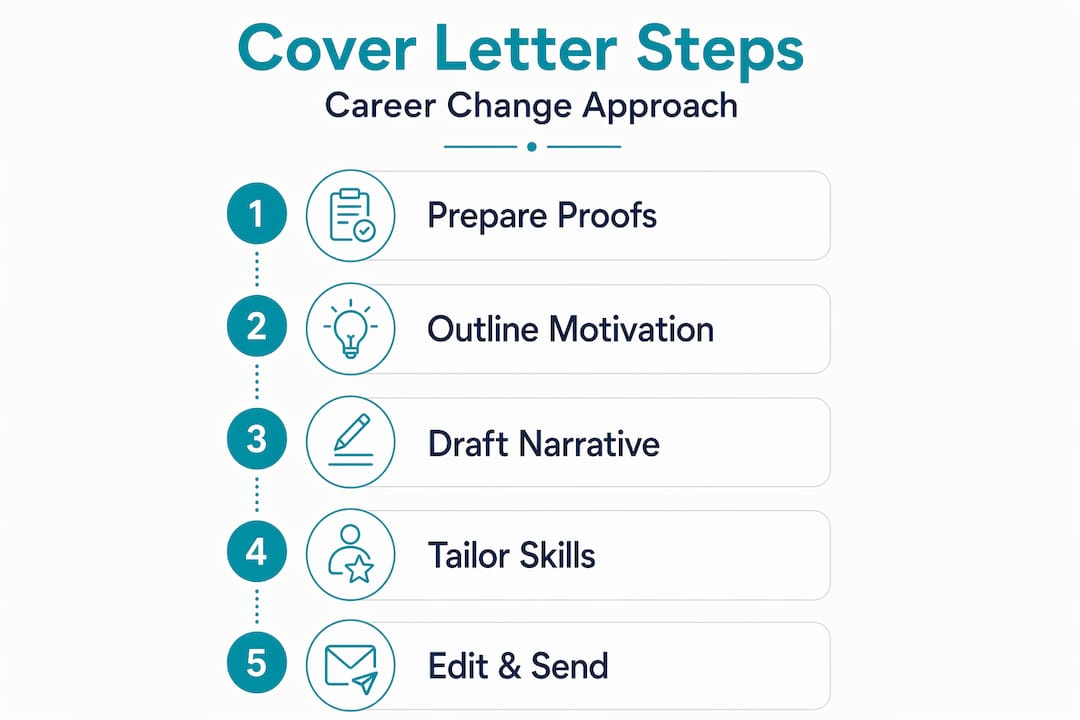
- How to write your career change cover letter, step by step
- Common mistakes that undermine your career change letter
- Career change cover letter examples that work
- My honest take on career change cover letters
- How Resumewiz can help you make the switch
- FAQ
Key takeaways
| Point | Details |
|---|---|
| Reframe, don’t apologize | Frame your career pivot as a deliberate choice, not a gap or failure. |
| Transferable skills are your foundation | Identify specific skills from your past role that directly apply to the target position. |
| Show proof of preparation | Include certifications, courses, or projects that demonstrate commitment to the new field. |
| Tailor every letter | Tailored applications earn roughly twice as many interviews as generic submissions. |
| Story beats a list | Hiring managers respond to narrative. Connect your “why” to the company’s goals. |
What career change cover letter writing actually means
Most people treat a cover letter as a summary of their resume. For career changers, that approach fails immediately. What is a career change cover letter, really? It is a persuasive document that explains not just what you have done, but why those experiences make you the right fit for a completely different role.
Standard cover letters assume your work history speaks for itself. A career change cover letter has to do more heavy lifting. Your resume will show a gap in direct experience. The cover letter is where you fill that gap with context, motivation, and proof.
Here is what makes this type of letter fundamentally different:
- It explains the pivot. You must address the career change directly and frame it as intentional, not reactive.
- It maps transferable skills. You identify specific abilities from your previous career that apply to the new role.
- It demonstrates preparation. You reference training, certifications, or hands-on projects that show you are already building in the new direction.
- It answers “why this company.” Generic motivation is not enough. You connect your pivot to the organization’s specific work.
The cover letter narrative and preparation must convince hiring managers of your commitment, not just your competence in past roles. A letter that simply lists past experience without addressing the change reads as tone-deaf. Hiring managers notice.
Before you write: the preparation that matters most
The biggest mistake career changers make is writing before they are ready. Effective cover letter writing for a career change starts well before you open a blank document.
Start with the job description. Read it three times. The first time for general understanding. The second time to circle skills and tools mentioned repeatedly. The third time to note the language the employer uses, because you will mirror that language in your letter. Analyzing job description keywords is one of the most critical preparation steps for writing targeted applications.
Map your transferable skills. Take a sheet of paper and draw two columns. On the left, list your five strongest skills from your previous career. On the right, write how each one applies to the new role. A teacher moving into instructional design brings curriculum development, learner psychology, and communication. A sales manager pivoting to business development brings negotiation, relationship management, and performance tracking. The skills exist. You just need to name them in the new context.
Research the company. Go beyond the About page. Read recent press releases, look at their LinkedIn content, and understand what challenges they are solving. This lets you write motivation that feels specific rather than scripted.
- Identify one or two things about the company’s work that genuinely excite you.
- Look for language in their public materials that you can echo authentically.
- Check if anyone on their team has made a similar career pivot. It signals they are open to it.
Gather your proof points. Have you taken a relevant course? Completed a certification? Volunteered in the new field? Built a side project? These details belong in your letter. Proof of active preparation tells a hiring manager you are not just interested in a change. You are already acting on it.
Pro Tip: Before writing a single sentence of your cover letter, write one paragraph for yourself only. Explain why you are making this change in plain, honest language. That raw paragraph is often the emotional core of your best opening.
How to write your career change cover letter, step by step
Structure matters. Here is how to build a cover letter that works for a career transition, section by section.
-
Open with the pivot, not your past. The first two sentences should state who you are now and where you are headed. Not where you have been. Try something like: “With eight years of experience in financial analysis and a recent certification in UX research, I am pursuing a role where data and human behavior intersect.” That opening signals clarity and confidence immediately.
-
Explain the why, briefly. One to three sentences on why you are making this change. Keep it forward-looking. Employers want to hire people who are moving toward something, not running from a bad situation. Connect your motivation to the role or company specifically. “I have spent years communicating complex data to non-technical stakeholders. When I discovered your work in data visualization for public health, I recognized the direct application of that skill in a context that matters deeply to me.”
-
Present your transferable skills with evidence. This is the core of the letter. Do not list skills in the abstract. Use a brief example or result for each one. Career changers who frame skills as assets, and back them with specifics, read far stronger than those who generalize. Pick two or three transferable skills and write one to two sentences on each, including a concrete outcome from your past role.
-
Show preparation actively. Name the course, the certification, the freelance project. “I recently completed a Google Project Management certificate and have been managing a volunteer campaign for a local nonprofit.” This single sentence changes how a hiring manager reads your application. It proves intent.
-
Connect to the company. One paragraph, no more. Reference something specific about their work. Show you have done real research. 63% of employers favor tailored applications over generic ones, and nothing signals tailoring more clearly than a company-specific paragraph that could not have been copied from another letter.
-
Close with confidence and a call to action. Avoid endings like “I hope you will consider me.” Try: “I would welcome the chance to discuss how my background in operations can contribute to your team’s growth. I am available at your convenience.” Clean, direct, and proactive.
Pro Tip: Keep your career change cover letter to one page, three to four short paragraphs. Hiring managers spend an average of seven seconds on an initial read. Dense text kills your chances before anyone reaches your best points.
Common mistakes that undermine your career change letter
Even well-prepared career changers fall into predictable traps. Knowing them in advance puts you ahead of most of your competition.
- Over-explaining the pivot. One concise, positive sentence on why you are changing careers is enough. A paragraph of backstory reads as defensive. Hiring managers are not therapists. They want to know what you bring, not why you left.
- Apologetic language. Phrases like “Although I do not have direct experience in this field…” signal insecurity. Replace them with confident equivalents. “My background in X translates directly to Y because…” is a completely different tone.
- Ignoring the career change entirely. Some candidates panic and just list their experience as if the pivot is invisible. Hiring managers see a mismatched resume and no explanation. Address the change directly.
- Copying a template word for word. Career change cover letter examples are useful as structural guides. They fail when you paste them in unchanged. Your story is specific. Your letter has to be too.
- Forgetting to proofread. A typo in a career change letter reads twice as badly as in a standard one, because it reinforces the idea that you might not be taking the transition seriously.
A tailored, concise narrative remains one of the clearest differentiators in 2026 recruiting environments, particularly when your resume does not align with the target role on its surface. Do not underestimate the format. A strong career change letter does what your resume cannot: it speaks directly to a human.
Career change cover letter examples that work
Looking at real examples is the fastest way to close the gap between theory and execution. Below is a comparison of two opening approaches for a teacher moving into corporate training.
| Approach | Example excerpt | Why it works (or doesn’t) |
|---|---|---|
| Weak opening | “I am a teacher with 10 years of experience looking to transition into corporate training.” | Generic, passive, and offers no motivation or connection to the company. |
| Strong opening | “After a decade designing learning programs for diverse student populations, I am bringing that expertise to corporate training, specifically to organizations like yours that prioritize measurable skill development.” | Specific, motivated, and immediately connects past experience to the new role. |
| Weak skills paragraph | “I have good communication skills and am organized.” | Vague, unsubstantiated, and offers no real evidence. |
| Strong skills paragraph | “In my last role, I designed a differentiated curriculum that improved assessment scores by 22% across three grade levels. That same data-driven design process applies directly to creating measurable training modules for adult learners.” | Quantified, specific, and draws a clear line from old role to new one. |
The pattern holds across any career pivot. Specificity beats generality. Motivation beats neutrality. And one in three job seekers seeking resume help actually need career positioning strategy alongside their documents. A well-structured letter is not just about good writing. It is about knowing what story to tell.
My honest take on career change cover letters
I have worked in recruiting for over a decade, and I have read thousands of cover letters. The ones that consistently underperform are not the ones from career changers. They are the ones from career changers who do not believe their own story yet.
Here is what I have learned: the pivot itself is rarely the problem. The apologetic tone is. When someone writes “I know my background is not traditional, but…” I already know the rest of the letter is going to hedge. Confidence is not arrogance. It is just choosing to lead with what you have instead of what you lack.
I have seen a former military officer land a senior product management role because his cover letter reframed logistics command as cross-functional project leadership. I have seen a nurse transition into health tech sales because she led with patient outcomes and data, not bedside manner. Neither of them had “relevant” experience on paper. Both had compelling narratives on the page.
My advice: stop writing the cover letter you think a hiring manager wants to read, and start writing the letter that honestly explains why this role, at this company, is the logical next chapter for someone with your specific background. That letter exists. Most career changers just talk themselves out of writing it.
Kim
How Resumewiz can help you make the switch

Career change cover letter writing is one of the most nuanced documents in the job search process. Getting the tone, structure, and strategy right takes more than a template. At Resumewiz, Kim Taynor and the team work directly with career changers and executives to craft cover letters and resumes that make the pivot clear, compelling, and credible. With over 10 years of recruiting experience behind every document, Resumewiz offers tailored career materials, LinkedIn optimization, and interview coaching designed specifically for professionals repositioning into new industries. If you are ready to stop second-guessing your story and start telling it well, Resumewiz is where that work begins.
Want a recruiter in your corner for your next senior role? Book a free call with Resume Wiz and we will map out your next move together.
FAQ
What is a career change cover letter?
A career change cover letter is a tailored document that explains why you are transitioning into a new field, connects your past experience to the new role, and demonstrates active preparation like certifications or relevant projects.
How long should a career change cover letter be?
Keep it to one page with three to four focused paragraphs. Concise, specific letters consistently outperform longer ones because hiring managers favor clarity and relevance over volume.
Should I address my career change directly in the letter?
Yes. Ignoring the pivot is a common and costly mistake. Address it briefly and positively in the opening, then spend the rest of the letter showing how your background and preparation make you a strong candidate.
What transferable skills should I highlight?
Focus on skills that directly apply to the target role, such as leadership, project management, communication, data analysis, or client relationships. Back each skill with a specific result or example from your previous career.
How do I make my motivation sound genuine?
Research the company specifically and connect your reason for pivoting to something concrete about their work or mission. Generic motivation reads as copied. Specific motivation reads as real.
