Recruiter Backed Cold Emails for Hiring Managers, 3 Ready Templates
Cold email gets a hiring manager to reply when it’s targeted at the right person, brief, and honest about where you are in the formal application process. That means confirming you applied through the posted channel if one exists, then writing a brief cold email roughly within the seventy-five to one hundred fifty word range with one proof point, one company-specific detail, and a single low-friction ask, such as a short call or permission to send a resume. Skip any of those three, and the message reads like spam, no matter how well it’s written.
Key Takeaways:
- Target the hiring manager most closely related to the role, ensuring their scope of work matches your background and the responsibility from the listing.
- Keep your email concise, between 75 and 150 words, including one relevant proof point, one company detail, and a simple low-friction ask.
- Use a clear, descriptive subject line that specifies the role, metric, or mutual connection, and avoid vague or salesy phrases.
- Send your outreach within 24 to 48 hours after applying or midweek mid-morning if unposted, and limit follow-ups to two at most.
- Verify the recipient’s email address or seek a warm introduction to avoid bounce-backs and spam flags, respecting application boundaries and company contact rules.
Table of Contents
- How Do You Find the Right Hiring Manager to Email?
- What Should a Cold Email to a Hiring Manager Include?
- What Subject Line Gets a Hiring Manager to Open Your Email?
- When Is the Best Time to Send a Cold Email and Follow Up?
- How Do You Cold Email Without Skipping the Formal Process?
- Cold Email Templates for Hiring Managers: Three Examples
- Why Cold Emailing Hiring Managers Actually Works
- What Recruiters Actually Notice in a Cold Email
- Sources
- FAQ
How Do You Find the Right Hiring Manager to Email?
Most cold emails fail before they’re written, because they’re aimed at the wrong person. The job posting itself is your first clue: some list the hiring manager or team lead by name, and if not, the company’s LinkedIn People page or department leadership page usually will. Look for whoever owns the function the role reports into. A data analyst opening probably reports to a director of analytics, not the VP of engineering three levels up.
For a role that’s actively posted, target the person named in the listing or the team lead one level above the position. For a role that doesn’t exist yet, target the function lead who most likely owns the problem your background solves. That’s a judgment call, and getting it wrong is the single biggest reason outreach goes unanswered, since recipient accuracy matters more than copywriting.
Before you send anything, run this quick verification pass:
- Match one specific responsibility from the job posting to the manager’s actual scope of work.
- Confirm their title reflects the authority to act on your message, not just adjacent proximity to the team.
- Check whether a warm introduction is possible before defaulting to cold contact.
- Look for a published email format on the company’s site or press materials rather than guessing repeatedly.
That last point matters more than it seems. Repeated guesses at an email address bounce, and bounced emails can flag your domain as spam-prone with some mail providers. If you can’t verify an address, treat LinkedIn as your soft first touch or request an introduction instead of firing blind guesses at a company’s domain.
What Should a Cold Email to a Hiring Manager Include?
A cold email to a hiring manager works like a five-part machine, and every part has one job. Miss a part and the whole message stalls.
- Subject line. Its only job is findability. A hiring manager should be able to search their inbox six weeks later and find you.
- Opener. Prove in one sentence that this isn’t a mass blast. Reference something specific: a posting, a launch, a talk they gave.
- Proof. One concrete result that maps directly to a responsibility in their world. Not three. One.
- Company detail. A fact that shows you actually looked, not a generic compliment about “your innovative culture.”
- Ask. One small, low-friction request. A 15-minute call. Permission to send a resume. Nothing that requires them to do real work to respond.
Keep the whole thing between 75 and 150 words, because career guidance from UC Berkeley’s career center and job-search resources like PitchHired converge on that range for a reason: most hiring managers read email on a phone between meetings, and anything past 150 words gets skimmed or skipped. This is not a cover letter. A cover letter argues your whole case. A cold email opens a door.
On attachments: skip the resume on a true first touch to an unposted role. Offer to send one, or link a portfolio if you have a clean one. If you already applied to a posted role and are following up, attaching the resume again is fine since you’re reinforcing, not introducing.
Pro Tip: Before hitting send, read your draft and ask one question: could this exact email have been sent to five other people with zero changes? If yes, it needs another pass. If the answer is clearly no, you’re ready.
What Subject Line Gets a Hiring Manager to Open Your Email?
The best subject lines are boring on purpose. Clear and specific beats clever every time, because a searchable, descriptive subject line is what lets a hiring manager find your message again when a role opens up.
Five formulas that consistently perform:
- Role plus name: “Senior Product Manager Candidate, Referred by [Name]”
- Result plus role: “Cut Churn 18% in a Similar Product Role”
- Mutual connection: “[Name] Suggested I Reach Out”
- Company detail: “Loved Your Team’s Launch of [Product]”
- Short question: “Open to a Quick Note on the Marketing Ops Role?”
Keep it to 6 to 10 words and front-load the role or the metric, since most inboxes truncate subject lines on mobile after around 40 characters. Avoid “Quick Question,” “Following Up,” or anything with exclamation points. Those read as either vague or salesy.
For your sender identity: use a professional personal email address, your full name, your current or target job title, and a LinkedIn URL in the signature. That combination signals a real, findable professional rather than a mass-outreach account, and it gives the hiring manager an easy way to verify you in ten seconds flat.
When Is the Best Time to Send a Cold Email and Follow Up?
Timing depends on whether you already applied. If you did, send your cold email within 24 to 48 hours of submitting the application, while your name is still fresh in the applicant tracking system queue. If you haven’t applied and there’s no posting to reference, aim for midweek, mid-morning, when inboxes are past the Monday backlog but before Friday’s mental checkout.
Follow-up cadence matters just as much as the first send. Industry guidance settles on a two-touch model:
- First follow-up at 5 to 7 business days. Short. Restate your ask in one line. Add nothing new yet.
- Final follow-up at 14 to 21 days. Add one new piece of value: a relevant metric, a short work sample, or a fresh idea tied to their team.
- Stop after that. Two follow-ups is the industry-standard ceiling before persistence starts reading as pressure.
Referrals change the math. If someone internal is willing to forward your note, that email essentially skips the cold-outreach clock. But get their permission first, and thank them within a day or two, since a referral is a favor you’re spending, not a resource you’re owed.
How Do You Cold Email Without Skipping the Formal Process?
Cold email supplements the hiring process. It doesn’t replace it. If a posting has an application link, use it first, then say so in your email opener: “I applied for the Marketing Manager role yesterday and wanted to add context.” Skipping the formal application and going straight to cold contact reads as trying to jump the line, and most applicant tracking systems still require a submitted application for you to be considered a real candidate.
A few boundaries worth respecting:
- If the posting explicitly says “no direct contact” or names an assigned recruiter, honor it. Email the recruiter instead.
- Attach a resume only when you’ve already applied or when asked. Offer a link or a “happy to send one” line on cold first contact.
- Never imply an endorsement or referral relationship you don’t actually have. It’s discovered easily and it burns the bridge permanently.
Cold Email Templates for Hiring Managers: Three Examples
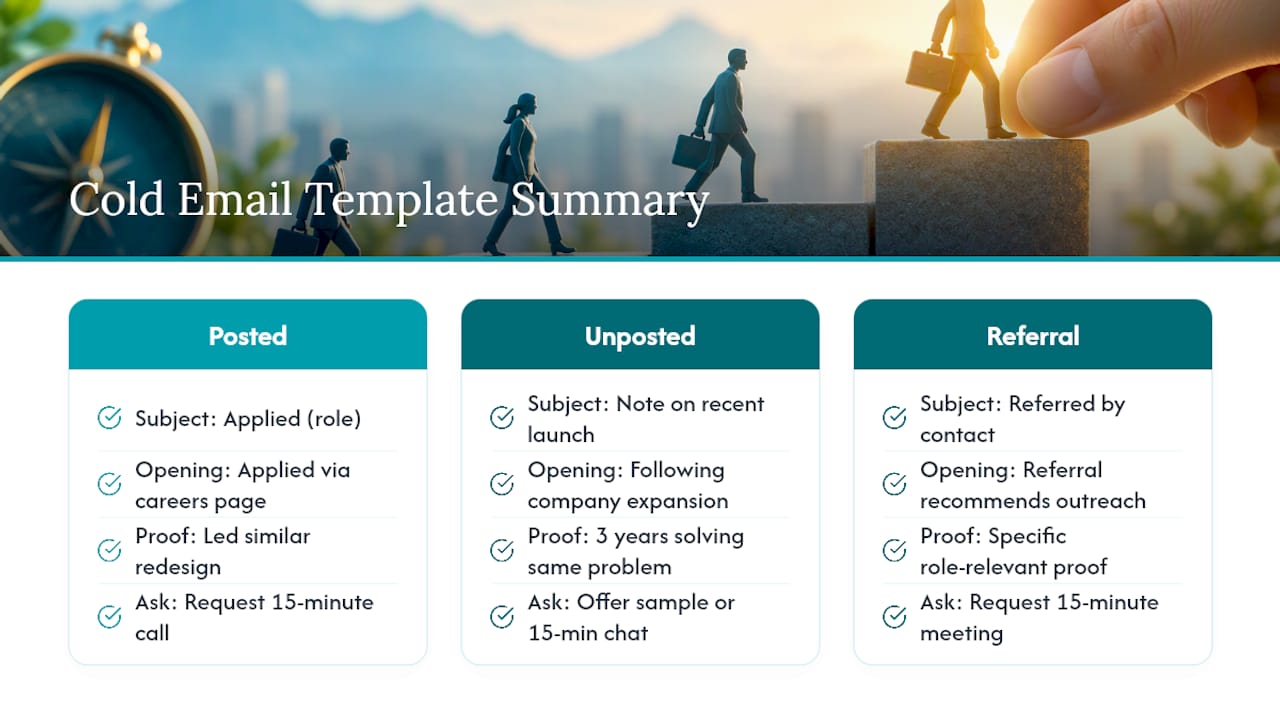
Posted-role template (about 90 words):
Subject: Applied for Senior UX Designer, Quick Note
Hi [Name], I applied for the Senior UX Designer role yesterday through your careers page. I noticed your team recently redesigned the onboarding flow. At [Company], I led a similar redesign that cut drop-off by a meaningful margin in the first month. I’d welcome 15 minutes to hear what you’re prioritizing for this hire, whenever it’s convenient. Thanks for considering it.
[Your Name]
Unposted-role template (about 85 words):
Subject: A Note on [Company]'s Recent [Product/Launch]
Hi [Name], I’ve been following [Company]'s expansion into [specific area] and wanted to reach out directly. I spent three years solving a nearly identical problem at [Previous Company], where the outcome was [one concrete result]. I don’t see an open role listed, but I’d be glad to send a short work sample or grab 15 minutes if that’s useful as you plan ahead.
[Your Name]
Referral template (about 70 words):
Subject: [Referrer Name] Suggested I Reach Out
Hi [Name], [Referrer Name] mentioned you’re building out the analytics team and suggested I get in touch. I recently [one specific proof point relevant to the role]. Would you have 15 minutes this week or next to talk through what you’re looking for?
[Your Name]
Pro Tip: Before sending any of these, swap every bracketed detail for something you personally verified. A template with placeholders left half-filled is worse than no email at all.
Why Cold Emailing Hiring Managers Actually Works
The advice above isn’t guesswork. UC Berkeley’s career center recommends framing outreach as a request for a conversation about someone’s work, not a direct ask for a job, because it lowers the psychological cost of replying. Indeed’s own career guidance backs the same core structure: a targeted recipient, one proof point, one ask.
The approach to outreach templates and coaching is shaped by extensive recruiting experience from thousands of similar interactions. That experience shapes Resumewiz’s approach to outreach templates and coaching, built around the same principle recruiters apply daily.
The emails that get replies aren’t the cleverest ones. They’re the ones where I can tell, in the first two lines, that this person actually looked at my team before writing to me.
Save this checklist before your next send: contact verified, one proof point matched to their scope, application status stated if applicable, word count under 150, single clear ask.
What Recruiters Actually Notice in a Cold Email
Most cold emails get skimmed in about five seconds, and what saves them is specificity, not polish. A hiring manager can tell in the first sentence whether you read the posting or just found their email address. Run the one-person test on your next draft: if it could go to five other people unchanged, rewrite it. Try one of the templates above this week and track your reply rate. You’ll notice the pattern fast.
Kim
Want a recruiter in your corner for your next senior role? Book a free call with Resume Wiz and we will map out your next move together.
Sources
For readers who want to go deeper on outreach mechanics or referral etiquette, these are worth keeping open in a tab:
- 5 Tips for Reaching Out - Career Engagement
- How to Write Effective Cold Emails for Jobs, Indeed
- How to Write a Cold Email for a Job | PitchHired
- How to Email a Hiring Manager in 2026, ZapResume
If writing these emails yourself feels like one more task on top of an already packed job search, Resumewiz’s Elevate packages build outreach templates and interview coaching directly into a job search coaching engagement. For done for you outreach and applications, Elevate and Land focuses on getting your outreach and application materials interview-ready.
FAQ
What Is the 30/30/50 Rule for Cold Emails?
There’s no single, widely recognized standard rule in professional cold-email guidance for job seekers. If you’ve seen specific ratios referenced elsewhere, treat them as one blogger’s personal framework rather than an industry standard, and instead anchor your emails to the well-documented 75 to 150 word target and five-part structure covered above.
What Is the 70/30 Rule in Hiring?
This isn’t a standardized hiring or outreach principle covered by the career-center and industry guidance referenced in this article. Some recruiters use informal ratios to describe skills versus culture fit in interviews, but there’s no consistent definition worth repeating as fact here.
Is Cold Email Still Effective in 2026?
Yes, when it’s targeted and brief. Hiring managers still respond to messages that clearly show research, one relevant proof point, and a low-friction ask like a 15-minute call, which is the same structure career guidance from UC Berkeley has recommended for years. What’s changed is tolerance for generic, templated blasts, since applicant tracking software and busy inboxes make it easier than ever to spot one.
What Is a Good Email to Send to a Hiring Manager?
A good email is 75 to 150 words, names the specific role or team, references one real company detail, and includes one concrete proof point tied to a responsibility in the posting. It closes with a single small ask, such as 15 minutes on a call or permission to send a resume, following the same structure Indeed’s career guidance recommends.
