Confidence Issues During Executive Job Search: A Fix
Confidence issues during an executive job search are defined by career psychologists as a self-trust gap, not a skills deficit. You have the track record, the judgment, and the results. What breaks down is your ability to trust that judgment when the outcome is uncertain and the stakes feel personal. FullFrame Coaching and the Belonging Partnership both identify this gap as the root cause of the anxiety, overthinking, and procrastination that derail senior professionals mid-search. This guide addresses that gap directly, with strategies built for executives, not entry-level job seekers.
Why confidence issues during executive job search start with self-trust
Self-trust gaps in senior leaders are the primary driver of confidence problems, not missing skills or experience. Most executives have spent decades making high-stakes decisions. The job search, however, removes the structural supports that normally reinforce their judgment: a team, a title, a clear mandate, and measurable outcomes. Without those anchors, the brain treats ambiguity as a threat.
Self-trust is distinct from confidence. Confidence is the feeling that you can perform a task. Self-trust is the deeper belief that your judgment is sound even when you cannot control the outcome. Executives who score high on confidence in their roles often score low on self-trust during a job search, because the search offers no immediate feedback loop. You send applications and hear nothing. You interview well and get passed over. The silence reads as evidence of failure.
This threat response produces three recognizable patterns in senior professionals:
- Overthinking. Executives rewrite cover letters and LinkedIn summaries obsessively, searching for the perfect framing instead of sending.
- Overpreparing. Interview prep stretches into days of research that crowds out actual outreach and networking.
- Decision paralysis. Executives delay applying to roles they are qualified for because they cannot guarantee the outcome will match their standards.
Coaching helps executives recognize that uncertainty is a normal condition, not a signal that something is wrong with their judgment. That reframe is the starting point for rebuilding self-trust.
Pro Tip: Set a hard limit of 90 minutes on any single application. Diminishing returns kick in fast. Sending a strong application beats perfecting one that never goes out.
What does job search anxiety actually look like for executives?
Job search anxiety in senior professionals looks different from the generic version described in most career advice. The Belonging Partnership identifies several specific patterns that show up at the executive level.
- Fear of invisible rejection. Executives apply to roles and receive no response. Unlike a formal rejection, silence offers no data. The brain fills that void with worst-case interpretations.
- High-functioning depression. Executives maintain external productivity while experiencing persistent low mood, reduced motivation, and a quiet sense of worthlessness. It rarely looks like clinical depression from the outside.
- Social anxiety around networking. Senior professionals who led teams of hundreds report genuine discomfort reaching out to peers for introductions. The perceived power shift feels destabilizing.
- Procrastination disguised as preparation. Executives spend weeks refining their resume or LinkedIn profile instead of sending outreach. The activity feels productive. It is avoidance.
Job search anxiety includes fear of rejection, high-functioning depression, and social anxiety, all of which intensify during career transitions. That intensity is higher for executives because the identity investment is higher. A VP of Operations does not just lose a job. She loses a daily structure, a professional identity, and a social network built around that role.
The gap between past achievement and present uncertainty is the core psychological wound. Executives are accustomed to being the person with answers. The job search puts them in the position of asking, waiting, and not knowing. That role reversal is genuinely difficult, and recognizing it as the source of anxiety is the first step toward managing it.
How to rebuild confidence and self-trust during your search
The most effective approach combines mindset shifts with specific behavioral changes. Neither works alone.
Separate identity from outcome. Your worth as a professional is not determined by whether a particular company extends an offer. One rejection, or ten, does not revise your track record. Executives who internalize this distinction stop treating each application as a referendum on their career.
Use a low-volume, high-quality application plan. Targeting 2 to 5 tailored applications and one networking contact per day reduces overwhelm and sustains momentum. Sending 40 generic applications in a week feels productive and produces almost nothing. Five targeted applications with personalized outreach produce more interviews and protect your mental energy.
Compress your interview answers. Practicing answers in 60 to 90 seconds prevents rambling and cognitive overload under pressure. Executives often over-explain in interviews because they are used to providing full context to their teams. Interviewers do not need full context. They need a clear, direct answer followed by one strong example.
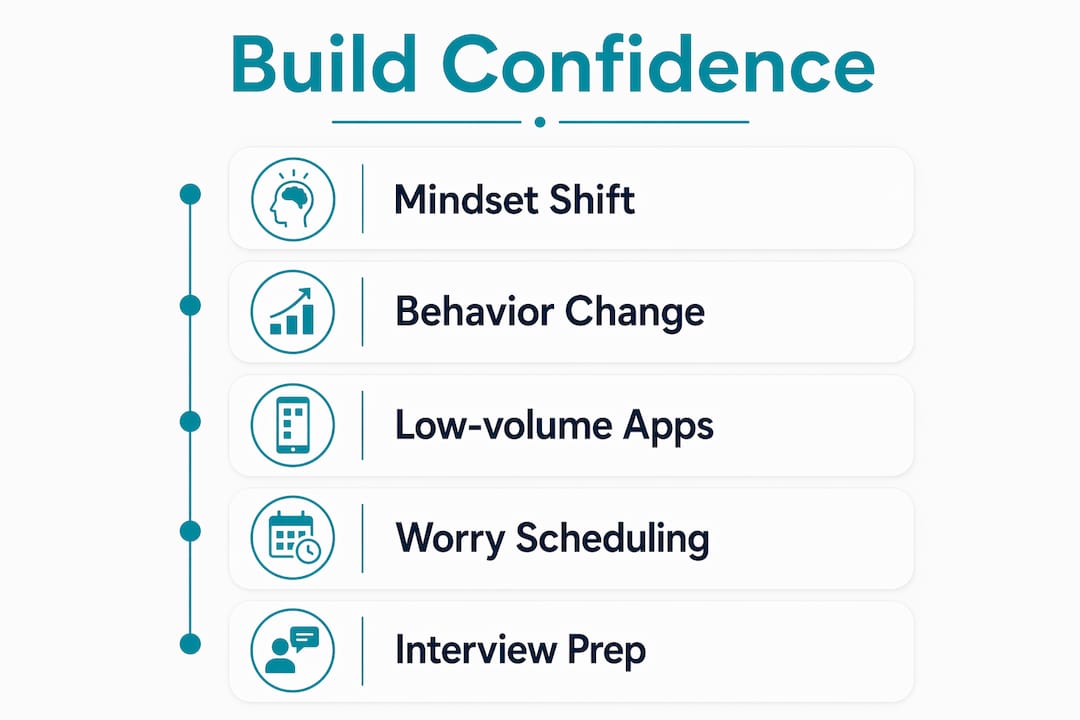
Schedule your worry time. Designating 15 minutes daily for anxiety processing keeps concern from bleeding into the rest of your day. Outside that window, redirect anxious thoughts to the scheduled slot. This is a clinically supported technique, not a productivity hack.
Regulate your nervous system before interviews. Familiarity and emotional regulation reduce anxiety and support stable delivery. Box breathing, a short walk, or five minutes of silence before a call all produce measurable reductions in cortisol. These are not soft suggestions. They change your physiological state and your cognitive clarity.
Pro Tip: Record yourself answering two or three common interview questions on your phone. Watch it once. The gap between how you think you sound and how you actually sound closes fast, and that gap is where most interview anxiety lives.
Generic confidence advice vs. executive-specific methods
Most job search confidence advice is written for early-career professionals. It does not translate to the executive experience.
| Approach | What it addresses | Limitation for executives |
|---|---|---|
| Rehearsing standard answers | Surface delivery | Misses the identity and self-trust layer |
| Generic affirmations | Mood lift | No structural change to anxiety patterns |
| Executive coaching | Self-trust, judgment, ambiguity tolerance | Requires time and investment |
| Scheduled worry time | Anxiety containment | Works best combined with behavioral structure |
| Low-volume application plan | Overwhelm and burnout | Requires discipline to maintain |
| Nervous system regulation | Physiological state before interviews | Needs consistent practice to become reliable |
Willpower alone is insufficient for sustaining confidence during a prolonged job search. The brain’s biological response to repeated rejection and uncertainty requires active neural protection strategies, not just positive thinking. Rhythm, agency-restoring tasks, and structured routines prevent the despair that willpower cannot hold back indefinitely.
Executive coaching outperforms generic advice because it addresses the actual problem: the self-trust gap. A coach provides honest feedback, reality checks on self-perception, and a structured process for rebuilding judgment confidence. That is categorically different from rehearsing answers to “tell me about yourself.”
How do you sustain confidence throughout a long executive search?
Long searches, which are common at the senior level, require maintenance strategies, not just a one-time confidence reset.
- Build a weekly review ritual. Every Friday, list three things you did well in the search that week. Not outcomes. Actions. This trains your brain to recognize agency rather than fixating on results outside your control.
- Limit job board and LinkedIn notifications. Turning off non-actionable alerts reduces the psychological toll of constant passive monitoring. Check job boards at scheduled times, not reactively.
- Maintain one non-search activity daily. Exercise, reading, a creative project. Executives who define themselves entirely by their job search lose perspective and burn out faster.
- Seek professional support if anxiety becomes chronic. Job search anxiety is normal and episodic. When it becomes persistent, disruptive, or starts affecting sleep and relationships, a therapist or counselor is the right resource, not more interview prep.
- Use a trusted advisor for calibration. A peer, mentor, or career coach who will tell you the truth about your positioning, your resume, and your interview performance is more valuable than encouragement alone.
Pro Tip: Treat your job search like a part-time job with defined hours. Working on it from 9 a.m. to noon, then stopping, produces better results than a diffuse all-day anxiety spiral that never fully turns off.
Key takeaways
Confidence issues during an executive job search stem from a self-trust gap, and closing that gap requires specific behavioral and mindset strategies, not generic positivity.
| Point | Details |
|---|---|
| Self-trust is the core issue | Executives lose confidence because uncertainty removes their normal judgment feedback loops. |
| Anxiety has specific executive patterns | Invisible rejection, high-functioning depression, and social anxiety are common at the senior level. |
| Low-volume plans outperform mass applying | Targeting 2 to 5 tailored applications daily sustains momentum and protects mental energy. |
| Interview compression reduces pressure | Practicing 60 to 90 second answers prevents rambling and cognitive overload under stress. |
| Sustained confidence needs structure | Weekly reviews, scheduled worry time, and defined search hours prevent burnout in long searches. |
What I’ve learned from watching executives fight their own track records
After more than a decade working in recruiting and career services, the pattern I see most often is not executives who lack ability. It is executives who have stopped trusting themselves because the job search stripped away every external signal they normally use to confirm their own judgment.
The most damaging thing I watch happen is when a highly capable VP or C-suite leader starts treating silence from a recruiter as evidence that their career was somehow less than it was. One ignored email does not revise 20 years of results. But the brain does not always know that.
What actually works is not more preparation. It is building a process that gives you back a sense of agency. When you control your daily actions, limit your exposure to uncontrollable outcomes, and get honest feedback from someone who knows the market, the anxiety does not disappear. It becomes manageable. You stop waiting for the search to tell you who you are.
The executives I have seen recover their confidence fastest are the ones who accept that nervousness is not a warning sign. It is a normal response to a genuinely uncertain situation. They channel it into focused action instead of letting it drive endless revision cycles. Consistent, structured action builds the kind of durable confidence that no amount of affirmation can replicate.
Kim
How Resumewiz supports executives through the confidence gap
Confidence in a job search is partly psychological and partly structural. When your resume does not reflect your actual impact, or your LinkedIn profile undersells your leadership, the self-doubt compounds.
Resumewiz was built specifically for executives and senior managers who need more than a polished document. The platform offers ATS-compliant executive resume development, LinkedIn profile optimization, personalized outreach templates, and interview coaching, all designed to give you the structural foundation that makes confidence easier to sustain. When your materials are strong and your process is clear, you spend less energy second-guessing and more energy executing. Kim Taynor and the Resumewiz team bring over 10 years of recruiting experience to every engagement, with a focus on getting high-fit interviews in front of the right decision-makers.
Want a recruiter in your corner for your next senior role? Book a free call with Resume Wiz and we will map out your next move together.
FAQ
What causes confidence issues during an executive job search?
Confidence issues at the executive level root in a self-trust gap, not a lack of skill. Uncertainty removes the feedback loops executives rely on to confirm their judgment, triggering overthinking and anxiety.
How many applications should an executive send per day?
Targeting 2 to 5 tailored applications and one networking contact daily is more effective than high-volume mass applying. Quality and personalization produce more interviews and reduce burnout.
How long should interview answers be for senior roles?
Answers compressed to 60 to 90 seconds prevent rambling and cognitive overload. Executives tend to over-explain; interviewers want a clear answer followed by one strong example.
Is job search anxiety normal for experienced executives?
Yes. Job search anxiety is a normal, episodic response to uncertainty and rejection. It becomes a problem when it is persistent, disrupts sleep, or leads to chronic procrastination, at which point professional support is appropriate.
Does willpower help with job search confidence?
Willpower alone is insufficient for sustaining confidence through a long search. Structured routines, agency-restoring tasks, and rhythm-based habits provide the neural protection that willpower cannot maintain indefinitely.
