Executives: Five Ten Minute Moves to Keep a Job Search Secret
A confidential job search means using candidate-side tactics, private channels, and tightened privacy settings to explore new roles without your current employer, colleagues, or clients finding out. The fastest fix comes first: run a LinkedIn privacy audit and set up a dedicated personal email and calendar today. Everything else, from reference bench to recruiter scripts, builds on that foundation.
Key Takeaways:
- Limiting visibility of resume and profile updates on LinkedIn, along with excluding the public “Open to Work” banner, minimizes accidental leaks.
- Bribing references and mapping their connections prevent overlaps with current employer and reduce the risk of exposure.
- Managing recruiter relationships carefully by requesting written approvals and clarifying search type helps maintain confidentiality.
- Conducting all research and communication through personal devices and accounts avoids monitoring software or company networks.
- Spreading profile edits and outreach gradually over time creates a less noticeable search, reducing algorithmic flags and alerting colleagues.
Table of Contents
- Ten-Minute Checklist: Five Moves That Cut Your Exposure Fast
- What LinkedIn Privacy Settings Actually Protect You
- How Do You Build a Reference Bench Without Tipping Off Your Employer?
- Working With Recruiters Without Losing Control of Your Name
- Operational Security: The Small Habits That Give You Away
- Refreshing Your Materials Without Signaling a Search
- When Should You Tell Your Current Employer?
- Do You Need a Career Coach or a Managed Confidential Search?
- A Recruiter’s View on When to Stop Doing This Alone
- How Resume Wiz Runs a Confidential Executive Search
- Where to Learn More About Privacy Settings and Recruiter Practices
- Sources
Ten-Minute Checklist: Five Moves That Cut Your Exposure Fast
Before you touch your resume or message a single recruiter, close the obvious leaks. Most accidental exposures trace back to a handful of preventable settings and habits, not bad luck.
- Turn off “Share Profile Updates” in LinkedIn settings so edits don’t ping your network.
- Set “Open to Work” to recruiters-only visibility, or skip it entirely, since the public banner is the single most common self-inflicted leak.
- Create a separate personal email address and calendar exclusively for job-search activity.
- Identify and quietly brief five references today, before you need them, not after a recruiter asks.
- Build a written off-limits list of companies and contacts recruiters should never approach on your behalf.
Block interview windows on your personal calendar only, and never touch a company laptop or phone for any of this.
Pro Tip: Do this checklist in one sitting on a personal device, ideally on a weekend. Piecemeal changes spread over weeks are more likely to get noticed than one quiet clean sweep.
What LinkedIn Privacy Settings Actually Protect You
LinkedIn’s settings menu is where most confidential searches quietly fail. Go to Settings & Privacy > Visibility and adjust three things: who can see your connections, whether your profile changes broadcast to your network, and your activity feed visibility. Then go to Job Preferences and either disable “Open to Work” or restrict it to recruiters with a LinkedIn Recruiter seat, never the public badge.
Here’s what those settings can’t fully protect you from:
- Recruiters with enterprise Recruiter seats can sometimes still see “open to work” style signals even when you think you’ve limited visibility.
- Former colleagues who work at companies with alumni tools may notice patterns in shared connections, a risk known as the alumni effect.
- A sudden burst of profile edits, even private ones, can trigger algorithmic “recently active” flags visible to close connections.
Behaviorally, stagger your edits over several days instead of overhauling your profile in one session. Avoid mass-connecting with recruiters. And use private browsing whenever you research target companies, since browser history and cookies can quietly build a trail. One data point worth remembering: never activate the visible Open to Work banner if you’re employed and searching quietly. It solves a problem you don’t have while creating one you do.
How Do You Build a Reference Bench Without Tipping Off Your Employer?
Your reference bench needs range: a former manager, a client who saw your work firsthand, and ideally a board member or senior peer who can speak to leadership. Three to five names, mixed across relationships, gives a recruiter enough triangulation without over-relying on any single person.
Pre-briefing matters more than most candidates realize. Call each reference directly, not by email, and give them three things: the type of role you’re targeting, two or three talking points about your impact, and an explicit confidentiality ask. A short script works: “I’m exploring a move quietly, would you be comfortable serving as a reference if it comes up, and can we keep this between us for now?”
Then map overlap. Before finalizing your list, check each reference’s LinkedIn connections against your current employer’s leadership and board. If someone sits one degree away from your boss or shares a tight-knit alumni network with your company, exclude them or delay activating them until later in the process.
- Rotate in a backup reference for any name with heavy overlap risk.
- Reconfirm each reference’s willingness every few months if your search stretches on.
Pro Tip: Ask each reference who else they’ve spoken with recently about your industry. That single question often surfaces overlap you’d never catch by scanning LinkedIn alone.
Working With Recruiters Without Losing Control of Your Name
Retained search firms and contingency recruiters operate on different incentives, and that difference matters enormously for confidentiality. Retained recruiters work exclusively for the hiring company on a single search and have far less reason to shop your name around. Contingency recruiters only get paid if their candidate gets placed, which sometimes pushes them toward broader, less careful distribution.
Senior-level searches tend to move through off-market, relationship-driven channels rather than public job boards, which is exactly why recruiter selection carries so much weight.
Set ground rules on the first call:
- Ask directly whether they’re running a retained or contingency search, and who the client is.
- Require written approval, even a two-line email, before your resume goes anywhere.
- Hand over your off-limits list of companies and named contacts up front, not after a mistake happens.
- Frame early conversations as market research or informational calls rather than active job seeking, which keeps the door open without committing you.
Private executive job boards and invitation-only networks tend to leak less than general-purpose sites, simply because fewer eyes see your activity there.
Operational Security: The Small Habits That Give You Away
Most confidential searches don’t fail because of one big mistake. They fail because of small, repeated ones. Never use your company email, work phone, or corporate VPN for anything search-related, including scheduling a “quick call” with a recruiter. Keep every piece of logistics, from calendar invites to document sharing, on personal accounts only.
- Use personal email and a personal phone number for all recruiter and interview communication.
- Label calendar entries generically (“Personal appointment” or “Dentist”) rather than “Interview with [Company].”
- Schedule interviews early morning, over lunch, or in the evening, using your own device and your own network connection.
- Store your resume, notes, and offer letters in a personal cloud account, never a shared or company drive.
Clear your browser cache after researching target companies on any device you share with your employer, even briefly.
Pro Tip: If your company issues laptops with monitoring software, assume anything typed or opened on that machine is visible to IT. Treat the device as public, even at home.
Refreshing Your Materials Without Signaling a Search
Update your resume and LinkedIn copy offline first, in a personal document, then decide what actually needs to go live. Most ATS-friendly formatting changes, keyword adjustments, and bullet rewrites can happen entirely outside LinkedIn, so there’s nothing for your network to notice until you’re ready.
When you do touch your LinkedIn profile, make small, low-signal edits spread over time rather than a visible overhaul. Maintaining a steady baseline of activity year-round, an occasional comment or share, means a few tweaks during your search won’t look like a sudden makeover.
- Draft outreach templates in stages: an initial “exploring options” message, a warmer follow-up once trust is established, and a final ask that shares references only when a conversation turns serious.
- Save resume drafts locally or in a personal cloud folder, never a company system, even temporarily.
- Hold your references in reserve until a specific opportunity reaches a real interview stage.
A resume-building tool like this resume formatting resource can help you get ATS structure right before you ever touch your live LinkedIn profile.
When Should You Tell Your Current Employer?
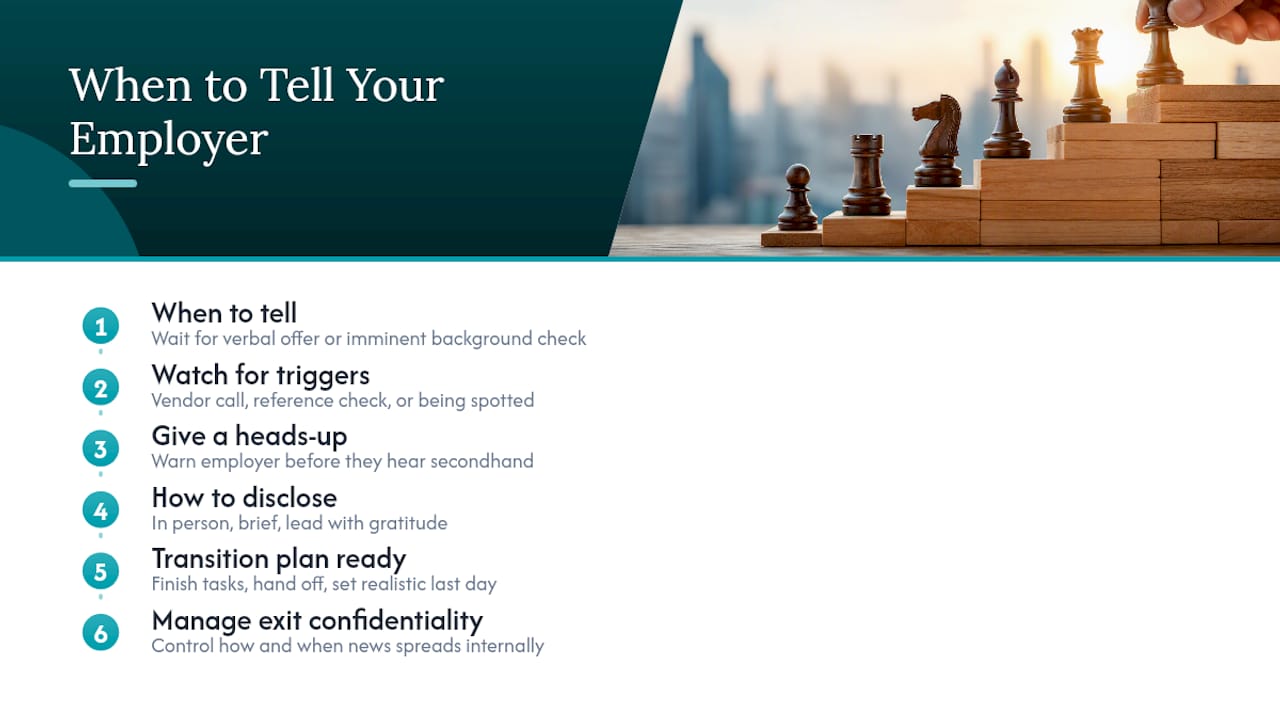
There’s no universal trigger point, but there’s a clear sequence most executives follow. You generally don’t need to say anything until you have a verbal offer or you’re deep enough into a final-round process that a background check or reference call is imminent. Telling your employer earlier than that rarely buys you goodwill and often just shortens your runway, sometimes literally, if the relationship sours and they choose to part ways immediately.
Watch for the moments that force your hand rather than waiting for a calendar date. A prospective employer’s background-check vendor contacting your current HR department, a mutual reference getting called without warning, or a colleague spotting you at an industry event tied to your target company can all accelerate the timeline whether you’re ready or not. If any of those become likely, it’s worth giving your employer a heads-up before they hear it secondhand.
When you do decide to disclose, do it in person if possible, keep it brief, and lead with gratitude rather than grievance, even if you’re leaving because of real frustrations. Have your transition plan ready before the conversation starts: what you’ll finish, what you’ll hand off, and a realistic last day. Executives who leave that meeting with a clear plan for the following two weeks tend to preserve the relationship far better than those who walk in and improvise.
One more practical note: once you’ve given notice, your confidentiality concerns shift, not disappear. You now need to manage the exit itself discreetly, including how and when the news spreads internally, which is a separate skill from the search that got you there.
Do You Need a Career Coach or a Managed Confidential Search?
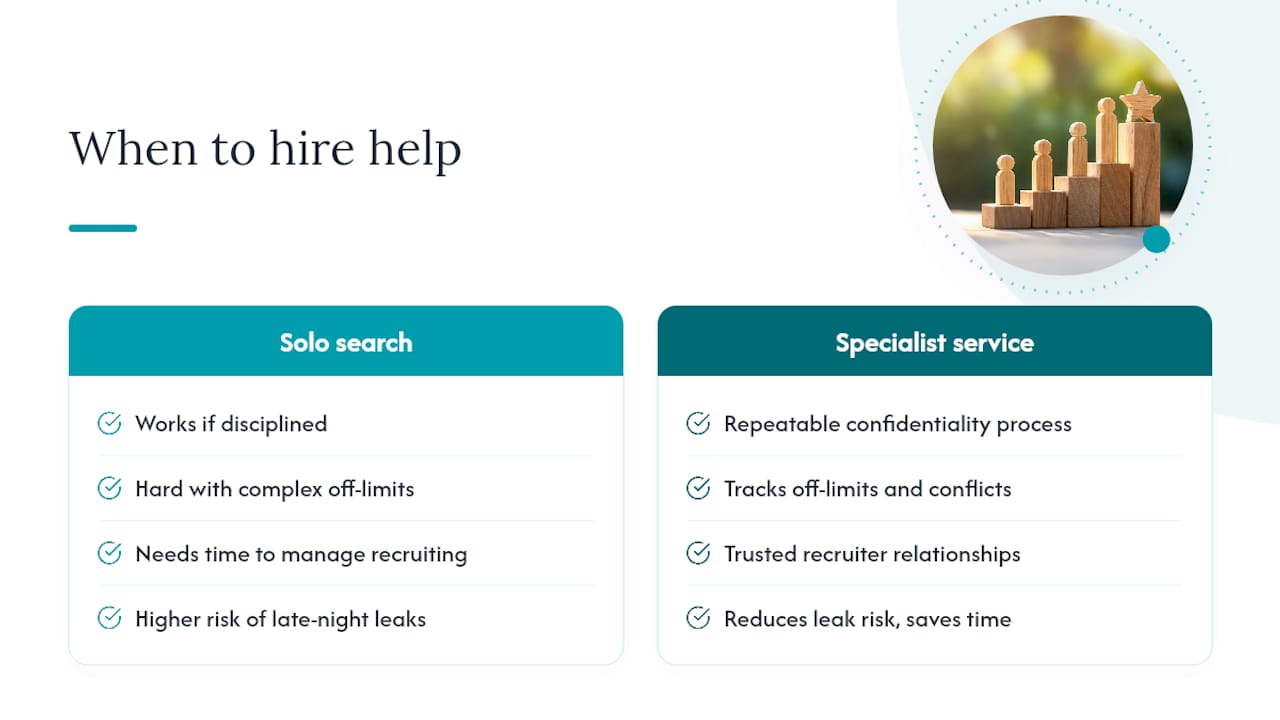
Some executives can run this entire process solo with a checklist and enough discipline. Others hit a point where the complexity outpaces their available time, and that’s the real signal to bring in help, not desperation or frustration with the process.
Consider a career coach or specialist service if any of these apply to your situation. Your off-limits list has grown long and tangled, spanning clients, board relationships, and portfolio companies, and you’re worried about missing a conflict. You’re running a search while working sixty-hour weeks and simply don’t have bandwidth to vet recruiters, draft outreach templates, and manage a reference bench on top of your day job. Or the privacy stakes are unusually high, perhaps you’re a public-facing executive, a board member elsewhere, or in a small industry where word travels fast.
A good specialist service does three things a solo search struggles to replicate consistently: it applies a repeatable confidentiality process instead of improvising each step, it maintains recruiter relationships built on trust rather than cold outreach, and it enforces the kind of approval gates and off-limits tracking that gets sloppy when you’re managing it yourself at 11 p.m. after a full workday. The value isn’t just time saved. It’s fewer chances for a preventable leak to happen on a day you’re too busy to catch it.
A Recruiter’s View on When to Stop Doing This Alone
Every confidentiality leak I’ve seen in a real search traces back to the same root cause: too many moving pieces and not enough hours to manage them carefully. If your off-limits list has grown past a dozen names, or you’re missing meetings because you’re drafting outreach at midnight, that’s your signal. A managed confidential search should give you pre-briefed references, written submission approval, and someone tracking overlap risk so you don’t have to.
Kim
How Resume Wiz Runs a Confidential Executive Search
Running a confidential search solo means juggling recruiter vetting, reference briefing, and materials refresh on top of a full workday, and one dropped ball can cost you your current job before the new one is secured. Specialist career services can handle that juggling for you: executive resume writing, LinkedIn optimization done with discretion, custom outreach templates, and managed submissions that never go out without your written approval first.

Every engagement runs on private channels, with your off-limits list respected from day one and no resume leaving the service provider’s hands without a green light from you. The process is built around extensive recruiting experience, which shapes how references get pre-briefed and how recruiter conversations get framed so nothing looks like a leak in progress. If your search has outgrown a solo checklist, start a confidential consultation with Resume Wiz and get a second set of eyes on the parts of this process that carry the most risk.
Where to Learn More About Privacy Settings and Recruiter Practices
For hands-on setting changes, Coursera’s walkthrough on signaling openness to recruiters covers the exact LinkedIn menus worth revisiting. On executive-search mechanics, MIT’s Career Development Office explains why retained relationships carry less exposure than broad outreach. For network-overlap risk specifically, the University of Oregon’s Mohr Center breaks down the alumni effect in detail worth a second read.
Want a recruiter in your corner for your next senior role? Book a free call with Resume Wiz and we will map out your next move together.
