Interview Ready Consulting Resume With Copy Ready Bullets
Lead with quantified outcomes, not project descriptions, and organize your consulting work as either a consolidated “Consultant” role or a set of curated engagement entries depending on how many gigs you’re covering. Every bullet should name the result first: a dollar figure, a percentage, a timeline cut. The formats, the bullet formula, and copy-ready examples below turn that rule into a resume that actually gets read.
Key Takeaways:
- Quantify at least 80% of bullets with specific outcomes, using dollar figures, percentages, or ranges, to demonstrate measurable impact.
- Prioritize the most impressive metric in the first bullet of each role to quickly catch recruiter attention within seconds.
- Keep each role to three to five bullet points, starting with the highest-impact results to avoid diluting key messages.
- Use formatted, consistent dates and layout throughout to maintain professionalism and avoid appearing careless to recruiters.
- Tailor your bullets by extracting keywords and reordering achievements to align with each job posting, saving time with a master resume.
Table of Contents
- How to list consulting or contract roles on your resume
- Writing impact-first consulting bullets that get read
- Format, length, and layout for a scannable consulting resume
- Building a modular master resume for fast tailoring
- How to write consulting resume bullets when clients are confidential
- Sample consulting resume bullets you can adapt today
- What recruiters actually look for and Resume Wiz’s approach
- Consulting resumes vs. traditional job resumes: what actually changes
- How to prove the value you actually delivered to clients
- Common mistakes that sink consulting resumes
- Certifications and professional development worth including
- What actually moves the needle on a consulting resume
- How Resume Wiz turns this into an interview-ready resume
- Sources
How to list consulting or contract roles on your resume
The right structure depends almost entirely on volume. If you jump straight into writing bullets before picking a format, you’ll end up rewriting the whole section later.
- Engagement-by-engagement entries. Best when you’ve had three to six major projects, each with a distinct scope and a clear result. List each engagement like a separate role, with its own dates, client type, and two to three bullets. This works well for independent consultants or boutique-firm associates whose projects varied widely in industry or function.
- Consolidated “Consultant” role. Best when you’ve had many short contracts, say eight or more in two years, or when a clean chronology matters more than granular detail. List one role (“Independent Consultant” or your firm name) with overall dates, then use bullets to call out two or three “selected engagements” inside it. This avoids a resume that looks like a patchwork of two-month stints.
- Parent-company or staffing-firm grouping. If your engagements ran through an employer of record or a staffing firm, list that company as the umbrella employer with continuous dates, then note client engagements as sub-bullets or a brief parenthetical. This keeps your tenure looking continuous instead of fragmented, which matters if a recruiter is scanning for job stability.
Whichever format you choose, keep date formatting identical across every entry. A recruiter scanning for gaps notices inconsistency before anything else.
Writing impact-first consulting bullets that get read
The formula is simple: outcome, then measure, then mechanism. State what improved, quantify it, and explain briefly how you did it. Consulting screeners read resumes as work samples, not biographies, so a bullet that only describes an activity gives them nothing to act on.
Here’s the formula applied across a few common project types:
- Strategy: “Advised a regional bank on branch consolidation, identifying $4.2 million in annual savings by modeling closure scenarios across 40 locations.” (Not: “Worked on branch consolidation strategy for a banking client.”)
- Operations: “Cut order-to-delivery cycle time 28% for a consumer goods manufacturer by redesigning the warehouse picking workflow, illustrating key operations consulting methods that drive efficiency improvements.” (Not: “Improved warehouse operations.”)
- Digital transformation: “Led CRM migration for a 200-person sales team, reducing lead response time from 48 hours to under 6 by automating routing rules.” (Not: “Managed CRM implementation project.”)
- Change management: “Drove adoption of a new procurement system to 92% usage within 90 days by designing a rollout plan and training 150 end users.”
Industry resume guides find that top consulting resumes quantify 80% or more of their bullets when the underlying data allows it. That’s a high bar, but it’s achievable once you stop describing your role and start describing what changed because you were in it.
Pro Tip: If you can’t remember the exact number, estimate conservatively and use a range (“reduced processing time by roughly 20 to 25%”) rather than dropping the metric altogether. A defensible range beats a vague verb every time.
Format, length, and layout for a scannable consulting resume
One page is the default for most consulting résumés, according to guidance from ConsultEdge’s resume framework, which treats the document as a work sample rather than a career history. A second page is defensible only past roughly 15 years of experience or for partner-level candidates with board work to list.
- Recruiters often make their first pass in under 10 seconds, so your strongest quantified bullet needs to be the first line under each role, not buried third.
- Use 3 to 5 bullets per role, one to two lines each; more than that dilutes the impact of your best line.
- Keep fonts, margins, and date formats identical throughout. Mixed formatting reads as carelessness, even when the content is strong.
Pro Tip: Put your most impressive metric in the first bullet of your most recent role, every single time. That’s the line most likely to get read before a recruiter decides whether to keep going.
Building a modular master resume for fast tailoring
Keep one master document with more bullets than any single job posting needs, then pull the most relevant ones for each application. This is the approach Yale’s career office recommends to MBA and executive job seekers, and it’s echoed in Roleframe’s tailoring framework, which treats a base resume plus quick edits as the balance between accuracy and speed.
- Build the master. Write four to six bullets per role, covering every skill and outcome you might want to highlight across different job types.
- Extract keywords from the posting. Pull the exact nouns and skills the job description uses, whether that’s “change management,” “P&L ownership,” or “stakeholder alignment.”
- Reorder and swap bullets. Move the most relevant achievements to the top of each role and swap in one or two proof points that mirror the posting’s language.
- Check scanability. Confirm your headings, dates, and keywords are in plain text, since applicant tracking systems and most employers parse for clear structure rather than creative formatting.
- Run a final read. Scan for the single strongest bullet in each role and confirm it’s positioned first.
This whole process should take fifteen minutes once your master resume exists. The time you save compounds every time you apply to a new role.
How to write consulting resume bullets when clients are confidential
NDAs don’t have to flatten your resume into vague mush. Use percentages, ranges, or relative scale instead of dollar figures tied to a named client, and describe the client by industry, size, or geography rather than by name.
- “Reduced inventory holding costs 20 to 30% for a Fortune 500 retailer” works without naming the retailer.
- “Advised a $2 billion industrial manufacturer on supply chain redesign” conveys scale without breaching confidentiality.
- Avoid vague filler like “worked with a major client” with no number attached. That phrasing signals you have nothing quantifiable to share, which reads worse than the confidentiality itself.
Sample consulting resume bullets you can adapt today
A few annotated examples show the formula in action, adjusted for different seniority levels.
- Entry to mid-level analyst: “Built a pricing model for a mid-size retailer that identified $600,000 in unrealized margin, presented to the VP of pricing.” Notice the outcome (margin identified), the measure (dollar figure), and the mechanism (the model).
- Senior consultant/manager: “Led a 5-person team redesigning a client’s onboarding process, cutting new-hire ramp time from 12 weeks to 7 across 3 business units.” Scale up the scope language (team size, business units) as seniority increases.
- Principal/partner-level: “Directed a portfolio of engagements generating $18 million in incremental annual revenue for a private equity portfolio company.” At this level, the bullet should reflect portfolio ownership, not task execution.
When exact numbers aren’t available, describe the mechanism and use a defensible range rather than dropping quantification altogether, since relative metrics still satisfy the outcome-first format recruiters expect.
A one-page snippet illustrating section order might look like this:
Independent Consultant | 2023 to Present Reduced client acquisition cost 22% for a B2B software company by rebuilding the lead-scoring model and reallocating ad spend across channels. Advised a healthcare startup on go-to-market strategy, contributing to a $3.5 million Series A raise within 6 months.
Notice the header, the dates, and the first bullet, all doing exactly what they should: proving the case for an interview in the first three lines.
What recruiters actually look for and Resume Wiz’s approach
Recruiters at Yale’s career office put it plainly: your consulting resume has to earn the interviewer’s 45 minutes before you ever walk in the room. Precision beats polish. Resume Wiz was built around that same principle, founded by Kim Taynor, who spent more than a decade recruiting before building resume and job search services around what actually gets candidates interviews. If you’ve got a specific consulting resume win or client story worth sharing, that’s exactly the kind of proof point worth adding to a case study.
Consulting resumes vs. traditional job resumes: what actually changes
A consulting resume and a standard full-time resume share a skeleton but diverge in what carries the weight. Traditional resumes often lean on job titles and tenure to signal seniority. Consulting resumes can’t rely on that, because titles across firms mean wildly different things and project-based work rarely maps cleanly to a single title progression.
Instead, consulting resumes lean almost entirely on the bullet content itself. Every line has to prove client impact, since there’s no multi-year tenure at one company to imply stability or trust. That’s why the outcome-measure-mechanism formula matters more here than almost anywhere else in resume writing.
The other big difference is variety of context. A traditional resume might describe deepening expertise in one function over years. A consulting resume has to show range: strategy one quarter, operations turnaround the next, then a digital rollout. Recruiters reading consulting resumes expect that variety and read for how well you adapted across contexts, not for a single linear narrative.
Finally, consulting resumes get evaluated as work samples, almost like a writing test. A recruiter assumes the way you structure your bullets previews how you’d structure a client deliverable. Sloppy formatting or vague claims on a consulting resume reads as a preview of sloppy client work, which is a harsher inference than a traditional resume typically invites.
How to prove the value you actually delivered to clients
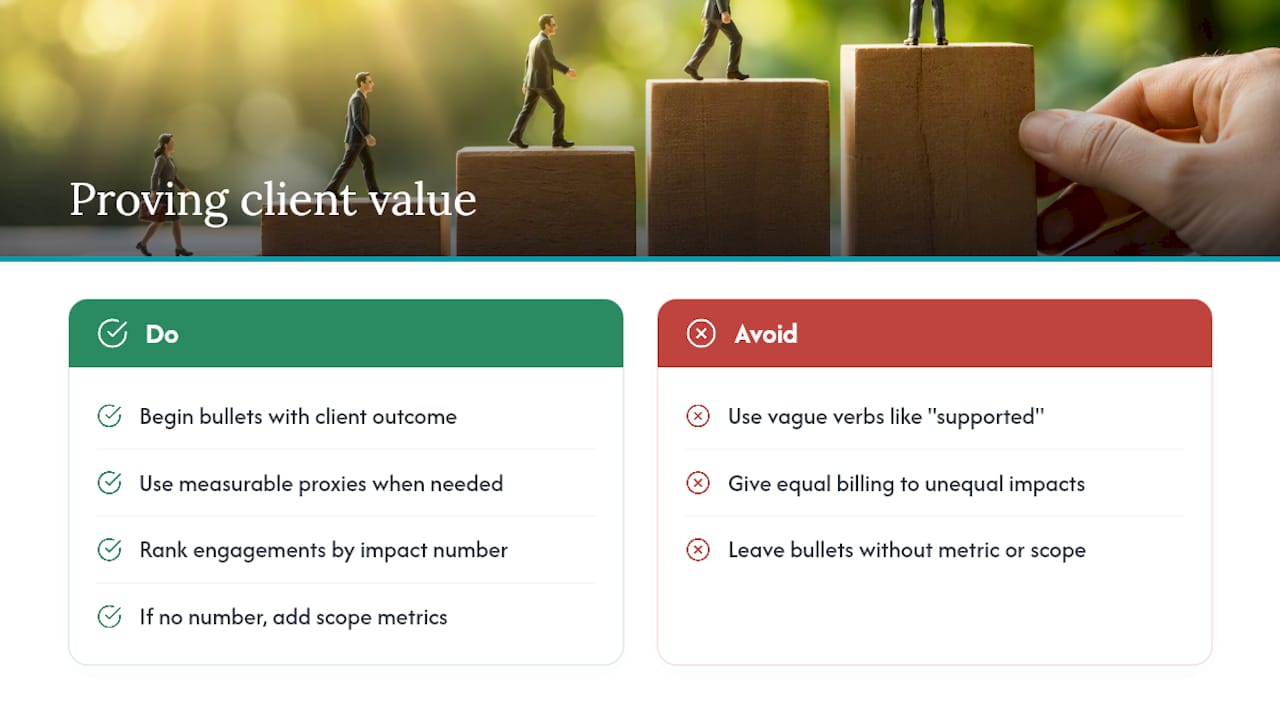
The biggest gap between an average consulting resume and a strong one isn’t the projects. It’s how clearly the resume connects your actions to a client’s bottom line. Vague verbs like “supported” or “assisted” tell a recruiter nothing about your actual contribution.
Start every bullet by asking: what changed for the client because of what I did? If the answer is “the client felt more confident in their strategy,” that’s real but hard to quantify, so look for the closest measurable proxy, like a decision that got made faster or a plan that got approved on the first pass.
Rank your engagements by the size of the number you can attach to them, and put the biggest ones first within each role. A $50,000 process improvement and a $5 million revenue unlock don’t deserve equal billing, even if both took similar effort.
When you genuinely can’t attach a number, attach a scope instead: team size led, budget managed, number of stakeholders aligned, or timeline compressed. Scope isn’t as strong as a dollar figure, but it’s stronger than a description with nothing attached at all. Recruiters can extrapolate impact from scope even when the exact financial result isn’t disclosed.
Common mistakes that sink consulting resumes
The most frequent error is leading with process instead of outcome. A bullet that starts with “Conducted analysis of…” buries the result at the end of the sentence, or leaves it out entirely. Flip the order: result first, method second.
Overloading each role with six or more bullets is another common mistake. It dilutes your strongest point and forces the reader to hunt for what actually matters. Cut ruthlessly down to three to five per role, and put your best line first.
A subtler mistake is treating every engagement as equally important. Not every project deserves the same bullet count. A three-week engagement with a modest result doesn’t need three lines; fold it into a single line or drop it if space is tight.
Inconsistent formatting is a mistake that costs more than people realize. Mixed date formats, inconsistent bullet punctuation, or fonts that shift between sections all signal carelessness before a recruiter reads a single word of content. And finally, vague claims without any quantification, even a range, read as either inexperience or an unwillingness to be specific. Neither impression helps you.
Certifications and professional development worth including
Certifications earn a spot on a consulting resume when they’re directly relevant to the work you’re targeting, not as filler to pad a thin page. Project management credentials like PMP, data-focused certifications like a Six Sigma belt, or specialized software certifications (Tableau, SQL, specific ERP systems) all signal concrete capability a recruiter can map to a job requirement.
List certifications in a compact section near the bottom of a one-page resume, or integrated into your education section if space is tight. Avoid a long list of minor online course completions. Two or three credentials that map directly to the role you want carry more weight than ten generic ones.
If you’re early in a transition into consulting, relevant coursework or an MBA concentration can substitute for a certification, especially when paired with a bullet showing how you applied that training in a real project.
What actually moves the needle on a consulting resume
The advice that gets repeated most, tailor everything, quantify everything, keep it to one page, is correct but incomplete. What most guidance underweights is sequencing: the order you present information in matters almost as much as the information itself. A recruiter skimming for seconds forms a judgment before reaching your third bullet, so the placement of your best line is a decision, not an afterthought.
The bigger gap I see is between advice that sounds thorough and advice that’s actually usable under time pressure. Telling someone to “quantify their impact” is true and useless if they don’t have a formula to apply immediately. Outcome, measure, mechanism works because it forces a rewrite in under a minute, not because it’s clever.
Where I’d push back on conventional wisdom: don’t chase a perfect single number for every bullet. A defensible range, stated plainly, beats a suspiciously precise figure that invites a follow-up question you can’t answer cleanly. Precision under probing matters more than precision on the page.
Kim
How Resume Wiz turns this into an interview-ready resume
If you’ve read this far and you’re staring at a consulting resume that still reads like a project list, that’s exactly the gap Resumewiz closes. Executives, career changers, and consultants juggling a full workload rarely have the time to rebuild a master resume, extract keywords for every posting, and rewrite bullets under the outcome-measure-mechanism formula on their own.

Career services platforms may offer ATS-compliant resume writing, LinkedIn profile optimization, personalized outreach templates, and interview coaching so the resume isn’t working alone. Founder Kim Taynor built the process around what recruiters actually screen for, not generic templates. If your consulting background needs to read as clearly on paper as it performed in the room, start with Resumewiz’s resume services and get a version built to earn the interview.
Want a recruiter in your corner for your next senior role? Book a free call with Resume Wiz and we will map out your next move together.
