Two Recruiter Backed Edits to Fix Consulting to Corporate Resumes
To win corporate interviews, convert your consulting deliverables into measurable, ATS-keyworded outcomes and rewrite your top-of-resume to mirror the target job title. Start with two edits: change your headline to match the job posting and rewrite one experience bullet so it states a business result, not a project description. Kim Taynor and the Resume Wiz team see this pattern most in candidates who finally break through.
Key Takeaways:
- Matching your resume headline to the target job title significantly increases your chance of getting noticed by both ATS software and hiring managers.
- Rewriting consulting project language to emphasize internal ownership and measurable outcomes demonstrates your ability to produce repeatable, company-specific results.
- Structuring bullets with problem, action, and result, including quantifiable metrics, makes your achievements clear and impactful in seconds.
- Tailoring keywords precisely from the job posting and organizing them in your skills section boosts your chances of passing ATS scans.
- Providing consistent messaging across your resume and LinkedIn profile, with clear explanations of employment gaps or transitions, reinforces your fit and reduces recruiter concerns.
Table of Contents
- What to change first: headline, executive summary, and role framing
- Translate consulting project language into corporate outcomes
- Bullet writing: P-A-R and quantifying consulting impact
- ATS and keyword strategy for consultants applying in-house
- LinkedIn, executive summary, and application materials that compound resume impact
- Common mistakes and the final checklist before you submit
- Strategies to address and explain employment gaps or contract-to-full-time transitions in consulting experience
- Guidance on tailoring the resume for different corporate industries or functional roles
- Tips on emphasizing teamwork and collaboration skills over individual consulting achievements
- How to demonstrate adaptability and cultural fit within corporate environments
- Recruiter view on consulting-to-corporate resumes
- How Resume Wiz helps consultants make the transition
- Primary sources and tools to check your resume
- Sources
- FAQ
What to change first: headline, executive summary, and role framing
Hiring managers and ATS software both scan the top third of your resume before deciding whether to keep reading. If your headline says “Senior Consultant” and the job posting says “Director of Operations,” you have already created a mismatch that costs you attention.
Replace your headline with the target job title, or the closest honest variant, and build a two to three line executive summary underneath it that states your functional domain, one measurable outcome, and why you fit this specific role now.
- Headline: Match it to the exact job title from the posting, not your consulting title.
- Summary line 1: State your domain and years of relevant experience.
- Summary line 2: Include one quantified outcome that mirrors the employer’s priorities.
Senior candidates often over-explain. Keep the resume to two pages, order experience in reverse chronological order, and put your most relevant engagement first even if it was not your most recent one.
Translate consulting project language into corporate outcomes
Consulting resumes describe projects. Corporate resumes describe outcomes owned by a person inside a company. That distinction shapes every bullet you write from here forward.
Client-facing language (“advised a Fortune 500 retail client on supply chain optimization”) reads as external and temporary to a hiring manager who wants to see internal ownership. Rewrite it as if you had been an employee driving the same result.
- Swap “advised the client” for “led,” “owned,” or “built” to signal decision authority.
- Replace “delivered recommendations” with the actual change implemented and its measurable effect.
- Anonymize client names using industry descriptors (“a global retail chain”) rather than dropping the credibility of scale entirely.
Pro Tip: Read each bullet and ask, “Would this sentence make sense if I had been a full-time employee at this company?” If not, rewrite it.
The goal is repeatability. A hiring manager wants to know you can produce this outcome again inside their organization, not that you advised someone else to try it once.
Bullet writing: P-A-R and quantifying consulting impact
The clearest way to write a resume bullet is Problem, Action, Result, also known as P-A-R or STAR, a structure Harvard’s career services team recommends for demonstrating measurable value to hiring managers. Start with the problem in a few words, state the action you took, and close with the quantified result.
- Before: “Worked with client teams to improve reporting processes.”
- After: “Redesigned monthly reporting workflow for a national logistics client, cutting reporting time by 40% and reducing errors flagged in leadership reviews.”
- Metric options: percent change, dollar impact, time saved, headcount affected, or a defensible range when exact figures are not available.
One habit separates interview-winning resumes from the rest: begin every bullet with a varied, context-fitting action verb, placed at the start of the line rather than buried mid-sentence. Verb variety matters more for consultants because your work often reads as process rather than outcome, so choose verbs that imply ownership: “restructured,” “negotiated,” “launched,” instead of “helped” or “assisted.”
Avoid passive phrasing like “was responsible for.” Active, front-loaded verbs make the accomplishment legible in the three seconds a recruiter spends per bullet.
ATS and keyword strategy for consultants applying in-house
ATS software and hiring managers both prioritize exact keyword matches pulled directly from the job posting, especially hard skills, specific tools, and certification names. A generic “Salesforce” on your resume matters less than the exact term used in the posting, such as “Salesforce Sales Cloud.”
Build a keyword bank by pasting three to five target job descriptions into a document and highlighting repeated terms: tools, methodologies, certifications, and the job title itself.
- Mirror exact strings for job titles, software names, and certifications rather than paraphrasing them.
- Organize your skills section into categories like “Analytics” or “Project Management” so both software and human reviewers can scan it quickly.
- Run your finished resume through a resume scanner before submitting to check your match rate against the specific posting.
Pro Tip: Keep a master resume with every keyword variant you have used, then trim it down for each application rather than starting from a blank page every time.
LinkedIn, executive summary, and application materials that compound resume impact
Your resume and LinkedIn profile should read as the same person applying for the same kind of role. Mismatched headlines confuse both recruiters and referrers who check your profile before responding.
Match your LinkedIn headline and About section language to your resume’s target job title and top skills, then use that alignment to make outreach easier.
- Send a short note to a former colleague now inside your target company: mention the specific role, ask for 15 minutes, and reference a shared project or connection.
- Offer a one-page case summary of a relevant engagement if a hiring manager asks for work samples, stripped of confidential client details.
- Keep your LinkedIn summary focused on the same measurable outcomes featured in your resume’s top third.
Common mistakes and the final checklist before you submit
Most consulting-to-corporate resumes fail for the same handful of reasons, and each one is fixable in minutes.
- Headline mismatch: Update it to reflect the target job title, not your consulting title.
- Client-centric language: Rewrite bullets to show internal ownership, not external advising.
- Missing keywords: Add exact terms from the posting into your skills section and bullets.
- No quantification: Add a number, percentage, or range to every major bullet.
- Overlong resume: Cut to two pages by removing outdated or low-relevance engagements.
- Passive verbs: Replace “was responsible for” with an active, specific verb.
- Inconsistent LinkedIn: Align your headline and summary across both documents.
| Checklist item | What to verify |
|---|---|
| Headline | Matches target job title |
| Summary | States domain, outcome, fit |
| Bullets | Follow P-A-R with a metric |
| Keywords | Match job posting exactly |
| Skills section | Categorized, ATS-readable |
| Length | Two pages for senior roles |
| Matches resume language |
Templates and a categorized skills block format are available through Resume Wiz’s resources if you want a starting structure rather than building one from scratch.
Strategies to address and explain employment gaps or contract-to-full-time transitions in consulting experience
Consulting careers often include bench time between engagements, project-based contracts, or a stretch between client work and a full-time offer. Hiring managers expect some of this in a consulting background, but you still need to frame it so it reads as intentional rather than unexplained.
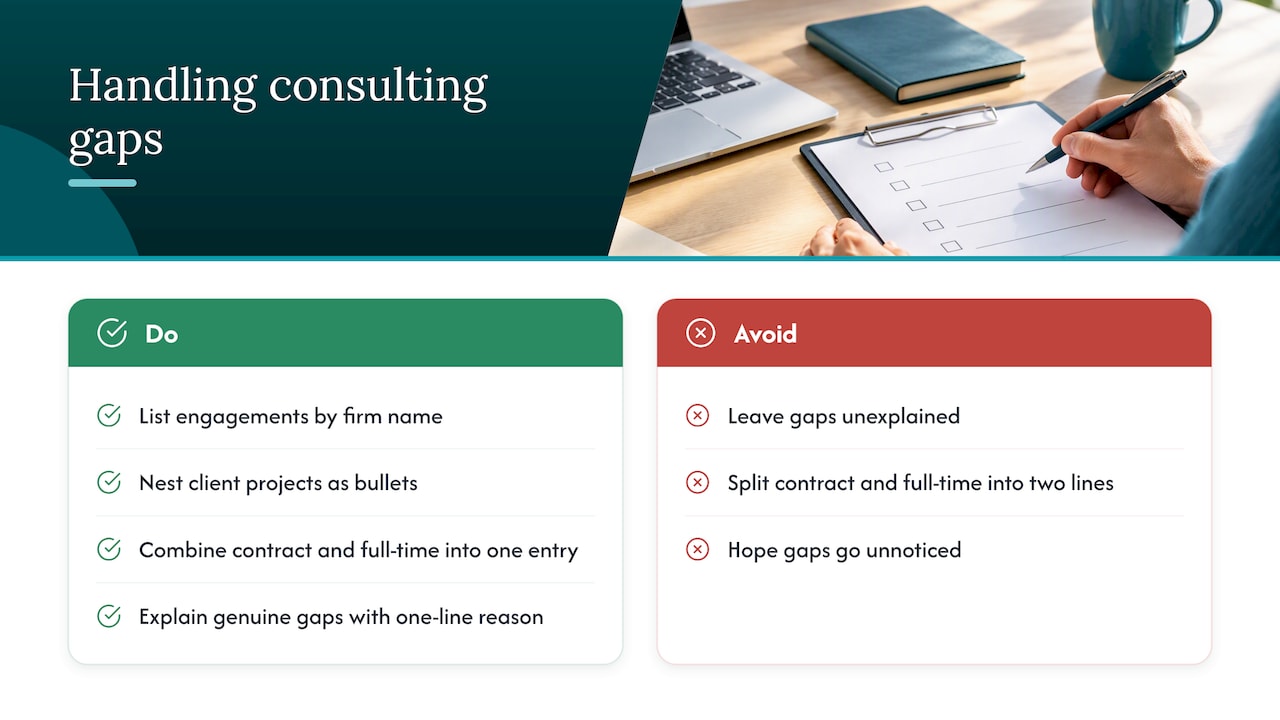
List consulting engagements by the firm name as the employer, with individual client projects nested underneath as bullet points rather than separate job entries. This keeps your employment history continuous on paper even when project assignments changed every few months.
If you moved from a contract role to full-time status at the same firm or client, list it as a single entry with a note like “converted to full-time” rather than two separate lines that suggest a gap. For genuine gaps between engagements, a brief one-line explanation such as “Consulting bench period: completed certification in project management” turns dead time into visible initiative.
Avoid leaving a gap unexplained and hoping it goes unnoticed. Recruiters read gaps as risk by default, so a short, factual line removes the guesswork and keeps the focus on your qualifications rather than your timeline.
Guidance on tailoring the resume for different corporate industries or functional roles
A resume built for a technology company’s operations role will not land the same way at a healthcare organization’s finance department, even if the underlying consulting skills transfer. Tailoring means adjusting vocabulary, prioritized skills, and even bullet order to match the target industry’s priorities.
For a finance or operations role, lead with process improvement, cost reduction, and efficiency metrics. For a technology or product role, lead with cross-functional collaboration, data-driven decisions, and delivery timelines. For a healthcare or regulated industry role, foreground compliance familiarity and stakeholder management, since these fields often weigh risk awareness heavily.
Keep a master resume with every project and metric you have available, then select and reorder the three or four most relevant bullets per engagement based on the target industry. A consultant who worked across retail, finance, and healthcare clients has more raw material than most corporate applicants. The advantage disappears if every version of your resume reads identically regardless of who is receiving it.
Tips on emphasizing teamwork and collaboration skills over individual consulting achievements
Consulting resumes often highlight individual analytical wins: the model you built, the deck you presented, the recommendation you made. Corporate hiring managers are usually building a team, not hiring a solo contributor, so collaboration signals matter as much as individual output.
Rewrite bullets to show who you worked with and how, not just what you personally produced. Instead of “built a financial model to assess market entry,” try “partnered with finance and sales teams to build a financial model that shaped a market entry decision.” The second version signals you can work across functions, a skill corporate roles depend on daily.
Include at least one or two bullets that specifically mention cross-functional partnership, whether with engineering, sales, finance, or operations teams. This matters more in corporate settings than in consulting, where much of your credibility came from independent expertise rather than internal relationship-building. A resume that reads as entirely solo work can raise a quiet concern about how you will function inside a team-based structure.
How to demonstrate adaptability and cultural fit within corporate environments
Consultants move between client environments constantly, which is a real advantage when framed correctly. Corporate hiring managers worry that consultants are used to advising from the outside and may struggle adjusting to being embedded, accountable, and present day to day inside one organization.
Address this directly in your executive summary or a bullet point: mention the range of industries or company sizes you have worked within and frame it as adaptability rather than instability. A line like “Adapted quickly across five client environments spanning retail, manufacturing, and financial services” turns a potential concern into a demonstrated strength.
In interviews and cover letters, be ready to explain specifically why you want to move from consulting into a permanent, embedded role now, since hiring managers will ask this directly. A vague answer about wanting more stability reads as generic. A specific answer about wanting to see a strategy through implementation, or build long-term relationships with one team, reads as intentional and reduces the perceived risk of the transition.
Recruiter view on consulting-to-corporate resumes
Recruiting experts note one pattern constantly: hiring managers spend seconds, not minutes, on a first resume pass, scanning for a matching job title and two or three recognizable outcomes before deciding whether to read further.
Resumes that survive that first pass consistently do the same things: a headline that matches the role, a bullet with a number in the first few lines, and a skills section that mirrors the posting’s language. Consultants who translate their work into that format move to interview far more often than those who keep client-facing language intact. Free templates and guides on Resume Wiz walk through this exact structure for readers who want to apply it themselves.
Kim
How Resume Wiz helps consultants make the transition
Rewriting your own resume gets you most of the way there. Getting a second set of recruiter-trained eyes on it, and having someone build your LinkedIn and outreach materials alongside it, closes the remaining gap faster than another round of self-editing.

- Evolution pairs a resume rewrite with a LinkedIn refresh for candidates who want both documents aligned at once.
- Elevate adds coaching and managed search support for consultants who want ongoing guidance through the full transition.
- Elevate fits candidates who need interview prep and want hands-on support to move quickly.
If you want a resume built around the exact outcomes and keywords this article covers, start with the Evolution package or explore the full range of Resume Wiz services to find the right fit for your needs.
Primary sources and tools to check your resume
- Jobscan’s ATS keyword guidance explains exact-match keyword strategy and how to run a scanner before submitting.
- Harvard career services’ action verb list offers verb choices for stronger bullet openers.
- Background on how recruiters use ATS platforms explains the mechanics behind keyword parsing.
Want a recruiter in your corner for your next senior role? Book a free call with Resume Wiz and we will map out your next move together.
Sources
- How to Write an ATS Resume That Gets Past the Bots in 2026
- 45 rare action verbs for your resume (Harvard FAS)
- Harvard career services guidance on action verbs and P-A-R
FAQ
How do I list consulting firm experience on a corporate resume?
List the consulting firm as your employer, with individual client engagements as bullet points underneath rather than separate job entries. This keeps your work history continuous and lets you highlight the two or three most relevant projects for the role you want.
What keywords should consultants use for ATS systems?
Use the exact job title and specific tool or certification names from the job posting rather than generic terms, since ATS software and recruiters prioritize exact matches. Build a keyword bank from several target postings and mirror the terms that repeat most often.
How long should a consultant’s corporate resume be?
Two pages is standard for senior consultants moving into corporate or manager-level roles, since most reviewers scan the top third first regardless of total length. Prioritize your most relevant engagements and cut older or lower-relevance projects rather than padding the resume to fill space.
Should I get professional help rewriting my resume?
A recruiter-trained review can catch language and formatting issues that are hard to see in your own writing, especially around translating consulting deliverables into corporate outcomes. Services like Resume Wiz’s Elevate packages pair resume writing with coaching for candidates who want hands-on support through the transition.
How do I explain a contract-to-full-time transition on my resume?
List it as a single employer entry with a brief note such as “converted to full-time” rather than two separate job listings, which avoids creating the appearance of a gap. This keeps your timeline clear while showing the employer recognized your value enough to extend a permanent offer.
