3 Ready Templates for Emails to Executive Recruiters Under 150 Words
Send a sub-200-word email that names a referrer or specific posting, states one measurable outcome you deliver, and asks for a 15-minute call. Open with your role and sector, not your résumé history. Reference a referral, job listing, or sector detail in the first line, then close with a single clear next step: a brief call or permission to send your résumé.
Key Takeaways:
- Sending a personalized email referencing a specific referral, posting, or sector detail increases the likelihood of engagement from recruiters.
- Including a quantified outcome or metric in the first two lines enhances the chances that a recruiter will read and respond to your message.
- Keeping your email under 200 words, with a clear call to action like a 15-minute call, improves reply rates and avoids appearing spammy.
- Researching the recruiter in three minutes by reviewing their LinkedIn activity or recent placements can significantly boost response likelihood.
- Attaching your résumé is best reserved for when a specific job posting or request is made, to prevent your email from seeming mass-produced.
Table of Contents
- What to include in your first email to a recruiter
- Subject lines that get opened
- Three templates you can copy and edit today
- How and when to follow up without annoying anyone
- Research that takes three minutes and changes your response rate
- What recruiters actually notice in these emails
- How Resume Wiz helps you get outreach right
- FAQ
- Sources
What to include in your first email to a recruiter
A strong first email has four parts, and each one does a specific job. The subject line gets the email opened. The opener proves the message was written for this recruiter, not copied from a template. The pitch gives a reason to respond. The CTA removes guesswork about what happens next.
- Subject line: names your target role or a shared connection so the recruiter knows why the email landed in their inbox.
- Opener: references the referral, posting, or sector detail in the first sentence, before any self-introduction.
- Value pitch: two or three lines stating your headline result, sector, and the type of role you want next.
- CTA: one direct ask, either a 15-minute call or permission to send your résumé.
Indeed’s guidance on emailing recruiters recommends a personalized opener, a brief experience summary, and a clear call to action, which matches what works for senior-level outreach. Attach your résumé only when you reference a specific posting or when the recruiter asks for it; in a cold or referral email, offer to send it rather than attaching it unsolicited, since an unprompted attachment can read as a mass-blast signal. For more practical guidance on concise, consulting-style cover letters and phrasing, see How to Write a Consulting Cover Letter (with a Template) | Cut to the Case.
Pro Tip: Write your pitch line first, then build the rest of the email around it. If the pitch doesn’t justify a reply on its own, no subject line will fix that.
Subject lines that get opened
Three formulas cover most situations: Referral plus Role, Role plus Outcome, and Posting Reference plus Role. Each signals relevance in six to eight words, before the recruiter opens the message.
- Referral + Role: “Jane Doe suggested I reach out, VP Finance” signals a warm connection and immediate context.
- Role + Outcome: “Supply Chain Director, cut costs in recent years” pairs a title with a result, which reads as evidence rather than a claim.
- Posting Ref + Role: “Re: Senior Product Manager posting, 12 years in fintech” ties directly to an open requisition the recruiter is tracking.
- Sector + Credential: “Healthcare Ops leader, ex-Cigna, open to COO roles” works well for cold outreach with no referral or posting to cite.
- Direct Ask: “15 minutes this week? Marketing exec, consumer brands” front-loads the CTA for a recruiter scanning fast.
Keep each one short. A recruiter scans dozens of subject lines a day, and clarity beats cleverness every time.
Three templates you can copy and edit today
Each template below runs under 150 words. Swap the bracketed details, keep the structure, and send.
Referral introduction
Open with the referrer’s name, state your pitch in two lines, and ask for 15 minutes.
“Hi [Recruiter], [Referrer] suggested I reach out given your work placing finance leaders in healthcare. I’m exploring CFO-track roles in the $200M to $500M revenue range and would value 15 minutes to see if there’s a fit with your current searches.”
Cold sector outreach
Lead with credibility, then a sector-specific outcome, then the ask.
“Hi [Recruiter], I noticed your focus on consumer fintech C-suite placements. I spent eight years scaling payments platforms, most recently taking a product from launch to 1.2 million active users. I’m open to COO or Chief Product Officer roles and wanted to introduce myself in case a relevant search comes up.”
Post-networking follow-up
Remind them of the context, add one new detail, and request a next step.
“Hi [Recruiter], good speaking at [Event] last week. Since then, I closed a $40M partnership I mentioned, which is now live. Would you have time this month to discuss whether any of your active searches might be a fit?”
- Swap the referrer, event, or posting reference in the opening line every time.
- Replace the outcome line with your own number, timeframe, and metric.
- Keep the CTA to one sentence, either a call request or a résumé offer, never both.
Pro Tip: *Quantify the outcome line whenever possible.
How and when to follow up without annoying anyone
Recruiters juggle dozens of searches at once, so a single follow-up rarely reads as pushy. The sequence below keeps you visible without repeating yourself.
- Wait 5 to 7 business days after your first email before sending anything else.
- Send one concise follow-up that adds something new: a recent accomplishment, a relevant article, or a fresh referral.
- Send a final touch after 10 to 14 days that leaves the door open, something like asking to stay on their radar for future searches rather than the current one.
If the recruiter replies that nothing is open right now, thank them and ask to stay in touch for roles that fit your profile later. That single sentence keeps you on their list without demanding a response.
Research that takes three minutes and changes your response rate
The U.S. Bureau of Labor Statistics notes that focused, researched outreach beats relying on mass-marketed listings, and the same logic applies to a single email. A few minutes of research turns a generic pitch into a specific one.
- Check the recruiter’s LinkedIn headline for their stated specialty or vertical.
- Scan their recent posts or activity for a placement, hire, or company they mentioned.
- Look for a mutual connection you can name in your opener.
- Note one sector-specific metric, such as a recent funding round or leadership change at a company they recruit for.
Turn one of these into a single sentence: “Saw you placed the CFO at [Company], and I lead finance for a similarly sized firm in the same space.” That one line does more work than three paragraphs of career history.
What recruiters actually notice in these emails
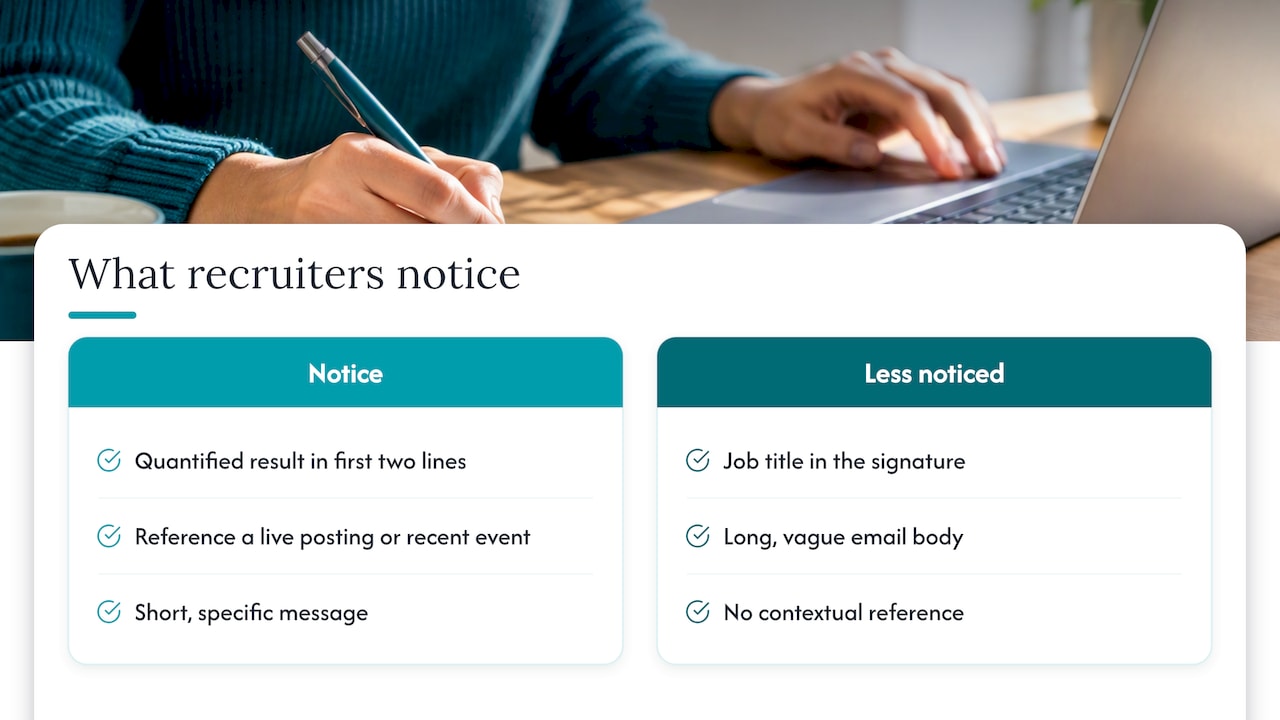
After more than ten years recruiting for executive and management roles, the pattern holds: short, specific emails get read, and long ones get skimmed or skipped. Recruiters notice a quantified result in the first two lines faster than a job title in the signature.
Timing matters too. An email that references a live posting or a recent company event tends to get a faster reply than one sent with no context at all, since it signals you did the work before writing.
Kim
How Resume Wiz helps you get outreach right
Writing a sharp recruiter email gets easier once your résumé and LinkedIn profile already tell a consistent, quantified story. Our Evolution package rebuilds both, so the metrics in your outreach match what a recruiter finds when they click through.

For a fuller push, our Elevate packages include outreach templates and LinkedIn optimization built around your target roles, with details on the page. If you want outreach handled for you entirely, Elevate and Land pairs applications with direct recruiter contact. Readers closer to the interview stage can start with Evolution. Visit Resume Wiz to see which package fits where you are right now.
Want a recruiter in your corner for your next senior role? Book a free call with Resume Wiz and we will map out your next move together.
FAQ
How do I reach out to an executive recruiter?
Send a short email under 200 words that opens with a referral, posting, or sector detail, states one measurable outcome, and ends with a request for a 15-minute call. Find recruiter emails through job listings, agency directories, company pages, or a mutual connection on LinkedIn, as outlined in Indeed’s recruiter outreach guidance.
What is the 70/30 rule in hiring?
Definitions vary across recruiting circles, and no single authoritative source defines a universal ratio rule in hiring. If you have seen the term elsewhere, treat it as informal shorthand rather than an established industry standard.
What is the 80/20 rule in recruiting?
Similar informal rules in recruiting are not standardized or sourced metrics and definitions vary by who uses them. Rather than relying on unverified ratios, focus on the researched tactics that do have backing, such as targeted outreach over mass applications.
How do I get noticed by executive recruiters?
Build a résumé and LinkedIn profile around quantified outcomes, then send concise, personalized emails that reference something specific about the recruiter’s focus or a mutual connection. The BLS notes that targeted, networked job search efforts tend to outperform generic high-volume approaches.
Should I attach my résumé to the first email?
Attach your résumé only when responding to a specific posting or when the recruiter requests it; otherwise, offer to send it in your closing line. This keeps a cold or referral email from reading like a mass submission.
