Recruiter Tested Email to a Hiring Manager in Under 100 Words
Email is the safest, most effective way to reach a hiring manager: keep the message under 100 words, name the role and a specific date, add one useful detail, and close with a single question they can answer in one line, or try alternative methods like QR-driven candidate flows and quick-apply links to connect efficiently. Send it on a Tuesday, Wednesday, or Thursday morning. Follow up once 5 to 7 business days after applying, send a thank-you within 24 hours of any interview, and stop after two unanswered follow-ups.
Key Takeaways:
- Use LinkedIn when no work email is available or networking is the goal; reserve calls for local employers, and choose one channel per outreach attempt.
- Thank the interviewer within 24 hours; follow up two business days after a promised date passes, then stop after two unanswered messages.
- Search LinkedIn and company leadership pages for the person one level above the role, then verify any inferred work email with a single test message.
- Apply through the official portal when one exists; use direct outreach to add context or ask a focused question, not to bypass screening.
Table of Contents
- When to contact a hiring manager and which channel to use
- How to find the hiring manager’s name and verify their email
- The five-part email structure hiring managers actually read
- Follow-up cadence: exact windows, the two-touch ceiling and graceful exit templates
- What to avoid: mistakes that make hiring managers ignore you
- Copyable templates: short email examples for pre-apply, applied, thank-you, and status-check
- Legal and privacy considerations when contacting hiring managers via email
- What hiring managers actually notice in your outreach
- Want your outreach written for you?
- FAQ
- Sources
When to contact a hiring manager and which channel to use
Three moments call for outreach: before you apply, after you’ve submitted your application, and after an interview. A fourth situation, confirming a scheduled call, deserves a short note 24 to 48 hours ahead so nothing gets missed.
Email works for all three windows because it’s asynchronous and creates a written record both sides can reference later, according to Indeed’s guidance on finding a hiring manager’s email. LinkedIn is a reasonable substitute when you can’t find an email address or when the outreach is more about networking than applying. Phone calls make sense mainly for small businesses, trades, or local employers where a front-desk call is normal practice, but they’re a poor first move for corporate roles.
Timing shapes whether your message gets opened at all:
- Send Tuesday through Thursday mornings in the recipient’s time zone, when inboxes are active but not swamped.
- Avoid Monday, when hiring managers are clearing weekend backlog, and Friday afternoon, when attention has already shifted to the weekend.
- Reply within an existing email thread whenever one exists rather than starting a new chain, which keeps context intact.
Pick one channel per touch. Mixing email, LinkedIn, and a phone call for the same outreach attempt reads as impatience rather than enthusiasm, a pattern Frontline Source Group flags as a common reason candidates get overlooked rather than remembered.
How to find the hiring manager’s name and verify their email
Finding the right person takes a few minutes of research, not guesswork. Here’s a sequence that works for most companies:
- Search LinkedIn and the company’s “team” or “leadership” page for the person one level above the posted role, since that’s usually who owns the hiring decision.
- Check the job posting itself and any recruiter contact listed. Sometimes the hiring manager is named directly or easy to infer from the department.
- Once you have a name, infer the email pattern from a known employee address ([email protected] is the most common format) and verify it with a free email checker or by sending a low-stakes test message first.
- If digital research stalls, call the company’s main line and ask the receptionist for the best contact for hiring-related questions, a method Indeed lists among practical ways to confirm contact information.
- If you have a personal connection at the company, ask them directly whether they’d prefer to refer you or have you apply through the recruiter instead; this keeps the relationship intact and avoids putting them in an awkward spot.
Skip any method that feels invasive, like scraping personal social accounts for contact details. A LinkedIn message or a confirmed work email is enough.
The five-part email structure hiring managers actually read
Hiring managers scan before they read, and most of your message’s fate is decided in the first two lines. A strong email to a hiring manager follows a consistent shape every time, according to HiringReach’s breakdown of effective follow-ups:
- Subject line: name the role and your name or the context (“Senior Analyst Application, Jordan Lee” or “Following Up: Marketing Coordinator Interview”), which helps the message get sorted, found, or forwarded later.
- Opening line: one sentence stating the role and a date or meeting reference, so the reader has context before they even open the body.
- One useful thing: add something new, a relevant idea, a short result, or a detail that connects directly to a need the team likely has. This is what separates a message worth reading from one that gets skimmed and ignored.
- One easy question: ask something answerable in a single line, like “Is the panel still on track to decide this week?” rather than an open-ended request.
- Sign-off: keep it brief and professional, and include a phone number if you want to make a quick call easy.
If the subject and opening line don’t establish relevance immediately, the rest of the message often goes unread, which is why those first two elements deserve the most editing attention.
Pro Tip: Write your “one useful thing” before you write anything else. If you can’t think of something specific and relevant, the email probably isn’t ready to send yet.
Follow-up cadence: exact windows, the two-touch ceiling and graceful exit templates
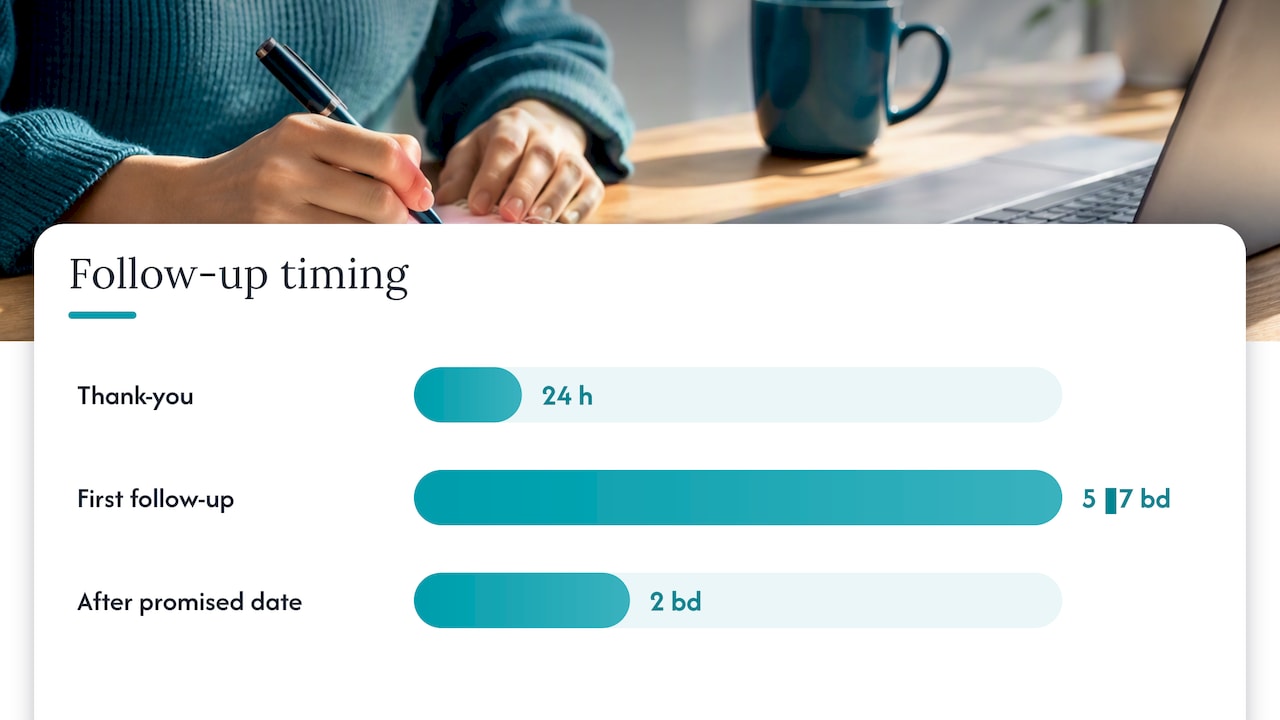
Timing discipline matters more than clever wording. HiringReach’s timing guidance lays out a sequence that covers nearly every stage of the process:
| Stage | When to send | Purpose |
|---|---|---|
| Thank-you | Within 24 hours of an interview | Reinforce interest and reference one specific detail from the conversation |
| First follow-up | 5 to 7 business days after applying | Check status and resurface your application |
| After a promised date | 2 business days after the date passes | Confirm timeline without appearing anxious |
| Final close | After two unanswered follow-ups | Leave the door open without pressing further |
Limit yourself to two follow-ups per stage, which means three total touches including your initial outreach. After the second unanswered follow-up, a third message rarely changes the outcome and can start to feel like pressure rather than interest.
A graceful final message keeps things simple: thank them for their time, note that you remain interested if the timeline shifts, and leave the thread open without demanding a response. Something like, “I know priorities can shift on your end. I’d still welcome the chance to talk if the role remains open, and I’ll leave this here for now,” closes the loop without burning the relationship.
What to avoid: mistakes that make hiring managers ignore you
A few habits consistently backfire, and they’re easy to avoid once you know to watch for them.
- Don’t send email, a LinkedIn message, and a phone call in the same morning. Hitting every channel at once reads as pressure, not persistence.
- Avoid vague asks like “just checking in” or cover-letter-length messages that restate your whole resume. Hiring managers are reading between meetings, not during a quiet afternoon.
- Don’t paste your resume or cover letter into the body of the email. Attach the file and reference it in one line instead, so the message stays scannable.
- Don’t ask for a job outright in a cold outreach message. Ask a small, specific question instead, something they can answer in 30 seconds.
Each of these mistakes shares a root cause: they ask the hiring manager to do more work than the message earns. Keep the ask proportional to how well they know you.
Copyable templates: short email examples for pre-apply, applied, thank-you, and status-check
Each template below follows the five-part structure and stays under the length that HiringReach’s pre-application guidance recommends, under 100 words, one channel, one small ask.
- Pre-apply question: “Subject: Quick Question on the Product Manager Role. Hi [Name], I noticed the Product Manager posting and wanted to ask before applying: is the role more focused on roadmap strategy or cross-team execution? That’ll help me tailor my application. Thanks for your time, [Your Name].”
- Applied message: “Subject: Application Submitted, Senior Analyst, [Your Name]. Hi [Name], I applied for the Senior Analyst role on [date]. My background includes three years building forecasting models for retail clients, which lines up closely with the job description. Happy to send over a writing sample if useful. Best, [Your Name].”
- Thank-you (within 24 hours): “Subject: Thank You, Marketing Coordinator Interview. Hi [Name], thanks for the conversation yesterday, especially the detail about the team’s upcoming campaign launch. It confirmed I’d be excited to contribute. Let me know if there’s anything else useful to send before your next step. Best, [Your Name].”
- 5 to 7 day status check: “Subject: Following Up, Senior Analyst Application. Hi [Name], following up on my application from [date]. Is the team still on track with the timeline you mentioned? Happy to provide anything else that would help. Best, [Your Name].”
- Final close: “Subject: Checking In One Last Time. Hi [Name], I know plans shift, so I won’t keep following up. If the role is still open down the line, I’d welcome the chance to talk. Wishing you well with the search, [Your Name].”
Legal and privacy considerations when contacting hiring managers via email
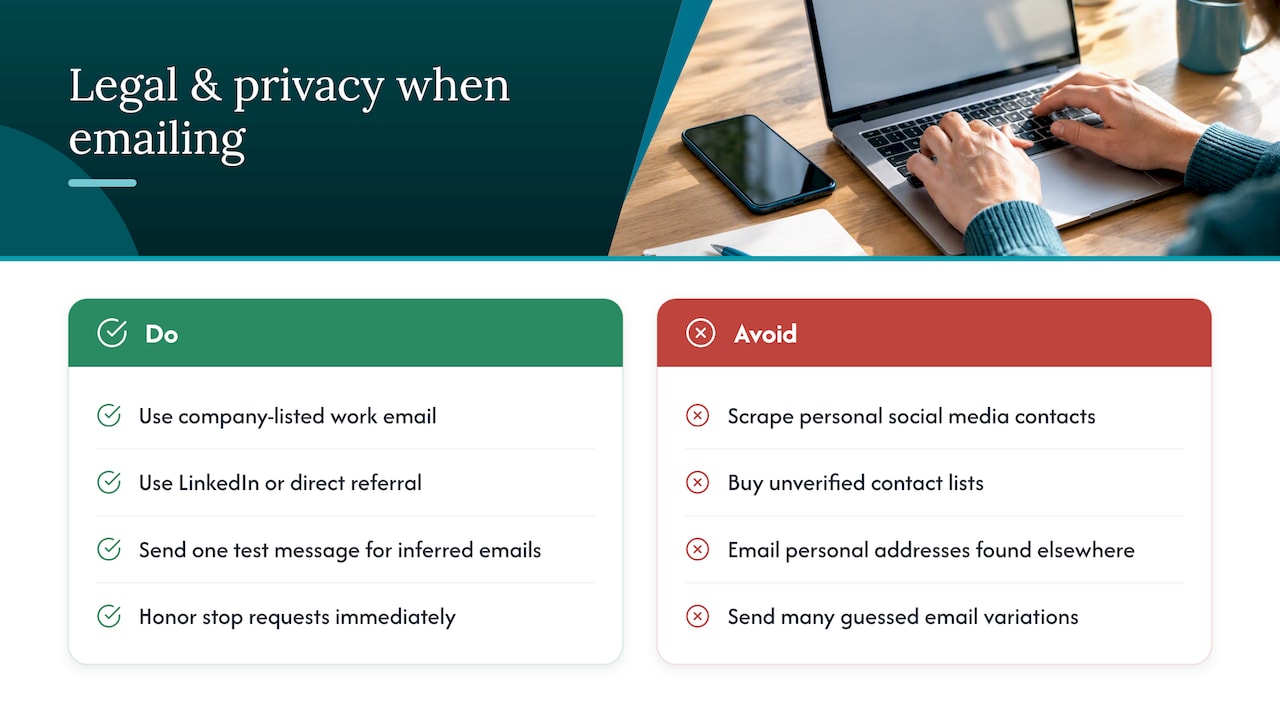
Reaching out to a publicly listed work email or a LinkedIn profile is standard professional practice and not a privacy violation on its own. The line to watch is how you obtained the contact information. Scraping personal social media accounts, buying contact lists from unverified data brokers, or contacting someone through a personal email address you found through unrelated means crosses into territory that can feel invasive, even if no law is technically broken in most cases.
Stick to information a company makes available on its own site, LinkedIn, or through a direct referral. If you infer an email address from a known pattern, a single test message is a reasonable way to confirm it rather than sending to a long list of guessed variations, which can trigger spam filters or flag your domain.
Unsubscribe expectations don’t apply to one-to-one job outreach the way they do to marketing email, but the same courtesy does: if someone asks you to stop contacting them, honor that immediately. Keep your outreach limited to professional contexts and avoid personal contact methods like a private phone number or home address unless the person has shared it with you directly for that purpose.
None of this is legal advice, and rules can vary by company policy or local regulation, so when in doubt, default to the most conservative, most professional channel available.
What hiring managers actually notice in your outreach
Having spent many years recruiting before founding my career services, I’ve read thousands of these emails from both sides of the inbox. The ones that get replies are never the longest or the most polished. They’re the ones that show the sender did five minutes of homework and respected my time.
A practical habit worth adopting: keep a simple log for each contact, noting the channel used, the date sent, a copy of the message, and your next planned follow-up date. Most outreach campaigns fail from poor tracking, not poor writing, and capping yourself at a handful of new contacts a day keeps each one thoughtful instead of templated.
Kim
Want your outreach written for you?
Crafting a tight, five-part email is a skill, and getting the first version right under deadline pressure is harder than it sounds. We built our Evolution service around exactly that gap: a resume and LinkedIn refresh paired with outreach templates tuned to get a reply, not just acknowledgment.

- We write ATS-compliant resumes and LinkedIn profiles that match the outreach you send.
- We provide tailored outreach templates built around your specific background rather than a generic script.
- Our Elevate and Land packages add managed outreach support for readers who want the whole process handled rather than templated.
If you’d rather start with the free templates on our site first, that’s a fine place to begin. When you’re ready for a document and outreach strategy built specifically around your background, visit Resume Wiz to see which package fits.
Want a recruiter in your corner for your next senior role? Book a free call with Resume Wiz and we will map out your next move together.
FAQ
Is it okay to send an email to a hiring manager?
Yes, emailing a hiring manager directly is appropriate and often expected, as long as the message is short, specific, and respectful of the formal application process. Apply through the official portal where one exists, and use direct outreach to add context or ask one answerable question rather than to bypass the process entirely, per HiringReach’s guidance on direct outreach.
What is the 70/30 rule in hiring?
This isn’t a standard, widely defined hiring framework, and definitions of it vary depending on the source. Rather than relying on an unverified rule, focus on the timing and structure guidance in this article, which is drawn from recruiting practice and published outreach research.
How do I professionally say I really want this job?
Skip generic enthusiasm like “I’m very excited about this opportunity” and instead point to one specific detail: a project the team is working on, a problem mentioned in the interview, or a skill match you can state in one line. Specific interest reads as genuine; general enthusiasm reads as a template.
What is a good short message to send to a hiring manager?
A strong short message names the role and a date, adds one useful detail relevant to the team’s needs, and asks one question that’s easy to answer, all in under 100 words. See the applied-message and status-check templates above for exact wording you can adapt.
