Listening-First Executive 90-Day Plan: 3 Board-Ready Deliverables
The best executive 90-day plan follows a listening-first structure: spend days 1 to 30 in structured 1:1s and stakeholder mapping, days 31 to 60 building a strategic point of view around a few priorities, and days 61 to 90 launching quick wins and presenting a board-ready roadmap. The single rule that matters most: resist acting on major changes until you've listened, and never let your priority list grow past five items.
Key Takeaways:
- Listening and stakeholder mapping during days 1 to 30 are crucial to avoid acting prematurely and damaging relationships.
- Priorities should be limited to five or fewer, clearly linked to identified risks, and validated through rapid stakeholder feedback.
- The 60-day document must define objectives, owners, timelines, and success metrics to prevent strategic misalignment and reduce failure risk.
- During days 61 to 90, executives must focus on structured communication, early wins, and a comprehensive board-ready roadmap.
- Flexibility and rapid recalibration are essential when circumstances change, with shorter diagnostic windows and transparent updates to maintain credibility.
Table of Contents
- What Is an Executive 90-Day Plan?
- Days 1 Through 30: The Listening Tour and Diagnosis
- Days 31 Through 60: Building a Strategic Point of View and Priorities
- Days 61 Through 90: Communicate, Execute Early Wins, and Present the Roadmap
- Deliverables, Metrics, and Checkpoints by Phase
- Common Mistakes and Red Flags in an Executive Transition Plan
- Templates and a Sample 30-60-90 Plan
- Why Author Expertise Matters Here
- Building Cross-Functional Relationships Beyond Direct Stakeholders
- How to Evaluate and Adjust the Plan After Day 90
- Tailoring the Plan by Executive Role
- Aligning the Plan With Company Culture and Organizational Goals
- Adapting the Plan When Circumstances Shift Fast
- Why This Framework Beats Acting Fast
- How Resumewiz Helps You Land the Role Before Day One Even Starts
- Sources
What Is an Executive 90-Day Plan?
An executive 90-day plan is a structured onboarding roadmap that moves a new leader through three distinct phases: diagnosis, strategy formation, and early execution. It differs from a typical new-hire checklist because it assumes the leader has authority to shape direction, not just absorb one. The framework traces back to political transition planning, but the version used in corporate leadership follows a simple arc: days 1 to 30 for learning and relationship-building, days 31 to 60 for developing a point of view, and days 61 to 90 for communication and early wins.
The stakes are real. Between roughly 30% and 46% of executive transitions fail within 18 to 24 months, and the cause is almost never technical skill. It's culture, politics, and relationships the new leader misjudged in the first few months. A well-run 90-day plan is the corrective for that specific failure mode, not a productivity exercise.
This matters for a CEO differently than it matters for a CIO, and a turnaround mandate changes the calculus again. But the underlying discipline holds across every role: listen before you diagnose, diagnose before you decide, and decide before you announce.
Days 1 Through 30: The Listening Tour and Diagnosis
The first month is not for fixing anything. It’s for building an accurate map of the organization you actually inherited, not the one described in your offer letter.
Start with a deliberate mix of conversations. You need time with direct reports, but also with peers across functions, customers or key clients where appropriate, and the informal influencers who don’t show up on an org chart but shape how decisions actually get made. Boards or investor contacts belong on this list too, especially for a CEO or a role with direct board exposure.
A workable cadence for most executives is 20 to 30 structured 1:1s across the month, roughly 45 minutes each, with 15 minutes immediately after to write up notes while the conversation is still fresh. Waiting until end of day to capture notes loses the nuance that actually matters, the hesitation before an answer, the person who wouldn’t quite finish a sentence.
Ask the same core questions in every conversation so the answers become comparable data, not scattered anecdotes:
- What’s working well right now that we should protect?
- What’s the biggest risk you see in the next 12 months?
- If you had my job, what would you do first?
- Who else should I be talking to that isn’t on my calendar yet?
- What would you change about how this organization makes decisions?
Build a stakeholder map early, ideally before your start date. A best practice among experienced transition coaches is to draft a rough version of this map during pre-boarding, once the offer is signed but before day one, so you walk in with hypotheses to test rather than a blank page. Rank stakeholders by influence and by how directly their cooperation affects your first priorities, then sequence your interviews accordingly. Talk to the people who can quietly sink an initiative before you talk to the ones who just need to be informed.
By day 30, produce a concise assessment memo, three to five pages, organized around three sections: the themes you heard repeated across conversations, the risks that came up unprompted, and your working hypotheses about what needs to change. Keep it in draft language. This is a diagnostic, not a manifesto.
Pro Tip: Most failed transitions trace back to a leader who acted before understanding the organization. If you feel the urge to reorganize a team or cancel a project in week two, write the idea down and revisit it at day 45. The urgency almost always looks different once you understand who built what and why.
Days 31 Through 60: Building a Strategic Point of View and Priorities
This is where a 90-day strategy for executives separates itself from a typical first-90-days checklist for a mid-level manager. You're not just learning the role. You're forming a defensible position on where the organization needs to go, and you're doing it with enough conviction that the CEO and your peers can align around it.
Synthesizing 20 to 30 conversations into a clear point of view is harder than it sounds, because the data is qualitative and often contradictory. The fix is to look for convergence, not consensus. If four unrelated people independently flagged the same operational bottleneck, that's a signal worth acting on even if a fifth person disagrees. From that convergence, distill a small set of SMART priorities: specific, measurable, achievable, relevant, and time-bound. Limiting the list to five items or fewer forces discipline, because every initiative your team runs should map back to one of those priorities. Anything that doesn't map back is activity, not progress.
Choosing quick wins deserves its own filter. A good quick win meets three tests:
- It’s visible to multiple stakeholders, not just your direct team.
- It’s tied to a genuine pain point people already feel, not a problem only you noticed.
- It’s achievable without a major restructuring or a budget fight.
A quick win that requires firing someone or blowing up a reporting line isn’t a quick win. It’s a structural change wearing a quick win’s clothing, and it will cost you credibility if it stalls.
By day 60, put the priorities into a formal document: objectives, named owners, target timelines, and the success metrics that will tell you whether each one is actually working. This document is what you bring to the CEO for a working session, not a courtesy briefing. Expect pushback, and treat it as useful. A priority that survives a direct challenge from your CEO is stronger for having been tested.
One number worth keeping in mind through this phase: failure rates for new executives climb into the 30% to 50% range within the first 18 months when misalignment on priorities goes unaddressed. The 60-day priorities document exists specifically to catch that misalignment while it's still cheap to fix.
Days 61 Through 90: Communicate, Execute Early Wins, and Present the Roadmap
The final third of the plan is where diagnosis turns into visible action, and where a new leader either builds momentum or loses the benefit of the doubt.
Launching your priority initiatives requires more structure than most executives give it. Before you announce anything, make sure each initiative has:
- A named owner who understands they’re accountable, not just informed
- Milestones with real dates, not “Q2” placeholders
- A weekly reporting rhythm, even if it’s a five-minute check-in
- A clear definition of what success looks like at 30, 60, and 90 days out
- A backup plan if the initial approach stalls
Communicating to the broader organization is a separate skill from communicating with your direct reports. Say what you learned during the listening tour, in general terms, and say what you’re prioritizing and why. Don’t announce personnel changes prematurely, and don’t promise outcomes you can’t control, like a timeline that depends on a board vote that hasn’t happened yet. Time this communication carefully. Too early, and it looks like you didn’t actually listen. Too late, and rumors fill the vacuum.
Early personnel decisions deserve caution. By day 90, you should have formed real opinions about your direct reports, but formal performance actions this early carry risk unless the evidence is overwhelming, think ethical violations or clear performance failures documented by multiple sources, not just personal chemistry. Where you do have concerns, initial feedback conversations are appropriate. Formal restructuring usually isn’t, yet.
The 90-day board review is the capstone deliverable. A strong agenda covers what you learned, your strategic point of view and why you landed there, early progress against your priorities with real metrics, specific resource or decision asks, and what the next 90 days look like. Structured reviews at these intervals exist precisely so the board isn't surprised by your direction, and so you're not negotiating for resources in a vacuum.
Deliverables, Metrics, and Checkpoints by Phase
Each phase of the plan should produce a physical artifact, not just a mental milestone. Treating onboarding as a series of scheduled reviews, at 30, 60, 90, and even 180 days, keeps you honest about progress and surfaces friction before it festers.
The 30-day memo runs three to five pages and covers recurring themes from your interviews, unprompted risks, working hypotheses, and any near-term resource asks. The 60-day priorities document lists your a few objectives with named owners, timelines, and success metrics attached to each. The 90-day board packet summarizes what you learned, your point of view, early wins with real numbers, specific asks, and your roadmap for the next quarter.
| Phase | Function example | Sample metric |
|---|---|---|
| Days 1 to 30 | Sales | Number of structured 1:1s completed, stakeholder map coverage |
| Days 31 to 60 | Operations | Cycle time on flagged bottleneck, baseline established |
| Days 61 to 90 | Finance | Budget variance on quick-win initiative, board sign-off secured |
Track these against your own priorities document rather than a generic template. A metric only matters if it maps to one of your five priorities.
Common Mistakes and Red Flags in an Executive Transition Plan
The most expensive mistake is acting on structural change before you’ve listened. Reorganizing a team or killing a project in week three signals that your mind was made up before you arrived, and it burns the goodwill you need for harder calls later. Wait until you have convergent evidence, not a single loud opinion.
A close second: never clarifying decision-making authority with your CEO or board. If you don’t know what you can decide alone versus what needs sign-off, you’ll either overreach or stall. Settle this explicitly in your first two weeks.
Other red flags to watch for:
- Setting eight or ten priorities instead of 3 to 5, which dilutes focus and confuses your team about what actually matters.
- Chasing vanity quick wins that look good in a memo but don’t address a real pain point.
- Ignoring informal influencers because they’re not on the org chart, then wondering why an initiative stalls for no visible reason.
Pro Tip: If you can’t name the two or three people in the building who have no formal authority but real influence over outcomes, you haven’t finished your listening tour yet.
Templates and a Sample 30-60-90 Plan
A usable checklist keeps the plan from becoming an abstraction. For days 1 to 30: schedule your 1:1s, build the stakeholder map, ask your five consistent questions, and draft the assessment memo. For days 31 to 60: synthesize themes, draft a small set of SMART priorities, select quick wins against the three-part filter, and pressure-test the document with your CEO. For days 61 to 90: assign owners and milestones, time your org-wide communication, address early personnel concerns carefully, and build the board packet.
Here’s a short example for a new CMO: priority one might be fixing attribution reporting that three separate teams flagged independently, priority two might be consolidating a fragmented agency roster, and the quick win could be a single dashboard that gives sales leadership visibility they’ve been requesting for a year.
Adapt the sequence for the situation you’re walking into. A turnaround mandate compresses the listening window, maybe 20 days instead of 30, because urgency is real. A sustaining-success mandate, where the prior leader succeeded, can afford a longer diagnostic phase since the cost of moving slowly is lower. Bring your draft memo into stakeholder conversations directly and ask people to poke holes in it. The document gets better every time someone disagrees with it.
Why Author Expertise Matters Here
This framework reflects lessons drawn from more than a decade of executive recruiting, where the gap between a candidate's résumé and how they actually navigate their first 90 days determines whether a placement sticks or unravels within a year. Kim Taynor built Resumewiz's coaching methodology around that exact pattern: the listening-first approach isn't theoretical, it's what separates executives who last from the roughly one-third to one-half who don't.
Resumewiz supports this work with executive branding, interview coaching, board-ready document preparation, and fully managed job search support. Whether you handle your own 90-day plan or bring in help depends on scale and risk. A functional VP with a supportive board might DIY it with templates. A CEO managing high board scrutiny or a turnaround often benefits from outside calibration on messaging and priority-setting before day one.
Building Cross-Functional Relationships Beyond Direct Stakeholders
Your formal stakeholder map covers the people you need. It rarely covers the people who can quietly help or hurt you regardless of reporting lines, and that’s where most new executives leave value on the table.
Seek out peers in functions you don’t directly touch, legal, IT, facilities, even if your role has no obvious overlap with theirs. These relationships pay off later when you need a fast favor or an honest read on a proposal before it goes to committee. Finance business partners embedded in other departments often have the clearest cross-functional view in the company, since their job is tracking how money moves between teams.
Don’t skip informal gatekeepers either: executive assistants who control calendar access, long-tenured employees who remember why a past initiative failed, or a regional leader two levels down who actually runs day-to-day operations in a market that matters to your priorities. None of these people show up on a board org chart, but all of them shape how fast your initiatives move.
A practical habit: block time each week specifically for a conversation with someone outside your direct reporting line, with no agenda beyond understanding how their part of the business works. Over 90 days, that's roughly a dozen relationships built before you needed anything from them, which is exactly the right time to build them.
How to Evaluate and Adjust the Plan After Day 90
The 90-day plan isn't a document you file away once the board packet is delivered. Treat day 90 as the start of a review rhythm, not the finish line.
Set a recurring cadence, monthly at first, then quarterly, to revisit your original priorities against actual results. Ask a blunt question each time: is this priority still the right one, or did circumstances shift enough that it needs to change? Markets move, budgets get cut, a competitor makes an unexpected move. A priority that made sense in month one can become irrelevant by month five, and holding onto it out of stubbornness wastes the credibility you built during the listening tour.
Build in a formal 180-day check-in with your CEO or board, echoing the structured review habit that carried you through the first 90 days. Bring updated metrics, not just narrative updates. If a quick win underperformed, say so directly and explain what you learned, rather than quietly letting it fade from the conversation.
Solicit feedback from the same stakeholders you interviewed early on. Ask them directly whether your priorities still match what they’re seeing on the ground. Their answers three or four months in are often more candid than what you heard in week two, once trust has had time to build.
Tailoring the Plan by Executive Role
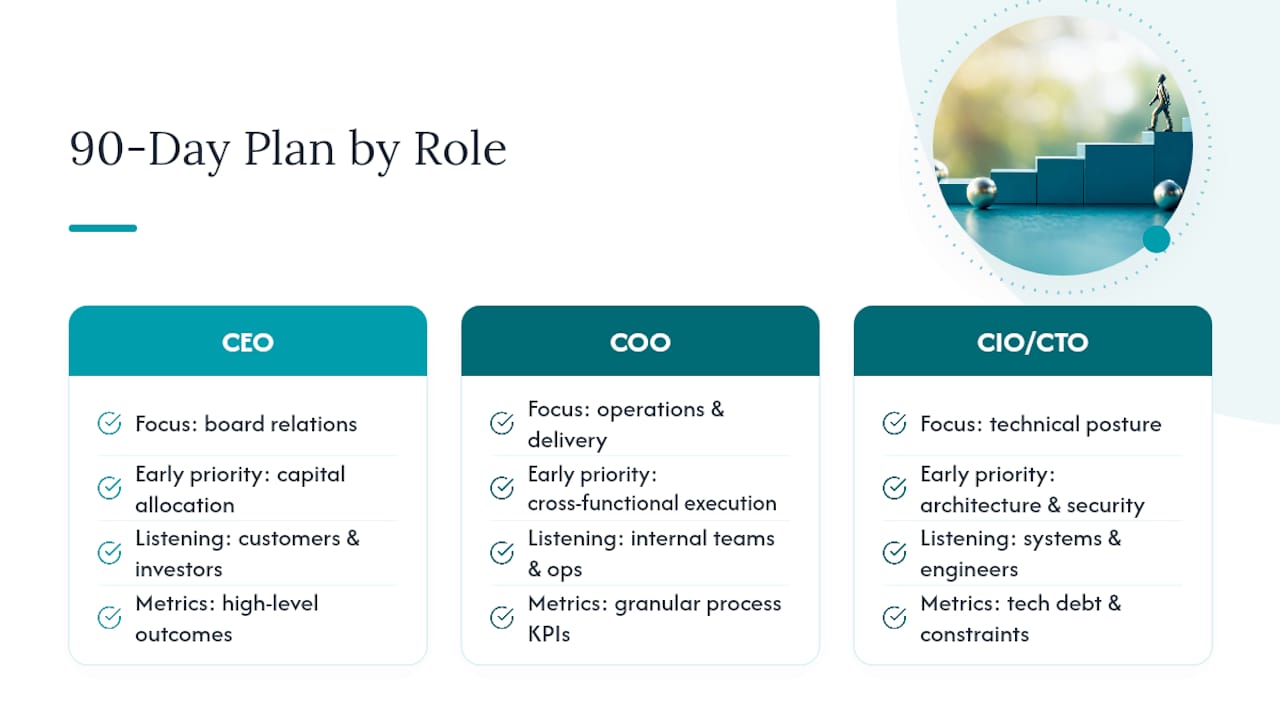
A 90-day plan for a CEO looks structurally similar to one for a CIO, but the emphasis shifts hard by role.
A new CEO spends disproportionate time on board relationships and capital allocation decisions in the first 30 days, since misalignment there can derail everything else. The listening tour extends to major customers and sometimes analysts or investors, not just internal staff.
A COO's version leans heavily toward operational metrics and cross-functional dependencies from day one, since the role often inherits accountability for execution across functions that don't report directly to them. The 60-day priorities document for a COO usually includes more granular process metrics than a CEO's version would.
A CIO or CTO's plan needs an early technical audit layered on top of the standard listening tour, current system architecture, technical debt, and security posture, because those realities constrain what priorities are even feasible. A CIO who commits to a 60-day priority before understanding the state of legacy infrastructure risks promising something the organization can't deliver.
Across all three, the underlying discipline holds: listen first, limit priorities to a small number, and get board or CEO alignment early. Only the content of the listening tour and the technical depth required to form a credible point of view really change.
Aligning the Plan With Company Culture and Organizational Goals
A technically sound 90-day plan can still fail if it ignores how the organization actually makes decisions and what it values.
Pay attention during your listening tour to how decisions historically got made, consensus-driven versus top-down, risk-tolerant versus conservative, and calibrate your approach accordingly. A leader who pushes a top-down mandate into a culture built on consensus will face quiet resistance even when the idea itself is sound.
Your few priorities should visibly connect to whatever strategic goals the company has already committed to publicly or to the board. If your priorities read as disconnected from the company’s stated direction, stakeholders will read that as either a signal you didn’t listen or a sign you’re pursuing your own agenda. Neither perception helps you.
Watch for gaps between stated culture and actual culture too. Plenty of organizations claim to value collaboration while actually rewarding individual heroics, or claim to be data-driven while decisions still get made on gut instinct in the room that matters. Your listening tour should surface these gaps, and your priorities document should account for the real culture, not the one on the careers page.
Adapting the Plan When Circumstances Shift Fast
A 90-day plan built for stable conditions falls apart the moment a market shock, leadership departure, or crisis hits mid-cycle. Build in flexibility from the start rather than treating the plan as fixed.
Shorten your listening window when urgency demands it. A crisis doesn't wait for a full 30-day diagnostic, but even a compressed 10-day version, focused conversations with your five or six most critical stakeholders, beats acting with zero listening at all.
Keep your priorities document loosely coupled rather than tightly sequenced, so a shock to one priority doesn’t cascade into derailing all five. If priority three depends entirely on completing priority one first, a delay in one becomes a delay in everything.
Build a rapid-recalibration habit: when something material changes, revisit your assessment memo within days, not at the next scheduled checkpoint. Communicate the adjustment to your team and your board honestly, framing it as responsive leadership rather than a failure of the original plan. Boards generally respond better to “here's what changed and how we're adjusting” than to silence followed by a missed milestone.
Why This Framework Beats Acting Fast
The instinct to move fast in a new role is almost always wrong, and I'd argue it's the single most common way capable executives sabotage themselves. Boards don't actually reward speed in the first 90 days. They reward judgment, and judgment requires listening before you decide anything meaningful.
The three-to-five priority limit isn’t a nice suggestion, it’s the discipline that keeps a strong diagnosis from turning into scattered activity. Use the templates in this guide as your starting structure, and adapt them honestly to your role and situation rather than following them rigidly.
Kim
How Resumewiz Helps You Land the Role Before Day One Even Starts
Everything above assumes you've already secured the executive role. Getting there is its own challenge, and it's where Resumewiz earns its keep. Resumewiz builds the executive resume, LinkedIn profile, and interview positioning that gets you into the room where a 90-day plan even becomes relevant, work most executives either skip or handle inconsistently on their own.

Where Resumewiz goes further is the coaching layer: sharpening how you talk about your track record, your board experience, and your strategic point of view before a hiring committee ever asks. That's the same discipline this guide recommends for your first 90 days, applied earlier, to the interviews that decide whether you get the job at all. For executives managing a tighter search timeline or higher scrutiny, the managed job-search support fills the gaps a DIY approach tends to miss.
If you’re preparing for your next executive move, start with a review of your current resume and LinkedIn positioning at Resumewiz and see where the gaps actually are before you walk into your next interview.
Want a recruiter in your corner for your next senior role? Book a free call with Resume Wiz and we will map out your next move together.
