Beat Executive Assessment Tests in Weeks With Six Metric STAR Stories
Executive assessment tests are employer-run simulations, psychometric batteries, and structured exercises used to judge whether a leader can decide, delegate, and communicate under pressure. They range from a single psychometric instrument to a full-day assessment center with multiple raters. The single best immediate step: practice realistic simulations and build a short, metric-backed evidence bank mapped to the competencies you’ll be scored on.
Key Takeaways:
- Practicing timed simulations of exercises like in-tray tasks and case presentations significantly improves performance under pressure and aligns with scoring criteria.
- Building a concise, evidence-backed story bank with real metrics enhances responses to specific competencies assessed during assessment exercises.
- Familiarity with the assessment format and rehearsing narration and decision-making strategies are critical, especially when limited preparation time is available.
- Assessment centers evaluate behaviors such as decision making, stakeholder management, and adaptability through multiple raters, not subjective impressions alone.
- Effective preparation focuses on simulation fluency and observable reasoning, rather than content review or general confidence, since assessors score behavior against defined criteria.
Table of Contents
- Executive Assessment Tests: The Formats You’ll Actually Face
- What Assessors Actually Look For
- How to Prepare When You Don’t Have Months
- What a Typical Assessment Day Looks Like
- Where Executive Candidates Lose Points (and How to Fix It)
- The Real Gap Between Assessment Design and Candidate Prep
- Get Assessment-Ready With Resume Wiz
- Sources
Executive Assessment Tests: The Formats You’ll Actually Face
Most executive assessment tests fall into two families, and knowing which one you’re walking into changes how you prepare.
The first is the assessment center: a set of live exercises where trained observers watch you perform, not just answer questions. The second is the psychometric battery: standardized instruments that measure traits, reasoning, or judgment through fixed-format questions.
- In-tray/in-box exercises: a simulated inbox of emails, memos, and competing priorities you must triage in a set window
- Role plays: a scripted conversation with a difficult stakeholder, direct report, or client
- Case presentations: analyze a business problem, then present a recommendation to a panel
- Leaderless group discussions: a team task with no assigned leader, designed to reveal who naturally organizes and influences
- Personality inventories and situational judgment tests: gauge how you tend to react and prioritize in ambiguous situations
- Cognitive/reasoning tests: timed problem-solving under pressure
Employers layer these because no single method predicts performance well on its own. DDI’s research on leadership assessment types makes the case plainly: personality and cognitive tools are useful but incomplete without behavioral evidence from simulations.
One concrete example of a timed instrument: INSIGHT Executive runs 90 minutes in two parts, roughly 30 minutes of leadership-mindset rating items followed by 60 minutes of scenario-based judgment questions. It’s a useful benchmark for how much stamina a single psychometric sitting can demand before you even reach the interview stage.
What Assessors Actually Look For
Every exercise, no matter the format, gets scored against the same handful of competencies: decision making, stakeholder management, strategic thinking, communication, delegation, and adaptability under ambiguity. Assessors aren’t grading you on charisma. They’re checking boxes against a defined behavioral anchor, and either you demonstrated the behavior or you didn’t.
Scoring rarely comes down to one person’s gut read. Well-run programs use multiple trained raters working from a validated competency model, each scoring independently before comparing notes. The U.S. Office of Personnel Management’s guidance on assessment centers describes this multi-rater, job-analysis-based structure as the reason assessment centers hold up better than unstructured interviews for predicting on-the-job leadership performance.
Here’s what typically gets scored across a leadership exercise set:
- Decision making: did you reach a defensible conclusion with incomplete information?
- Stakeholder management: did you read the room and adjust your approach?
- Delegation: did you offload tasks appropriately or try to do everything yourself?
- Communication: was your reasoning clear to someone outside your function?
- Adaptability: how did you respond when the scenario shifted mid-exercise?
Organizations combine simulations with psychometrics and structured interviews specifically to reduce single-method bias. A personality score alone can flag a tendency; only a simulation confirms whether that tendency shows up under real pressure.
Pro Tip: Assessors score behavior, not intent. Saying “I would prioritize the budget crisis” scores lower than actually stopping mid-exercise to say out loud, “I’m setting aside the vendor email because the budget crisis is time-sensitive and higher-risk.” Narrate your reasoning; don’t just have it.
How to Prepare When You Don’t Have Months
Executives rarely get more than a few weeks’ notice before a promotion panel or external hiring process schedules an assessment. Here’s where to spend limited prep time, in priority order.
- Practice timed simulations, not just theory. Run a 45 minute in-tray exercise against a real clock. Deliver a five-minute case presentation to a colleague who will interrupt you with questions. The exercises feel completely different once a timer is running.
- Build a compact evidence bank. Prepare six to eight STAR stories (situation, task, action, result) tied directly to the core competencies above, each with a real number attached: revenue saved, headcount managed, timeline compressed. Vague stories don’t survive follow-up questions.
- Do short, timed cognitive reps. Fifteen minutes of reasoning practice a few times a week sharpens speed without burning you out before test day.
- Rehearse day-of behaviors. Ask clarifying questions before diving in. Take visible notes. State your prioritization out loud, especially in in-tray exercises, where practitioner guidance from AssessmentDay recommends explicitly naming what you’re delegating and why rather than silently completing tasks.
- Handle logistics early. For virtual formats, test your camera, screen-share, and document access the day before. For in-person sessions, confirm what materials you can bring. If you need accommodation for a disability or a processing difference, request it in writing as soon as the assessment is scheduled, not the morning of.
Pro Tip: If you only have time for one thing, do the mock in-tray exercise under a real clock. It’s the format most executives underestimate, and it’s the one where panic most visibly shows up in the scoring.
What a Typical Assessment Day Looks Like
Formats vary enormously in length. A standalone psychometric instrument like INSIGHT Executive takes 90 minutes total. A full assessment center for a senior leadership role can span several hours across multiple exercises, sometimes over multiple days for the most senior appointments.
A typical sequence: a written exercise first (fresher mind, less social pressure), followed by a role play or group discussion, then a case presentation to close. Assessors usually take a break between exercises to calibrate their notes, comparing observations before scores get finalized.
Feedback timing depends on the process. Internal promotion boards often deliver a debrief within a week or two, sometimes verbally from HR or the hiring manager. External hiring processes vary more, and some employers only share pass/fail without detailed scoring.
Quick checklist for the day itself:
- Confirm the format and timing in advance so you know whether you’re facing 90 minutes or a full day
- Bring a notepad and pen even for virtual sessions, plus a printed resume if in person
- Test your internet connection and webcam an hour before, not five minutes before
- Ask for a short break between exercises if none is offered and you need one
- Clarify instructions before starting, not partway through, since most exercises penalize misread prompts more than slow starts
Where Executive Candidates Lose Points (and How to Fix It)
The mistakes I see most often aren’t about intelligence or experience. They’re about pacing and evidence. Executives used to running long meetings tend to over-explain in exercises that reward brevity, and they burn ten of their sixty minutes reading the case brief twice instead of starting to triage.
The fix isn’t more knowledge. It’s rehearsal under a clock, with someone giving honest feedback afterward. A candidate who has run one realistic mock simulation before the real thing almost always outperforms one who has only reviewed competency frameworks on paper. Structured evidence beats general confidence every time, and a short framing statement at the top of an answer (“I’m going to prioritize X because Y, then address Z”) reads as executive presence to an assessor even when the content underneath is still developing.
Coaching or a mock assessment pays off most when a candidate has strong experience but has never been scored against a formal rubric before. That gap between “I know I’m good at this” and “I can demonstrate it in twenty minutes to a stranger” is where most preparation time should go.
The Real Gap Between Assessment Design and Candidate Prep
Most advice on this topic treats executive assessment tests like exams you study for. That’s the wrong model. These tools are built from job analysis and validated competency frameworks specifically to observe behavior, not recall. Studying a leadership textbook the night before does almost nothing; rehearsing the actual exercise format does almost everything.
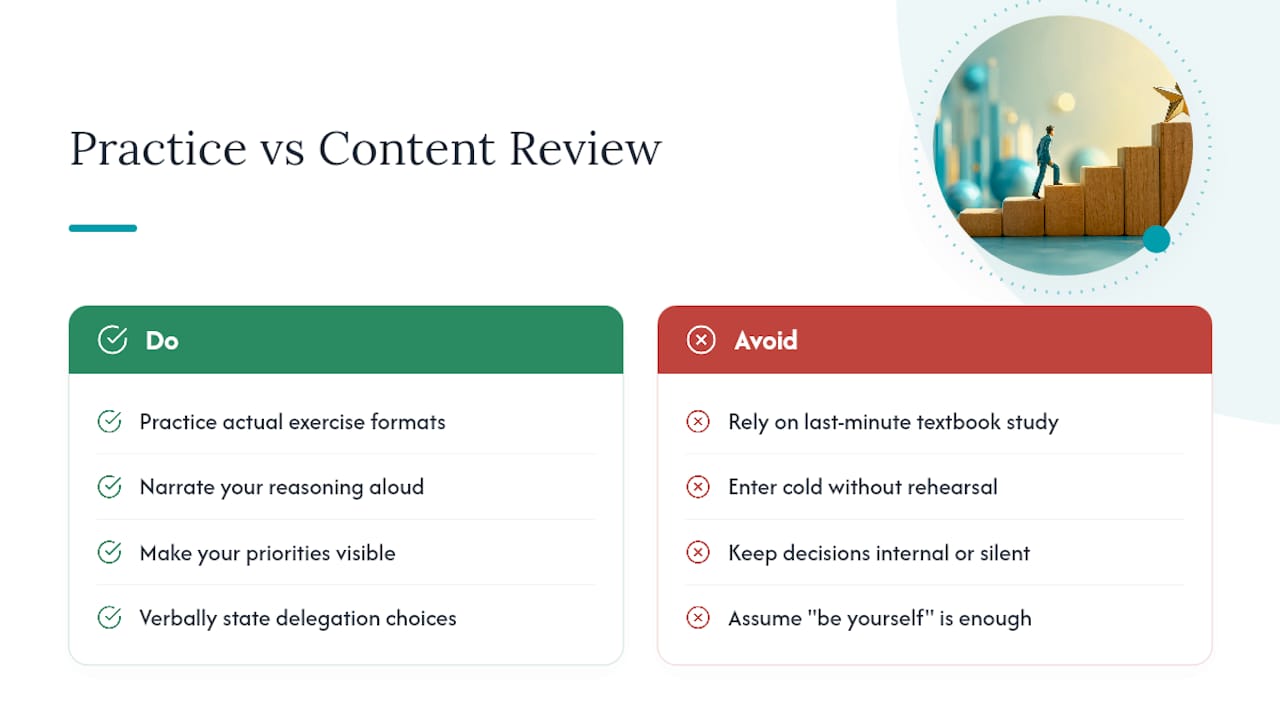
The conventional advice to “be yourself” also undersells what’s happening. Assessors are trained to code specific behaviors against specific anchors. Being yourself without narrating your reasoning, prioritizing visibly, or naming your delegation choices leaves a rater with nothing to score, even if you made the right call internally. The candidates who do well aren’t necessarily the most capable leaders in the room. They’re the ones who understood the scoring mechanism and made their thinking observable.
If you take one thing from this: prioritize simulation practice over content review. A senior candidate rarely lacks the judgment to lead. What they lack, walking in cold, is fluency with the format itself.
Kim
Get Assessment-Ready With Resume Wiz
This service offers a practice-first alternative to walking into an assessment center cold, designed for executives who have limited time to rehearse alone. It includes mock simulations mirroring in-tray exercises, role plays, and case presentations, along with feedback focused on critical scoring moments.

A short prep engagement typically covers three things: a mock assessment session with structured feedback, a metricized evidence bank built from your actual career results, and alignment between your resume, LinkedIn profile, and the leadership narrative you’ll be defending live. Founder Kim Taynor built this approach on more than a decade inside recruiting, watching which candidates got promoted and which stalled at the assessment stage for reasons that had nothing to do with their ability.
If you have an assessment center or promotion panel on the calendar, bring the date, the competencies you’ve been told will be evaluated, and two or three recent wins with real numbers attached to your first consultation. Start with a visit to Resume Wiz to see how the prep process maps to your specific timeline.
Want a recruiter in your corner for your next senior role? Book a free call with Resume Wiz and we will map out your next move together.
