Recruiter Backed Executive Bio Examples: One Page Models & Templates
An executive bio is a public-facing leadership summary, not a resume rewritten in paragraph form. It’s written in third person, run through the eyes of investors, boards, employees, and reporters who’ll never see your resume. The best ones run roughly 280 to 340 words, fit on one page, and lead with a value claim before dipping into achievements. Shorter versions, four to eight sentences, exist for LinkedIn and press mentions.
Key Takeaways:
- The opening value claim should highlight a major metric or impact, not just a job title, to immediately communicate influence.
- Including two or three quantifiable achievements and a leadership philosophy early on increases credibility and engagement.
- Update bios biannually with recent metrics, roles, and new credentials, maintaining multiple versions for consistency across platforms.
- Lead with specific, sector-relevant metrics or credentials; finance requires precise deal sizes, while tech emphasizes vision and growth.
- Avoid listing roles chronologically or burying your unique differentiator; these reduce clarity and decrease recruiter interest.
Table of Contents
- Executive Bio Examples by Role and Use Case
- How to Write an Executive Bio Step by Step
- Executive Bio Templates You Can Fill In Today
- Executive Bio Mistakes That Undercut Your Credibility
- Tailoring Your Bio for Different Industries
- Keeping Your Executive Bio Current
- A Recruiter’s View on What Actually Gets Read
- Sources
Executive Bio Examples by Role and Use Case
Every strong bio opens with a claim, not a job title. Here are examples worth studying, organized by who’s reading them.
CEO and founder bios need to read like a leadership thesis, not a résumé recap.
- “Maria Chen has spent many years turning underperforming retail brands into category leaders, most recently growing [Company]'s revenue significantly over several years as CEO.” (Opens with the outcome, not the title.)
- “As founder and CEO of [Company], David Kim built a $0 to $60M SaaS platform by obsessing over customer retention before growth.” (Personal philosophy baked into sentence one.)
C-suite bios (CFO, COO, CMO) should anchor to a function-specific metric that boards actually care about.
- “As CFO of [Company], Angela Torres led the company through two acquisitions and a successful IPO, tightening operating margins significantly along the way.”
- “James Whitfield serves as COO of [Company], where he redesigned supply chain operations to cut fulfillment time notably across multiple distribution centers.”
Board and investor-facing bios lean harder on credibility signals: exits, fund performance, governance experience.
- “Rachel Ford sits on multiple public company boards and previously led [Company] through a major acquisition, with a track record of scaling founder-led businesses into institutional-grade operations.”
- “Prior to founding [Fund], Tom Alvarez spent many years at [Firm] evaluating numerous growth-stage deals, some of which returned very high multiples.”
Functional leaders (VP of Engineering, Head of Sales) can be shorter and more tactical, since the audience is usually internal or industry-specific.
- “Priya Nair leads an engineering organization at [Company], shipping multiple major platform releases over recent periods without notable deadline misses.”
- “Lucas Bennett runs global sales for [Company], where his team closed substantial new business recently, representing a significant increase over prior periods.”
Every one of those examples could run as a full one-page bio or get trimmed to a single sentence for a conference program. Curated collections that pair long and short formats side by side, like the one MIT Sloan’s career office put together, make it easier to see how the same story flexes across formats.
How to Write an Executive Bio Step by Step
Building one from scratch is less about creative writing and more about following a sequence. Here’s the order that works:
- Open with a value claim. One sentence stating what you do and the scale at which you do it. Skip your name’s origin story.
- Add two or three career highlights. Numbers beat adjectives every time. “Grew revenue 3x” beats “drove significant growth.”
- State your leadership philosophy in one sentence. This is the line that separates you from every other exec with similar numbers.
- Close with something human. A board seat, an alma mater, a volunteer role, or a hobby.
- Match tense to timeline. Present tense for your current role, past tense for everything before it.
Voice matters as much as structure. Write in third person even though you’re the one writing it. It’s the standard for a reason: third person reads like an outside assessment of your value, which is exactly what a board member or reporter expects.
Length depends on where the bio lives. A website or press kit bio runs the full 280 to 340 words. A LinkedIn “About” section works better around 150 words. A press release blurb should sit at four to six sentences.
Photos aren’t optional at this level. Use a current, professional headshot, cropped from the shoulders up, in high resolution for both print and web. A guide from Lemonshark Studio breaks down why lighting and cropping choices affect how “senior” a headshot reads, and Easy CV’s examples show the difference between a headshot that looks staged and one that looks confident.
Pro Tip: Put your single biggest number in the first two sentences. Recruiters and board members skim before they read, and if the impact metric is buried in paragraph three, most readers never get there.
Executive Bio Templates You Can Fill In Today
A blank page is the enemy here. Start with a skeleton and swap in your details.
One-page template: “[Name] is [Title] of [Company], where [he/she/they] [core value claim with metric]. Over [X years], [Name] has [achievement 1], [achievement 2], and [achievement 3]. [Name]'s approach to leadership centers on [philosophy in one sentence]. Prior to [Company], [Name] held [role] at [previous company], where [notable outcome]. [Name] holds [degree] from [school] and serves on the board of [organization]. Outside of work, [Name] [personal detail].”
Three archetypes worth keeping on hand, since tone shifts by situation:
- Turnaround leader: lead with the crisis and the recovery number (“stabilized a company losing $2M/month within six quarters”).
- Growth/scale leader: lead with the multiplier (“scaled headcount from 30 to 300 while maintaining profitability”).
- Investor-facing founder: lead with capital raised or exit value, then pivot to vision.
Rewrite example, long to short: A 300-word bio about a CFO’s IPO experience compresses to: “Angela Torres is CFO of [Company], where she led the business through a successful IPO and two acquisitions while lifting operating margins 12 points. She previously spent eight years at [Firm] and sits on the finance committee of [Nonprofit].” That’s the three-part compression worth memorizing: keep the value claim, keep one metric, close with a current detail.
Executive Bio Mistakes That Undercut Your Credibility
The single biggest mistake is writing a bio like a resume with a byline. A chronological list of job titles and dates tells a reader what you did, not why it mattered or how you think. Compress the timeline into outcomes instead.
The second mistake is burying your differentiator. Boards and recruiters read the first two sentences and decide whether to keep going, so your best metric and your leadership approach need to show up immediately, not after three paragraphs of context.
By the numbers: bios that lead with a metric and a philosophy statement in the first two sentences perform better with recruiters than ones that open with a title and tenure. Skimmable formatting, short paragraphs, no dense blocks, bolded metrics where appropriate, matters just as much as the words themselves.
Tailoring Your Bio for Different Industries
A finance bio and a creative-agency bio shouldn’t sound the same, even if the underlying resume is similarly impressive.
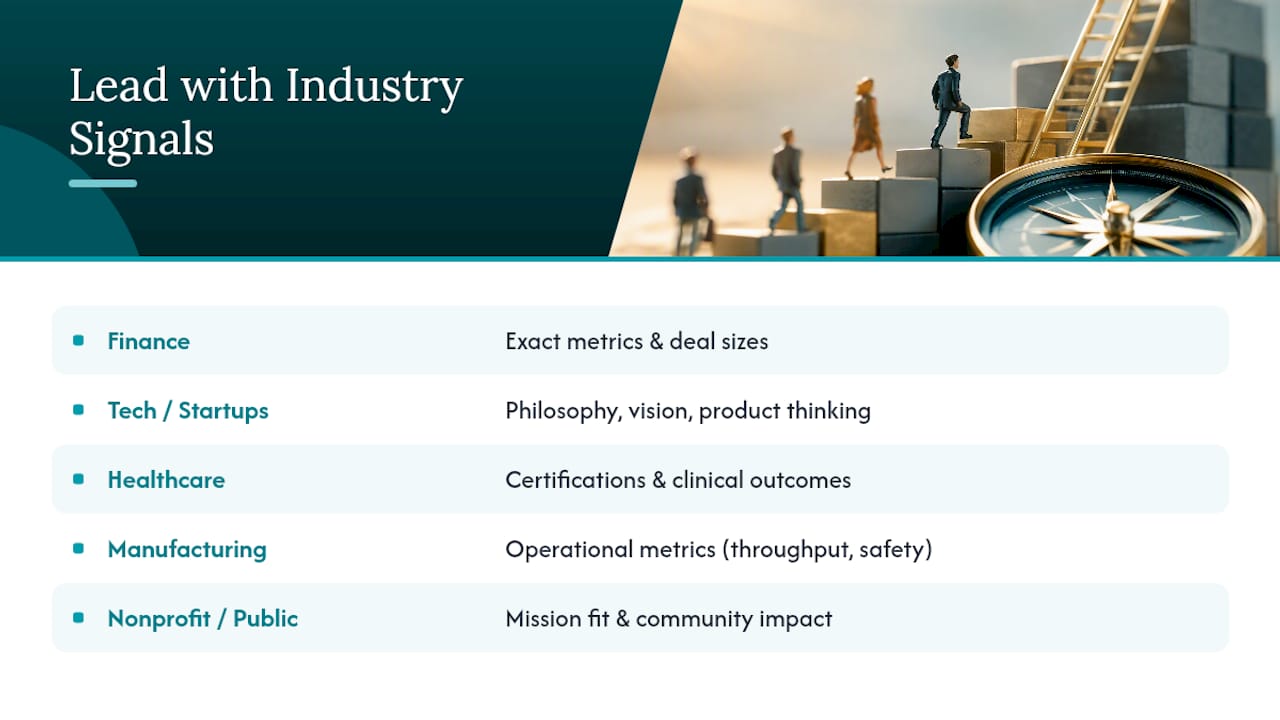
In finance and professional services, lean into precision. Use exact percentages, deal sizes, and regulatory or compliance credentials. Vague language reads as a red flag to this audience.
In tech and startups, philosophy and vision carry more weight than in other sectors. Investors want to know how you think about product, risk, and growth, not just your title history.
In healthcare and life sciences, credentials and patient or clinical outcomes belong near the top. Board certifications, published research, or FDA milestones function as trust signals the way revenue numbers do elsewhere.
In manufacturing and industrial sectors, operational metrics (throughput, safety records, cost reduction) resonate more than brand-style language.
In nonprofit and public sector roles, mission alignment and community impact numbers matter as much as financial ones. A bio heavy on revenue language can actually undercut credibility in this space.
The through-line: identify what your specific audience measures success by, then lead with that metric or credential in your opening lines, not your closing ones.
Keeping Your Executive Bio Current
An outdated bio is worse than no bio. A board bio still listing a role you left two years ago tells a reader you’re not paying attention to your own materials.
Set a recurring check twice a year, ideally tied to performance reviews or fiscal year-end. Update three things every time: your current title and scope, your most recent major metric or win, and any new board seats or credentials.
Keep a running document of accomplishments as they happen rather than trying to reconstruct a year of work from memory when it’s time to update. A single sentence logged quarterly (“closed $12M enterprise deal in Q2”) turns bio updates from a research project into a copy-paste job.
Maintain multiple versions in parallel: the full one-page bio, the LinkedIn summary, and the short press blurb. Updating all three at once, rather than letting the shorter versions drift out of sync with the long one, avoids the awkward situation where your LinkedIn says one thing and your speaker bio says another.

A Recruiter’s View on What Actually Gets Read
Recruiters read the opening line and the numbers first, everything else second. A bio that buries its best metric under three sentences of preamble loses that reader before it earns their attention.
Resumewiz builds bio templates and offers direct reviews specifically for that gap, because most executives are too close to their own accomplishments to know which one belongs in sentence one. If you want a second set of eyes on yours, Resumewiz can help you find it.
Kim
Want a recruiter in your corner for your next senior role? Book a free call with Resume Wiz and we will map out your next move together.
