Three Stories to Build a CCAR Ready Executive Career Narrative
An executive career narrative is a short set of evidence-led stories that connect your past impact to future business outcomes, not a longer resume summary. It works because it’s specific, not because it’s comprehensive. Start today by pulling three strategic stories from the last five to seven years of your career, ones with a measurable result attached, and build everything else around them.
Key Takeaways:
- Craft three to seven recent stories focused on measurable results, each centered on a single decision or action, to ensure they demonstrate impact.
- Use CCAR or STAR frameworks to structure each story, highlighting context, challenge, and quantifiable outcomes appropriately for different audiences.
- Regularly test and update your stories by sharing them with others, tracking their memorable proof points, and retiring outdated or less effective narratives.
- Develop a coherent, integrated narrative across your resume, LinkedIn profile, and interview scripts to present a consistent professional story that emphasizes strategic impact.
- Prioritize storytelling skills over credentials, as articulate, evidence-based narratives are more influential in hiring decisions than titles or experience alone.
Table of Contents
- Crafting Your Executive Career Narrative Step by Step
- STAR vs. CCAR: Choosing the Right Framework for Your Story
- The 30-Second Pitch and the 2-Minute Interview Story
- Executive Narrative Templates You Can Adapt Today
- How to Test and Update Your Career Stories Over Time
- How Resume Wiz Turns Stories Into a Coordinated Narrative
- Perspective: Storytelling Beats Credentials Alone
- Which Resume Wiz Package Fits Your Narrative Goals
- Sources
- FAQ
Crafting Your Executive Career Narrative Step by Step
Most executives try to build a narrative from memory, which is why it comes out generic. The better approach starts with a document, not a story.
Begin by making what communications professionals call a “good list”: a running inventory of every measurable outcome from your last two roles, revenue moved, teams built, systems replaced, deals closed. Don’t filter yet. Just capture. This is the raw material the PRSA’s guidance on career storytelling recommends before you write a single sentence of narrative, because trying to write persuasively before you’ve inventoried your evidence produces vague, adjective-heavy prose.
From that list, follow this sequence:
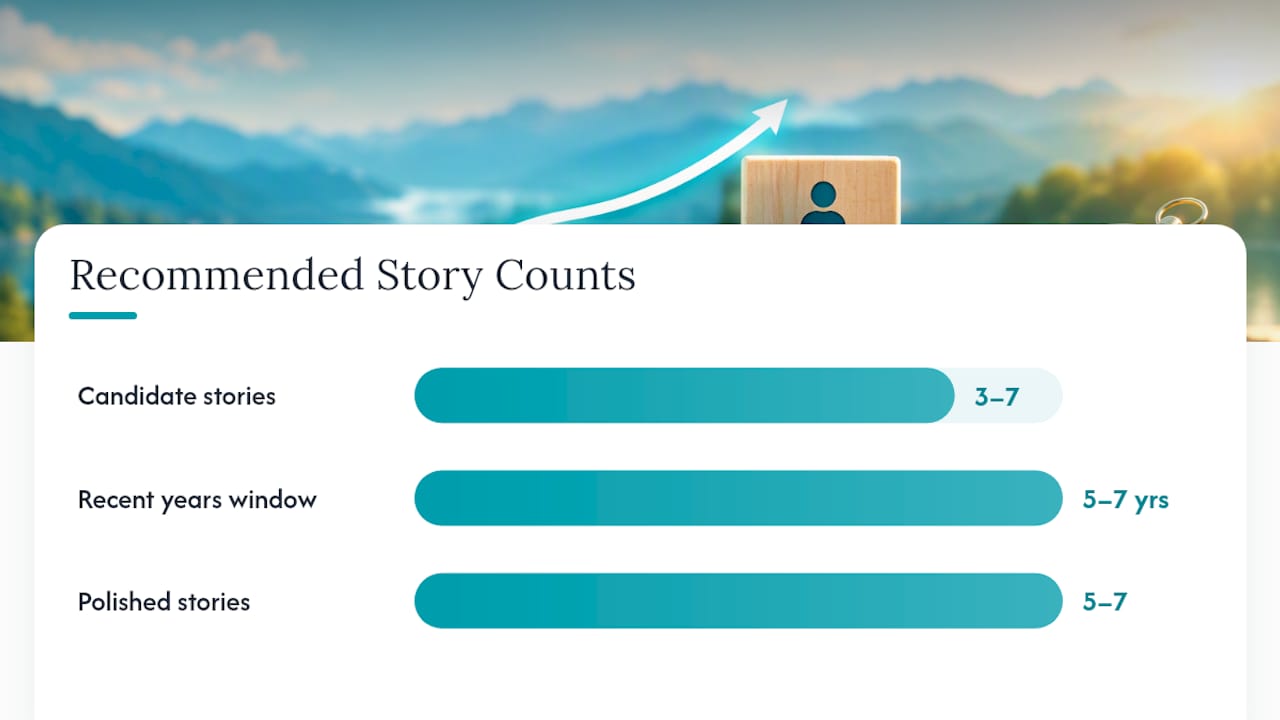
- Narrow to 3 to 7 candidate stories, weighted toward the last five to seven years. Older wins matter less to a hiring committee evaluating you against today’s market.
- Find your through-line. Look across your shortlist for a repeating pattern, maybe you’re the executive who fixes broken supply chains, or the one who scales product teams past chaos. That pattern becomes your professional anchor.
- Convert each item into a compact story. Use a behavioral framework (more on that below) so every story has a clear action and a number attached to the result.
- Adjust emphasis by audience. A board hears governance and risk framing. A recruiter hears speed and fit. A peer hiring manager hears operational detail. Same story, different weight.
Pro Tip: Keep a living document of five to seven polished stories tagged by competency (turnaround, scaling, M&A, crisis management). When a new opportunity requires a fresh angle, you adapt an existing story instead of writing from scratch.
STAR vs. CCAR: Choosing the Right Framework for Your Story
STAR (Situation, Task, Action, Result) and CCAR (Challenge, Context, Action, Result) both force you to show ownership and a measurable outcome. The difference is in how much complexity they let you carry.
STAR compresses situation and task into one beat, which works well for a fast verbal answer or a resume bullet. CCAR splits that beat into Challenge and Context, which gives you room to separate the specific problem from the environment it happened in, a distinction that matters enormously when the story involves politics, budget constraints, or competing stakeholders you didn’t control.
That’s why CCAR is the format the U.S. Office of Personnel Management recommends for Senior Executive Service qualification statements. The Context section lets a candidate show they understood the broader terrain, budget cycles, agency priorities, competing interests, before describing what they actually did about it. That same separation strengthens private-sector executive stories too, especially when the “challenge” was self-created (a strategic bet) rather than externally imposed (a market shock).
Practical compression and expansion:
- To shrink a full CCAR story into one resume line, keep only the Action verb, the scope, and the Result number. Drop Context and Challenge entirely; the reader infers them from your title.
- To expand a STAR answer into a 90 to 120 second verbal story for a panel interview, add one sentence of Context before the Action, and a second, secondary result after the primary one.
- Never label your paragraphs “Challenge,” “Context,” “Action,” “Result.” The same OPM-based guidance warns that labeling flattens what should read as natural prose.
Watch for three recurring errors: overusing “we” when the story needs to show your individual judgment, omitting a number entirely and leaning on adjectives instead, and cramming three anecdotes into one answer instead of committing to one deep example.
The 30-Second Pitch and the 2-Minute Interview Story
Your elevator pitch and your full interview story are the same narrative at two different zoom levels. Master the short version first.
The 30-second executive pitch has four parts, and skipping any one of them is why most pitches fall flat:
- Anchor: your domain or function in one phrase (“I lead digital transformation for regulated financial services”).
- One quantified proof point: a single number that proves the anchor is real, not aspirational.
- A differentiator: what you do that peers with the same title typically don’t.
- A specific ask: not “I’m exploring opportunities,” but something concrete: an introduction, a board conversation, a named type of role.
To stretch that into a two-minute interview story, add one sentence of context before your proof point, and layer in a second result, ideally one that shows a different kind of impact (cultural or financial, not just financial twice).
Pro Tip: Record yourself delivering both versions on your phone. Most executives run 20 to 30 seconds long on their first take because they hedge instead of committing to the ask.
Executive Narrative Templates You Can Adapt Today
Templates only work as starting points if you’re disciplined about what you swap out. Here’s the pattern across five common executive situations, adjust the bracketed details and keep the rest of the structure intact.
- CFO turnaround: “Inherited a business burning $X/month with 90 days of runway; renegotiated vendor terms and restructured the finance team, extending runway to [timeframe] while cutting burn by [%].”
- Product leader scaling: “Took a product from [$X ARR] to [BY ARR] in [timeframe] by rebuilding the roadmap process around customer usage data instead of sales requests.”
- GM pivoting industries: “Moved from [industry A] to [industry B] and applied the same operational discipline that cut delivery times by [%], proving the playbook, not the sector, was the differentiator.”
- Board-seat candidate: “Served as audit committee chair through a [$X] acquisition, bringing governance rigor to a board that had never managed integration risk at that scale.”
- Fractional executive: “Engaged for [X] months to fix a specific gap (finance ops, go-to-market), delivered [measurable result], and structured the engagement so the client didn’t need to retain me longer than necessary.”
The variable that matters most in every template isn’t the adjective, it’s the single decision you made and the number that followed it. Swap the metric, the timeframe, or the stakeholder detail, but never strip out the decision itself.
How to Test and Update Your Career Stories Over Time
A story that sounded sharp a year ago can go stale fast, so build a habit of testing it. Tell it to three people who don’t know the backstory, then ask them to repeat back what they heard. If they can’t recall your result or your ask, the story is too cluttered.
- Record and time yourself. Anything past two minutes for a full story is a sign you’re including context the listener doesn’t need.
- Track which proof points land. Some numbers get a reaction; others get a blank stare. Keep the ones that work.
- Refresh after major outcomes. A new turnaround or launch should bump an older story out of rotation.
- Retire stories older than seven to ten years unless you can reframe them around a skill that’s newly relevant again.
Pro Tip: If a listener repeats back your differentiator instead of your title, the story is working exactly the way it should.
How Resume Wiz Turns Stories Into a Coordinated Narrative
Kim Taynor, founder of Resume Wiz, built the company’s process around more than a decade of recruiting experience, watching firsthand which executive stories actually moved hiring decisions and which ones stalled interviews. That experience shapes a workflow where a coach and writer extract three to five strategic stories directly from a candidate, then thread the same through-line across the resume, LinkedIn narrative, and elevator scripts, rather than treating each document as a separate writing project. The result is one coherent story told consistently in every format a hiring manager or board member might encounter.
Perspective: Storytelling Beats Credentials Alone
Executives overinvest in credentials and underinvest in the four or five stories that actually get repeated in hiring rooms. Analysis of executive hiring outcomes has found that the ability to articulate strategic impact through narrative correlated more strongly with hiring success than raw experience or technical skill. A title only proves you held a job. A story proves you made a choice. Before you update anything else, take one flat bullet from your resume right now and rewrite it as a CCAR story with a number in it.
Kim
Which Resume Wiz Package Fits Your Narrative Goals
If you already have strong stories but they’re scattered across a dated resume and a thin LinkedIn profile, Evolution at $699 rebuilds both around one consistent narrative. If you’re running an active search and need more than a document, the Elevate package adds coaching and application strategy layered on top of that same narrative work.

For executives who want the applications and outreach handled alongside the story development, Elevate and Land extends the engagement into managed search support. And if an interview is already on the calendar and you need your stories interview-ready fast, the Elevate program is built for exactly that need. Whichever path fits, the deliverable is the same: three to five polished stories, ATS-aligned resume bullets, a LinkedIn narrative, and elevator scripts that all say the same thing about you. Pick the package that matches your goals and get started on Resume Wiz's site.
Want a recruiter in your corner for your next senior role? Book a free call with Resume Wiz and we will map out your next move together.
Sources
For deeper reading on the frameworks and evidence behind this guide, see the CCAR format breakdown, PRSA’s career storytelling guidance, and the analysis of storytelling in executive hiring. For a broader look at aligning your narrative to business outcomes, the strategy execution framework guide is also worth a read.
- Beyond the resume: master the art of telling your career story - PRSA
- The #1 Factor in Executive Hiring Decisions (It’s Not What You Think) | JobEase
FAQ
How Do You Write a Career Narrative?
Start with a “good list” of measurable outcomes from your recent roles, then narrow it to three to seven stories built around a consistent through-line. Structure each one with CCAR or STAR so it has a clear action and a quantified result, then tailor the emphasis to whoever’s listening.
What Does “Career Narrative” Mean?
A career narrative is the connected set of stories that explain what you’ve done, why it mattered, and what you’re positioned to do next, rather than a chronological list of jobs and titles. It’s the difference between a resume that lists facts and one that makes a case.
What Makes a Strong Narrative Example?
A strong example centers on one decision, one action, and one measurable result, not a string of adjectives describing your leadership style. The PRSA’s guidance on career storytelling recommends grounding every story in concrete evidence rather than general claims about your abilities.
How Long Should an Executive Career Narrative Be?
A single story should run 30 seconds for an elevator pitch or roughly 90 to 120 seconds for a full interview answer. Keep your working set to five to seven stories total so you always have the right one ready without over-preparing material you’ll rarely use.
