Recruiter Led Executive Case Study Interview: Use a Named Thesis
An executive case study interview asks you to prepare and present a real project you led, then defend the decisions, metrics, and trade-offs in front of a panel. The single best move you can make: open with a named thesis, the decision you’d make, the operating change it requires, and what changes by week 13, then build a decision-shaped 30/60/90 plan around it. Everything else in your deck, evidence, assumptions, rehearsal, supports that opener.
Key Takeaways:
- Candidates must clearly state a decision, required operating change, and a measurable signal at week 13 to demonstrate sound judgment.
- Tailoring the presentation to panel members’ priorities, such as finance or operations, increases the relevance and impact of your recommendations.
- Planning five to seven slides with concise content ensures you finish early and have ample time for questions, boosting your overall score.
- Using a short assumptions slide and preparing for interruptions shows strategic thinking and adaptability, which panels view favorably.
- Rehearsing with mock panels and scripting responses for tough questions significantly improves confidence and performance during the real interview.
Table of Contents
- What Panels Actually Evaluate (And How to Decode a Vague Brief)
- Building a Named Thesis and a 30/60/90 Plan That Reads Like Decisions
- How to Structure the Deck: Slides, Timing, and Backup Material
- Presenting Evidence and Metrics That Actually Prove Impact
- Naming Your Assumptions and Handling Interruptions Gracefully
- Rehearsing the Room: Mock Panels and the Three Hardest Questions
- Your Copy-and-Paste Prep Checklist
- What Panels Reward (And Where Senior Candidates Trip Up)
- How Resume Wiz Helps You Build This Presentation Before Panel Day
- Sources
- FAQ
What Panels Actually Evaluate (And How to Decode a Vague Brief)
Most panels don’t score you on your résumé’s timeline. They score diagnosis, prioritization, decision-making under ambiguity, and whether you’d be safe to hand a budget and a team to. The Office of Personnel Management’s structured interview guidance exists precisely because unstructured, story-heavy answers make weak signals for hiring committees. That’s true whether it’s a government panel or a private-sector executive search.
Before you build a single slide, get clarity on the brief. Ask:
- Who is on the panel, and what does each person actually own (finance cares about margin, operations cares about throughput)?
- What decision is pending right now that this hire would influence?
- Is there a specific problem behind the case study prompt, or is it deliberately open-ended?
Tailor your emphasis to whoever is in the room. A finance-heavy panel wants unit economics; an operations panel wants sequencing and dependencies.
Building a Named Thesis and a 30/60/90 Plan That Reads Like Decisions
Candidates who win senior rounds open with a named thesis: the specific decision they’d make, the operating change it demands, and the signal they’d expect by around day 100, according to an analysis of forty senior-candidate presentations. That structure beats a chronological project recap because it shows judgment on command, not just a memory of what happened.
Use a three-part formula for your opener:
- The decision. State it in one sentence: “I would consolidate the three regional support queues into one.”
- The operating change required. Name what has to move: staffing, tooling, reporting lines.
- The week-13 signal. Define what a panel could check in twelve or thirteen weeks that proves the decision was right.
From there, convert the thesis into two to four prioritized decisions with dependencies attached. Don’t present six initiatives with equal weight. Rank them, and say which ones block the others.
Pro Tip: Write your week-13 signal as a number a stranger could verify, not a feeling. “Support backlog under 48 hours” beats “improved responsiveness.”
How to Structure the Deck: Slides, Timing, and Backup Material
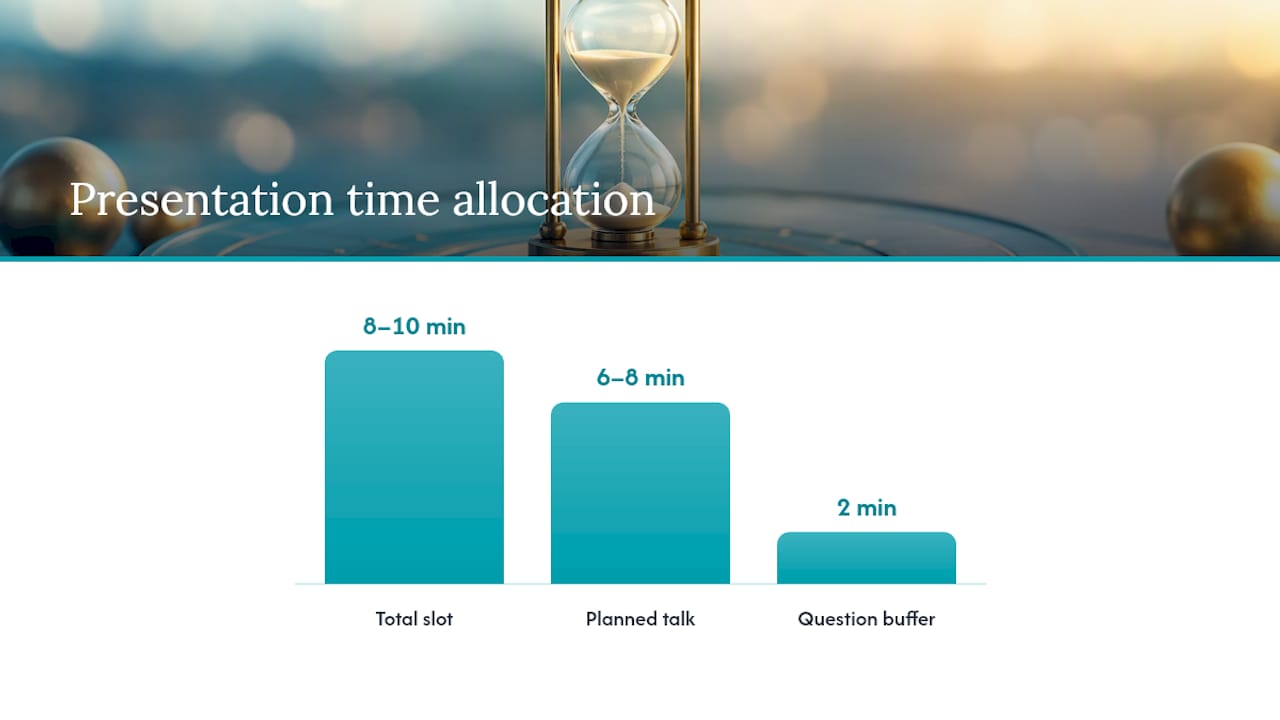
Most panels give you 8 to 10 minutes. Plan five to seven slides, finish two minutes early, and leave room for questions, a pattern that shows up consistently in presentation reviews of senior finalists. One idea per slide, minimal text, and no paragraphs projected behind you while you talk.
A tight core sequence looks like this:
- Thesis slide. The decision, the change, the week-13 signal, stated once.
- Diagnosis slide. What the brief actually meant once you dug in.
- Decisions slide. Your ranked two to four moves.
- Dependencies and risks slide. What could break, and what you’d defer.
- Close and ask slide. What you want next.
Save the file as both PPT and PDF, keep a copy in two locations, and build a hidden appendix with backup data you can surface only if someone asks, standard advice from interview presentation prep guides. A confident presenter says, “I have the detailed cohort breakdown if useful,” and pulls it up in seconds instead of scrambling.
Presenting Evidence and Metrics That Actually Prove Impact
Executives care about four kinds of proof: financial impact, cost or time saved, retention, and reduced operational risk. State each cleanly, in a single sentence, with the unit attached. “Cut onboarding time from 19 days to 11” lands harder than “significantly improved onboarding.”
Credit your team honestly. Use “I” statements for what you personally decided or built, and name teammates for what they executed. A panel that hears you claim every win solo will discount your judgment, not just your modesty.
Charts belong in the main deck only when they support one specific claim, a before/after bar, a single trend line. Detailed tables, cohort breakdowns, and multi-variable data belong in the appendix. The STAR framework (Situation, Task, Action, Result), widely used in behavioral interview coaching, works well for structuring the short verbal story behind each metric when a panelist asks “walk me through that.”
Statistic Callout: Presenters who finish early and reserve time for interaction consistently score better with senior panels than those who use every available minute on slides, per the same review of forty finalist presentations.
Naming Your Assumptions and Handling Interruptions Gracefully
A short “Things I’m Assuming” slide does two jobs at once: it converts a vague prompt into a disciplined diagnosis, and it protects you when the panel corrects a factual detail you got wrong. Naming what you don’t know signals strategic thinking rather than guesswork.
Pair it with a risks-and-trade-offs slide that states plainly what you’d defer and what you’d need from the board to move faster.
- List three to five assumptions in plain language, not hedged corporate phrasing.
- State one thing you’re explicitly not solving in the first 90 days.
- If a panelist interrupts to correct an assumption, thank them, ask one clarifying question, then show how the new information shifts your decision.
Pro Tip: Practice saying “that changes my week-13 signal to X” out loud. Panels remember candidates who adapt in real time far more than candidates who stay rigid.
Rehearsing the Room: Mock Panels and the Three Hardest Questions
Run at least one mock panel with three people playing distinct roles: a skeptic who challenges your numbers, a peer who asks about team dynamics, and a timekeeper; this approach is recommended by resources like Corporate Sales Pro, GetVoucher for those preparing for client-facing executive roles. Case-study prep research consistently points to deep company and panel research plus real rehearsal time as the differentiator between strong and weak finalists, according to Execs In The Know’s case-study interview guidance.
- Write down the three toughest challenges someone could raise against your thesis, and script a short, evidence-based answer to each.
- Time the full run twice, once alone and once with your mock panel, adjusting pace until you finish with two minutes to spare.
- Close every rehearsal with the same explicit ask: the role, a named 30-day milestone, and a request for a specific follow-up conversation. Vague closes lose offers at senior levels, per the same finalist review.
Your Copy-and-Paste Prep Checklist
- Thesis slide: decision, operating change, week-13 signal, one sentence each.
- Diagnosis slide: what the brief really meant, in your own words.
- Decisions slide: two to four moves, ranked, with dependencies marked.
- Assumptions slide: three to five plain-language guesses you’re making.
- Appendix: detailed tables and cohort data, hidden until asked.
If you want a working template deck, a mock-panel script, or one-on-one interview coaching built around this structure, Resume Wiz offers options developed by founder Kim Taynor from over a decade of recruiting work. Save your final deck in two file types and two storage locations before you walk in.
What Panels Reward (And Where Senior Candidates Trip Up)
Hiring committees unconsciously reward candidates who name a decision early and defend it under pressure. They punish candidates who narrate their résumé slide by slide, hoping the panel connects the dots themselves.
The most common failure I see is a deck with no thesis. A dozen bullet points about “responsibilities,” zero sentences about what the candidate would actually decide. The second most common: too much detail on the main slides and nothing held back for questions.
Kim
How Resume Wiz Helps You Build This Presentation Before Panel Day
Resume Wiz is the alternative to guessing your way through a senior presentation alone. Instead of rebuilding a deck from scratch the night before, you get structured coaching built around exactly this named-thesis, decision-shaped format.

The Elevate program is built for candidates who want interview prep and coaching alongside their broader job search. It walks you through the thesis formula, deck review, and a scripted mock-panel session. If you want deeper coaching alongside your résumé and LinkedIn work, the Elevate program folds interview prep, deck feedback, and personal coaching into the same engagement as your broader job search; see the page for current details. For candidates who also need their branding tightened before the panel, Evolution, a $699 one-time package, covers resume and LinkedIn work that reinforces the same thesis you’ll present live. Whichever fits your timeline, the typical deliverable includes a reviewed deck, a rehearsed opener, and preparation for your toughest questions before you walk into the room.
Want a recruiter in your corner for your next senior role? Book a free call with Resume Wiz and we will map out your next move together.
Sources
- OPM: Structured interviews
- Interview presentation prep, Askcruit
- What I Watched Forty Senior Candidates Do in a Final-Round Presentation, WinningPresentations
- Crack the Interview Code, Part 2: Case Studies, Execs In The Know
FAQ
What Is an Executive Case Study Interview?
It’s a hiring or promotion format where you prepare and present a real project you led, then field questions from a panel about your decisions, metrics, and trade-offs. It differs from a standard behavioral interview because it requires a built presentation, not just spoken answers.
How Long Should My Presentation Be?
Most panels allot 8 to 10 minutes, so plan five to seven slides and aim to finish about two minutes early to leave room for questions, a pattern seen across senior finalist presentations. Longer decks tend to run out of time before the panel gets to ask anything.
What Should My Opening Slide Say?
State your decision, the operating change it requires, and the signal you’d expect by around week 13, all in one or two sentences. This named-thesis format is what separates strong finalists from candidates who narrate a chronological project recap.
How Do I Handle a Panelist Who Interrupts With a Correction?
Thank them, ask one clarifying question, then explain how the new information shifts your decision or your week-13 signal. Panels read adaptability under interruption as a stronger signal than a flawless, uninterrupted run-through.
Can Resume Wiz Help Me Prepare Specifically for This Format?
Yes. The Elevate program includes deck review and mock-panel coaching built around the named-thesis structure. Current pricing for Elevate coaching is listed on the Resume Wiz site.
