Executive Interview Elevator Pitch: Fit 20+ Years Into 90 Seconds
An executive interview elevator pitch is a tight briefing that frames your leadership value and invites the conversation to continue. Aim for 30 to 90 seconds, and keep your “Tell me about yourself” answer near 90 seconds. Your goal is not to recite a career. It is to show who you are, what you deliver, and why the conversation should focus on you.
Key Takeaways:
- Use a Past, Present, Future sequence: establish your leadership domain, give one or two measurable outcomes with scope, then connect them to the role.
- Research the interviewer and company priorities; emphasize scope and fit with recruiters, but lead with outcomes and tradeoffs when speaking with hiring executives.
- Choose recent, relevant achievements with broad scope, replace vague claims with defensible numbers, and prepare to explain how you calculated each result.
- Record and time rehearsals to stay within 30 to 90 seconds, remove filler and jargon, and ask a peer what they remembered or found unclear.
- Prepare three backup stories for likely follow up questions, and answer each in about 30 seconds with the situation, your action, and the result.
Table of Contents
- How do you build the pitch in three parts?
- How do you tailor it to the interviewer?
- What do strong executive examples and templates look like?
- How should you practice and refine the pitch?
- What mistakes do senior candidates make?
- How do you prepare for follow-up questions?
- Why do these tactics work?
- When should you sound conversational and when should you brief?
- Ready to sharpen your pitch with expert help?
- FAQ
- Sources
How do you build the pitch in three parts?
Think of the pitch as a short briefing with three moves. A Past to Present to Future structure maps onto them cleanly, and senior-level guidance from IESE points to a brief introduction, one or two measurable achievements, and a closing that connects your experience to the future role.
- Opening (Past): One positioning line that establishes seniority and domain, such as “I run global supply chain operations for consumer goods companies.”
- Middle (Present): One or two high-impact outcomes with scope and results. Name the size of the team, budget or business you led, and what changed because of you.
- Closing (Future): Link what you have done to this role and say what you want to tackle first.
Write each part as a single spoken sentence or two before you polish anything. If a part needs three sentences to land, you have not yet found its point. Draft in plain speech, then tighten. The order matters because interviewers form an impression early, and a clear opening frames everything you say afterward.
How do you tailor it to the interviewer?
A pitch that works for a recruiter can fall flat with a CEO. Before you rehearse, look up the interviewer’s background, the company’s current priorities, and the problems the role exists to solve. Then pick the achievements that answer those problems, and drop the rest: roles from early in your career, tactical details, and acronyms only your last employer used.
- Match the altitude. With HR or a recruiter, stress scope and fit. With a hiring executive, stress outcomes and tradeoffs.
- Use two rules for technical detail. Include a detail only if the interviewer could repeat it to a colleague, and only if it changes how they judge your results.
- Lead with their priority. If the company is cutting costs, open with efficiency. If it is growing, open with scale.
- Say it their way. Borrow the vocabulary from the job posting, but never at the cost of plain language.
Pro Tip: The night before, rewrite only your middle section. Swap in the achievement that best matches the interviewer’s biggest stated priority and leave the opening and closing alone.
What do strong executive examples and templates look like?
Each example below runs about 30 to 60 seconds when spoken.
- Operations: “I lead operations for mid-market manufacturers. I consolidated plants, cut cycle time, and kept on-time delivery above target. I’d like to bring that discipline to your expansion.”
- Product: “I build product organizations that ship. I took a platform from concept to launch and turned it into the company’s fastest-growing line.”
- Finance: “I’m a CFO who partners with the business. I rebuilt forecasting and capital allocation, which gave leadership confidence to fund acquisitions.”
- Transformation: “I turn around underperforming divisions. My last role took a loss-making unit to profit by simplifying the portfolio and resetting the team.”
Template: “I’m a [title] who [core strength] in [industry or function]. Most recently I [achievement with scope and result]. I’m excited about [this role] because [link to their need], and I’d like to [first objective].”
IESE advises that a long career should be compressed into one or two measurable achievements. Choose the ones that are recent, large in scope, and relevant to this employer. Replace vague claims with real numbers you can defend, and be ready to explain how you reached each one.
How should you practice and refine the pitch?
Fluency comes from repetition, not memorization. Say it aloud, time it, and cut until it breathes.
- Record yourself. Listen for pace, filler words such as “um” and “basically,” and any sentence that wanders.
- Time every run. Keep the pitch inside 30 to 90 seconds, and your longer “Tell me about yourself” answer near 90 seconds.
- Role-play with a peer. Ask them two things: what did you remember, and what did you not understand?
- Run a checklist. Is there one clear positioning line, one or two results, one link to the role, and no jargon?
- Refine aloud. Stanford’s career guidance suggests refining your statement out loud so it sounds authentic and spontaneous rather than scripted.
Pro Tip: Practice standing, in the clothes you will wear. It changes your breathing and your pace more than you expect.
If you want structured rehearsal with feedback, our Elevate program is built for exactly this stage.
What mistakes do senior candidates make?
Seasoned leaders often have too much to say. Interview experts quoted by Cambridge Judge Business School note that strong candidates avoid reciting their CV and instead show self-reflection, explain changes in direction, and describe value the organization cannot get elsewhere.
- Reciting your résumé. Replace the job list with outcomes and what you learned.
- Stacking metrics. Two strong results beat six forgettable ones.
- Hiding behind jargon. Say “I cut delivery time” instead of “I optimized throughput across the value chain.”
- Running long. Use three trimming rules: cut any role older than your last two, cut any number you cannot explain in one sentence, and cut any sentence the interviewer would not miss.
How do you prepare for follow-up questions?
A good pitch invites questions, so plan for them. The most common ones ask for impact detail, team scope, or the tradeoffs you faced. Answer each in about 30 seconds using a STAR-lite structure: the situation in one line, your action in one or two, and the result in one.
- Impact detail: “The result was [outcome], measured by [metric], over [timeframe].”
- Team scope: “I led [number] people across [functions], and my role was to [decision you owned].”
- Tradeoffs: “We chose [option] over [option] because [reason], and accepted [cost].”
Carry three backup stories tied to the achievements in your pitch, each with a clear problem, your decision, and the outcome. If someone asks you to go deeper, you can expand without improvising. Forbes coaching commentary also cautions that a generic networking pitch often fails in an interview, so make every backup story specific to this employer’s needs.
Why do these tactics work?
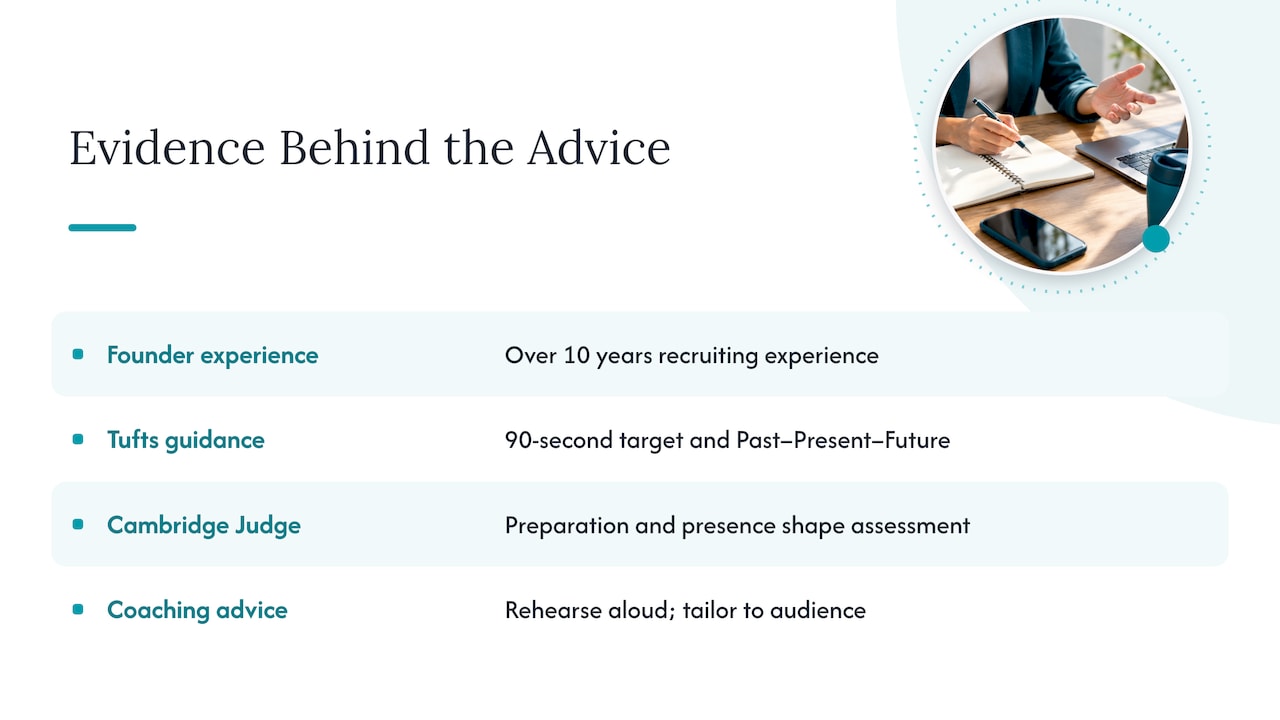
Our founder, Kim Taynor, brings over 10 years of recruiting experience to this advice. The timing and structure guidance here rests on published career-center and business-school sources: Tufts supports the 90-second target and Past to Present to Future framing, and Cambridge Judge Business School describes how interviewers assess preparation and presence. Our own coaching adds practical guidance: rehearsing aloud and tailoring to the audience helps candidates sound clearer and more confident.
When should you sound conversational and when should you brief?
I use a simple rule: with a panel that feels like networking, talk like a person; with a senior hiring panel, brief like an executive. The same achievement can open as “I got pulled into fixing a stalled launch, and it turned into the best project of my career” or as “I rescued a stalled launch and delivered it on schedule.” Either works if it is clear and relevant to the room.
Kim
Ready to sharpen your pitch with expert help?
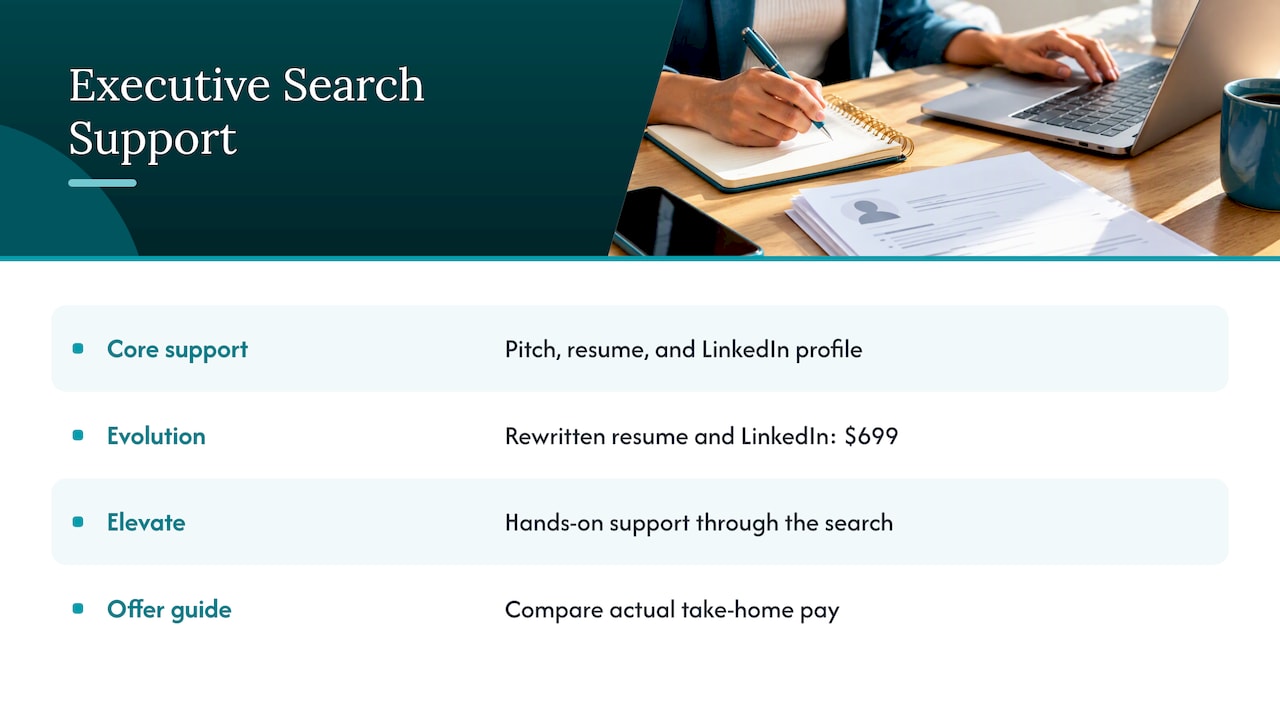
Most executives know their story but struggle to compress it. We take your experience and turn it into a pitch, a resume and a LinkedIn profile that hold up in front of a senior panel, backed by recruiting experience from the other side of the table. If you want your brand and documents refreshed first, our Evolution pairs a rewritten resume with an updated LinkedIn profile for $699. If you want hands-on support through the whole search, explore our Elevate programs. When an offer arrives, a resource like this guide to negotiating a job offer using take-home pay helps you compare what you would actually earn. Book your next step with us at Resumewiz and walk into your next interview ready.
Practice out loud before the real thing. Try Recruiter Graded, the Resume Wiz interview simulator. Answer real interview questions by voice and get a recruiter style grade with feedback on every answer. Free to start.
Want a recruiter in your corner for your next senior role? Book a free call with Resume Wiz and we will map out your next move together.
FAQ
What are the three parts of an interview elevator pitch?
Open with a short positioning line, share one or two measurable achievements, and close by linking your experience to the role. That matches the Past to Present to Future structure used for “Tell me about yourself.”
How long should an executive elevator pitch be?
Plan for 30 to 90 seconds in an interview, and aim for about 90 seconds when answering “Tell me about yourself.” Shorter is fine if your message lands clearly.
What should you leave out of an elevator pitch?
Skip your full job history, long lists of metrics, and internal jargon. Interview experts say strong candidates avoid reciting the CV and focus on reflection and unique value.
Should an interview pitch sound like a networking pitch?
Not quite. A generic networking pitch usually underperforms in interviews, so tailor yours to the role and show you can contribute from day one.
