Recruiter Backed Six Stories to Ace Executive Interview Questions
Executive panels are testing one thing above all else: whether you exercise sound judgment under uncertainty and can prove it with numbers. Before you memorize a single sample answer, pick six to eight stories that map to strategy, people, change, and financial outcomes, then rebuild each one with a scope statement, your specific contribution, and a measurable result. Everything below, from question categories to a 30-60-90 template to the questions you should be asking the panel, builds on that one move.
Key Takeaways:
- Candidates must prepare detailed stories with measurable results that demonstrate their influence across strategy, people, change, and financial outcomes, with clear scope and decision ownership.
- Strong answers include quantifiable outcomes, specific trade-offs, risk management, and reflection on lessons learned, especially when owning failures or unpopular decisions.
- Building a tailored 30-60-90 day plan based on diagnosis, stabilization, and delivery phases is critical to show realistic, role-specific action plans.
- Asking targeted questions about success metrics, risks, decision authority, and cultural challenges signals strategic seniority and prepares for deeper engagement.
- Effective candidates align their stories with their resume claims, rehearse credibility in delivery, and avoid vagueness, blame, or lack of trade-offs to avoid disqualification.
Table of Contents
- Executive Interview Questions Organized By Competency
- How To Structure A Behavioral Answer At The Executive Level
- Three Annotated Sample Answers That Pass The Panel Test
- Answering Unpopular Decisions And Owning Failure
- Building A 30-60-90 Day Plan That Sounds Real
- What To Ask The Panel, And Why It Signals Seniority
- What Panels Are Listening For, And The Red Flags That Sink Candidates
- A Recruiter’s View On What Actually Separates Candidates
- Get Ready For The Room, Not Just The Questions
- Sources
Executive Interview Questions Organized By Competency
Interviewers rarely improvise at the senior level. Hiring guides recommend grouping questions into leadership themes and scoring each answer against a written rubric, which is why the same six categories show up across nearly every C-suite and VP-level panel.
- Strategy. Expect prompts like “Tell me about a time you chose between two strong strategic options” or “Describe a market bet you made that took over a year to pay off.” Panels want to hear the alternatives you rejected and why, not just the option you picked.
- People and talent. Questions center on hiring, firing, and succession decisions: “Walk me through a time you had to replace a long-tenured leader” or “How have you built a bench for your own role?” These reveal whether you influence outcomes through people or just through authority.
- Change and execution. “Describe a cross-functional initiative you drove that required buy-in you didn’t have automatically” is a common phrasing. Panels are listening for how you scaled something beyond your direct team.
- Decision quality and failure. “Tell me about a decision you’d make differently” or “Describe your biggest professional misstep” test whether you own outcomes without spiraling into either false modesty or excuse-making.
- Operations and finance. Be ready for direct questions about P&L ownership, budget size, and the KPIs you were accountable for. Vague answers here (“we improved efficiency”) read as a red flag, not humility.
- Culture and values. “Describe a time you had to choose between hitting a number and doing right by your team” surfaces how you handle tension between results and integrity.
Sample phrasings for each of these categories, along with example answers, appear in Indeed’s roundup of executive interview questions, which is worth practicing against out loud, not just reading.
How To Structure A Behavioral Answer At The Executive Level
The classic STAR format (Situation, Task, Action, Result) works fine for individual contributors. It falls short at the executive level because it doesn’t force you to prove scale or reflection. Add two elements: Scope and Growth.
Open with a one-line verdict and the scope of what you’re about to describe, including team size, budget, and timeframe. Then state the specific decision you owned, the trade-offs you weighed, and the assumptions you made going in. Walk through the actions you personally took, especially the influence levers you pulled when you didn’t have direct authority over everyone involved. Close with a quantifiable outcome and what it changed about how you lead now.
- Scope: “This was a division with a substantial budget and a large team spread across multiple regions.”
- Decision: “I chose to consolidate two regional teams despite pushback from both regional VPs.”
- Action: “I built a steering committee with finance and HR, ran a 90-day transition, and personally handled the two hardest conversations.”
- Result and growth: “We cut redundant overhead significantly and retained most of the critical talent. I learned to sequence the hardest conversations earlier, not later.”
Panels also listen for how you surfaced risk before it became a problem and how you managed stakeholders who disagreed with you. Iteration’s behavioral interview question library has drillable examples if you want to practice this structure until it feels automatic rather than rehearsed.
Pro Tip: Record yourself answering one story out loud. If the “action” section takes longer than the “result” section, you’re probably narrating events instead of proving impact.
Three Annotated Sample Answers That Pass The Panel Test
Strategy answer. "We had two paths to grow revenue: acquire a smaller competitor or build the capability in-house. I chose to build, because the acquisition target’s culture didn’t match ours and integration risk was high.
Failure answer. “I greenlit a product launch based on early customer interviews that turned out to be unrepresentative. We missed our initial target significantly. I canceled the early roadmap, conducted a thorough segmentation study, and relaunched with a more focused target customer six months later, surpassing the revised goal.” This works because the candidate owns the wrong assumption directly and shows the corrective mechanism.
People/turnaround answer. “I inherited a team with high annual turnover. I restructured compensation bands, added a mentorship rotation, and removed one underperforming manager. Turnover dropped significantly within a year.” Each of these benefits from one more sentence naming the follow-up question a panel is likely to ask, such as how you measured the mentorship program’s effect.
Answering Unpopular Decisions And Owning Failure
Panels use these prompts specifically to test integrity under pressure, so defensiveness is the single most damaging response. Name the trade-off directly instead of softening it: “I knew this decision would hurt morale short-term, and I decided the long-term stability was worth that cost.” Quantify the consequence rather than gesturing at it. Then describe the specific remedial step you took, not a vague intention.
- Instead of “it was a tough call,” say “I accepted a 15% dip in team engagement scores for two quarters.”
- Instead of “the market changed,” say “I underestimated how fast the competitor would respond, and that’s on my forecasting.”
- Instead of blaming a predecessor, describe what you did differently once you owned the problem.
Pro Tip: If your answer to a failure question doesn’t include the word “I” in the sentence describing the mistake, rewrite it. Panels notice when responsibility gets grammatically outsourced.
Building A 30-60-90 Day Plan That Sounds Real
A generic plan is worse than no plan, because it signals you didn’t read the job posting closely. Structure it in three phases with concrete milestones tied to the specific role.
- Days 1 to 30: Diagnose. Meet every direct report and key stakeholder, review the last two quarters of performance data, and identify the two or three constraints actually limiting the team.
- Days 31 to 60: Stabilize. Address the most urgent operational gap you found, communicate a clear direction to the team, and set measurable checkpoints.
- Days 61 to 90: Deliver. Show one visible win tied to a metric the board or your manager already cares about.
Pull role-specific inputs from the job posting itself, recent company news, and earnings calls if the company is public. The most common pitfall is overpromising results before you’ve diagnosed anything, which a good panel will immediately flag as inexperience dressed up as confidence.
What To Ask The Panel, And Why It Signals Seniority
The questions you ask reveal as much as the ones you answer. Skip generic questions about company culture and ask ones that double as intelligence gathering for your own decision.
- “What does success look like in this role at the 12 and 18 month mark, in specific numbers?”
- “What’s the single biggest risk to this business right now that keeps you up at night?”
- “Why is this role open, exactly, and what happened with the last person in it?”
- “How does this role interact with the board, and where does decision authority actually sit?”
- “What’s the hardest people or culture problem the next person in this seat has to solve?”
Asking these questions does double duty: it demonstrates strategic thinking, and it gives you raw material for a sharper 30-60-90 plan if you get the offer.
What Panels Are Listening For, And The Red Flags That Sink Candidates
Evaluators are scoring for measurable impact, sound judgment, real influence, and evidence that you learn from mistakes. Behavioral prompts outperform hypothetical ones for judging complex senior roles, according to research on senior-role interview questions, because panels can probe for scope and actual outcomes rather than theoretical reasoning.
- Red flag: evasive answers that never name a specific number or outcome.
- Red flag: persistent blame directed at former bosses, teams, or “the market.”
- Red flag: no mention of a trade-off, ever, on any question.
A simple rubric for “strategic thinking” might score a 1 as “describes a decision with no alternatives considered,” a 3 as “names one alternative and a rough rationale,” and a 5 as “lays out multiple options, the trade-offs weighed, and a quantified outcome tied to a specific timeframe.” SHRM’s guide to executive interview questions recommends this kind of written anchor specifically to reduce inconsistency across interviewers.
A Recruiter’s View On What Actually Separates Candidates
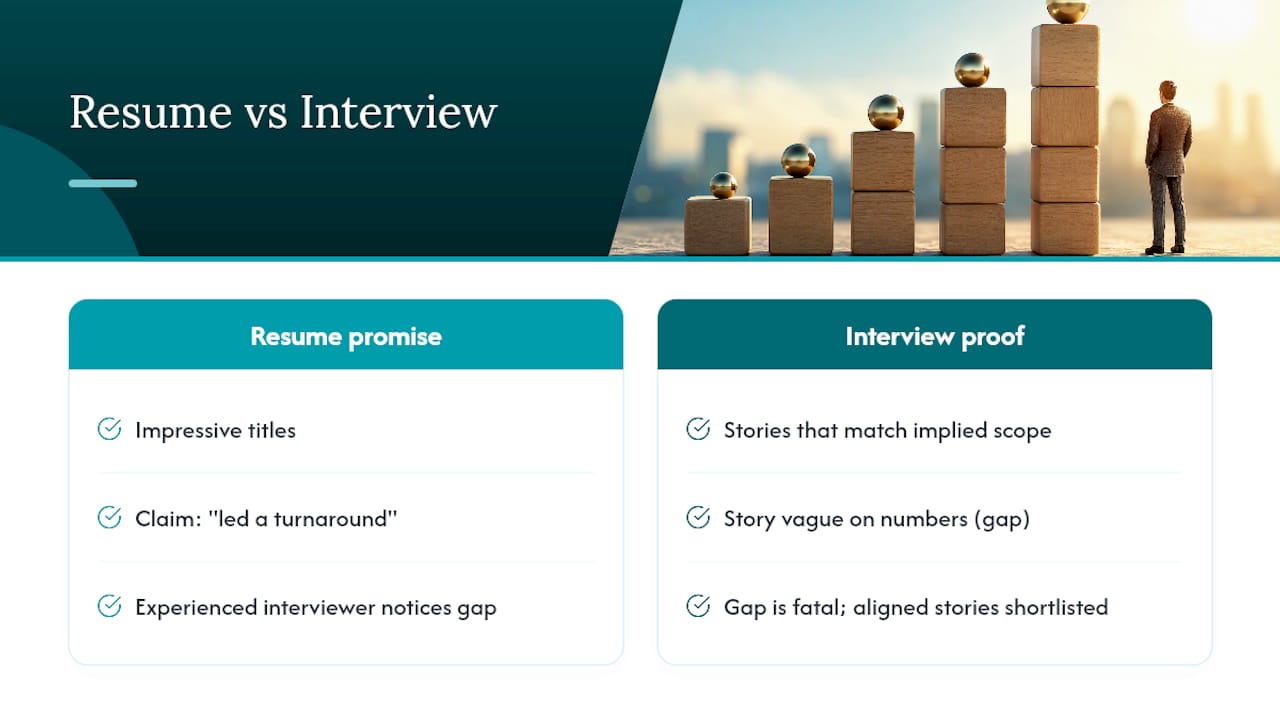
Ten years of screening executive candidates taught Kim Taynor one consistent lesson: the candidates who get shortlisted aren’t the ones with the most impressive titles. They’re the ones whose interview stories match what their resume and LinkedIn profile already imply about their scope of impact. If your resume claims you “led a turnaround” but your interview story is vague on numbers, that gap is the first thing an experienced interviewer notices, and it’s fatal.
The fix isn’t more polish. It’s alignment between what your documents promise and what your stories prove under questioning.
Kim
Get Ready For The Room, Not Just The Questions
Knowing the questions is half the work. The harder half is rehearsing your six to eight stories out loud until the scope, the trade-off, and the number come out without hesitation, and that’s exactly where most self-prep breaks down. Mock panel sessions can be run around the competency categories covered above, stories can be annotated similar to the sample answers here, and a 30-60-90 plan can be drafted tailored to the actual job posting rather than a generic template.

It is important to ensure that your resume and LinkedIn profile tell the same story your interview answers will tell, so a panel never catches a gap between what’s on paper and what comes out of your mouth. If you’re heading into executive interviews in the next few weeks, start with a session at Resumewiz to get your stories stress-tested before a real panel does it for you.
Want a recruiter in your corner for your next senior role? Book a free call with Resume Wiz and we will map out your next move together.
Sources
For deeper prep, SHRM’s C-suite interview question guide covers rubric-based scoring in more detail. AssessYou’s breakdown of what senior panels assess explains the judgment-under-uncertainty framing referenced throughout this piece. BambooHR’s guide to senior leadership interviews covers competency mapping from the interviewer’s side.
