12 Board Ready Executive Resume Achievements Recruiters Notice
A high-impact executive achievement is a one-line before→after that names your scope, whether that’s P&L size or headcount, states your action, and closes with a measurable result. Skip the mission-statement language and the vague verbs. Recruiters read scope and numbers first, everything else second.
Key Takeaways:
- Executive achievement bullets should focus on scope, numbers, and measurable impacts, such as revenue growth, cost savings, or team size, to quickly convey impact.
- Prioritize metrics related to business outcomes like revenue, EBITDA, margins, or organizational scope, pairing percentage improvements with absolute figures when possible.
- Structure accomplishments using the Challenge, Action, Result framework and include a timeframe to demonstrate how quickly results were achieved.
- Avoid vague language and duties; instead, highlight specific, defendable numbers and scope signals that show leadership over functions or entire companies.
- Conduct a three-step resume audit (size, quantify, and contextualize) before submission to ensure all bullets clearly communicate scope, impact, and relevant results.
Table of Contents
- What Are Executive Resume Achievements, and How Do They Differ From Responsibilities?
- What Metrics Should You Use to Quantify Executive Achievements?
- How Do You Structure a Board-Ready Achievement Bullet?
- Which Metrics Fit Your Specific Executive Function?
- What Do Strong Executive Achievement Statements Actually Look Like?
- What Mistakes Weaken Executive Achievement Statements?
- Why Recruiters Respond to This Method
- The Three-Step Audit Before You Submit Your Resume
- Get Hands-On Help Turning Your Career Into Board-Ready Bullets
- Sources
- FAQ
What Are Executive Resume Achievements, and How Do They Differ From Responsibilities?
A responsibility describes what you were supposed to do. An achievement describes what happened because you did it well. “Oversaw the finance team” is a duty. “Led a 22-person finance team through a $340M budget cycle, cutting close time from 12 days to 4” is an achievement, and it’s the kind of line hiring committees actually remember.
The scale gap matters more at the executive level than anywhere else in a resume. A director-level bullet might mention a department budget. A CFO-level bullet needs to mention the whole P&L, the number of business units it touched, or the geography it covered. That scope signals whether you’ve run a function or run a company, and executive resume guidance consistently points to scope and impact as the fastest way recruiters size up a candidate.
Two quick rewrites show the pattern:
- Operations: “Responsible for supply chain operations” becomes “Restructured a 6-country supply chain, cutting lead times 31% and freeing $4.2M in working capital.”
- Technology: “Managed IT infrastructure” becomes “Consolidated infrastructure across 3 data centers, reducing annual cloud spend by $1.1M while improving uptime to 99.95%.”
What Metrics Should You Use to Quantify Executive Achievements?
Numbers earn trust, but only when they’re the right numbers for the role. Resume guidance from Indeed recommends quantifying results wherever possible, and at the executive level that means picking metrics tied to business outcomes, not activity.
Prioritize in roughly this order:
- Revenue and P&L impact: total revenue managed, revenue growth, EBITDA improvement.
- Cost savings and margin: dollars saved, percentage margin gained, cost-per-unit reduction.
- Headcount and organizational scope: team size, span of control, number of direct reports or business units.
- Cycle time and efficiency: days to close, time to market, process cycle reduction.
- Quality and reliability: defect rate, uptime, customer retention.
- Growth metrics for revenue-facing roles: ARR, ACV, pipeline value.
Pro Tip: *Pair a percentage with an absolute number when you can.
When you don’t have the exact figure, use a defensible range rather than guessing at false precision. Saying “reduced operating costs by an estimated 15 to 20%” and being ready to explain how you arrived at that number protects your credibility in an interview far better than a suspiciously round number you can’t back up.
How Do You Structure a Board-Ready Achievement Bullet?
CCAR, short for Challenge, Context, Action, Result, is the framework federal executive core qualification writers use to structure high-stakes accomplishment records, and it compresses well onto a single resume line. The ECQ accomplishment format walks through this exact structure for senior government roles, and the same logic applies to a corporate C-suite bullet: state the challenge fast, skip most of the context, lead with your action, and land on the result.
Three annotated examples:
- Finance: Challenge (working capital was tied up in aging receivables) + Action (led an AR restructuring across 4 regions) + Result (“Freed $6.8M in working capital within 9 months.”)
- Operations: Challenge (plant downtime was eating margin) + Action (redesigned maintenance scheduling for 3 facilities) + Result (“Cut unplanned downtime 40%, adding an estimated $2.3M to annual output.”)
- Product: Challenge (adoption had stalled post-launch) + Action (repositioned the go-to-market plan for a flagship product) + Result (“Grew active users from 40,000 to 210,000 in 14 months.”)
Add a timeframe to every bullet. It answers the unspoken question every recruiter has, “how fast did this happen,” without needing extra words. If a figure is confidential, round it or describe it as a percentage change instead of dropping it entirely.
Which Metrics Fit Your Specific Executive Function?
The same resume language that impresses a sales committee can undercut credibility for an operations or R&D leader, because each function has its own fluency signals. Matching the metric to the discipline is what makes a bullet read as insider knowledge instead of generic corporate copy.
- Operations: inventory turns, cycle time reduction, working capital freed, defect rate decline.
- Technology and R&D: system uptime, release cadence, tool or vendor rationalization, cost per deployment.
- Sales and commercial: ARR or ACV growth, pipeline value lift, average deal size change, channel or market expansion.
- People and HR: retention rate improvement, time-to-hire reduction, leadership bench growth, internal promotion rate.
A CTO who reduced a sprawling software stack from 140 tools to 96, saving $1.4M annually, demonstrates judgment far more convincingly than a line claiming vague “digital transformation.” Specific tool counts and dollar figures read as lived experience. Generic transformation language reads as a template.
What Do Strong Executive Achievement Statements Actually Look Like?
Here are 12 anonymized examples across common executive roles, each built on the same before→after skeleton so you can swap in your own numbers.
- CEO: “Grew annual revenue from $80M to $142M over 3 years while expanding EBITDA margin from 9% to 15%.”
- CFO: “Restructured debt across a $200M portfolio, reducing interest expense by $3.1M annually.”
- COO: “Streamlined logistics across 12 distribution centers, cutting delivery time from 5 days to 2.”
- CTO: “Migrated legacy infrastructure to cloud-native architecture, reducing annual IT spend by 28%.”
- CMO: “Rebuilt brand strategy, lifting qualified lead volume 65% year over year.”
- VP Sales: “Expanded enterprise pipeline from $4M to $19M in 18 months.”
- VP Operations: “Reduced defect rate from 3.2% to 0.6% across 4 manufacturing lines.”
- Head of HR: “Cut time-to-hire from 52 days to 29 while lowering first-year attrition 18%.”
- Head of Finance: “Led a finance transformation covering $340M in annual spend, cutting close time from 12 to 4 days.”
- VP Product: “Launched 3 new product lines generating $22M in first-year revenue.”
- Transformation Lead: “Directed a 9-month reorganization across 6 business units, reducing overhead by $5.4M.”
- General Manager: “Grew regional market share from 11% to 19% over 2 years.”
Each of these works in two forms: a resume bullet for the experience section, and a compressed board-summary line for your executive profile at the top of the page.
What Mistakes Weaken Executive Achievement Statements?
Six mistakes show up constantly on senior-level resumes, and each has a quick fix.
- Vague language (“drove results”) → name the specific metric that moved and by how much.
- Duties dressed up as achievements (“responsible for P&L”) → add the outcome: “grew P&L from $50M to $68M.”
- Unverified or inflated percentages → use a range you can defend in an interview instead of a precise-sounding guess.
- Passive voice (“revenue was increased by”) → lead with your action: “increased revenue by.”
- Irrelevant early-career detail crowding out recent wins → cut anything more than 15 years old unless it’s the single strongest line you have.
- No scope signal (missing team size, budget, or geography) → add one scope marker to every bullet in your most recent role.
If a figure is covered by an NDA, describe direction and magnitude instead of the exact dollar amount: “reduced costs by double digits” still communicates far more than silence.
Why Recruiters Respond to This Method
Resumewiz founder Kim Taynor built this approach on more than a decade of recruiting experience, watching hiring committees scan resumes for exactly two things first: scope and result. Recruiters don’t read job descriptions closely. They scan for P&L size, headcount, and a number that moved.
Resumewiz’s resume writing and coaching services exist to turn a list of duties into claims that survive that scan, and into stories a candidate can defend confidently in an interview when a hiring manager asks “walk me through that number.”
The Three-Step Audit Before You Submit Your Resume
Before you send anything out, run every bullet through three checks: Size it (does this line carry a scope marker, like team size or budget), quantify it (is there a number, not an adjective), and contextualize it (does the reader understand why the result mattered to the business, not just that it happened).
Prioritize your most recent role first, then anything that would appear on a board summary or executive profile. Those are the lines a hiring committee reads before they decide whether to keep reading at all.
Once the numbers are on the page, corroborate them against whatever records you can still access. Then prepare a short verbal version of each one. If you can’t explain how you arrived at a figure in thirty seconds, it’s not ready for the resume yet.
Kim
Get Hands-On Help Turning Your Career Into Board-Ready Bullets
Most executives know their numbers. Turning them into bullets a hiring committee reads in under ten seconds is the harder part, and it’s where Resumewiz’s over 10 years of recruiting experience does the heavy lifting instead of you guessing at phrasing alone.

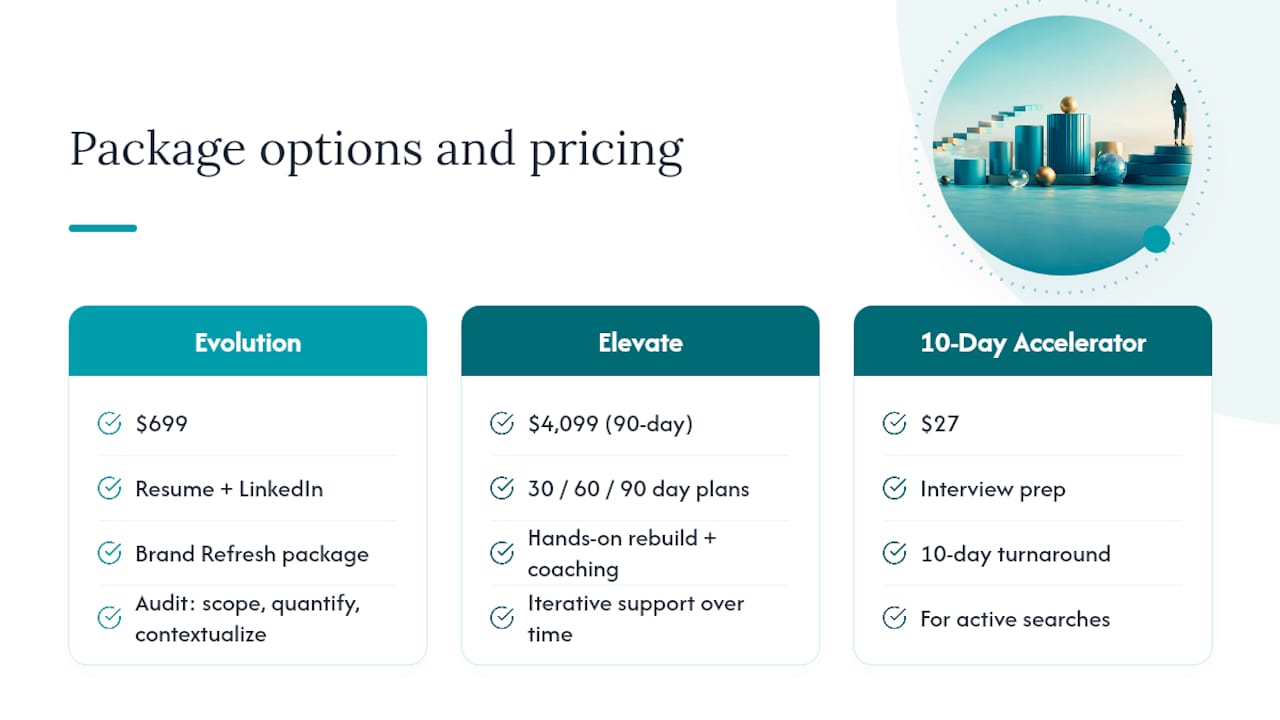
If your resume and LinkedIn profile both need a rewrite around quantified achievements, the Evolution package covers both for $699. For a more hands-on rebuild that includes coaching and iteration over time, see the Elevate packages. If you’re closer to an active search and want interview prep fast, Elevate is built for exactly that.
Every engagement starts with the same audit outlined above: scope, quantify, contextualize. Book a look at your current resume and see which lines are already board-ready and which ones are still duties in disguise.
Want a recruiter in your corner for your next senior role? Book a free call with Resume Wiz and we will map out your next move together.
Sources
For readers who want to go deeper on the frameworks and examples referenced here:
- Executive resume examples and what makes them work (Empire Resume)
- Listing accomplishments on your resume (Indeed)
FAQ
What Are Good Achievements to Put on an Executive Resume?
The strongest ones name your scope (budget, headcount, or geography), your specific action, and a measurable result, ideally as a before→after comparison. A line like “grew regional market share from 11% to 19% over 2 years” outperforms a general claim about leadership or vision every time.
Can You Give Examples of Personal Achievements for a Resume?
Personal achievements matter less than professional ones on an executive resume, but if you include them, quantify them the same way: completed certifications, board or advisory roles, published thought leadership, or measurable community leadership with a defined scope. Keep them brief and place them below your professional accomplishments.
What Is a Good Executive Summary for a Resume?
A strong executive summary opens with your scope, states your signature achievement, and closes with your value proposition, all in three or four lines. Forbes Coaches Council guidance recommends this structure specifically to avoid generic “results-driven leader” openings that tell a reader nothing.
How Should I Write Achievements Versus Responsibilities on My Resume?
Write responsibilities as short context, one line at most, then follow with two or three achievement bullets that quantify what you did with that responsibility. Resumewiz’s approach leads with the achievement and folds the responsibility into it, since recruiters spend more time on outcomes than on job descriptions.
How Many Achievements Should Be on an Executive Resume?
Aim for three to five quantified achievements per role, with more weight on your most recent one or two positions. Older roles can shrink to a single strong line, since recency and relevance matter more than volume at the executive level.
