Executive Resume Not Getting Results? Fix This First
An executive resume not getting results is almost always a failure to prove clear, measurable leadership impact within the first few seconds of review. You may have decades of experience, a track record of P&L ownership, and cross-functional leadership at scale. None of that matters if your resume fails to communicate it immediately and in the right format. Applicant Tracking Systems filter out 75% of resumes before a human ever reads them, and the recruiters who do see your document spend only six to seven seconds on an initial scan. The gap between your experience and your interview count is almost never about qualifications. It is about presentation, alignment, and technical compliance.
Why your executive resume is not getting results
The core problem is structural. Most senior professionals write resumes as career biographies, listing roles, responsibilities, and tenure in chronological order. Recruiters and hiring committees at the executive level do not read for history. Robert Half confirms that recruiters scan executive resumes for what was owned, the scale of responsibility, and measurable change delivered. A biography does not answer those questions. A marketing document does.
Think of your resume as a landing page, not a LinkedIn profile printout. The opening section must communicate your highest-value leadership proposition immediately, before the reader scrolls or clicks away. If your summary reads like a job description or a list of soft skills, you have already lost the recruiter’s attention. The fix starts with reframing the entire document around proof of fit, not proof of employment.
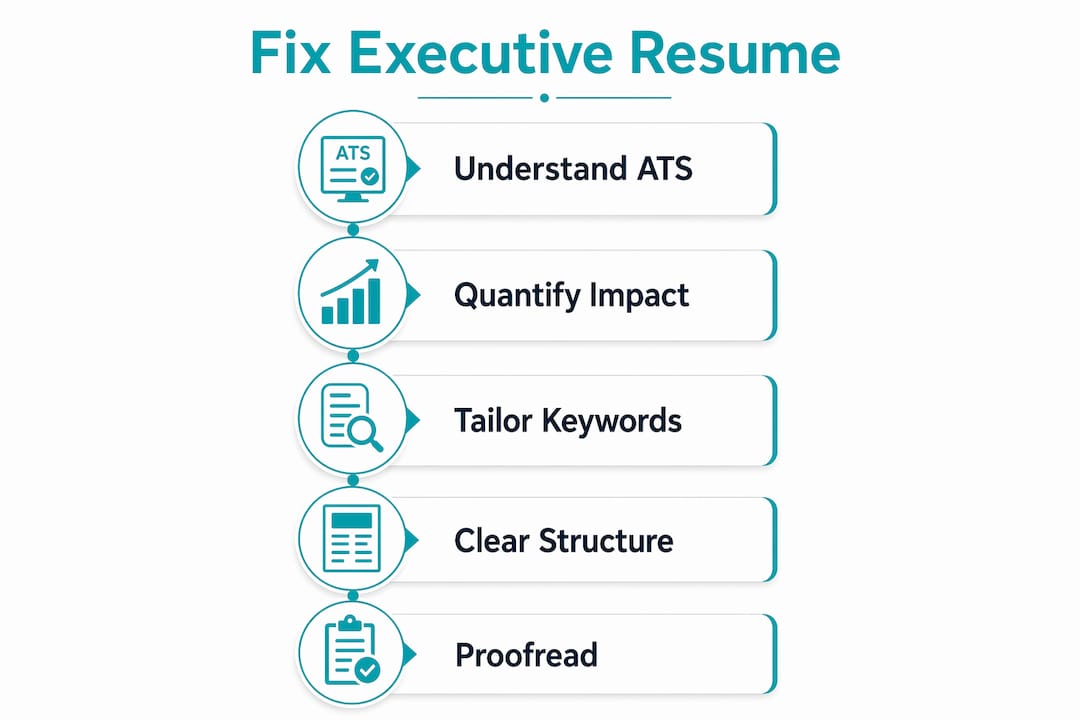
Two failure modes account for most cases of a resume not attracting interviews at the executive level. The first is technical: the resume fails ATS parsing and never reaches a human. The second is strategic: the resume reaches a recruiter but fails to demonstrate role alignment in the first third of the page. Both problems are fixable, and fixing them requires understanding how each gatekeeper evaluates your document.
How ATS systems filter executive resumes before anyone reads them
Applicant Tracking Systems are the first audience for your resume, and they read very differently from humans. ATS software parses your document into structured fields, then scores it against the job description using keyword matching. A resume with the right experience but the wrong format can score near zero.
Single-column layouts achieve roughly 93% parsing accuracy, while multi-column formats drop to around 86%, with the skills section taking the hardest hit. That gap is large enough to cost you the interview. Tables, text boxes, headers and footers, and graphics all create parsing errors that cause your content to disappear from the ATS record entirely.
The most common technical mistakes executives make include:
- Using a two-column layout to make the resume look polished and modern
- Placing contact information inside a header or footer, where ATS systems often cannot read it
- Embedding skills or certifications inside tables or text boxes
- Using special characters, icons, or logos as visual elements
- Saving the file in a format other than .docx or .pdf when the job posting does not specify
Pro Tip: Use a tool like Jobscan to upload your resume and the target job description together. It scores your keyword match rate and flags formatting issues before you apply, giving you a concrete number to improve rather than guessing.
Keyword placement is equally important. Each primary keyword should appear two to three times across your resume, placed strategically in the summary, a core competencies section, and within your achievement bullets. Tools like Jobscan and Resume Worded compare your document against the specific job description and surface the exact terms you are missing. This is not about stuffing words. It is about matching the language the hiring organization uses to describe the role.
Why leadership impact matters more than career history
Once your resume clears the ATS, it faces a recruiter who will decide in seconds whether to read further. The first third of the first page must mirror the job description’s leadership scope to avoid being passed over. That means your executive summary and your first two or three bullet points carry most of the weight.
Recruiters evaluating senior candidates are not looking for a comprehensive career history. They are looking for answers to three questions: What did you own? How big was it? What changed because of you? Generic duty lists do not answer any of those questions.
“Executive resumes function as marketing documents focused on proving fit and credibility, not biographies.” Robert Half
Here is what strong executive positioning looks like in practice. Instead of writing “Responsible for leading the North American sales organization,” you write “Led 220-person North American sales organization across 14 markets, growing revenue from $480M to $710M in three years.” The second version answers all three recruiter questions in one sentence. It names the scope, the scale, and the result.
Executives must quantify leadership scope with numbers that express team size, budget ownership, geographic reach, and business outcomes. Numbers reduce risk for boards and hiring committees. They signal judgment, not just activity. Your executive profile at the top of the document is your leadership snapshot. It should name your functional domain, the scale at which you operate, and the type of transformation or growth you deliver. Three to five sentences, no soft skills, no buzzwords.
Showcase leadership that crosses departmental lines. A VP of Operations who also drove a digital transformation initiative, reduced supply chain costs by 18%, and built a vendor partnership program is a far more compelling candidate than one who lists operational oversight as a core responsibility. Cross-functional impact at scale is what separates executives from managers on paper.
Common executive resume mistakes that kill your credibility
Most of the damage happens at the content level, not the formatting level. Forbes advises targeting your resume to the role and removing errors that reduce perceived fit and credibility. The following mistakes appear repeatedly in executive resumes that fail to generate interviews:
- Listing duties instead of achievements. “Managed a team of 40” tells a recruiter nothing about what you accomplished. “Built a 40-person product team from scratch, reducing time-to-market by 30% over 18 months” tells them everything.
- Missing quantified results. Generic summaries and duty-based bullets lead to early rejection. Every bullet point at the executive level should contain at least one number: a percentage, a dollar figure, a headcount, or a timeframe.
- Untailored summaries. A generic objective statement or a summary that could apply to any executive in your field signals that you did not read the job description. Recruiters notice immediately.
- Inconsistent formatting. Inconsistent formatting signals carelessness and reduces recruiter confidence. Mismatched fonts, inconsistent date formats, and irregular spacing all communicate a lack of attention to detail at the exact moment you need to project executive precision.
- Ignoring the job description’s qualifications section. If the role requires P&L ownership above $50M and your resume never mentions a budget figure, you have failed to address the most basic screening criterion.
- Unexplained gaps or missing contact details. A missing LinkedIn URL or an unexplained two-year gap raises questions that a recruiter will not take the time to resolve. Address gaps briefly and directly.
Pro Tip: Read your resume as if you are a recruiter who has never met you. Ask: “Does this document prove, with numbers, that this person can do the specific job I am hiring for?” If the answer is no, rewrite before you apply.
How to tailor your executive resume for each application
Tailoring is the highest-return activity in any executive job search strategy, and it is also the most skipped. Forbes confirms that tailoring resumes precisely to the job description’s leadership priorities yields better ATS scores and stronger recruiter interest. The process does not require rewriting your entire resume for every application. It requires strategic adjustments to the sections that matter most.
Use this approach for each role you target:
- Copy the job description into a separate document and highlight every leadership requirement, functional skill, and business priority mentioned
- Compare those terms against your current resume and identify gaps in language, not experience
- Rewrite your executive summary to mirror the top two or three priorities in the job description, using the organization’s own language where possible
- Adjust your top three to five bullet points to emphasize results that directly address the role’s stated business challenges
- Add a core competencies or areas of expertise section that reflects the keywords from the posting, placed near the top of the document for both ATS and recruiter visibility
- Check that your LinkedIn profile matches your resume titles, dates, and key claims exactly, since recruiters cross-reference both
For matching your resume to a job description, the goal is not to copy the posting word for word. It is to demonstrate that your leadership experience maps directly onto what the organization needs right now. Apply only to roles where you meet at least 70 to 80 percent of the stated qualifications. Applying broadly to roles where you are underqualified wastes time and dilutes your positioning.
Your resume headline is also part of the tailoring equation. A headline like “Chief Operating Officer | P&L Leadership | Supply Chain Transformation” communicates your domain and your value in under ten words, giving both ATS systems and recruiters an immediate frame for everything that follows.
Key takeaways
An executive resume fails to generate interviews when it cannot prove clear, measurable leadership impact and role alignment within the first few seconds of review.
| Point | Details |
|---|---|
| ATS compliance is non-negotiable | Use single-column layouts, standard headings, and .docx or .pdf format to avoid parsing failures. |
| Quantify every leadership claim | Include team size, budget, revenue impact, and geographic scope in every major bullet point. |
| Tailor the top third of each resume | Rewrite your summary and top bullets to mirror the specific job description’s leadership priorities. |
| Fix formatting inconsistencies | Mismatched fonts, irregular dates, and spacing errors reduce recruiter confidence at the senior level. |
| Test before you apply | Run your resume through Jobscan or Resume Worded to identify keyword gaps before submitting. |
What I have learned after 10 years of reviewing executive resumes
After a decade of recruiting and working directly with senior professionals on their job search strategies, the pattern I see most often is this: the executive who is most frustrated is usually the one with the strongest actual track record. The resume is the problem, not the career.
The most common mistake I see is burying the lead. Executives spend the first half of their resume establishing context and history, then mention their biggest win in a single bullet point on page two. Recruiters never get there. Your most impressive, most relevant achievement belongs in your summary or in the first bullet under your most recent role. Full stop.
I also see executives resist tailoring because it feels like misrepresenting themselves. It is not. Tailoring is translation. You are taking the same experience and expressing it in the language the hiring organization uses to describe what they need. If you led a “digital transformation” but the job description calls it “technology-enabled operational change,” use their phrase. You are not changing your story. You are making it legible to the right audience.
The executives who get results treat their resume like a product going to market. They test it, get feedback, revise it, and measure the output in interview invitations. If you have sent out 20 applications with zero responses, that is data. It means something in the document is not working, and the answer is to diagnose and fix it, not to send 20 more applications.
Kim
How Resumewiz helps executives turn resumes into interview invitations
If your resume is not generating the interviews your experience deserves, the issue is almost always fixable with the right expertise applied to the right problems. Resumewiz specializes in executive resume development for senior professionals who need more than a template. The team combines ATS compliance expertise with leadership storytelling to produce documents that clear automated filters and hold recruiter attention. Services include keyword optimization mapped to target job descriptions, impact-focused rewriting of achievement bullets, and executive profile development that communicates your leadership scope immediately. If you are ready to stop guessing why your applications are not converting, Resumewiz offers the targeted support that gets measurable results.
Want a recruiter in your corner for your next senior role? Book a free call with Resume Wiz and we will map out your next move together.
FAQ
Why is my executive resume not getting interviews?
The most common causes are ATS filtering due to formatting errors and keyword gaps, or a resume that lists duties instead of quantified leadership achievements. 75% of resumes are filtered out before a recruiter sees them, so technical compliance is the first problem to solve.
How do I improve my executive resume for ATS?
Use a single-column layout, standard section headings, and avoid tables, text boxes, and graphics. Run your resume through Jobscan to identify missing keywords from the target job description before applying.
What should an executive resume summary include?
Your summary should name your functional domain, the scale at which you operate (team size, budget, revenue), and the type of business outcome you deliver. Three to five sentences with no soft skills or generic phrases.
How often should I tailor my executive resume?
Tailor the summary and top bullet points for every application. Tailoring to the job description’s leadership priorities improves both ATS scores and recruiter relevance, and the adjustment takes 20 to 30 minutes per application when your base document is strong.
How long should an executive resume be?
Two pages is the standard for most executive roles. A third page is acceptable for candidates with 25 or more years of directly relevant experience, board positions, or extensive publication and speaking records.
