Executive resume vs standard resume: win more interviews
Making the jump from senior professional to executive is one of the most significant career moves you’ll ever make, and your resume is the first test you’ll face. Most candidates assume they can update their existing resume with a fancier title and a few new bullet points. That assumption quietly kills more executive job searches than almost any other mistake. The strategic gap between a standard resume and an executive resume is real, measurable, and something hiring committees notice within seconds of reviewing your application.
Table of Contents
- What is the difference between executive and standard resumes?
- Core elements of an executive resume
- Common mistakes when transitioning to an executive resume
- How to optimize your resume for executive interviews
- Our perspective: what most executive candidates miss
- Optimize your executive resume with Resume Wiz
- Frequently asked questions
Key Takeaways
| Point | Details |
|---|---|
| Executive resumes emphasize leadership | Leadership impact and strategic vision are essential for executive resume success. |
| Standard templates miss key details | Using a standard resume format can fail to highlight the achievements and qualities needed for executive roles. |
| Optimization is a structured process | Tailoring your resume for executive interviews involves auditing, rewriting, and benchmarking against industry leaders. |
| Avoid common mistakes | Transitioning to an executive resume requires avoiding errors such as over-filling with skills or using generic templates. |
| Professional support is available | Services like Resume Wiz help ensure your resume stands out for executive opportunities. |
What is the difference between executive and standard resumes?
A standard resume tells a hiring manager what you’ve done. An executive resume tells the board, the CEO, or the executive search firm what you can transform. That’s not a subtle difference in tone. It’s a completely different communication strategy.
Standard resumes are built around job responsibilities, skills lists, and a linear career timeline. They work well when a recruiter needs to confirm that you’ve held the right roles and have the relevant technical qualifications. For mid-level professionals, that approach is perfectly appropriate. The goal is to show fit.
Executive resumes operate at a different level. According to best practices for writing resumes for executives, the document needs to establish strategic leadership, organizational vision, and business impact before anything else. The reader isn’t checking a list of qualifications. They’re evaluating whether you can lead an enterprise.
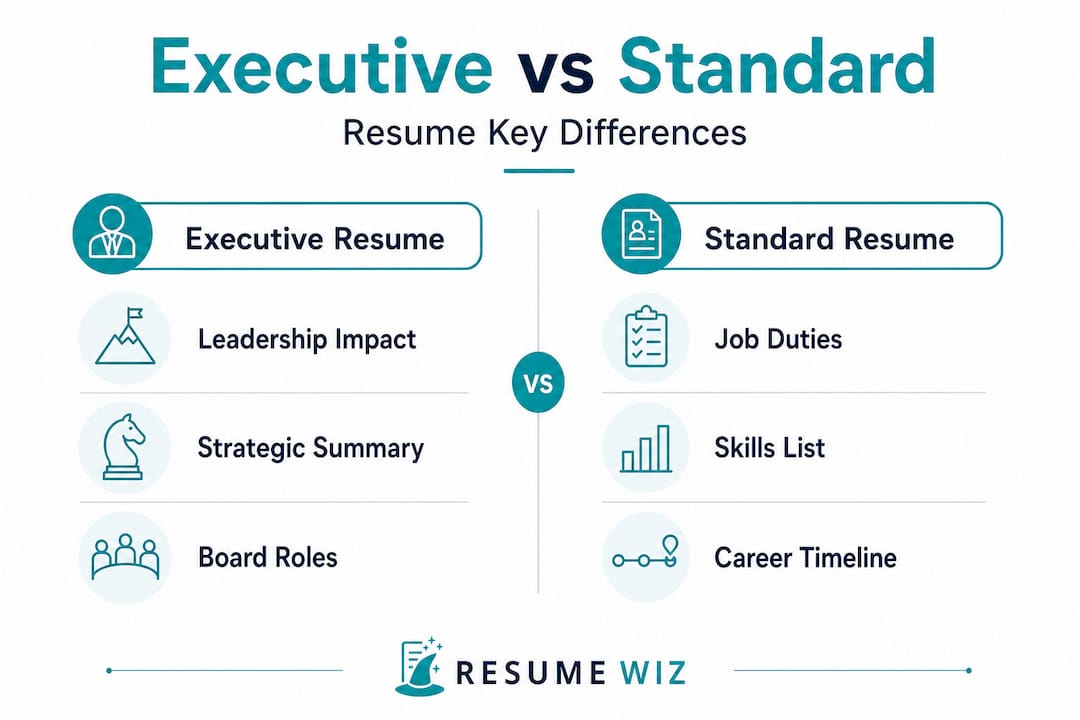
Here’s a comparison that makes the distinction concrete:
| Element | Standard resume | Executive resume |
|---|---|---|
| Primary focus | Responsibilities and skills | Strategic impact and leadership vision |
| Length | 1 to 2 pages | 2 to 3 pages |
| Opening section | Objective or career summary | Executive value proposition |
| Achievement framing | Task completion | Revenue, growth, and organizational change |
| Keywords | Job description keywords | Board-level and industry-specific terminology |
| Tone | Professional and functional | Authoritative and strategic |
| Audience | HR screeners, ATS systems | Executive search firms, C-suite, board members |
One of the most persistent misconceptions is that an executive resume is simply a longer version of a standard one. In reality, the length difference is the least important distinction. You could write a three-page executive resume that still reads like a junior-level document if it focuses on activities rather than outcomes. The executive resume tips that actually move the needle are about strategic positioning, not page count.
“An executive resume isn’t a history of your career. It’s a business case for why you are the right leader for this specific challenge.”
This framing changes everything. Once you see the document as a business argument rather than a biographical record, the content decisions become much clearer.
Core elements of an executive resume
Having clarified the main differences, it’s vital to understand what makes an executive resume truly effective. The right structure sends the right signals before a decision-maker reads a single sentence.
Strategic summary statement. This is your opening paragraph, and it carries enormous weight. A weak summary reads like a job description: “Results-oriented leader with 15 years of experience in operations.” A strong executive summary positions you as a solution: “Operations executive who reduced supply chain costs by 34% while scaling capacity to support $2B in new revenue.” Notice the specificity. Notice the scale. That’s what the executive audience expects.
Quantified achievements. Generic claims about “driving growth” or “improving performance” are meaningless without numbers. The modern executive resume strategies that consistently land interviews are built on hard metrics. Revenue generated. Cost eliminated. Teams built and led. Market share gained. Every claim should connect to a measurable result.
Board and leadership credentials. If you have served on advisory boards, nonprofit boards, or industry committees, that information belongs prominently on an executive resume. Standard resumes often bury this or leave it out entirely. For executive audiences, board visibility signals that peers at a senior level already trust your judgment.
Market-driven keywords. ATS systems filter executive applications just as aggressively as entry-level ones. However, the keywords that matter at the executive level are different. Terms like “P&L ownership,” “enterprise transformation,” “stakeholder alignment,” and “corporate governance” carry weight in executive search contexts. Generic skills like “team player” or “strong communicator” do not.
Here’s what a well-structured executive resume includes:
- Executive value proposition (opening summary, 4 to 6 lines)
- Core competencies or leadership capabilities (8 to 12 keywords)
- Professional experience with achievement-focused bullet points
- Education and executive development programs
- Board affiliations and professional associations
- Selected achievements or career highlights section (optional but powerful)
Pro Tip: Executive search firms use their own screening criteria that go beyond standard ATS filters. Before you submit, research the firm handling the search and align your language with the industries and leadership models they prioritize. A small adjustment in vocabulary can dramatically increase your visibility.
Studies consistently show that executive resumes with metrics receive significantly more callbacks than those without, because quantified claims are far easier for decision-makers to evaluate and compare across candidate pools.
Common mistakes when transitioning to an executive resume
Even if you understand the right elements, many candidates fall into common traps. Knowing what to avoid is just as important as knowing what to include.
1. Using a standard template with minor tweaks. This is the most common mistake and the hardest to see from the inside. When you’ve been using the same resume format for 10 to 15 years, it feels professional and polished. But a template designed for a project manager doesn’t communicate executive authority, regardless of what titles you add to it. The visual hierarchy, the section structure, and the content framing all need to shift.
2. Failing to demonstrate leadership impact. Many experienced professionals describe their work in terms of participation rather than ownership. Phrases like “contributed to,” “assisted with,” or “was involved in” signal a supporting role, even when the reality was senior leadership. Executive resumes require you to own your results directly and clearly.
3. Leaving out strategic vision. Hiring at the executive level isn’t just about what you’ve achieved. It’s about how you think. Decision-makers want evidence that you see around corners, anticipate market shifts, and make bold bets that pay off. Your resume needs narrative threads that show strategic thinking, not just a list of successful projects.
4. Underestimating the value of board roles and external leadership. Candidates often focus so heavily on their day-to-day roles that they forget to mention the board memberships, advisory positions, and industry leadership roles that give them credibility in executive circles. These affiliations tell a story about how you’re regarded by your peer community. Following resume best practices for senior leaders means treating these roles as primary, not supplemental, content.
“The candidates who get noticed aren’t the ones with the most experience. They’re the ones who make their experience feel most relevant to the specific challenge at hand.”
5. Treating the resume as a universal document. Standard resumes are often generic by design, meant to work across multiple applications. Executive resumes need to be tailored more precisely, because the audience is smaller, more specific, and better at detecting a document that wasn’t written for them.
Pro Tip: Always write your executive resume for the decision-maker who matters most, whether that’s a board chair, a CEO, or an executive search partner. Then ask yourself whether every line on that document would resonate with that specific reader.
How to optimize your resume for executive interviews
Avoiding mistakes paves the way. Now it’s time to optimize your resume so it actively generates interview invitations rather than just avoiding rejection.
Step 1: Audit your current document. Read your resume through the lens of an executive search professional. Ask whether each section answers the question: “Why should we trust this person to lead at the highest level?” If a section only answers “What did this person do?”, it needs to be rewritten.
Step 2: Reframe every achievement around business outcomes. Go through each bullet point and identify the business result. If you managed a team of 20, what did that team accomplish? If you launched a product, what was the revenue impact? Replace activity-based language with outcome-based language throughout.
Step 3: Add a selected achievements section. This is one of the most powerful structural changes you can make. A short section near the top of your resume, separate from your job history, that highlights your four or five most impressive career-level results. This section is the first thing executive search professionals often read after the summary.
Step 4: Refine your keyword strategy. Pull job descriptions for the executive roles you’re targeting and identify the language patterns. Map those patterns to your own experience and adjust your vocabulary accordingly.
Here’s how different optimization strategies correlate with interview outcomes:
| Resume strategy | Impact on interview rate |
|---|---|
| Quantified achievements throughout | High positive impact |
| Tailored executive summary | High positive impact |
| Board and advisory roles listed | Moderate to high impact |
| ATS-optimized keyword placement | Moderate impact |
| Generic objective statement | Negative impact |
| Responsibilities-focused bullet points | Minimal to no impact |
Pro Tip: Pull five actual interview-winning resumes from executives in your target industry and benchmark your document against them. Look at the language, the structure, and the types of achievements they highlight. Then close the gap between where your resume is and where theirs are.
The goal of this optimization process isn’t perfection. It’s differentiation. Hiring committees review dozens of qualified candidates. Your resume needs to be the one they remember after closing the folder.
Our perspective: what most executive candidates miss
With the practical steps outlined, here’s what most guides and candidates consistently overlook, and it costs them significantly.
The entire industry conversation about executive resumes focuses on format, length, and keywords. Those elements matter. But the deeper issue is one that no template can fix: most executive candidates still write from the perspective of an employee, not a leader.
Employees describe what happened to them in their career. Leaders describe what they caused to happen. That’s a storytelling difference, but it’s also a positioning difference that recruiters and boards feel immediately, even if they can’t articulate exactly why one resume feels more compelling than another.
Here’s the contrarian truth: the best executive resumes don’t list skills at all. They tell a coherent story of strategic decisions made under pressure, markets entered or exited, teams built from scratch, and organizations stabilized in crisis. Skills are implied by the achievements. You don’t need to say you’re a strong communicator if your resume shows that you led a merger negotiation across three continents.
Another thing candidates consistently underestimate is the role of narrative framing. Executive search is a relationship-driven process. The resume is often a conversation starter, not a final decision document. That means it needs to generate curiosity, not just check boxes. Candidates who receive the most calls from search firms are often those whose resumes raise interesting questions, not those whose resumes are simply the most comprehensive.
Our experience at Resume Wiz tells us that the professionals who get the fastest traction after a transition are the ones who commit fully to writing as leaders. Not as former managers who are now seeking a leadership title, but as executives who have always thought at that level. That mindset shift, reflected throughout every line of the document, is what separates a resume that generates calls from one that generates silence. Getting expert resume guidance early in your transition can accelerate this shift considerably.
Optimize your executive resume with Resume Wiz
Knowing what an executive resume requires is only the beginning. Translating that knowledge into a document that actually wins interviews takes a level of strategic clarity that’s genuinely hard to achieve on your own, especially when you’re close to your own story.

Resume Wiz offers executive-level resume development built on over 10 years of recruiting experience. Kim Taynor and her team understand exactly what executive search firms and hiring committees look for, and they build resumes that speak directly to those expectations. From ATS-compliant formatting to executive value proposition writing, every element is handled with precision. If you’re serious about making your next move count, discover Resume Wiz and see how professional executive resume support turns your experience into a compelling leadership narrative.
Want a recruiter in your corner for your next senior role? Book a free call with Resume Wiz and we will map out your next move together.
Frequently asked questions
Is a standard resume format acceptable for executive positions?
No. Executive resumes require specialized formatting, a strategic executive summary, and achievement-focused content that goes well beyond what a standard template delivers.
What makes an executive resume effective?
Clear leadership impact and vision, backed by quantifiable achievements and strategic framing, are the defining qualities that make an executive resume stand out from the competition.
How long should an executive resume be?
Most executive resumes run two to three pages, with every section earning its space through leadership credentials, high-impact achievements, and executive-level positioning.
Should I include board memberships on my executive resume?
Absolutely. Board memberships signal peer-level credibility and executive trust, which are qualities that matter enormously to hiring committees and executive search firms.
How do I quantify achievements in an executive resume?
Use specific business metrics such as revenue growth percentages, cost reductions in dollars, team sizes built, and market expansion results to make your impact concrete and credible.
