Executive Resume Writing Guide for Senior Leaders
You have led organizations, driven results, and built teams that move industries. But when it’s time to put that on paper, most executives freeze. The challenge in this executive resume writing guide is not creativity. It is translation. You need to compress decades of complex, high-stakes leadership into a document that recruiters spend roughly 11 seconds reviewing before deciding whether you advance. Add AI-powered applicant tracking systems to the mix, and the margin for error shrinks further. This guide covers exactly what you need to write a resume that gets you past both the algorithm and the human on the other side.
Table of Contents
- Key Takeaways
- The essentials of an effective executive resume
- Writing bullet points that prove leadership impact
- Customizing your resume for each opportunity
- Executive resume formatting and length
- Mistakes that quietly kill executive applications
- My honest take on executive resumes
- Ready to take your resume to the next level
- FAQ
Key Takeaways
| Point | Details |
|---|---|
| Lead with leadership proof | The first third of your first page must show scope, function, and measurable impact immediately. |
| Quantify every achievement | Replace vague descriptions with specific numbers to make your contributions undeniable. |
| Build one strong baseline | Create a core resume capturing your leadership strengths, then refine it per role rather than rewriting from scratch. |
| Format for humans and ATS | Clean layouts, consistent headers, and keyword alignment help both recruiters and automated systems find your value fast. |
| Avoid the biography trap | Your resume is not a career history. It is proof that you are the right leader for this specific role. |
The essentials of an effective executive resume
Most professionals in senior roles have not written a resume in five to ten years. When they finally sit down to do it, they default to listing job titles and responsibilities. That approach fails at the executive level. What hiring committees and search firms want is not a description of what you were hired to do. They want evidence of what you actually delivered.
The structure of an executive resume (also called a senior-level CV in some industries and markets) follows a clear hierarchy. According to Indeed’s executive CV format guidance, the core sections include contact information, a professional summary, notable achievements, work history, and education. But the order and weight of each section matters as much as the content inside it.
Your contact information and professional headline sit at the top and do more work than most executives realize. The headline should name your function, level, and a signature result. An example from Metaintro's 2026 research illustrates the point well: “Senior Product Manager, B2B SaaS, 8 years scaling subscription products from $0 to $10M ARR.” That headline tells a recruiter everything in one line.
Below the headline sits your executive profile or summary, a three to five sentence leadership snapshot. This is the most scrutinized section of the document. Recruiters expect the first third of the first page to clearly confirm alignment with the leadership scope they are hiring for. If it does not, the rest of the resume rarely gets read.
Your work experience section follows, and this is where executives most commonly underperform. Listing responsibilities reads like a job description. What belongs here is a tight set of achievement bullets for each role.
Below work experience, include a skills and competencies section with terminology drawn directly from your target roles. Then close with education, certifications, and board or advisory positions if relevant.
Here is a quick reference for each core section:
- Professional headline: Title, function, and one signature metric
- Executive profile: Four to five sentences capturing scope, style, and outcomes
- Work history: Reverse chronological, achievement-focused bullets per role
- Core competencies: Keyword-rich skills aligned to target roles
- Education and credentials: Degrees, certifications, and executive programs
- Additional sections: Board roles, publications, speaking engagements, languages
Pro Tip: Write your executive profile last. Select your strongest achievement bullets first, then craft the profile to reflect exactly what those bullets prove. This prevents the profile from becoming a generic bio disconnected from the evidence below it.
Writing bullet points that prove leadership impact
This is where resumes win or lose the interview. Not in the formatting. Not in the font choice. In the bullets.
The most effective structure for executive-level bullets follows a verb + result + context format. You did something, it produced a measurable outcome, and it required a specific capability or approach. Tuck’s resume writing framework reinforces this: use past tense for former roles, present tense for your current role, and keep each bullet to one or two lines.
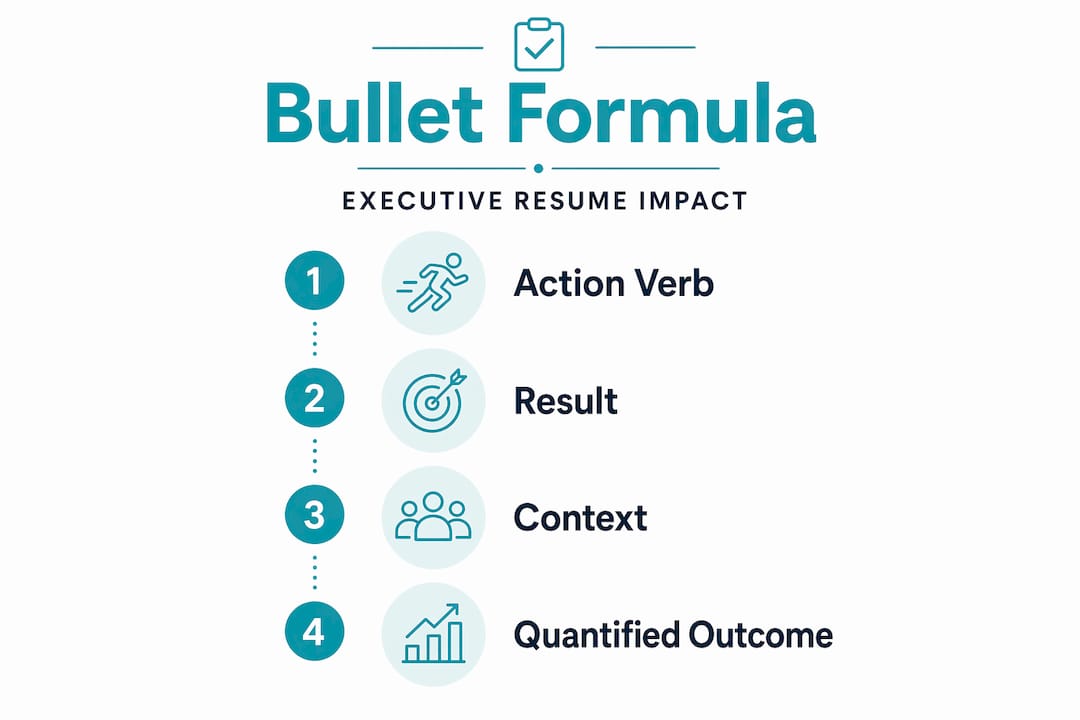
Here is the difference between a weak bullet and a strong one:
Weak: Responsible for overseeing company-wide digital transformation initiatives across multiple business units.
Strong: Led a 3-year, $18M digital transformation across 6 business units, reducing operational costs by 22% and cutting time-to-market by 4 months.
The strong version is specific. It names the investment, the scope, the result, and the timeline. A recruiter reading it can immediately picture the scale of your work. The weak version tells them nothing except that you had a title.
Every bullet should pass a simple test: could someone else have written this exact bullet? If yes, it is too generic. Your bullets should reflect your specific context, your specific numbers, your specific decisions.
Strong executive resumes use short, focused bullets with quantified outcomes and clear action verbs under consistent headers. If you genuinely cannot recall a specific number, use a percentage range, a comparative qualifier (“reduced by more than half”), or a directional metric tied to a benchmark.
Pro Tip: Prepare a raw “achievement inventory” before you write a single bullet. Pull board presentations, performance reviews, and project reports to mine actual numbers. Most executives have more quantifiable data than they realize. The inventory becomes the source of truth for every bullet you write.
Soft skills also belong in bullets, not just in a skills list. Rather than listing “change management” as a competency, show it: “Guided 400-person organization through post-merger integration with zero attrition in senior leadership ranks.” That single bullet communicates the soft skill better than any label ever could. For guidance on showcasing leadership soft skills effectively, the principle is the same: prove it, do not just claim it.
Customizing your resume for each opportunity
The biggest efficiency mistake senior executives make is treating customization as rewriting from scratch. It is not. You need one strong baseline resume that captures the full scope of your leadership, and then you make targeted refinements per application.
Here is how to do it efficiently:
- Build your baseline. Your baseline should reflect your full leadership scope, strongest achievements, and core competencies. A strong baseline resume allows for purposeful customization rather than starting over with every application.
- Analyze the job description. Read it twice. First for the overall leadership mandate. Second specifically for repeated language, technical terms, and stated priorities. These become your keyword targets.
- Refine your executive profile. Adjust two to three sentences in your profile to mirror the language and priorities from the posting. If the role emphasizes “global P&L ownership,” use that phrase.
- Reorder or swap bullets. Move your most relevant achievements to the top of each role. You do not need to rewrite them. Reorder them to match what this employer cares about most.
- Align your skills section. Add or surface specific keywords from the job description that already appear in your experience. This improves ATS match scores without changing the truth of your profile.
For a practical CV tailoring checklist that covers keyword mapping and application strategy in 2026, the framework mirrors the approach above.
Pro Tip: Create a simple two-column document for each application: the job description’s key phrases on the left, your matching resume language on the right. Gaps you spot become your editing targets. This process rarely takes more than 20 minutes once your baseline is solid.
The payoff is significant. When your language mirrors the job description, you improve ATS keyword match scores and give recruiters immediate confirmation that you understood what they were actually looking for.
Executive resume formatting and length
Length is where executives argue the most, so let’s settle it. Most executive resumes should be one to two pages. A CEO candidate with board tenure and deep cross-industry experience may stretch to three pages, but that is the exception. The rule is this: if a bullet cannot hold up in an interview, it does not belong on your resume.
The following table shows the most common formatting mistakes and what to do instead:
| Formatting mistake | Better approach |
|---|---|
| Dense paragraph blocks in work history | Use two to four achievement bullets per role |
| Inconsistent fonts and heading sizes | Pick one font family, two sizes maximum |
| Missing white space between sections | Add 8 to 12 points of spacing between sections |
| Decorative graphics or columns | Use plain, single-column layouts for ATS compatibility |
| Dates buried at the end of bullets | Place dates at the right margin in consistent format |
| Outdated GPA or early career jobs | Remove anything more than 20 years old unless highly relevant |
Clean design is not minimalism for its own sake. It is a signal. It tells a recruiter that you know what matters. Executive resume formatting should prioritize scannability above everything else. Headers should be bold and clear. Each role should have a company name, title, location, and date block that a recruiter can parse in under three seconds.
Pro Tip: Save your final resume as a plain .docx or ATS-safe PDF. Avoid tables, text boxes, and headers built inside design software. ATS platforms often cannot parse these elements, and your strongest content disappears from the system entirely.
Mistakes that quietly kill executive applications
Even experienced senior leaders make the same errors. Here is where executive-level resumes most commonly fail:
- Writing a career biography. Your resume is not a narrative of everything you have done. It is a curated argument for why you are the right hire for this role.
- Ignoring ATS alignment. Using language that differs from the job description means the system scores you lower, even when your experience is a strong match.
- Including outdated information. Early career jobs from 20-plus years ago, GPA scores, and personal details like marital status or age add noise and signal inexperience with current norms.
- Omitting quantification. “Improved performance” means nothing. “Improved gross margin by 14 points over 18 months” means everything.
- Overcomplicating the layout. Multi-column formats, infographic-style designs, and custom fonts often fail in ATS and frustrate recruiters who want information fast.
- Underselling the executive profile. A generic three-line summary wastes the most valuable real estate on your resume. This section should name your leadership identity, your scope, and your defining accomplishment in four to five strong sentences.
My honest take on executive resumes
I have reviewed thousands of executive resumes over more than a decade in recruiting. The pattern I see most often is not bad writing. It is misaligned effort. Senior leaders spend enormous time crafting prose about their day-to-day responsibilities and almost no time identifying the three or four moments in their career that genuinely changed a business trajectory.
Here is what I have learned: your strongest achievement bullets are rarely the ones you think of first. They are the ones buried in a board presentation from four years ago, or the restructuring that felt routine at the time but resulted in $30M in annual savings. Mining for those stories takes work. It is the most valuable work you will do in your job search.
I also want to push back on the conventional wisdom that AI writing tools can solve this problem. They can help you structure a bullet, check syntax, and identify keyword gaps. What they cannot do is replace the judgment call of which three bullets from your last role actually tell the right story for this specific application. That requires a human who understands your career arc and the hiring context.
The other thing I tell every executive I work with: treat the second page as “interview proof.” Do not compress mediocre bullets just to stay on one page. Either your second page carries genuine weight, or it does not deserve to exist. A tighter, stronger one-page resume almost always outperforms a bloated two-pager.
Kim
Ready to take your resume to the next level
If you have worked through this guide and you are still not confident your resume communicates the full weight of your leadership, you are not alone. Most executives find it genuinely difficult to market themselves with the same clarity they bring to business decisions.

At Resumewiz, Kim Taynor and her team specialize in exactly this work. With over a decade of recruiting experience, Resumewiz builds ATS-optimized, recruiter-ready executive resumes that capture your leadership identity and get you in front of the right decision-makers. Services range from fully managed resume development to LinkedIn profile optimization and 1:1 executive job search coaching with interview prep. Professional resume writing services at the executive level typically range from $750 to over $2,500, and the return on a faster, better-matched search pays for itself quickly. Explore what is possible at Resumewiz and move your search forward with a team that knows what hiring managers actually want to see.
Want a recruiter in your corner for your next senior role? Book a free call with Resume Wiz and we will map out your next move together.
FAQ
What should an executive resume include?
An executive resume should include a professional headline, executive profile, quantified achievement bullets in work history, a core competencies section, and education or credentials. Each section should emphasize measurable leadership outcomes tied to the target role.
How long should an executive resume be?
Most executive resumes perform best at one to two pages. Candidates at the CEO or board level with broad cross-sector experience may extend to three pages, but every bullet included must be strong enough to defend in an interview.
How do I make my executive resume ATS-friendly?
Mirror the exact language from the job description in your headline, profile, and bullets. Use a clean, single-column layout with standard section headers. Avoid graphics, text boxes, and complex formatting that ATS systems cannot read correctly.
What is the best way to tailor an executive resume for each job?
Build a strong baseline resume first, then adjust your executive profile language, reorder your most relevant bullets, and align your skills section to the specific keywords in each job description. Customization should take 20 to 30 minutes per application, not hours.
Why does my executive resume need quantified results?
Numbers eliminate ambiguity. “Reduced operating costs by 22%” is verifiable, memorable, and compelling. Vague statements like “improved efficiency” give recruiters nothing to evaluate and no reason to prioritize your application over a more specific candidate.
