Functional Resume Format for Career Changers: 2026 Guide
A functional resume is defined as a skills-based document that groups your experience under transferable skill categories rather than listing jobs in reverse-chronological order, making it a strategic tool for career changers who need to reframe their background for a new industry. Also called a skills-based resume, this format puts your most relevant abilities front and center, before a recruiter ever sees your job titles. For career changers, that distinction matters enormously. This guide covers when to use the functional resume format, how to build each section, and why a hybrid approach often delivers better results in 2026.
What is the functional resume format for career changers?
A functional resume is designed for career changers by grouping experience under skill areas rather than reverse-chronological job titles. The standard structure includes a contact header, an objective statement, three to five core skill categories with supporting examples, a brief work history, and an education section. This layout lets you lead with what you can do rather than where you worked, which is the core advantage when your past job titles don’t match your target role.
The format works because recruiters in your new field don’t know your old industry’s context. A title like “Senior Claims Adjuster” means little to a hiring manager in product management. But a skill category labeled “Data Analysis and Decision-Making” with quantified examples from that same role speaks directly to what they need. The functional structure translates your experience into language your new audience understands.
That said, the format has real limitations. ATS systems associate skills with specific job titles and dates, so a skills-only format can lower your match score before a human ever reads your resume. Understanding this tradeoff is the first step toward choosing the right format for your situation.
When should career changers use a functional vs. hybrid resume?
The honest answer is that a pure functional resume works best in a narrow set of circumstances. It fits extreme career pivots where your job titles are genuinely irrelevant, situations with significant employment gaps you need to de-emphasize, or cases where your most recent roles are in a completely unrelated field. Outside those scenarios, a hybrid format is the stronger choice for most career changers.
Functional resumes are often misread as evasive by recruiters, who want to see a transparent timeline connecting your skills to actual roles. A skills-only document raises the question: “Why are they hiding their history?” That perception alone can cost you an interview, regardless of how strong your skills are.
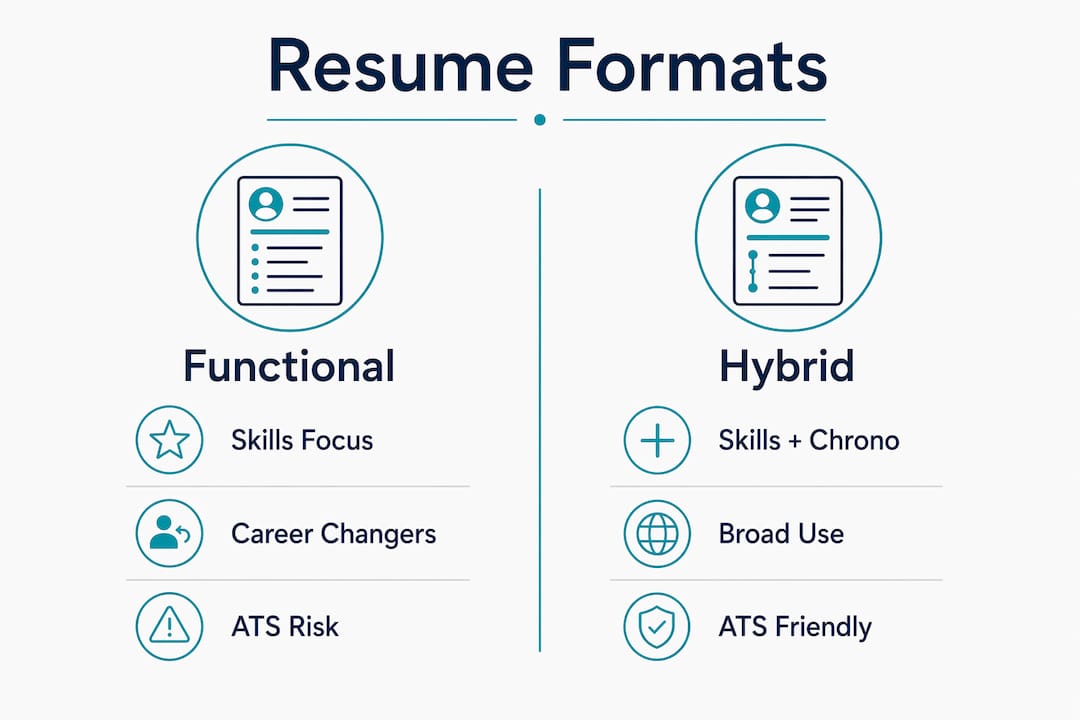
The hybrid resume solves this problem. It blends a skills-first section with chronological work history, giving ATS systems the timeline data they need while showing recruiters the transferable skills you want to highlight. Think of it as the functional format’s more credible sibling.
Here’s how the three main formats compare:
| Format | Best for | ATS compatibility | Recruiter trust |
|---|---|---|---|
| Chronological | Staying in the same field | High | High |
| Functional (skills-based) | Extreme pivots, major gaps | Low | Low to medium |
| Hybrid | Most career changers | Medium to high | High |
Pro Tip: If you’re unsure which format to use, default to hybrid. It preserves your employment timeline for ATS scoring while letting you frame transferable skills prominently at the top. Resources like Easy CV’s format guide walk through the tradeoffs in detail.
How to identify and organize transferable skills for your resume
Identifying the right skills starts with the job descriptions in your target field, not your own memory of what you’re good at. Pull five to ten postings for your target role and highlight every skill, tool, or competency that appears more than twice. Those recurring terms are the keywords your resume needs to include, both for ATS matching and recruiter relevance.
Once you have your keyword list, group them into three to five major categories using industry-standard labels. A former teacher moving into corporate training might use categories like “Curriculum Development,” “Stakeholder Communication,” and “Performance Assessment.” A finance professional pivoting to operations might use “Process Improvement,” “Budget Management,” and “Cross-Functional Leadership.” The category names themselves signal fluency in your new field’s language.
Here’s a practical workflow for building your skill categories:
- Collect five to ten job descriptions for your target role.
- Highlight every skill, tool, or requirement that appears in at least three postings.
- Group the highlighted terms into three to five thematic clusters.
- Label each cluster with an industry-standard term from your target field.
- Map two to four accomplishments from your past roles to each cluster.
- Quantify each accomplishment with a number, percentage, or dollar figure where possible.
Each skill category needs supporting evidence, not just a label. Concrete examples with quantified achievements under each skill increase resume credibility and help recruiters see transferability clearly. “Managed communications” is weak. “Developed internal communications program reaching 400 employees, reducing HR inquiry volume by 30%” is a claim a recruiter can evaluate.
Pro Tip: Customize your skill categories for every application. A project management role at a healthcare company and one at a tech startup may use different terminology for the same competency. Swap in the exact language from each job posting to maximize ATS match rates.
How to build each section of a career change functional resume
A well-built functional or hybrid resume for a career change follows a clear sequence. Each section serves a specific purpose, and skipping any one of them creates gaps that recruiters notice.
-
Contact header. Include your name, phone number, email, LinkedIn URL, and city or region. Skip the full street address. Keep it clean and professional.
-
Objective statement. Write one to three sentences that name your target role, summarize your most relevant transferable skills, and briefly address your career change rationale. Example: “Operations professional with eight years of supply chain experience seeking a transition into data analytics. Proven record of using Excel, SQL, and process mapping to reduce costs and improve efficiency across multi-site logistics networks.” This preempts the recruiter’s first question about why you’re applying.
-
Core skills section. This is the heart of a functional resume structure. List three to five skill categories, each with two to four bullet points showing specific, quantified accomplishments. Every bullet should be traceable to a real role, even if you don’t name the role in this section. That traceability matters for ATS scoring.
-
Work history. Include employer names, job titles, and dates of employment. You don’t need bullet points here if your skills section already covers your accomplishments. A brief, clean list of roles tells ATS systems and recruiters what they need to verify your timeline. Skills bullet points must be attributable to specific roles and dates to avoid ATS scoring issues and recruiter skepticism.
-
Education and certifications. List degrees, relevant coursework, and any certifications that support your new career direction. If you’ve completed a Google Project Management Certificate, a Coursera data science program, or a SHRM certification, place it prominently here. New credentials signal intentional preparation for the pivot.
-
Additional sections. Volunteer work, freelance projects, or relevant side work can fill experience gaps in your new field. A marketing professional moving into UX design might list a pro bono website redesign project here. These entries add credibility without requiring paid employment in the new field.
Pro Tip: Keep your resume to one page if you have under ten years of experience, and two pages maximum for more senior backgrounds. Clean formatting with standard fonts like Calibri or Arial at 10 to 12 points keeps ATS parsing accurate. Avoid tables, graphics, or text boxes in the main body since many ATS platforms cannot read them.
Common mistakes that hurt career change resumes
The most damaging mistake career changers make is omitting work history entirely. A skills-only document with no employment timeline is a red flag to both ATS systems and recruiters. Hybrid formats that keep chronological history are preferred precisely because they remove that red flag while still leading with skills.
Here are the other errors that consistently reduce interview rates:
- Overloading jargon from your old field. Terms that signal expertise in your previous industry can read as irrelevant or confusing in a new one. Replace field-specific language with the terminology your target employers actually use.
- Under-quantifying accomplishments. Vague claims like “improved team performance” or “managed projects” tell recruiters nothing. Every bullet point in your skills section should include a number, a scope, or a measurable outcome.
- Using identical resumes for every application. A hybrid resume built for one role rarely fits another without customization. Swap in keywords from each specific job posting to improve ATS match scores.
- Ignoring the objective statement. Career changers who skip the objective leave recruiters guessing about their intent. A clear, targeted statement removes ambiguity immediately.
- Inconsistent dates or unexplained gaps. Gaps aren’t disqualifying if you address them. A brief note like “2023 to 2024: Career development and certification program” is far better than a blank timeline that invites speculation.
Pro Tip: Before submitting, run your resume through Grammarly for proofreading and a free ATS checker tool to verify keyword density. A resume that reads well but fails ATS parsing never reaches a human reviewer.
Key takeaways
The functional resume format for career changers works best when paired with a chronological work history, creating a hybrid document that satisfies both ATS systems and recruiter expectations.
| Point | Details |
|---|---|
| Functional vs. hybrid | Pure functional resumes hurt ATS scores; hybrid formats work better for most career changers. |
| Skill category building | Analyze job descriptions to group transferable skills into three to five labeled categories with quantified examples. |
| Work history is non-negotiable | Always include employer names, titles, and dates to prevent ATS and recruiter red flags. |
| Objective statement matters | A one to three sentence objective names your target role and addresses your career change rationale upfront. |
| Customize every application | Swap in keywords from each job posting to maximize ATS match rates and recruiter relevance. |
Why I think most career changers are using the wrong resume format
After more than a decade in recruiting, I’ve reviewed thousands of career change resumes, and the pattern is consistent. Candidates spend hours perfecting a pure functional resume, convinced that hiding their old job titles will help them. It almost never does.
The functional format made more sense before ATS systems became standard. Today, hybrid resumes serve most career changers by preserving the employment timeline that both software and humans need to evaluate you fairly. A skills-first layout at the top of a hybrid resume gives you the framing advantage of the functional format without the credibility cost.
What I tell every client at Resumewiz is this: your career change story is an asset, not a liability. A well-written objective statement and a strong skills section don’t hide your background. They reframe it. Recruiters respond to candidates who are transparent about their pivot and confident about the value they bring. The resume format is just the vehicle for that story. Choose the one that tells it most clearly, and in 2026, that vehicle is almost always the hybrid. For career changers in professional services especially, resources like Easy CV’s resume templates guide offer useful structural examples worth reviewing before you finalize your format choice.
Kim
Build your career change resume with Resumewiz
Career changers need more than a template. They need a resume that reframes their entire professional story for a new audience, passes ATS filters, and earns recruiter trust from the first read.

Resumewiz provides tailored resume development built specifically for career changers, executives, and managers making strategic transitions. Kim Taynor and the Resumewiz team bring over ten years of recruiting experience to every engagement, delivering ATS-compliant hybrid and functional resume formats, keyword optimization, and LinkedIn profile alignment. Whether you need a complete resume overhaul or a targeted review before your next application, Resumewiz offers the tools and expert guidance to get you in front of the right hiring managers faster.
Want a recruiter in your corner for your next senior role? Book a free call with Resume Wiz and we will map out your next move together.
FAQ
What is a functional resume?
A functional resume groups your experience under skill categories rather than listing jobs in reverse-chronological order. It is designed to highlight transferable skills and accomplishments over job titles.
Is a functional resume good for career changers?
A functional resume can help career changers reframe their background, but a hybrid format that combines a skills section with a chronological work history is better for most situations. Pure functional resumes often score lower in ATS systems and raise red flags with recruiters.
How many skill categories should a functional resume include?
Three to five skill categories is the standard for a functional or hybrid resume. Each category should include two to four bullet points with quantified accomplishments drawn from your actual work history.
Does a functional resume need a work history section?
Yes. Omitting work history entirely triggers ATS parsing issues and recruiter skepticism. Include employer names, job titles, and dates even if you move the detailed accomplishments to your skills section.
How do I customize a functional resume for each job?
Analyze the job description for recurring skill terms and keywords, then update your skill category labels and bullet points to match the language of each specific posting. This improves ATS match scores and signals direct relevance to the hiring manager.
