Don't Lose Months: Headhunter vs Recruiter for Managers & Senior Execs
A recruiter fills open jobs by working through applicants who are already looking, usually as a paid extension of a company’s HR team. A headhunter goes after specific people who aren’t looking at all, targeting senior or hard-to-find talent on a company’s behalf. If you’re hiring for a high-volume role, go with a recruiter. If you’re hiring for a critical leadership seat, or you’re a senior professional who wants to be found rather than found searching, a headhunter is the better fit.
Key Takeaways:
- Recruiters are faster and work with a pool of actively seeking candidates, making them ideal for filling multiple mid-level roles quickly.
- Headhunters target passive, high-level talent through market mapping, often taking several months for a more precise, confidential search.
- Retained headhunters offer more thoroughness and exclusivity, but come at a higher cost and longer timeline compared to contingency recruiters.
- Job seekers should optimize ATS-compliant resumes and maintain a strong, visible LinkedIn profile to increase chances of being found by both channels.
- Candidates must verify who they represent, avoid sharing sensitive information prematurely, and watch out for unethical practices like undisclosed fee demands.
Table of Contents
- Recruiter vs Headhunter: The Quick Comparison
- What a Recruiter Actually Does All Day
- What a Headhunter Actually Does All Day
- The Differences That Actually Change Your Outcome
- When Employers Should Choose Each One
- How Job Seekers Should Work Each Channel
- Questions to Ask, Scripts to Use, and Red Flags to Watch
- What Fees and Timelines Actually Look Like
- Red Flags, Ethics, and Protecting Yourself
- What Resume Wiz Sees Working Both Sides of the Table
- The Real Gap Between Recruiter Advice and What Works
- Get Found by Recruiters and Headhunters, Not Just Applications Systems
- Sources
- FAQ
Recruiter vs Headhunter: The Quick Comparison
The two roles overlap enough to confuse most people, but the mechanics diverge fast once you look at how each one gets paid and who they actually answer to.
- Sourcing method: Recruiters lean on job postings, applicant tracking systems, and inbound resumes. Headhunters build a map of the market and cold-contact people who never applied anywhere.
- Roles and seniority: Recruiters typically fill mid-level, high-volume, or process-driven roles. Headhunters typically work executive, board-level, or highly specialized searches.
- Fee model: Recruiters often work on contingency, paid only on placement. Headhunters commonly work retained, contingency, or a mix, with fees running 20% to 30% of first-year salary.
- Engagement and timeline: Recruiter searches move faster because the candidate pool already exists. Headhunter searches take longer because the search itself has to build the pool first.
- Who benefits most: Recruiters suit companies hiring frequently or at scale. Headhunters suit companies filling one seat that can’t afford to be filled wrong.
Neither model is better on its own. The right one depends on how rare the role is and how much confidentiality the search requires.
What a Recruiter Actually Does All Day
A recruiter’s job is volume and speed. They’re usually working several open roles at once, sourcing candidates who are actively job hunting, and screening resumes against a hiring manager’s checklist. Most recruiters function as an unofficial arm of a company’s HR department, and their primary tools are job boards and applicant tracking systems rather than a personal network built over years.
Recruiters make sense when a company needs to fill several similar roles, when the position is well-defined, and when time to hire matters more than an exhaustive search of every possible candidate. Sales teams, customer support desks, and mid-level operations roles get filled this way constantly.
If you’re a job seeker working with a recruiter, it’s best to apply directly to the roles the recruiter is actively working on, follow up promptly after conversations as recruiters manage many candidates, and clarify the specific company and role before sharing salary details.
Pro Tip: Treat every recruiter conversation like it’s going into a database, because it is. A vague or generic resume gets filtered out by the same ATS that flagged you as a match. Tailor it to the exact job title.
What a Headhunter Actually Does All Day
A headhunter doesn’t post a job and wait. They start with a target list, often called market mapping, and go directly to people who are currently employed and not looking. Headhunters get hired for confidential or high-stakes searches where the company can’t risk a public posting or simply can’t reach the right candidates through normal channels.
Executive search work runs on two payment structures. Retained headhunters get paid upfront and in stages regardless of outcome, which buys the client a deeper, slower, more exhaustive search. Contingency headhunters only get paid on placement, which pushes them toward speed over exhaustiveness.
If a headhunter reaches out to you, the tone is different from a recruiter cold email:
- The message is usually specific to your background, not a mass template.
- Confidentiality matters. A headhunter representing a client rarely names the company early.
- You’re being evaluated for one seat, not slotted into a general pool.
Pro Tip: If a headhunter contacts you out of nowhere, that’s usually a sign your public profile is doing its job. Don’t rush to share your current salary. Ask about the role and company fit first.
The Differences That Actually Change Your Outcome
The surface-level distinction, recruiter fills jobs while headhunter fills people, undersells how differently the two operate once money and incentives enter the picture.
Sourcing and candidate pools. A recruiter’s pool is self-selecting: people who applied or uploaded a resume somewhere. A headhunter’s pool is built from scratch through direct outreach, which means the person contacted may not have updated a resume in a decade. This is also why headhunting produces higher-fit leadership matches but takes longer: building a target list and vetting behavioral fit before the first call takes real time.
Role complexity. Recruiters are built for repeatable hiring, filling the same title five times a quarter. Headhunters are built for the seat that only opens once every few years, where the cost of a wrong hire is measured in years of lost momentum, not just a bad quarter.
Incentives. A contingency recruiter or headhunter gets paid only if someone gets hired, which naturally biases toward speed. A retained headhunter gets paid in stages whether or not a hire happen quickly, which biases toward thoroughness. Neither incentive is dishonest. They just produce different behavior, and a retained search generally offers more attention and more exhaustive mapping than a contingency one.
Speed versus precision. Recruiters typically move in days to a few weeks because the pool already exists. Headhunter searches often stretch to two or three months because the pool has to be built, vetted, and approached one relationship at a time.
When Employers Should Choose Each One
Deciding between a recruiter and a headhunter comes down to four practical questions.
- How many people do you need to hire in this role type? If it’s more than one, or you’ll need to repeat this hire, use a recruiter.
- How senior or specialized is the role? Executive, board, or deeply technical niche roles favor a headhunter’s targeted search.
- Does the search need to stay confidential? Replacing an underperforming executive or restructuring a leadership team almost always calls for a headhunter.
- What’s your budget and timeline? Recruiters typically cost less and move faster. Headhunters cost more but reach candidates you’d never see otherwise.
If your answer leans toward volume, speed, or a well-defined process, a recruiter earns its keep. If it leans toward rarity, risk, or discretion, staffing, recruiting, and headhunting solve genuinely different hiring problems, and paying more for a headhunter’s precision is usually the lesser mistake to make.
How Job Seekers Should Work Each Channel
Working with a recruiter means playing an active role: apply directly, respond fast, and keep your resume tailored to the exact ATS keywords in the posting. A well-formatted resume built for applicant tracking systems clears the first filter most recruiters never see past manually.
Getting noticed by a headhunter works almost backward. You don’t apply. You build a visible track record that makes you findable.
- Keep your LinkedIn profile current with measurable results, not just job titles.
- Publish or share commentary in your field so your name surfaces in searches.
- Stay active in industry groups and maintain relationships with former colleagues who might recommend you.
Career experts consistently point to LinkedIn optimization and public visibility as the real driver behind who gets headhunted and who doesn’t. It’s rarely about paying for access. It’s about being impossible to miss when someone starts building a target list.
Pro Tip: Executive branding isn’t a vanity project. It’s the mechanism that puts you in front of a headhunter before they even start dialing.
Questions to Ask, Scripts to Use, and Red Flags to Watch
Before you share anything sensitive with either a recruiter or a headhunter, get clarity on who they represent.
- “Who is the client here, and am I one of several candidates or the only one being presented?” This tells you if you’re in a pool or a shortlist.
- “What’s your fee structure, and who pays it?” In almost every legitimate arrangement, the employer pays, never the candidate.
- “What happens if I’m placed and don’t work out? Is there a guarantee window?” Most agencies offer replacement guarantees ranging from 30 to 90 days.
On disclosure: don’t lead with your current or expected salary before understanding the role and budget. A recruiter representing the employer has an incentive to anchor your number low, since recruiters typically work on the employer’s side of the table.
Red flags worth walking away from:
- Anyone asking you to pay a fee to be considered for a role.
- Vague answers about which company you’re being presented to.
- Pressure to accept an offer within hours with no room to negotiate.
What Fees and Timelines Actually Look Like
Contingency placements, whether through a recruiter or a headhunter, commonly run in the 18% to 30% range of first-year salary, paid entirely by the employer only if someone is hired. Retained executive searches work differently: the client pays a portion upfront, often a third, with the rest staged across the search and at placement.
Retained search fees generally fund more extensive and thorough search processes, including structured behavioral interviewing and reference mapping before presenting candidates, contributing to placements that tend to be more durable.
Timelines track the same pattern. Recruiter-led hires often close in two to four weeks. Headhunter-led executive searches frequently run eight to twelve weeks. Guarantee windows, the period during which an agency will replace a hire at no extra cost, typically fall between 30 and 90 days depending on the seniority of the role and whether the search was retained or contingency.
Red Flags, Ethics, and Protecting Yourself
Most recruiters and headhunters operate professionally, but a handful of patterns should make you pause. Exclusivity demands, where someone insists you can’t work with any other recruiter while they represent you, are common in headhunting and reasonable within a defined timeframe. They become a problem when the timeframe is open-ended or unstated.
Watch for:
- A recruiter who won’t name the employer even after you’ve had a full conversation about the role.
- Someone forwarding your resume to companies without asking first, which can burn a relationship you were building on your own.
- Requests for sensitive personal information unrelated to the job, like banking details before an offer exists.
If a recruiter or headhunter misrepresents you to an employer or shares your information without consent, document the conversation in writing and stop responding. Serious ethical violations, like fee demands from a candidate, can be reported to your state’s labor board or, for LinkedIn-based outreach, flagged directly through LinkedIn’s reporting tools.
What Resume Wiz Sees Working Both Sides of the Table
Kim Taynor, founder of Resume Wiz, spent more than a decade recruiting before building a service around what that experience actually taught: most candidates lose ground before a recruiter or headhunter ever sees their full potential, usually because their resume doesn't clear the ATS filter or their LinkedIn profile reads like a static job history instead of a case for why they matter.
That gap between what a candidate can actually do and what a recruiter's system sees in the first ten seconds is where Resume Wiz spends most of its energy. The checklist in this article, the questions to ask, the visibility tactics, the fee expectations, comes directly from watching that gap play out on both the employer and candidate side of hundreds of searches.
The Real Gap Between Recruiter Advice and What Works
Most advice on this topic treats recruiters and headhunters like a binary choice you make once and stick with. That’s backward. The smarter approach is running both channels simultaneously: apply actively through recruiters for immediate opportunities while building the visibility that gets you headhunted for roles that never get posted publicly.
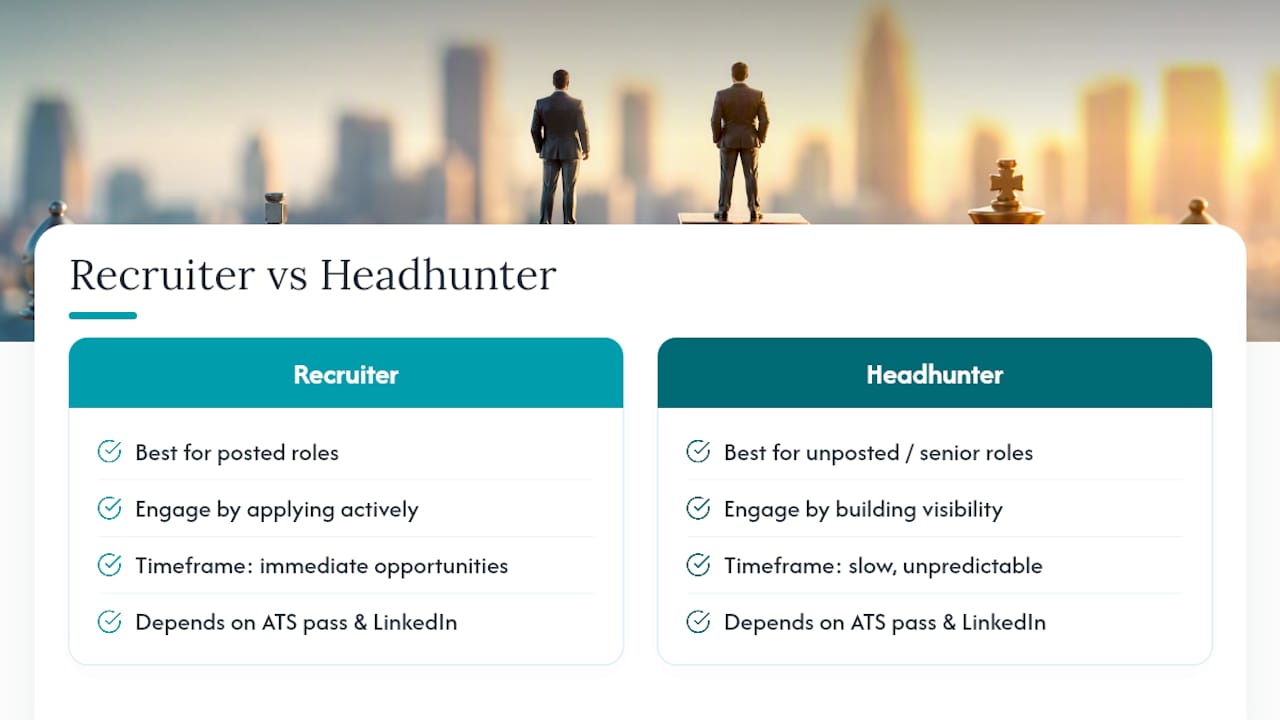
The conventional wisdom oversells “just network more” as the answer to getting headhunted. Networking helps, but it’s slow and unpredictable. What actually moves the needle is a specific, measurable LinkedIn presence and a resume that survives ATS screening on the first pass, because that’s the invisible filter deciding who even gets considered before a human looks twice.
If you take one thing from this comparison, prioritize the ATS and LinkedIn work first. It’s the layer both recruiters and headhunters run you through before a conversation even starts, and it’s the layer most job seekers ignore because it feels less important than the interview itself. It isn’t.
Kim
Get Found by Recruiters and Headhunters, Not Just Applications Systems
Most of what separates a candidate who gets called back from one who doesn't happens before either a recruiter or a headhunter ever reads a resume closely. Resume Wiz builds the resume, LinkedIn profile, and outreach materials that clear ATS filters and make senior professionals visible to the people doing the searching, not just the applying.
The service lineup covers ATS-compliant resume writing, LinkedIn profile optimization, personalized outreach templates, interview coaching, salary negotiation guidance, and a fully managed job search option with tailored applications and outreach. It's built for executives, managers, and career changers who want experienced help on their side of the table instead of the employer's.
If you're weighing whether a paid service is worth it against doing this alone, the honest test is time and callback rate: if your applications aren't converting to interviews after real effort, the resume or profile is usually the bottleneck, not your qualifications. Visit Resume Wiz to see which package fits where you are in your search.
Want a recruiter in your corner for your next senior role? Book a free call with Resume Wiz and we will map out your next move together.
Sources
- Headhunter - Investopedia
- What Is a Headhunter? - Indeed (Indeed Hire)
- Staffing Agency vs Recruiting Agency: What Is the Difference? - KORE1
FAQ
What Are Headhunters Called Now?
Many operate under the title “executive search consultant” or “talent acquisition partner,” though “headhunter” remains the common informal term across the industry.
What Should You Not Tell a Headhunter?
Avoid volunteering your current salary or your urgency to leave your job before you understand the role, company, and compensation range being discussed.
Is It Worth Using a Headhunter to Find a Job?
For senior, specialized, or executive-level roles, yes. Headhunters often surface opportunities that never get posted publicly, though the process typically takes longer than applying directly.
What Is the Typical Fee for a Headhunter?
Fees commonly run 20% to 30% of the hire’s first-year salary, paid by the employer, with retained searches sometimes running higher for the added depth of the search.
How Can I Improve My Chances of Being Headhunted?
Keep your LinkedIn profile current with measurable achievements, stay visible in your industry, and consider working with a service to sharpen your executive branding and resume before you’re on a headhunter’s radar.
