Help Landing a Senior Level Job in 2026
Securing a senior level job, what executive search professionals call a “C-suite or director-level placement,” requires far more than a polished resume. The hidden job market controls access to most top roles, and passive applications rarely break through. Mid-career professionals who succeed in 2026 combine three things: a clear executive brand, mastery of the leadership skills boards actually want, and a proactive networking system that puts them in front of decision-makers before a job is ever posted. This guide gives you the exact playbook.
What core leadership skills are essential for senior roles in 2026?
Nearly 95% of C-suite roles demand a combination of strategic vision and execution speed. That means boards are not hiring thinkers who cannot ship results, or operators who cannot see three years ahead. You need both, and your application materials must prove both.
The three skills that separate finalists from also-rans right now are:
AI fluency. AI governance understanding is the number one skill gap on executive leadership teams, and boards are prioritizing it for ROI management. You do not need to write code. You need to show you understand how AI affects your function, where the risks sit, and how to govern its use responsibly.
Emotional intelligence. EQ accounts for up to 58% of leadership performance success. Leaders with high emotional intelligence drive better retention and faster innovation. That is not a soft claim. It is a measurable performance variable.
Revenue ownership. Over 90% of executive job descriptions require revenue ownership or operational scaling expertise. If your resume does not show P&L responsibility or growth metrics, you are invisible to most search filters.
Developing these skills does not require a sabbatical. Read one AI governance brief per week. Take a structured EQ assessment like the EQ-i 2.0. Build a one-page case study showing a revenue outcome you drove directly.
Pro Tip: Attach a dollar figure or percentage to every leadership claim on your resume. “Led product team” becomes “Led 12-person product team, delivering $4.2M in new ARR in 18 months.” Specificity is what gets you past the first screen.
How do you build an executive brand that attracts senior opportunities?
Your executive brand answers three questions every hiring committee asks silently: why you, why now, and what will you deliver? If your resume, LinkedIn profile, and outreach messages do not answer all three in the first 10 seconds, you lose the read.
Build your brand in this order:
Write an outcome-focused resume. About 75% of resumes never reach human eyes without proper ATS formatting. Use clean section headers, standard fonts, and keyword-rich language pulled directly from target job descriptions. Every bullet should describe a result, not a responsibility.
Optimize your LinkedIn profile for search. Recruiters increasingly use AI-powered tools to scan LinkedIn profiles before reaching out. Embed role-specific keywords in your headline, About section, and job titles. A headline like “CFO | SaaS Revenue Growth | Series B to IPO” outperforms “Experienced Finance Executive” every time.
Post original content weekly. One short post per week on a leadership challenge you solved, a trend you see in your industry, or a decision framework you use builds visible credibility over time. Consistency matters more than brilliance.
Build an executive problem-solver portfolio. This is a short document, two to four pages, containing three to five case studies. Each case study names the problem, your specific actions, and the measurable result. Share it selectively with recruiters and hiring managers. Most candidates do not have one, which makes yours memorable.
Pro Tip: Mirror the exact language from the job description in your resume and LinkedIn headline. ATS systems score keyword match rates, and a 70%+ match dramatically increases your chances of reaching a human reviewer.
Resumewiz specializes in building ATS-compliant executive resumes and LinkedIn profiles that answer all three brand questions clearly and consistently.
What networking strategies help you access hidden senior roles?
About 70 to 80% of senior-level roles are never publicly posted. That number should change how you spend your time. If you are putting 80% of your effort into job boards, you are fishing in the wrong pond.
The networking approach that works at the executive level looks like this:
Target 30 to 50 companies deliberately. Define your criteria: industry, revenue stage, geography, and the specific problem you want to solve. Vague targets dilute outreach effectiveness. A focused list makes every conversation more relevant and every referral more precise.
Reach decision-makers, not peers. Connect with CEOs, board members, and functional heads who have hiring authority. Your goal is a 20-minute conversation about their business challenges, not a job ask. Value-driven conversations build the trust that leads to referrals.
Plan for volume with quality. A proactive search requires roughly 60 outreach attempts to generate 30 meaningful conversations. That is not a discouraging number. It is a planning number. Build it into your weekly schedule.
Engage specialized executive recruiters. Executive recruiters act as matchmakers for candidates who are already visible and relevant in their networks. Send a concise one-page bio, your target criteria, and two or three recent wins. Follow up every 30 days with a brief update.
Effective senior candidates bypass automated filters entirely by building trust-based human networks that reach actual hiring decision-makers. That is the core mechanism of the hidden job market.
How to execute a senior job search playbook
A focused search is not a sprint. It is a structured campaign with four distinct phases.
Phase 1: Define and build. Write your precise target role definition. Include revenue stage, geography, company size, and the three problems you solve best. Build your core assets: updated resume, optimized LinkedIn profile, and your executive portfolio. Do not start outreach until these are ready. A weak first impression with a decision-maker is harder to recover from than a delayed start.
Phase 2: Targeted outreach. Begin reaching out to your curated company list and warm network contacts. Aim for 20 to 30 meaningful conversations in this window. Track every outreach in a simple spreadsheet: contact name, company, date, response, and next step. Treat this like a sales pipeline because it is one.
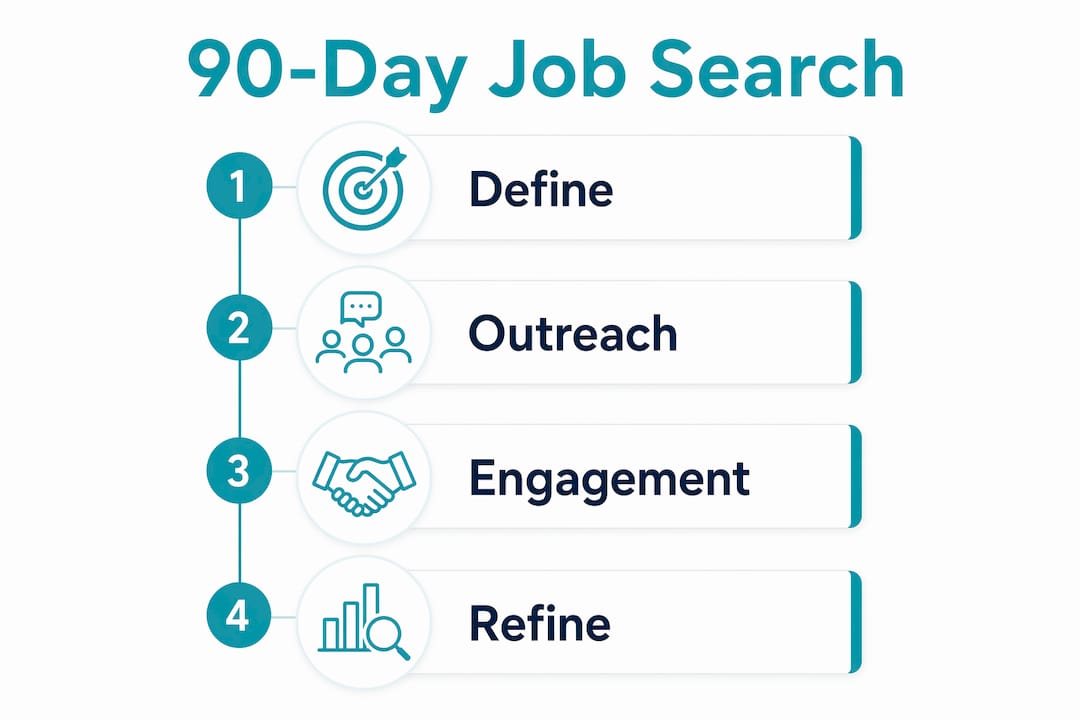
Phase 3: Recruiter engagement and pipeline review. Identify 10 to 15 executive search firms that specialize in your function and sector. Send your one-page bio and target criteria to each. Review your pipeline data. Which companies responded? Which messages got replies? Adjust your outreach language based on what is working.
Phase 4: Refine and close. Use feedback from conversations to sharpen your positioning. If three different people say the same thing about a gap in your story, fix it. Focus your energy on the five to eight opportunities that have shown real momentum. Prepare for due diligence: know your numbers, your leadership philosophy, and your 90-day plan for the role.
PhasePrimary focusKey outputDefine and buildTarget clarity and asset creationResume, LinkedIn, portfolioTargeted outreachConversations with decision-makers20 to 30 meaningful conversationsRecruiter engagementSearch firm relationships and pipeline review10 to 15 recruiter connectionsRefine and closePositioning refinement and due diligence5 to 8 active opportunities
Key Takeaways
Landing a senior role in 2026 requires a deliberate combination of executive branding, targeted networking, and demonstrated mastery of AI fluency, emotional intelligence, and revenue ownership.
PointDetailsSkills that matter mostAI governance, emotional intelligence, and revenue ownership appear in over 90% of executive job descriptions.Resume and ATS formattingOutcome-focused, ATS-formatted resumes dramatically increase the chance of reaching a human reviewer.Hidden job market70 to 80% of senior roles are never posted; proactive networking with decision-makers is the primary access route.Outreach volumePlan for roughly 60 outreach attempts to generate 30 meaningful conversations with hiring decision-makers.Structured searchA phased search with defined targets, tracked outreach, and recruiter engagement produces consistent results.
What I have learned after 10 years of placing senior executives
The candidates who land senior roles fastest are not always the most qualified on paper. They are the ones who treat their job search like a business development campaign. They know their numbers, they follow up consistently, and they never confuse activity with progress.
The single biggest mistake I see mid-career professionals make is waiting until they are ready to start networking. They want the resume perfect, the LinkedIn profile polished, the portfolio complete. By the time everything feels ready, three months have passed and the pipeline is empty. Start the conversations while you are building the assets. The two tracks run in parallel, not in sequence.
AI fluency is the skill I see candidates underestimate most. Boards are not asking whether you can use AI tools. They are asking whether you can govern AI risk, measure AI ROI, and lead a team through an AI-driven transformation. If you cannot speak to that in an interview, you will lose to someone who can, even if your operational track record is stronger.
Authentic storytelling is what closes the gap between a strong candidate and a hired one. The executives who get offers tell specific stories about specific decisions with specific results. They do not summarize their careers. They narrate them. Practice your three best leadership stories until you can tell each one in under two minutes with a clear problem, a clear action, and a clear result.
Kim
How Resumewiz supports your executive job search
The executive job market in 2026 rewards candidates who show up with a clear brand, a formatted resume that passes ATS screening, and a LinkedIn profile that attracts the right recruiters. Most professionals know what they need. The gap is execution.
Resumewiz works with mid-career professionals and executives to build ATS-compliant executive resumes that lead with outcomes, LinkedIn profiles optimized for recruiter search, and personalized outreach templates that generate real conversations. The platform was built by Kim Taynor, who brings over 10 years of recruiting experience to every engagement. If you are serious about securing a senior position in 2026, Resumewiz gives you the tools and the expert support to compete at the level the market demands.
Want a recruiter in your corner for your next senior role? Book a free call with Resume Wiz and we will map out your next move together.
FAQ
What is the hidden job market for senior roles?
The hidden job market refers to senior positions filled through referrals and direct outreach before they are ever posted publicly. About 70 to 80% of senior-level roles fall into this category, which is why proactive networking outperforms job board applications at the executive level.
How long does a senior job search typically take?
A focused, proactive executive search typically moves from target definition to first offers. Candidates who start with a clear target role, built assets, and a structured outreach plan move through the process faster than those who apply reactively.
What skills do hiring boards prioritize in 2026?
Boards prioritize AI governance fluency, emotional intelligence, and revenue ownership. Nearly 95% of C-suite roles require a combination of strategic vision and execution speed, and AI fluency is the number one identified skill gap on executive teams.
How many applications should I send for senior roles?
Volume of applications matters far less than quality of conversations. A focused executive search targets 30 to 50 companies and aims for 30 meaningful conversations with decision-makers, not hundreds of submitted applications.
Do I need a different resume for senior roles?
Yes. An executive resume must focus on outcomes and be formatted for ATS readability. About 75% of resumes never reach a human reviewer without proper formatting, and senior-level resumes must demonstrate P&L responsibility, team scale, and measurable business results.
