How hiring managers review resumes: Insider steps to stand out
Most executives spend days crafting their resume, yet recruiters spend about 6 to 8 seconds on the initial review. That gap between effort and attention is where careers stall. The reality is that your resume isn’t being read. It’s being scanned, sorted, and either advanced or discarded based on split-second signals. Understanding exactly how hiring managers evaluate resumes, and what they’re actually looking for in those critical moments, is the single biggest advantage you can give yourself as a senior professional targeting a high-stakes role.
Table of Contents
- The fast pass: How resumes are triaged in seconds
- What hiring managers actually scan for (and what gets ignored)
- Structured scoring and red flags: How consistency is enforced
- Automation and bias: The hidden layer of ATS and AI screening
- How senior and executive resumes stand out
- What most job seekers get wrong about resume reviews
- Get expert help refining your resume
- Frequently asked questions
Key Takeaways
| Point | Details |
|---|---|
| First pass is ultra-fast | Hiring managers typically decide on resumes within 6 to 10 seconds. |
| Layout and top section matter | Recent titles, clear achievements, and easy-to-scan structure increase the odds of being seen. |
| Scorecards drive consistency | Structured checklists and rubrics shape fairer, more reliable resume reviews. |
| Automation sets the stage | ATS/AI filters can screen out or surface resumes before humans ever see them, so balance keywords with substance. |
| Executives must front-load fit | Lead with evidence of leadership and measurable impact to stand out above the pile. |
The fast pass: How resumes are triaged in seconds
Before anyone reads a word of your resume, there’s a process. Call it triage. A hiring manager or recruiter picks up your document, scans it for key fit signals, and makes a gut-level decision in moments. That decision is binary: keep or discard.
The initial screening criteria recruiters apply aren’t random. They’re trained to spot role fit fast. Screening often runs 8 to 10 seconds in high-volume hiring scenarios. In executive searches where fewer applications come in, the time is sometimes slightly longer, but the snap-judgment dynamic still applies.
Here’s what that means in practice: a poorly structured resume, even one packed with genuine accomplishments, can be discarded before the hiring manager reaches the third bullet point.
| Resume element | First pass weight | Why it matters |
|---|---|---|
| Job title (current/recent) | Very high | Instant role fit signal |
| Company names | High | Signals context and credibility |
| Top-third layout | Very high | Sets tone for the whole document |
| Quantified results | High | Proof of impact in seconds |
| Dense paragraph text | Negative | Slows scanning, triggers skip |
| Dates and gaps | Moderate to high | Red flag filter |
Pro Tip: Format your resume so the most important credentials sit in the top third of the page. If a hiring manager has to scroll or flip to see your most relevant role, you’ve already lost ground.
The takeaway here isn’t that detail doesn’t matter. It’s that detail only matters after you pass the first scan. Structure your document to earn the deeper read first.
What hiring managers actually scan for (and what gets ignored)
Understanding the speed is only part of the challenge. Here’s a closer look at what managers’ eyes truly focus on during that pivotal scan.
Eye-tracking research consistently shows that attention concentrates on layout and specific scan targets like current titles, companies, and dates. These elements sit in predictable zones. The left side of the page and the top third of the document form what many recruiting professionals call the “hot zone.” That’s where hiring managers look first, and it’s where your most critical credentials must live.
Here’s what typically gets attention during the first scan:
- Current or most recent job title: does it match or closely align with the target role?
- Company name and brand recognition: familiar logos carry immediate credibility
- Employment dates: reviewed for gaps or short tenures, both of which raise questions
- Opening phrases of the top three bullet points: the first five to eight words per bullet carry disproportionate weight
- Education credentials: particularly relevant for regulated industries or roles requiring specific degrees
Here’s what commonly gets ignored, at least in the first pass:
- Lengthy professional summaries that don’t lead with a clear value statement
- Skills sections buried below the fold
- Soft skills listed without any supporting context or evidence
- Awards and affiliations that don’t reinforce role relevance
“The way a hiring manager reads a resume is a lot more like skimming a news headline than reading a novel. If the headline doesn’t hook them, they don’t open the article.”
This is especially critical for executive candidates. If you’re applying for a VP or C-suite role, your scope of leadership, the size of teams you managed, and the revenue or operational impact you drove need to be visible immediately. Metrics like “$40M budget ownership” or “led 120-person organization” belong in the first bullet under your current role, not buried in paragraph three.
Modern recruiting practices have evolved to favor evidence of outcomes over a list of responsibilities. A bullet that says “responsible for sales team performance” is far weaker than “grew regional sales team revenue by 34% in 18 months.” The latter passes the scan. The former often doesn’t.
Pro Tip: Rewrite your top three resume bullets to lead with an outcome, not a duty. Start with the number, the result, or the impact, then explain how you achieved it.
Structured scoring and red flags: How consistency is enforced
Once the first scan succeeds, a closer yet still structured evaluation determines if you move forward. Let’s clarify those rules and the pitfalls that derail even strong candidates.
Many organizations, particularly those with high hiring volume or sophisticated talent acquisition teams, use formal review tools. Scorecard approaches define criteria with numerical weights, 1 to 5 rating scales, and require calibration between reviewers before the process begins. This ensures consistency and reduces the individual bias of any single hiring manager.
The checklist screening process starts with calibration between the recruiter and hiring manager to align on required qualifications and predefined red flags. That means the rejection criteria are baked in before your resume is ever opened.
| Scorecard category | Green flags | Red flags |
|---|---|---|
| Role fit | Title match, relevant industry | Unrelated background, vague summary |
| Impact and results | Quantified achievements, scale | Responsibilities only, no outcomes |
| Employment history | Steady progression, logical moves | Unexplained gaps, frequent short tenures |
| Formatting and clarity | Clean layout, ATS-friendly | Dense text, irregular fonts, graphics |
| Education and credentials | Meets minimum requirements | Missing required degree or certification |
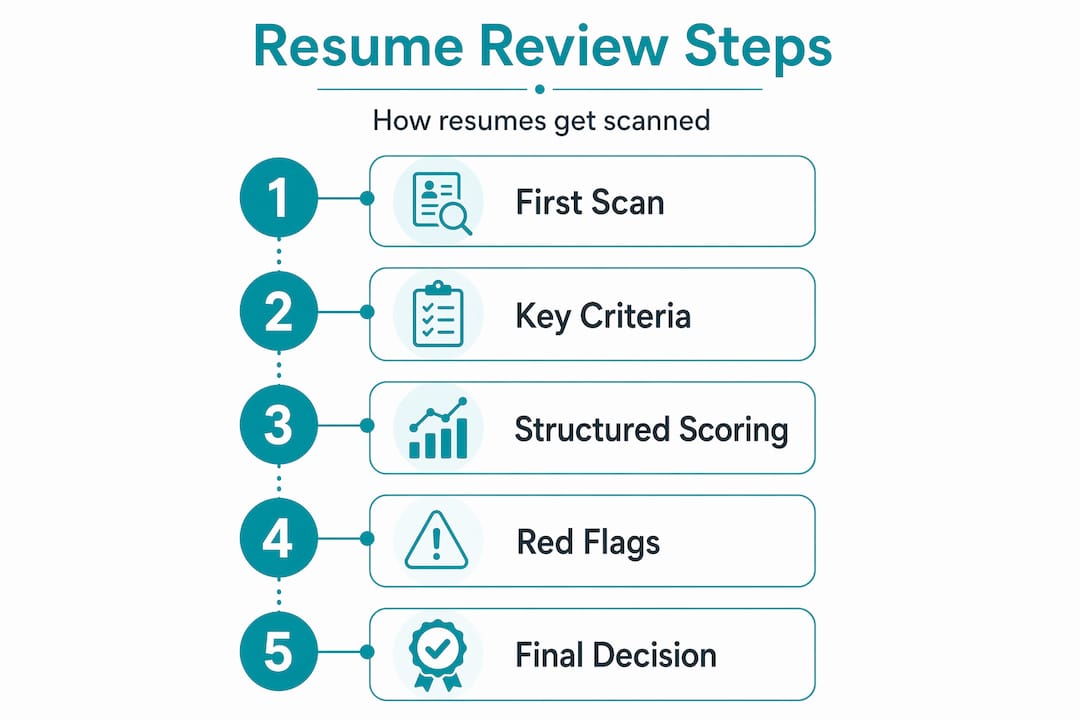
The numbered steps a resume must clear in structured screening are typically:
- Pass minimum qualifications check (role-specific requirements)
- Survive ATS keyword filtering (more on this below)
- Clear the recruiter’s first-pass visual scan
- Meet the hiring manager’s role fit criteria on deeper review
- Pass any team-level or panel calibration before interview selection
Understanding these resume evaluation standards helps you tailor your document with each stage in mind, not just the human reviewer. Every layer has its own logic, and a resume that fails at step one never reaches the person with the power to say yes.
What triggers rejection most often? Missing required qualifications is the top disqualifier. But closely behind it are: employment gaps without context, excessive job hopping, and resumes that are formatted so poorly they’re hard to parse. Hiring managers at the executive level also flag what professionals in recruitment expert roles call “scope mismatch,” meaning your previous roles operated at a significantly smaller or different scale than the role demands.
Pro Tip: Before submitting, map your resume against the job description line by line. If the posting calls for P&L ownership and your resume never mentions budget scope, you’ve created a gap that structured screening will likely catch.
Automation and bias: The hidden layer of ATS and AI screening
Before a manager even sees your document, automation shapes who gets through. Here’s what you need to know about this hidden layer.
Applicant tracking systems (ATS) are software platforms that manage, sort, and filter incoming applications. Most enterprise employers and a large number of mid-sized companies use them. These systems parse your resume for keywords, formatting structure, and job history patterns before any human sees it. AI-powered screening tools take this further by scoring resumes against a trained model.
Here’s the challenge: automated screening evaluates structured signals but can introduce bias even when qualifications are controlled. Research has identified gender and racial bias in AI resume screening, meaning candidates from certain demographic groups may be filtered out at higher rates, even when their qualifications are equivalent.
What this means for executive job seekers:
- Use clean, single-column formatting. Tables, text boxes, and graphics often confuse ATS parsers.
- Include exact keywords from the job description, not just synonyms. ATS systems match terms, not intent.
- Avoid headers like “Core Competencies” if the job description uses “Key Skills.” Mirroring the exact language matters.
- Don’t assume ATS is the whole game. Getting past the system is step one. Impressing the human reviewer requires something deeper.
“Gaming the ATS by stuffing keywords works until it doesn’t. A resume full of keywords but empty of narrative will pass the filter and fail the human review.”
The landscape of resume management systems continues to evolve rapidly, with AI capabilities becoming more sophisticated each year. But the core principle remains: authentic, role-relevant evidence is what survives both automated and human review. Keyword density helps you clear the filter. Compelling evidence of impact is what gets you the interview.
How senior and executive resumes stand out
For executives, beating the odds requires more than basics. Here are targeted strategies designed to make senior-level resumes rise above the rest.
Fast skimming means front-loading your role fit, leadership scope, and measurable outcomes right in the first section. This isn’t just about keywords. It’s about making the hiring manager feel, within seconds, that you’ve done this job before at the right level.
Practical tactics for executive-level resumes:
- Lead with a tight executive summary of two to three lines that names your leadership specialty, scale, and a signature outcome. Skip the generic “results-driven leader” language entirely.
- Use whitespace intentionally. Dense text signals poor communication skills to a hiring manager. Clean margins and consistent spacing signal executive presence.
- Quantify scope on every major role. Team size, budget owned, revenue influenced, and geographic footprint are all proof points that establish scale immediately.
- Front-load each bullet with impact. “Restructured global supply chain, reducing annual costs by $8M” beats “Led supply chain transformation project” by a wide margin.
- Trim older roles ruthlessly. Roles from more than 15 years ago rarely need more than one or two lines. Your recent track record carries the most weight.
The executive resume strategies that consistently work share one common thread: they tell a focused story about what kind of leader you are and what you deliver. Not a catalog of everything you’ve ever done.
For professional resume tips that go beyond surface-level formatting, focus on one question: does every element of this resume make a clear case for fit in the specific role you’re targeting? If anything on the page is irrelevant or dilutes that story, cut it.
Pro Tip: Print your resume and hold it at arm’s length. If you can’t immediately see your most recent title, company, and a key impact metric, your layout needs work.
What most job seekers get wrong about resume reviews
After examining every step in the hiring manager’s review process, there’s one persistent misconception worth confronting directly. Most executives believe that if they just optimize enough, polish the formatting, and load up on keywords, the resume will take care of itself. That belief is both understandable and wrong.
The ATS-first mindset has led many otherwise strong candidates to produce documents that read like keyword spreadsheets. Keyword optimization tactics can help pass automated filters but don’t replace authentic, role-relevant evidence when a human picks up the document. Hiring managers, especially experienced ones, spot keyword stuffing immediately. It signals a lack of genuine fit, not the presence of it.
There’s also a version of over-engineering that hurts candidates on the human side. Resumes with 12 different font sizes, elaborate graphics, and color-coded sections often fail to communicate authority. They look like the work of someone trying to compensate for a weaker track record, even when that’s not the case.
What actually works, based on years of working with executives and inside the hiring process, is strategic clarity. Know exactly what role you’re targeting. Build your resume around that single objective. Make it effortless for a hiring manager to see, in eight seconds, why you’re the right person. That means ruthless editing, front-loaded impact, and honest language that reflects what you actually achieved.
The other thing most candidates get wrong is treating the resume as static. A strong executive job search means tailoring your document for each target role. The core stays constant, but the emphasis shifts. A COO role at a private equity-backed company needs to see operational rigor and EBITDA impact. A COO role at a nonprofit needs to see mission alignment and stakeholder management. The facts don’t change. The framing does.
Your resume isn’t a biography. It’s a sales document with one job: earn the interview.
Get expert help refining your resume
Knowing what hiring managers look for is one thing. Translating that knowledge into a resume that actually performs under real screening conditions is another challenge entirely.

At Resume Wiz, we work with executives and senior managers to build resumes that survive ATS filtering and earn the deeper read from hiring managers. Our approach is grounded in over 10 years of recruiting experience, which means we know exactly what signals decision-makers are looking for at the senior level. Whether you need a full resume rewrite, ATS-compliant formatting, or a complete executive branding package, we can help you move from overlooked applicant to top-of-shortlist candidate. The process is personalized and designed specifically for high-level professionals targeting their next significant career move.
Want a recruiter in your corner for your next senior role? Book a free call with Resume Wiz and we will map out your next move together.
Frequently asked questions
How long do hiring managers actually look at each resume?
Most hiring managers spend only 6 to 8 seconds on an initial resume review, making first impressions critically important for any candidate.
What are instant red flags that get resumes rejected?
Formatting errors, unexplained employment gaps, and missing required qualifications are among the most common rejection triggers, as checklist screening processes are specifically calibrated to catch these issues early.
Do automated tools (ATS/AI) still matter for executive resumes?
Yes, automated screening filters resumes before human review, so clean formatting and keyword alignment remain essential even at the executive level.
Does keyword optimization guarantee a resume will be read by a hiring manager?
No. Keyword tactics improve ATS performance, but clear evidence of leadership fit and measurable impact is what ultimately moves a resume forward in human review.
