How Executive Job Search Works: What You Need to Know
Most executives discover how executive job search works only after they are already in it, often surprised by how different the process is from anything they have experienced before. You send a few applications, update your LinkedIn profile, and wait. Weeks pass. The silence is not a sign that you are unqualified. It is a sign that you do not yet understand the system you are operating in. Executive searches are research-driven, employer-funded, and deliberately slow. Once you understand the mechanics, you stop guessing and start positioning yourself with intention.
Table of Contents
- Key Takeaways
- How executive job search works differently from standard recruiting
- Understanding the executive job search timeline
- Getting found: how to increase your discoverability
- Navigating the final stages: interviews, references, and offers
- My take on what executives keep getting wrong
- Ready to get your executive search working for you?
- FAQ
Key Takeaways
| Point | Details |
|---|---|
| It’s a 3 to 6 month process | The executive search lifecycle spans discovery, sourcing, screening, and offer negotiation across 12 to 24 weeks. |
| Search firms work for employers | Retained executive search firms are paid by the hiring company, not by candidates, which shapes every interaction you have with them. |
| Discoverability beats applying | Most leadership roles are never publicly posted; your LinkedIn profile and recruiter relationships matter more than job boards. |
| Shortlists are curated packages | You are not just a resume on a pile. You are a competency-mapped dossier evaluated against a precise success profile. |
| Delays are structural, not personal | Notice periods, counter-offers, and multi-stakeholder approvals routinely extend timelines by 30 to 90 days beyond the initial offer. |
How executive job search works differently from standard recruiting
The most disorienting thing about executive job search is that the rules you already know do not apply. At the senior level, the process is not reactive. Nobody is sorting through 300 applications and picking the best resume. Instead, companies hire retained search firms to conduct a confidential, structured investigation into the market for qualified leadership talent.
Retained search firms operate under exclusive, upfront agreements with employers. Their fees typically run around 33% of the first-year compensation package, paid in milestone-based thirds. Because of that financial commitment, they take the process seriously and move methodically. They are not staffing agencies filling roles reactively. They are researchers identifying the best possible candidates, many of whom are not looking.
The process moves through four core phases:
- Discovery and position specification. The search firm meets with the hiring company to define the role, the leadership profile, cultural expectations, and what success looks like at 90 days, one year, and beyond.
- Market research and talent mapping. Researchers build a map of qualified executives in comparable roles across target companies and industries.
- Candidate sourcing and screening. Firms reach out proactively to passive candidates. Outreach is personalized, not mass-blasted.
- Evaluation and closing. Behavioral interviews, leadership assessments, and cultural fit evaluations narrow the field to a shortlist before the client ever meets a candidate.
The key distinction is this: a proactive sourcing approach gives hiring companies access to high-performing candidates who would never respond to a job posting. If you are only visible through applications, you are invisible to most of this market.
Pro Tip: Treat your relationship with executive search firms as ongoing, not transactional. Stay connected even when you are not actively looking. Recruiters remember the executives who were professional and responsive when a role opens up.
Understanding the executive job search timeline
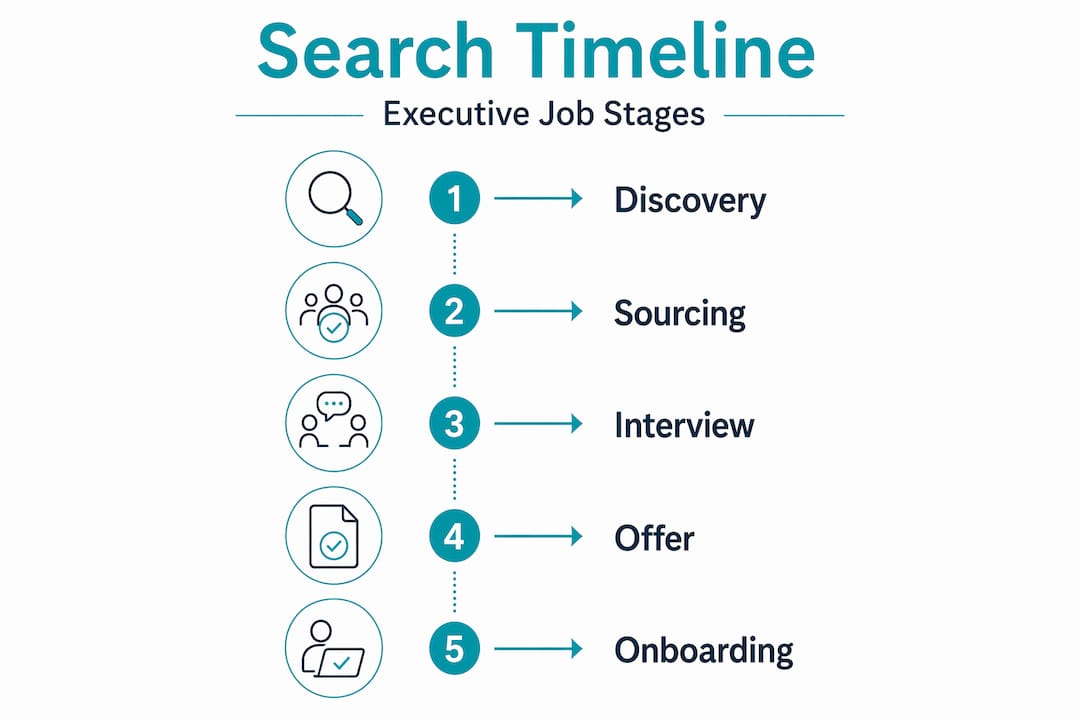
Knowing what is an executive job search timeline means understanding that time is not wasted between stages. It is consumed. Every week has a purpose, and every delay has a cause.
The typical breakdown looks like this:
- Weeks 1 to 4: Discovery and search strategy. The firm finalizes the position specification, aligns stakeholders internally, and builds the target company list.
- Weeks 5 to 12: Sourcing and screening. Researchers identify candidates, conduct initial outreach, complete screening interviews, and begin narrowing the field.
- Weeks 13 to 20: Finalist interviews and offer negotiation. The hiring company meets a shortlist of typically three to five candidates, selects a finalist, and moves to reference checks and offer discussions.
| Phase | Typical duration | Key activities |
|---|---|---|
| Discovery and planning | Weeks 1 to 4 | Role definition, success profile, stakeholder alignment |
| Sourcing and screening | Weeks 5 to 12 | Market mapping, outreach, screening interviews, dossier preparation |
| Finalist evaluation | Weeks 13 to 16 | Client interviews, leadership assessments, cultural fit evaluation |
| Reference checks and offer | Weeks 17 to 20 | Reference validation, offer construction, negotiation, acceptance |
Most searches take 12 to 24 weeks to fill, and that window can extend further. Notice periods commonly run 60 to 90 days at the senior level. Non-compete clauses can complicate start dates. Counter-offers from current employers add another variable. All of this is normal. Delays rooted in multi-stakeholder alignment reflect the seriousness of the hire, not dysfunction in the process.
The takeaway for executives is to begin their search before urgency sets in. If you wait until you are already looking, you are starting three to six months behind where you should be.
Getting found: how to increase your discoverability
Here is what most executives miss: discoverability is a bigger obstacle than candidate quality. You can be the most qualified executive in your field and still be completely off the radar of the firms conducting searches for your ideal role.
Your LinkedIn profile is not a formality. It is the primary mechanism through which executive search researchers locate and evaluate you. A highly optimized profile includes your specific scope of responsibility, such as revenue managed, team size, geographic footprint, and industry context. Generic phrases like “experienced leader” tell a researcher nothing. “P&L ownership across a $400M manufacturing division with operations in four countries” tells them exactly where to place you.
Beyond LinkedIn, here are the levers that actually move the needle:
- Align your career narrative to a success profile. Research the types of roles you want. Identify the outcomes those roles reward. Then articulate your own career in those terms, not your own.
- Stay warm with recruiters. Check in periodically. Share relevant content. Respond quickly when they reach out, even if a particular role is not right. Responsiveness signals readiness.
- Tailor your outreach. When approaching a search firm, reference specific searches they have run in your sector. A generic “I’d love to connect” message is forgotten immediately.
- Make your resume work alongside your profile. Many executives over-invest in one and neglect the other. A well-structured executive resume, optimized for ATS and cover letters, reinforces your profile and ensures nothing gets lost in the screening process.
Pro Tip: Build a target list of 10 to 15 executive search firms that specialize in your sector. Send a brief, specific introduction every 6 months. Most senior placements come from relationships developed well before the search begins.
Navigating the final stages: interviews, references, and offers
Reaching the shortlist is not the finish line. The closing stages of an executive search are where searches succeed or fall apart, and they demand a different kind of preparation than earlier rounds.
Structured interviews at the executive level are designed to surface specific competencies against the client’s position specification. You are not being evaluated on your general impressiveness. You are being scored against a defined success profile. Candidate profiles presented to the client include your leadership style, compensation expectations, and any assessed risk factors. Every answer you give either supports or undermines that picture.
Reference checks are more serious than most executives expect. Firms conduct rigorous referencing across peer, manager, and direct report perspectives to validate leadership style and cultural fit. They are not just confirming dates of employment. Prepare your references the way you would prepare a witness. Brief them on the role, the culture, and what the company is evaluating. An unprepared reference who speaks generally can cost you the offer.
The offer itself will typically include:
- Base salary and annual bonus structure
- Equity or long-term incentive plan details
- Benefits package and executive perquisites
- Relocation support if applicable
- Post-placement integration support, including 30, 60, and 90-day check-in commitments from the search firm after placement
Negotiate through the search firm, not around it. The recruiter has visibility into the client’s flexibility and genuine constraints. Working with them rather than directly pressing the employer produces better outcomes and preserves the relationship.
One more thing: do not accept a counter-offer without serious analysis. The data on executives who accept counter-offers and stay is not favorable. The underlying reasons that prompted you to explore a move rarely change.
My take on what executives keep getting wrong
I have spent over 10 years working inside the recruiting world before building Resumewiz, and the pattern I see most often is not about qualifications. It is about timing and narrative.
Executives wait too long to start, then move too fast once they begin. They treat the search like a sprint when it requires the mentality of a long game. I have watched brilliant, highly credentialed executives lose roles not because they were less qualified than the finalist, but because their career story was not shaped to match what the client’s success profile was looking for.
The other mistake I see constantly is executives treating search firms as a passive channel, as if being on a recruiter’s database is enough. It is not. The executives who get called are the ones who have stayed visible, stayed warm, and made themselves easy to place. That means a LinkedIn profile that does the work for you, a clear narrative about what you want next, and a track record presented in outcomes rather than responsibilities.
Feeling stuck in job search at executive level is real and it is common. But most of the time, it is not a quality problem. It is a positioning and timing problem. The fix is not to apply to more jobs. It is to become more discoverable and more aligned to what the market is actually hiring for right now.
Kim
Ready to get your executive search working for you?
If this article clarified the mechanics but left you wondering whether your current materials and positioning are actually working, that is worth addressing before your next search begins.

At Resumewiz, Kim Taynor and the team specialize in exactly this: building the executive resume, LinkedIn profile, and career narrative that gets you onto shortlists rather than waiting on the sidelines. With over 10 years of recruiting experience behind every engagement, Resumewiz offers ATS-optimized resumes, LinkedIn rewrites, personalized outreach templates, and a fully managed job search with tailored applications and outreach. If you are serious about your next move, the right place to start is making sure your positioning actually matches what search firms are looking for.
Want a recruiter in your corner for your next senior role? Book a free call with Resume Wiz and we will map out your next move together.
FAQ
How long does an executive job search typically take?
Most executive searches take 12 to 24 weeks from initial discovery to offer acceptance, with additional delays of 30 to 90 days possible due to notice periods and negotiation.
Why aren’t executive search firms contacting me?
Discoverability often outweighs candidate quality as the primary obstacle. An under-optimized LinkedIn profile and limited recruiter relationships are the most common reasons executives get bypassed.
What is a retained executive search, and how does it affect candidates?
A retained search is an exclusive engagement where the employer pays the search firm upfront, typically around 33% of first-year compensation. This means the firm’s loyalty runs to the employer, and candidates are evaluated against a precise position specification, not self-submitted applications.
How should I prepare for executive-level interviews?
Understand that you will be scored against a structured success profile, not evaluated generally. Review the competency areas tied to the role, prepare outcomes-based examples, and brief your references in advance so their feedback reinforces your candidacy.
Is it worth working with an executive job search coach?
Working with an executive career coaching service can significantly shorten your search by helping you align your narrative, optimize your materials, and approach search firms strategically. The return on investment is measured in weeks of search time saved and compensation gained through better offer negotiation.
