How Executives Actually Get Hired: The 2026 Guide
Executive hiring is defined by direct, targeted outreach to profit-and-loss owners, not by submitting applications through job boards. Understanding how executives actually get hired means accepting one uncomfortable truth: the standard application process was never designed for senior roles. Most C-suite and VP-level positions are filled before a job posting ever goes live. The executives who land these roles are the ones who identify the right decision-maker, articulate a specific business solution, and make contact before a search firm is even retained.
How executives actually get hired: the full process explained
The executive hiring process is a structured sequence of stages, not a single event. The full cycle spans 8 to 16 weeks for most senior roles, while C-suite appointments regularly require 6 to 12 months from mandate to integration. That timeline reflects the complexity involved, not inefficiency.
The process typically moves through seven to ten distinct stages:
- Mandate definition. The hiring organization defines the business problem, not just the title. Success criteria, reporting lines, and budget authority are established before any search begins.
- Market mapping. A search firm or internal talent team identifies the pool of qualified candidates, including those not actively looking.
- Candidate outreach. Targeted, personalized messages go to passive candidates. Outreach pitch quality directly influences whether a passive executive considers disrupting their current role.
- Initial screening. Phone or video calls narrow the field based on fit, motivation, and compensation alignment.
- Assessment. Structured interviews, psychometric tests, and situational judgment exercises account for 25 to 30% of the total search timeline.
- Shortlist presentation. Two to four candidates are presented to the hiring committee with full evaluation summaries.
- Client interviews. Multi-round interviews with the board, CEO, or senior leadership team follow.
- Offer negotiation. Compensation, equity, and performance milestones are agreed upon.
- Reference and background checks. Deep professional references, often from peers and direct reports, are completed.
- Onboarding support. Retained search firms typically support the first 90 days post-hire.
What retained search firms actually cost
Retained executive search firms charge 25 to 35% of first-year compensation and often include a 12-month performance guarantee. That fee structure reflects the depth of work involved. It also signals why companies take executive hiring seriously. A failed placement at the VP or C-suite level costs far more than the search fee.
| Stage | Typical duration | Key output |
|---|---|---|
| Mandate and market mapping | 2 to 3 weeks | Candidate longlist |
| Outreach and screening | 3 to 4 weeks | Qualified shortlist |
| Assessment and interviews | 4 to 6 weeks | Final two to three candidates |
| Offer and onboarding | 2 to 4 weeks | Signed offer and integration plan |
Who are the real decision-makers in executive hiring?
The person holding the title you want is rarely the person who decides to hire you. The real decision-maker is the P&L owner two levels above the target role. This is the executive who owns the business pain point your skills directly solve. Reaching that person changes everything about your approach.
Hiring managers at the senior level bypass applicant tracking systems entirely. They rely on referrals from trusted peers, introductions from venture capital or private equity networks, and direct headhunting. Blind ATS conversion rates for senior positions approach zero. Submitting a resume through a job portal at the VP or C-suite level is not a strategy. It is a waiting room with no door.
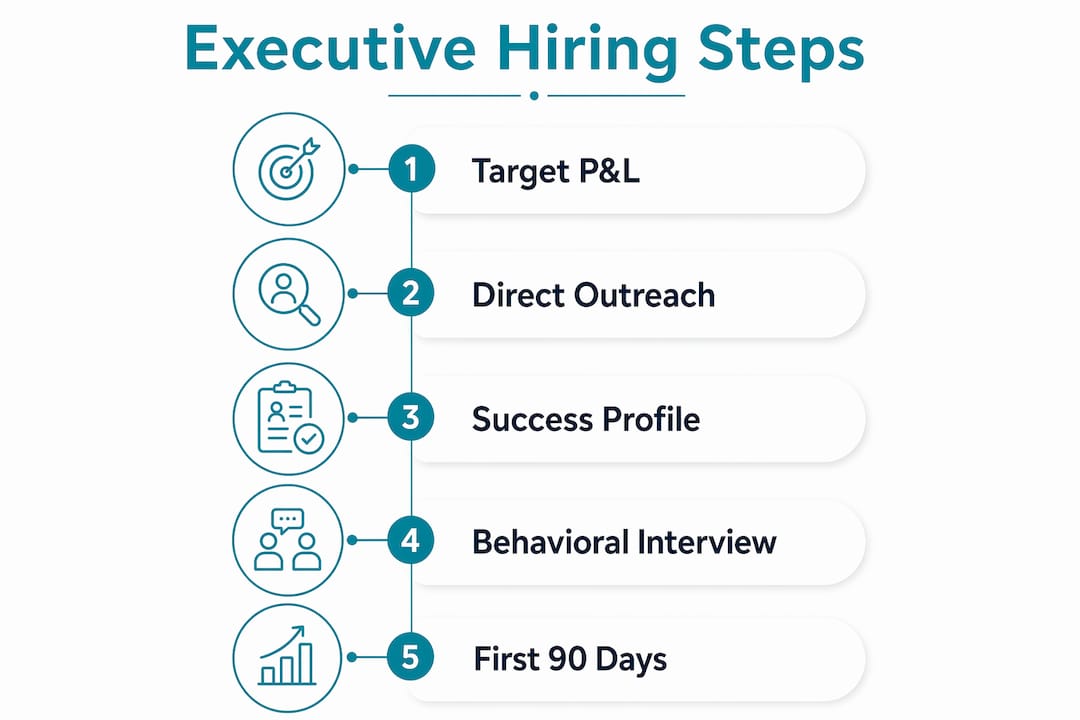
The most effective executive job search tactic is one-to-one, personalized outreach. Targeting one specific person per company, with a message built around their specific business challenge, signals that you have done real work. Mass outreach signals the opposite. A personalized message has roughly 15 seconds to capture interest and must connect immediately to a real business problem.
Pro Tip: Before reaching out to any executive decision-maker, identify one specific operational challenge their company faces publicly, whether through earnings calls, press releases, or LinkedIn activity. Lead with that problem, not your resume.
- Target the P&L owner, not the HR department or the person currently holding the role you want.
- Send one tailored message per company. Personalization signals intent. Volume signals desperation.
- Use LinkedIn, mutual connections, and industry events to establish a warm path before cold outreach.
- Speak to business outcomes you have delivered, not job duties you have performed.
- Networking with qualified decision-makers is the single most effective channel at the executive level. Speaking only to HR or recruiters is not enough.
How do companies evaluate executives beyond the resume?
Forward-thinking organizations have moved away from traditional job descriptions. They use success profiles instead. A success profile defines the measurable outcomes expected in the first 6 to 12 months: scaling a team from 40 to 120 people, completing a technology migration, or entering two new markets. Past job titles matter far less than evidence that you have delivered comparable outcomes before.
This shift changes what companies look for in executives. They are not hiring a resume. They are hiring a result. Success profiles improve hiring accuracy by aligning candidate evaluation with measurable business outcomes and expected leadership behaviors. That means your interview preparation must focus on specific, quantified stories from your career, not general descriptions of your responsibilities.
Pro Tip: Map your top five career achievements to the outcomes listed in the success profile before your first interview. If no formal success profile is shared, ask the hiring committee directly: “What does success look like in the first 90 days?”
Assessment at the executive level is multi-layered. Structured behavioral interviews probe how you handled specific past situations. Psychometric tools measure leadership style, decision-making patterns, and risk tolerance. Some organizations add a case presentation where candidates analyze a real business challenge the company faces and present a response. This format tests strategic thinking under pressure, not just communication polish.
| Evaluation method | What it measures |
|---|---|
| Structured behavioral interview | Past decision-making and leadership in context |
| Psychometric assessment | Leadership style, risk tolerance, and cognitive patterns |
| Situational judgment test | How you respond to realistic business scenarios |
| Case presentation | Strategic analysis and communication under pressure |
| Reference interviews | Peer and direct-report perspective on your actual impact |
What happens after the offer: the first 90 days
Accepting an offer is not the finish line. 50% of new executives fail or leave within 18 months of being hired. That statistic reframes the entire executive hiring process. The offer is the beginning of the real evaluation, not the end of it.
The concept known as the “90-Day Trap” captures this reality. The first 90 days post-hire are the decisive period. Executives who arrive with a structured diagnostic plan, one that demonstrates listening, constraint identification, and prioritization of high-impact actions, are far more likely to succeed long-term. A structured 90-day plan that balances listening with decisive action on key initiatives is the clearest signal that a new executive is the right hire.
Practical steps for the first 90 days include:
- Listen before acting. Spend the first 30 days in diagnostic mode. Interview key stakeholders, map internal dynamics, and identify the three to five constraints that limit the business most.
- Deliver one visible win. By day 60, identify and execute one high-impact action that demonstrates your judgment and builds credibility with the team.
- Present a 90-day summary. At the 90-day mark, share your findings and your 12-month plan with the leadership team. This signals that you operate with structure and accountability.
- Maintain search firm contact. Retained search firms that placed you often provide onboarding support. Use it. Their perspective on organizational dynamics is valuable and objective.
The executives who fail in the first 18 months typically do one of two things: they act too fast without diagnosing the real constraints, or they wait too long to demonstrate value. The 90-day plan solves both problems.
Key takeaways
Executive hiring success depends on targeting P&L owners directly, presenting outcome-based evidence, and arriving with a structured 90-day plan that proves your value before the first performance review.
| Point | Details |
|---|---|
| Skip the ATS for senior roles | Direct outreach to P&L owners converts far better than job board applications at the executive level. |
| Know the full timeline | Executive searches run 8 to 16 weeks; C-suite roles can take 6 to 12 months from mandate to start date. |
| Prepare for success profiles | Companies evaluate executives on measurable milestones, not job descriptions, so lead with quantified outcomes. |
| Treat the first 90 days as the real test | Half of new executives leave within 18 months, a structured diagnostic plan in the first 90 days changes those odds. |
| Network with decision-makers directly | Conversations with HR alone are not enough; the P&L owner two levels above your target role is the person who matters. |
What I have learned after 10 years of watching executives get hired and passed over
The executives I have seen land the best roles share one trait: they stopped thinking like job seekers. They started thinking like business owners who were designing the role they wanted to fill. That mindset shift changes everything about how you write, speak, and reach out.
The most common mistake I see is executives spending weeks perfecting a resume and then sending it into an ATS portal. The resume matters. But it is not the tool that gets you the meeting. The meeting comes from a direct, well-researched message to the right person at the right company at the right moment. The resume is what you send after they ask for it.
Storytelling is the other piece that separates the executives who get hired from the ones who stay stuck. Boards and CEOs do not remember bullet points. They remember the candidate who described turning around a $40 million division in 14 months and explained exactly how they did it. Specificity builds credibility. Vague claims about “driving growth” or “leading transformation” do not.
The hardest truth I share with clients is this: networking with business leaders who can create the job is the work. It is not a supplement to the job search. It is the job search. The executives who treat it that way get hired. The ones who wait for postings keep waiting.
Kim
How Resumewiz helps executives get in front of the right people
Resumewiz works with executives who are done waiting for the right posting to appear. The platform offers tailored resume development built around success profiles, so your application speaks directly to the outcomes a hiring committee cares about. Every engagement includes LinkedIn profile optimization and personalized outreach templates designed to reach P&L owners, not just recruiters.

Kim Taynor and the Resumewiz team bring over 10 years of recruiting experience to every client engagement. The executive career services at Resumewiz go beyond resume writing. They include interview coaching, a fully managed outreach process, and tailored applications designed to help you land interviews. If you are ready to move from passive candidate to active contender, Resumewiz gives you the tools and the strategy to make that happen.
Want a recruiter in your corner for your next senior role? Book a free call with Resume Wiz and we will map out your next move together.
FAQ
How long does the executive hiring process take?
Executive searches typically run 8 to 16 weeks, while C-suite roles often require 6 to 12 months from mandate definition to integration. The timeline reflects the depth of assessment and the number of stakeholders involved.
Why do ATS applications fail for senior roles?
Hiring managers at the executive level rely on referrals, direct headhunting, and trusted introductions rather than applicant tracking systems. Conversion rates through ATS for senior positions approach zero.
What do companies look for in executives during assessment?
Companies evaluate executives through structured behavioral interviews, psychometric tests, situational judgment exercises, and case presentations. Assessment accounts for 25 to 30% of the total search timeline.
What is a success profile and why does it matter?
A success profile defines the measurable outcomes expected in the first 6 to 12 months of a role rather than listing past job duties. Success profiles improve hiring accuracy by connecting candidate evaluation to real business results.
Why do so many new executives fail after being hired?
50% of new executives leave or fail within 18 months of being hired. The most common cause is acting without first diagnosing the real constraints of the organization, which is why a structured 90-day plan is the single most important tool a new executive can bring to the role.
