How the Internal Promotion Process Works for Executives
Treat the promotion as a joint business project with your manager and one or two senior sponsors, then deliver measurable outcomes that prove the case. That single reframe separates executives who get promoted from those who wait and wonder.
Here is your immediate action list:
- Define the target role precisely. Write one paragraph describing the decisions you will own, the scope you will hold, and the business value you will create. Vague ambition is the most common reason promotion campaigns fail before the first conversation.
- Align your manager. Book a 20-minute career conversation this week. Frame it as: “I want to build a shared plan that makes your team stronger and positions me for the next level.”
- Secure one sponsor. Identify a senior leader outside your direct chain who has seen your work and can speak to your judgment in rooms you will never enter.
Three tools worth knowing as you build this plan: Resumewiz for executive positioning materials, Kim Taynor’s recruiting-informed frameworks for structuring your promotion case, and Maya Grossman’s coaching principle that career growth is a skill you practice deliberately, not a reward you wait to receive.
Key Takeaways
Executives who win internal promotions treat the process as a negotiated business case, not a performance reward, and they start building the case 6 to 12 months before the role opens.
| Point | Details |
|---|---|
| Start before the role posts | Promotion decisions often happen before a job opens; begin your campaign 6 to 12 months early. |
| Frame it as a shared project | Bring a written promotion plan to your manager so they can claim development credit and sponsor you upward. |
| Equip your sponsors | Give Tier 3 advocates a one-page brief with two proof points and one talking point they can use in leadership rooms. |
| Document decisions, not tasks | Your operating memo should name decisions owned, business outcomes, and the organizational problem the role solves. |
| Resumewiz builds the case | Resumewiz provides the operating memo, sponsor briefs, and interview coaching executives need to close the promotion. |
Table of Contents
- How does the internal promotion process work for executives? A 3 to 12 month milestone plan
- How to make the promotion a shared project with your manager
- How to map and secure senior sponsors who will advocate for you
- How to shift from “fixer” to strategic leader in the signals you send
- How to close capability gaps with stretch assignments and visible wins
- How to prepare for internal interviews and the compensation conversation
- Common mistakes that derail internal promotion efforts
- What 10+ years of recruiting taught me about internal promotion
- Resumewiz helps executives build a promotion-ready case
- Sources
How does the internal promotion process work for executives? A 3 to 12 month milestone plan
Understanding how the internal promotion process works for executives means accepting that the decision rarely happens at the moment a role posts. Promotions are often decided before the job opens, which means your campaign starts now.
Decision checkpoints to watch:
- At month 3, if your manager cannot articulate your promotion case in one sentence, the plan needs sharpening before you go wider.
- At month 6, if no sponsor has organically mentioned your name in a leadership forum, schedule a direct ask.
- At month 9, if the role has not surfaced, consider a lateral move into a scope gap that builds the missing credential.
KPIs that translate to business value: revenue influenced, cost avoided, cycle time reduced, team capability built (measured by direct report promotions), and customer retention tied to your decisions. Pick two or three and track them monthly.
“The three levers are visibility, credibility, and sponsorship. Map your stakeholders before mapping your skills.” Career Mechanics: The Internal Mobility Playbook
How to make the promotion a shared project with your manager
Your manager’s incentive to push your promotion is real but fragile. They get credit for developing talent, but they also lose a reliable performer. Reduce that friction by making the plan explicit and giving them something to hand upward.
A 25-minute career conversation agenda:
- Open (3 min): “I want to share where I see my career heading and get your honest read on the gap.”
- Role definition (7 min): Walk through your one-paragraph role description. Ask: “Does this match what the organization needs at that level?”
- Gap inventory (8 min): Ask your manager to name the two or three things that would make the case obvious to a skeptic.
- Shared plan (5 min): Propose one joint milestone for the next 90 days. Leave a written summary behind.
- Close (2 min): Agree on a monthly check-in cadence.
One-page promotion plan template to leave behind:
- Target role and reporting line
- Three proof points (decisions owned, outcomes delivered, scope managed)
- Two capability gaps and the plan to close them
- Named sponsor and their relationship to the decision
- Proposed timeline and first milestone
Pro Tip: Draft a one-page “team continuity brief” that shows who covers your current responsibilities if you move up. Hand it to your manager in the same meeting. It removes the single biggest objection before it is spoken.
How to map and secure senior sponsors who will advocate for you
Senior internal promotions hinge on reshaping how decision-makers read your past work, and sponsors are the people who do that reshaping in rooms you cannot enter. Identify them in three tiers.
| Tier | Role | Your Ask |
|---|---|---|
| Tier 1: Decision-makers | VP or C-suite who approves the role | Awareness; they need to know your name and your case |
| Tier 2: Influencers | Peers of the hiring manager who will be consulted | Endorsement of your cross-functional judgment |
| Tier 3: Active sponsors | Senior leaders who will proactively advocate | A specific, rehearsed talking point they can use |
Equip your Tier 3 sponsor with a one-page brief containing:
- The role you are targeting and why it is the right organizational move
- Two or three decisions you have owned and their business outcomes
- One sentence on what the organization gains by promoting you now
Touch base with each sponsor monthly. Send a brief update (two to three sentences, no attachment) that gives them fresh proof to use. Something like: “Closed the supply chain gap three weeks early; saved an estimated $400K in expediting costs.” That is a talking point, not a status report.
How to shift from “fixer” to strategic leader in the signals you send
The gap between a high performer and an executive candidate is rarely about capability. It is about the signals embedded in how you communicate.
Before/after briefing language:
- Before: “The system went down for four hours. We fixed it and added a monitoring alert.”
- After: “We had a four-hour outage with $200K revenue exposure. Root cause was a configuration drift we have now automated. Recommend we add this check to the quarterly infrastructure review to prevent recurrence.”
The second version shows judgment, quantifies impact, and offers a forward recommendation. That is what executive communication looks like.
Structure every briefing: conclusion first, recommended action second, one supporting metric third. Decision-makers at the senior level do not have time to read toward your point.
Pro Tip: In your next leadership meeting, replace “Here is the problem” with “Here is my recommendation and the tradeoff I considered.” One sentence. It repositions you from reporter to advisor.
How to close capability gaps with stretch assignments and visible wins
A gap analysis does not need to be complicated. Score yourself honestly across four dimensions: scope (have you managed this size?), skills (technical or functional gaps), relationships (do you know the right people?), and reputation (what is the prevailing read on you at the next level?).
The stretch assignments that reliably produce promotable signals are cross-functional project leadership, P&L or budget ownership, and critical escalation handling where your judgment is visible to senior leaders.
| Stretch Type | What It Proves | How to Capture It |
|---|---|---|
| Cross-functional project lead | Influence without authority | Document decisions made, stakeholders aligned, outcome delivered |
| P&L or budget ownership | Financial accountability | Before/after variance with your decisions named |
| Critical escalation ownership | Judgment under pressure | Written debrief: situation, decision, result, lesson |
Set a success metric before the assignment starts. “I will help with onboarding” is not.
One blocker executives rarely anticipate: the organization fears it cannot run without them. A documented succession plan, naming who covers your current scope and how they will be developed, removes that objection before it becomes a veto.
How to prepare for internal interviews and the compensation conversation
Internal interview panels are testing something different from external ones. They already know your track record. What they are probing is whether your judgment scales and whether you understand the politics and complexity of the next level.
Your internal operating memo (the document that replaces a traditional resume) should include:
- Decisions owned in the last 18 months, with business outcomes
- One example of judgment under ambiguity
- The organizational problem the target role solves
- Your 90-day plan if appointed
For the compensation conversation, frame it as role alignment, not personal negotiation. “Based on the scope of decisions this role owns and the market range for this level, I would expect the package to reflect X. What flexibility exists?” That framing keeps the conversation on business logic.
Common mistakes that derail internal promotion efforts
- Being indispensable without a succession plan. If no one can do your job, you are too valuable to move. Fix it by documenting your processes and developing a deputy.
- Making a vague ask. “I want to grow” gives a manager nothing to work with. Replace it with a specific role, timeline, and proof point.
- Waiting for a job posting. By the time a role posts internally, the decision is often already made. Start the campaign 6 to 12 months before you expect the opening.
- Sharing low-impact work. Visibility built on task completion signals a doer, not a leader. Curate what you share: decisions, outcomes, and strategic contributions only.
If you receive a “no,” ask one question: “What would need to be true for the answer to be yes in six months?” That converts a dead end into a roadmap.
What 10+ years of recruiting taught me about internal promotion
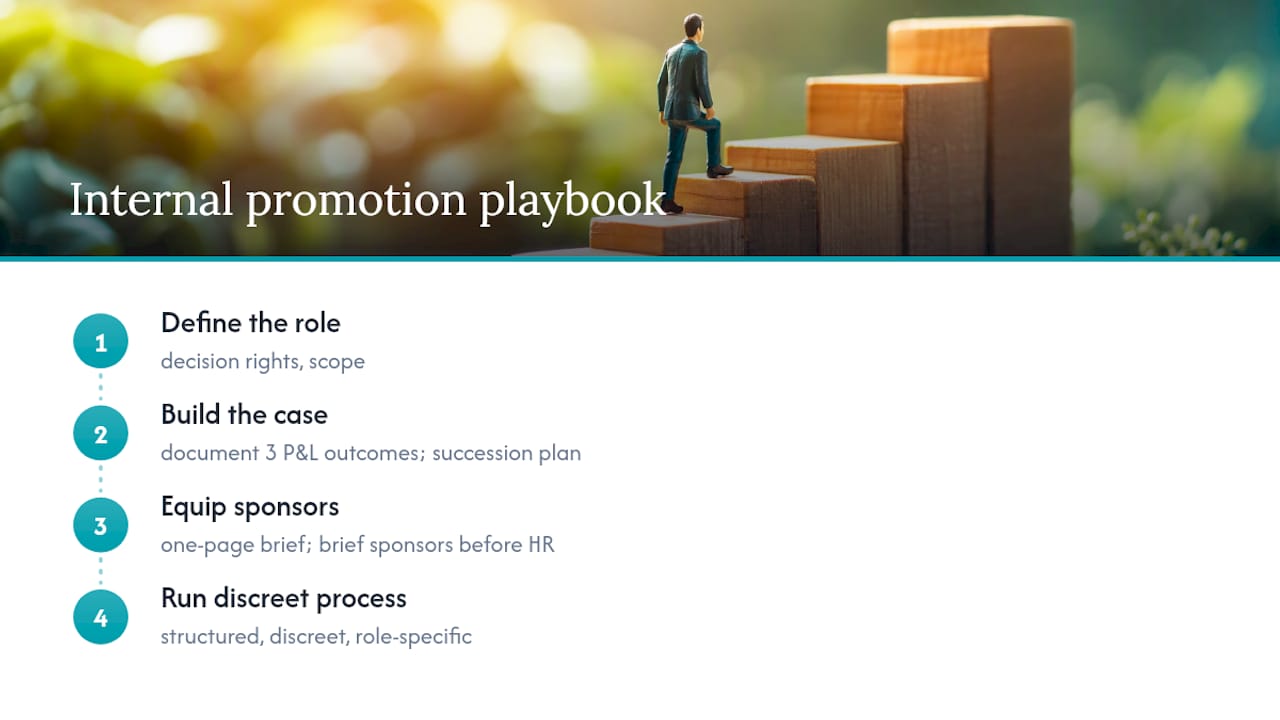
After more than a decade placing executives and reviewing thousands of promotion cases, the pattern is consistent: the candidates who succeed treat the process as a business negotiation, not a performance review. They define the role, build the case, and equip their sponsors before the conversation ever reaches HR.
One anonymized example: a VP of Operations targeting a Chief Operating Officer role spent nine months building her case using exactly this playbook. She defined the role’s decision rights, documented three P&L outcomes, developed a succession plan for her current scope, and briefed two senior sponsors with a one-page brief. When the role opened, the CEO told the board the decision was obvious. The role never posted externally.
Clients who engage Resumewiz for internal promotion preparation receive an executive operating memo, sponsor briefing templates, and interview coaching calibrated to internal panel dynamics. The process is discreet, structured, and built around the specific organization and role.
Resumewiz helps executives build a promotion-ready case
Executives preparing for an internal move need more than a polished resume. They need materials that work inside the organization: an operating memo that frames decisions and outcomes, sponsor briefs that give advocates something concrete to say, and interview coaching that prepares for the specific dynamics of an internal panel.

Resumewiz delivers exactly that. Kim Taynor’s recruiting background means every document is built the way a decision-maker reads it, not the way a job seeker writes it. The engagement starts with two deliverables: a one-page promotion case document and a stakeholder map with talking points for each sponsor tier. From there, clients move into interview preparation and negotiation coaching calibrated to the target role’s scope and compensation band.
If you are six to twelve months from a promotion conversation, start your engagement at Resumewiz now. The earlier the preparation begins, the stronger the case you build.
Want a recruiter in your corner for your next senior role? Book a free call with Resume Wiz and we will map out your next move together.
Sources
- Getting Promoted at Work: Your Executive Playbook 2026
- How a Senior IC Secured an Internal Promotion in Four Months, Laurie J Wetzel
- The Invisible Promotion: How to Build Your Brand Before the Role Even Opens - Leadership Coaching for Managers
- Career Mechanics: The Internal Mobility Playbook: Own Your Next Move Before the Org Chart Owns It for You · Expert LinkedIn
