How LinkedIn Builds Executive Influence and Opportunity
Many senior leaders assume that building a powerful LinkedIn presence requires publishing content every single day. That assumption is wrong, and it’s costing executives valuable time. Growing influence on LinkedIn as an executive has far more to do with strategic engagement and deliberate relationship-building than with how often you flood your network’s feed. This guide breaks down the specific tactics, profile strategies, and networking frameworks that actually move the needle for senior leaders who want to build real credibility, attract high-value opportunities, and position themselves as the go-to voices in their industries.
Table of Contents
- Why LinkedIn matters for senior executives
- Strategic engagement: Building influence without daily posting
- Optimizing your executive profile for credibility and search
- Maximizing LinkedIn for executive networking and business development
- A new approach: What most executives misunderstand about LinkedIn influence
- Ready to level up your executive LinkedIn strategy?
- Frequently asked questions
Key Takeaways
| Point | Details |
|---|---|
| Strategic presence over volume | Consistent, high-impact engagement outperforms daily posting for executive influence. |
| Comments drive visibility | Thoughtful interactions on others’ posts often boost credibility more than publishing alone. |
| Profile credibility matters | Complete and authoritative profiles are essential for building trust and attracting opportunities. |
| Network with intention | Quality relationships and targeted engagement unlock partnerships and leadership roles. |
Why LinkedIn matters for senior executives
Establishing why LinkedIn is a strategic tool lays the foundation for understanding its unique impact on an executive career. LinkedIn is not simply a digital resume or a job board. For senior leaders, it functions as the world’s most concentrated C-suite and B2B networking environment, where decision-makers, board members, investors, and industry influencers gather in one place. No other platform offers that density of high-level professional interaction.
Your LinkedIn presence shapes how the world perceives your executive brand before you ever walk into a room. A well-positioned profile signals authority, attracts inbound opportunities, and opens conversations that would otherwise require months of cold outreach. Consider the range of doors a strategic LinkedIn presence can unlock:
- Board seat opportunities: Nominating committees and governance search firms actively scan LinkedIn to identify candidates with the right expertise and reputation.
- Strategic partnerships: Potential partners research your background and thought leadership before reaching out, making your profile the first handshake.
- Talent attraction: Top-tier candidates evaluate leadership teams on LinkedIn before applying, and your presence directly influences their decision.
- Thought leadership platforms: Media outlets, conference organizers, and podcast hosts use LinkedIn to identify credible executive voices for speaking opportunities and commentary.
- Deal sourcing: Investors and business development professionals use LinkedIn to identify executives whose companies align with their portfolios or acquisition targets.
As research confirms, LinkedIn builds networks and executive influence without requiring daily content creation. The platform rewards presence, relevance, and relationship depth over raw posting volume. Understanding executive networking strategies through this lens changes how you allocate your time and energy on the platform entirely.
You can also study LinkedIn business development tactics to understand how B2B leaders generate real pipeline from their LinkedIn activity without becoming full-time content creators.
Pro Tip: Prioritize the quality of your network and the depth of your engagement over the quantity of your posts. One substantive comment on a high-visibility post from an industry leader can generate more profile views and connection requests than five generic status updates.
Strategic engagement: Building influence without daily posting
Knowing why LinkedIn matters prompts the next question: How should senior leaders actually use their time on the platform for influence? The answer centers on strategic engagement rather than content production. Comments, specifically well-crafted, insightful comments on the right posts, are one of the most underutilized tools in an executive’s LinkedIn playbook.
When you leave a substantive comment on a post from a respected industry figure, your name and perspective appear in front of their entire network. That is often thousands of highly relevant professionals who would never have encountered your profile otherwise. The reach is borrowed, but the credibility is entirely your own.
“Executive influence on LinkedIn does not require daily posting. It requires being present in the right conversations at the right time, with something genuinely valuable to contribute.”
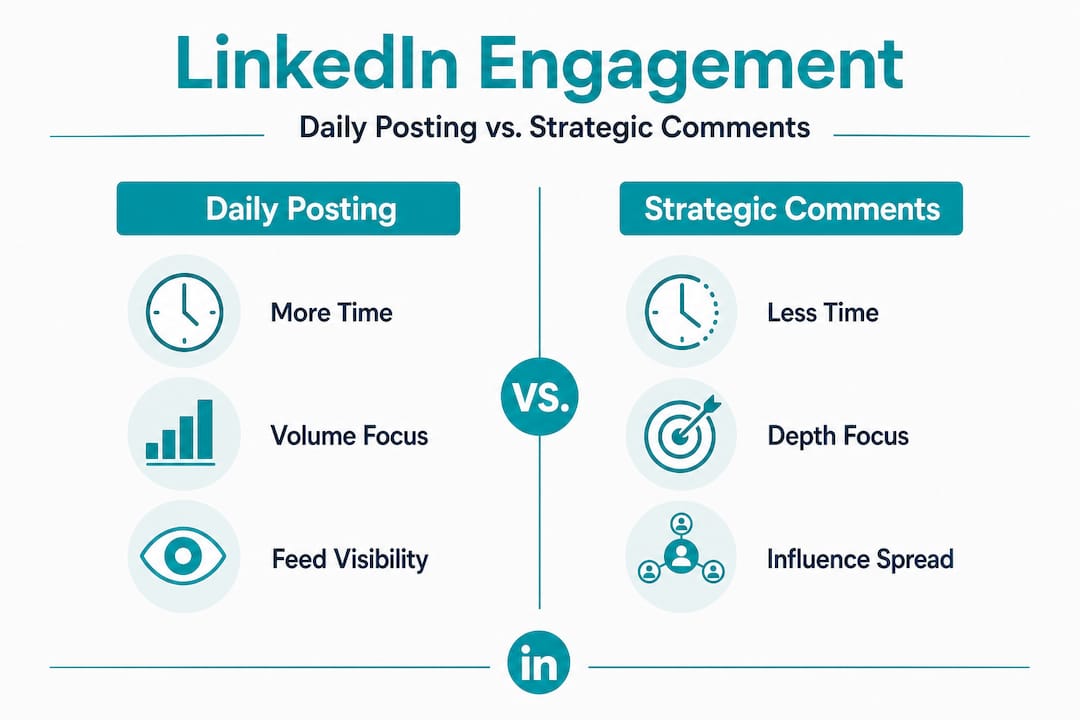
Here is a direct comparison of the two approaches most executives consider:
| Factor | Daily posting | Strategic commenting |
|---|---|---|
| Time investment | High (30-60 min/day) | Low to moderate (15-20 min/day) |
| Visibility reach | Limited to your network | Extends to poster’s entire network |
| Relationship depth | Passive (followers consume) | Active (direct dialogue with influencers) |
| Credibility signal | Depends on content quality | Reinforced by association with respected voices |
| Consistency pressure | Very high | Manageable and sustainable |
| Algorithmic boost | Moderate | High (comments drive engagement signals) |
As Forbes highlights for CEOs, the power of commenting as an influence tactic is real and measurable. The executives who understand this shift their effort from broadcasting to participating, and their results reflect it.
To put this into practice, follow these three steps to identify high-value engagement opportunities:
-
Map your influence targets. Identify 15 to 20 accounts that your ideal connections, clients, or partners actively follow and engage with. These are the conversations where your comments will land in front of the right eyes. Think industry analysts, sector-specific journalists, respected peers, and potential board colleagues.
-
Set a daily engagement window. Block 15 minutes each morning to scan your mapped accounts for new posts. Prioritize posts that have strong early engagement, since commenting early on a trending post maximizes your visibility before the thread becomes crowded.
-
Write comments that add a layer. Avoid “Great post!” or “Totally agree.” Instead, extend the idea, challenge a premise respectfully, share a relevant data point, or offer a brief real-world example from your experience. That is what stops readers mid-scroll and prompts them to click your name.
Avoid the most common pitfall in this approach: generic comments that add no value. A thoughtless comment can actually signal poor judgment to exactly the audience you are trying to impress. Review LinkedIn networking frameworks for executives to build a sustainable engagement rhythm that reflects your expertise. You can also explore step-by-step B2B lead generation approaches that complement a comment-first strategy with targeted outreach.
Optimizing your executive profile for credibility and search
Strategic engagement gains the most value when paired with a discoverable and credible executive profile. Think of your profile as the landing page for every impression you make through comments, connections, and recommendations. If someone clicks your name after a compelling comment and finds an incomplete or generic profile, the opportunity evaporates.
Profile optimization is the foundation for being discovered and trusted on LinkedIn. Here is a breakdown of what is essential versus what is simply optional for executives:
| Profile element | Essential or optional | Why it matters for executives |
|---|---|---|
| Headline | Essential | First thing people read; must convey value, not just title |
| Summary (About section) | Essential | Sets the narrative of your leadership philosophy and impact |
| Featured section | Essential | Showcases thought leadership, press, speaking, and key wins |
| Recommendations | Essential | Social proof from credible peers and direct reports |
| Experience section | Essential | Quantified achievements, not job descriptions |
| Skills and endorsements | Optional | Useful for search but not a primary credibility driver |
| Education | Optional | Relevant for certain industries; less critical at senior levels |
| Certifications | Optional | Adds depth but rarely a decision factor at executive level |
| Profile photo and banner | Essential | Visual authority signals professionalism immediately |
Follow this step-by-step process to upgrade your profile for executive-level impact:
-
Rewrite your headline. Move beyond your current job title. Use the headline to communicate your area of expertise and the value you bring. For example: “CFO helping mid-market companies scale through strategic capital allocation and operational discipline.”
-
Craft a summary that tells a story. Your About section should open with a single sentence that captures your leadership identity, then walk through the problems you solve, the results you have driven, and what you care about professionally. Write in first person. Keep it under 300 words.
-
Populate the featured section. Add links to published articles, media mentions, speaking videos, white papers, or key presentations. This section is prime real estate that most executives leave empty.
-
Request targeted recommendations. Ask board members, direct reports, and senior peers to write specific recommendations that reference measurable outcomes. “She led our company through a $200M acquisition with zero disruption to operations” is far more powerful than “She is a great leader.”
-
Audit your experience section. Replace duty-focused bullet points with achievement-focused statements. Use numbers wherever possible: revenue grown, teams built, costs reduced, markets entered.
Pro Tip: Use the featured section to showcase thought leadership and press appearances prominently. A link to a published op-ed or a keynote recording tells visitors more about your executive caliber in five seconds than three paragraphs of text ever could.
Explore executive profile tips for additional guidance on positioning each section for maximum impact. For a deeper look at the tools that support profile visibility, review this LinkedIn lead tools comparison to understand what platforms executives use to amplify their reach.
Maximizing LinkedIn for executive networking and business development
With an optimized profile and a thoughtful engagement strategy, executives are poised to translate their LinkedIn presence into tangible business outcomes. The final layer is intentional networking and business development, where LinkedIn becomes a genuine deal-making and partnership-sourcing environment.
LinkedIn enables executives to build influence, reputation, and networks that directly support business growth. The key is moving from passive visibility to active relationship cultivation. Here are the executive-level networking best practices that consistently produce results:
- Connect with intention. Every connection request you send should include a personalized note that references a shared context, a mutual connection, or a specific reason for reaching out. Generic requests get ignored at the executive level.
- Follow before you connect. Follow a target contact for a few weeks, engage with their content meaningfully, and then send a connection request. By that point, they already recognize your name.
- Nurture your existing network. Regularly congratulate connections on milestones, comment on their wins, and share relevant content directly with individuals who would find it useful. Relationships decay without maintenance.
- Use LinkedIn’s search filters strategically. Filter by industry, title, geography, and company size to identify exactly the right people for partnership conversations, advisory roles, or business development outreach.
- Join and contribute to relevant groups. Industry-specific LinkedIn groups can surface high-value contacts and conversations that do not appear in your standard feed.
Pro Tip: Personalize your outreach using industry context. Reference a specific challenge facing their sector, a recent regulatory shift, or a market trend you know they are navigating. That level of specificity signals that you did your homework and that the conversation will be worth their time.
For a structured approach to building your executive networking playbook, consider mapping your target relationship categories: potential board colleagues, strategic partners, talent pipeline contacts, and media or speaking opportunities. Each category requires a slightly different engagement approach. The B2B LinkedIn sales guide offers additional frameworks for converting LinkedIn relationships into real business conversations.
A new approach: What most executives misunderstand about LinkedIn influence
After exploring best practices, it is worth stepping back to challenge some of the assumptions that still dominate executive thinking about LinkedIn. Here is the uncomfortable reality: most senior leaders either ignore LinkedIn entirely or approach it like a marketing channel. Both mistakes cost them influence.
The executives who build the most durable LinkedIn presence are not the ones publishing the most content. They are the ones who show up consistently in the right conversations, add genuine insight, and let their reputation compound over time. Influence on LinkedIn, at the executive level, is less about reach and more about resonance.
Here is what that looks like in practice. A CEO who comments thoughtfully on three industry-relevant posts per week, connects with five high-value contacts per month, and keeps their profile current with recent wins will outperform a peer who posts daily but says nothing particularly memorable. The first executive is building relationships. The second is broadcasting into the void.
There is also a timing element that most guides miss. There are moments in your career when stepping back from active LinkedIn promotion is actually the right move. When you are deep in a sensitive negotiation, a board transition, or a company restructuring, a lower profile protects you. Let your advocates, your recommendations, and your track record speak during those periods.
The hardest lesson for high-achieving executives is this: you do not need to dominate the feed to dominate the conversation. Understated, consistent relationship-building, done with real substance and genuine curiosity about others, produces the kind of LinkedIn influence that translates into board seats, partnerships, and career-defining opportunities. Volume is a shortcut that rarely pays off at the senior level.
Ready to level up your executive LinkedIn strategy?
Knowing what to do and actually executing it at an executive level are two very different challenges. Your time is finite, and every hour spent figuring out LinkedIn optimization is an hour not spent running your business or advancing your career.
That is exactly where Resume Wiz executive services come in. Resume Wiz specializes in helping senior leaders transform their LinkedIn profiles into credibility engines, building the kind of presence that attracts board opportunities, strategic partnerships, and high-fit career moves. With over 10 years of recruiting experience behind every recommendation, the team knows precisely what decision-makers look for when they land on an executive's profile. From headline rewrites to featured section strategy to personalized networking frameworks, Resume Wiz delivers tailored solutions that turn your LinkedIn from a static page into an active opportunity generator. If you are serious about your next career move or business development goal, the right expert support accelerates everything.
Want a recruiter in your corner for your next senior role? Book a free call with Resume Wiz and we will map out your next move together.
Frequently asked questions
Do senior executives need to post on LinkedIn every day to build influence?
No, strategic engagement and network-building are more effective than daily posting for executives. Consistent, high-quality interactions with the right people produce better results than high-volume content creation.
What are the most important LinkedIn profile sections for a senior executive?
Focus on your headline, summary, featured content, and recommendations for maximum credibility and discoverability. Profile optimization in these four areas alone can dramatically increase inbound opportunities and search visibility.
How can LinkedIn help executives with business development?
Executives use LinkedIn to identify partnerships, source deals, and develop industry leadership by engaging strategically with targeted contacts. The platform’s search and filtering tools make it possible to identify exactly the right decision-makers for any business development goal.
Do comments and interactions matter more than original posts for executive visibility?
Yes, engaging on others’ posts can build more influence with less effort compared to frequent posting. Comments drive engagement signals that boost your visibility across the poster’s entire network, often reaching thousands of relevant professionals at once.
