How Recruiters Find Executive Candidates in 2026
Executive recruitment, also called retained search or headhunting, is a proactive, research-driven process targeting leaders who are not actively looking for a new role. Understanding how recruiters find executive candidates gives you a direct advantage, whether you are managing a search or positioning yourself to be found. Recruiters do not post jobs and wait. They build targeted lists, map competitor organizations, and tap warm referral networks to identify the right person before a single outreach message is sent. Tools like LinkedIn Recruiter, ZoomInfo, and Apollo are standard in every serious search firm’s toolkit.
How recruiters find executive candidates: building a leadership universe
The first step in any executive search is constructing what the industry calls a “leadership universe.” This is a curated list of 30 to 100 target executives identified through structured research before any outreach begins. Most executives never realize this mapping phase exists. By the time a recruiter calls you, your name has already been on a list for weeks.
Recruiters build this universe through several methods:
- Reverse org chart engineering: Recruiters map the organizational structure of competitor and peer companies, identifying who holds relevant titles and what their career trajectory looks like.
- Market intelligence monitoring: Funding announcements, restructuring news, executive departures, and board changes all signal where talent is moving. Recruiters track these events through platforms like Crunchbase, PitchBook, and industry press.
- AI-enhanced database searches: Tools like LinkedIn Recruiter, ZoomInfo, Apollo, Gem, and hireEZ allow recruiters to filter candidates by industry, company size, tenure, and specific career milestones.
- Manual verification: Technology surfaces names, but experienced recruiters validate each candidate through direct research, peer conversations, and reference checks before adding them to the shortlist.
| Tool | Primary Use | Strength |
|---|---|---|
| LinkedIn Recruiter | Profile discovery and outreach | Largest professional network |
| ZoomInfo | Contact data and org mapping | Deep company intelligence |
| Apollo | Email and phone prospecting | High contact accuracy |
| Gem | Pipeline tracking and analytics | Workflow management |
| hireEZ | AI-powered candidate matching | Competency filtering |
Pro Tip: If your LinkedIn profile does not reflect your most recent leadership impact, you may not appear in filtered searches at all. Recruiters use keyword-driven queries, so the language you use on your profile directly determines whether you show up.
Why warm referrals drive more executive placements than cold outreach
Warm referrals dramatically outperform cold outreach for securing exploratory conversations with senior candidates. This is not a minor difference. A cold LinkedIn message to a passive executive converts at a fraction of the rate that a personal introduction from a trusted board member or advisor achieves.
Recruiters know this, so they build referral pipelines deliberately. Key sources include:
- Board members and advisors who know the talent landscape in a specific sector
- Former executives who have worked alongside the type of candidate being sought
- Industry conference organizers and association leaders who have visibility into who is performing at a high level
- Clients themselves, who often refer candidates from their own networks
Confidentiality is central to this process. Retained executive search is inherently proactive and confidential, which means neither the client company nor the candidate’s name is disclosed until both parties agree to move forward. Introductions are handled carefully to protect reputations on both sides.
For you as an executive, this has a direct implication. The people most likely to refer you to a search firm are former colleagues, clients, and mentors who have seen your work firsthand. Maintaining those relationships actively, not just when you need something, is what keeps you in the referral pipeline.
Pro Tip: After completing a major project or leadership win, send a brief personal update to three or four key contacts in your network. You are not asking for anything. You are keeping your name and your results visible to the people most likely to recommend you.
What role does AI play in competency-based executive sourcing?
The shift from title-based to competency-based sourcing is the most significant change in executive recruitment in the past five years. Recruiters now focus on future capability and strategic fit rather than on what your last job title was. A VP of Operations who led a successful turnaround is more interesting to a recruiter than a COO who maintained steady-state operations.
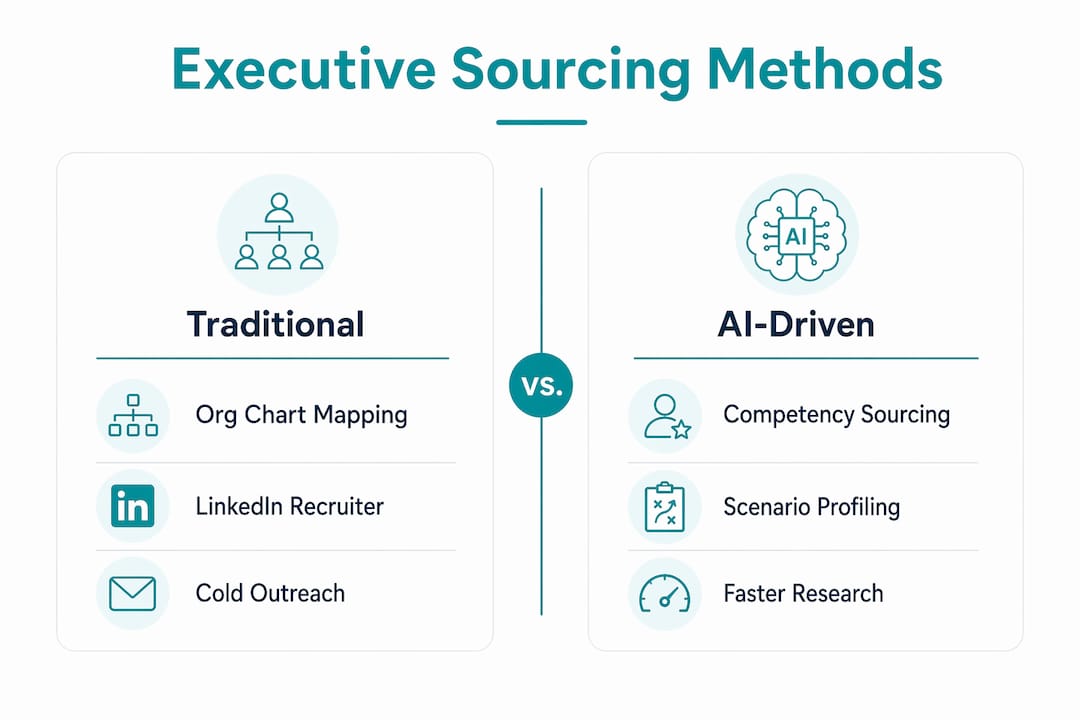
AI platforms like Findem enable scenario-based candidate profiling, where recruiters input specific business challenges and the system surfaces executives who have solved comparable problems. This is a fundamental shift from keyword matching to outcome matching. The recruiter is not searching for “Chief Revenue Officer.” They are searching for “executive who scaled ARR from $20M to $100M in a B2B SaaS environment.”
| Traditional Sourcing | AI-Driven Competency Sourcing |
|---|---|
| Searches by job title | Searches by business outcomes achieved |
| Filters by company size and tenure | Filters by verified performance scenarios |
| Manual review of resumes | Automated shortlisting with human validation |
| Weeks of research | Days from brief to initial shortlist |
| Broad candidate pool | Targeted list of 30 to 100 verified candidates |
This approach also reduces the time from research to shortlist significantly. Recruiters using AI tools can move faster, which means the window for a passive candidate to be identified and contacted is shorter than it used to be.
Pro Tip: Review your LinkedIn profile and resume with this question in mind: do they describe the business problems you solved, or just the roles you held? Reframe your experience around outcomes. “Led a team of 50” is a title detail. “Reduced operational costs by 22% while scaling headcount” is a competency signal.
How do recruiters engage passive executive candidates?
Initial recruiter outreach is part of a confidential research phase, not a job application process. The goal of the first message is not to pitch a role. It is to open a conversation. Recruiters who understand this craft outreach that feels like a peer-to-peer exchange, not a sales call.
The most effective engagement sequence looks like this:
- LinkedIn connection or message: Used for discovery and initial visibility. Personalized with a reference to a specific achievement or shared connection.
- Email follow-up: More detailed and private. References the strategic challenge the client is facing without disclosing the client’s identity.
- Phone call: The relationship-building step. This is where a recruiter assesses fit, gauges interest, and begins building trust.
- Warm introduction: If a mutual contact exists, the recruiter may request an introduction before any direct outreach, which increases response rates substantially.
A multi-channel approach involving email, phone, and LinkedIn produces higher response rates from passive candidates than any single channel alone. Timing also matters. Messages sent on Tuesday through Thursday mornings tend to reach executives when they are most responsive.
The message itself must be specific. Generic outreach fails. A recruiter who references your specific work, your company’s recent growth, or a challenge you publicly addressed in a conference talk signals that this is not a mass campaign. That specificity is what earns a response.
Pro Tip: When a recruiter reaches out, respond even if you are not interested. A brief, professional reply keeps you in their network for future searches. Recruiters remember who was gracious and who went silent.
What can executives do to get found by recruiters?
Executives with strong industry thought leadership and visible impact are significantly more likely to be identified and approached. Visibility is not accidental. It is built deliberately over time through consistent, public demonstrations of expertise.
Here is what actually moves the needle:
- Speak at industry conferences. Conference speaker lists are a primary sourcing tool for recruiters. If your name appears on an agenda for a relevant event, you are already in a recruiter’s research pool.
- Publish on LinkedIn or in trade publications. Articles and posts that address specific business challenges signal your thinking and your domain expertise to anyone searching your name.
- Clarify the problems you solve. Executives who articulate business challenges solved rather than listing job duties are far more likely to surface in competency-based searches. Your profile should answer: what kind of company needs someone like you, and why?
- Maintain a complete, current LinkedIn profile. Recruiters using AI-driven sourcing tools rely on the data your profile provides. Gaps in your profile create gaps in your discoverability.
- Stay connected to your referral network. The people who can introduce you to a search firm need to know what you are working on and what you are open to. Keep those conversations alive.
The executive search process typically takes 8 to 16 weeks from brief to offer. Recruiters are always building their next universe in parallel. Your visibility today determines whether you appear in a search that starts six months from now.
Key takeaways
Executive recruiters find candidates through proactive research, AI-driven competency sourcing, and warm referral networks, not job postings or reactive applications.
| Point | Details |
|---|---|
| Leadership universe mapping | Recruiters build a list of 30 to 100 targets before any outreach begins. |
| Competency over title | AI tools surface candidates based on business outcomes, not job titles. |
| Warm referrals win | Personal introductions from trusted contacts convert far better than cold outreach. |
| Multi-channel engagement | Effective recruiter outreach combines LinkedIn, email, and phone in sequence. |
| Visibility drives discovery | Speaking, publishing, and a complete LinkedIn profile put you in recruiter research pools. |
What 10 years in recruiting taught me about getting found
Most executives I work with are surprised to learn that by the time a recruiter calls them, they have already been researched, discussed, and ranked. The call is not the beginning of the process. It is the end of a research phase that may have taken weeks.
The biggest misconception I see is that a strong resume is enough. It is not. Recruiters are organizational archaeologists, not resume readers. They are mapping markets, tracking career moves, and building relationships long before any specific role opens. If you are not visible in the places they look, your resume never enters the picture.
What I have found actually works is this: executives who treat their professional visibility as an ongoing practice, not a job-search activity, consistently appear in more searches. They speak at events. They post about the problems they solve. They stay in contact with former colleagues and clients. They do not wait until they need a new role to build the network that will find them one.
The shift to competency-based sourcing through platforms like Findem also changes what you need to communicate. Titles and tenure are table stakes. What recruiters and their AI tools are looking for is evidence of specific outcomes. If your public profile does not reflect the business results you have delivered, you are invisible to the most sophisticated sourcing methods in use today.
The executives who get called are not always the most accomplished. They are the most findable. That is a distinction worth acting on.
Kim
How Resumewiz helps executives get found first
Understanding how recruiters source talent is only useful if your profile and resume reflect what they are actually searching for.

Resumewiz specializes in helping executives translate their leadership impact into the language recruiters and AI sourcing tools recognize. From ATS-compliant executive resumes built around competencies and outcomes, to LinkedIn profile optimization that puts you in front of the right searches, Resumewiz delivers the positioning work that makes you discoverable. Founder Kim Taynor brings over 10 years of recruiting experience to every engagement, which means the strategy behind your profile reflects how search firms actually operate, not how most career coaches assume they do.
Want a recruiter in your corner for your next senior role? Book a free call with Resume Wiz and we will map out your next move together.
FAQ
How long does an executive search typically take?
The executive search process takes 8 to 16 weeks from initial brief to offer. Most of that time is spent in the research and outreach phase before candidates are formally presented.
Do executive recruiters use job boards to find candidates?
Executive recruiters do not rely on job boards. They use proactive sourcing techniques including org chart mapping, AI-powered databases, and warm referrals to identify passive candidates who are not actively searching.
What do recruiters look for in executive candidates?
Recruiters prioritize future capability and strategic fit over job titles. They look for executives who can demonstrate specific business outcomes, such as scaling revenue, leading turnarounds, or building high-performance teams in comparable environments.
How can i increase my chances of being found by a recruiter?
Speak at industry events, publish content that reflects your expertise, and keep your LinkedIn profile current with outcome-focused language. Executives with strong public visibility and active referral networks appear in recruiter research pools far more often.
What is the difference between executive recruitment and headhunting?
All retained executive search is headhunting. The distinction is that headhunting is proactive and confidential, targeting leaders who are not applying for roles, while general recruitment responds to active applicants.
