How to Bypass Online Applications and Get Noticed
Bypassing online job applications is defined as using direct outreach and human contact to get your resume in front of hiring managers instead of submitting it through automated portals. ATS platforms reject roughly 75% of applications before a human ever reads them. That number means three out of four applicants are eliminated by software, not people. The strategies covered here are ethical, practical, and grounded in how hiring actually works. Resumewiz has helped executives and career changers use these exact methods to secure interviews faster than the standard portal route.
Why do online applications fail so often?
Applicant Tracking Systems, commonly called ATS, are the gatekeepers of modern hiring. They scan resumes for keywords, filter by experience thresholds, and rank candidates before any recruiter sees a single name. The result is a system that rewards formatting tricks over actual qualifications.
The core problem is that ATS systems perform keyword matching and do not evaluate content quality or candidate fit beyond simple rules. A highly qualified candidate with a two-column resume or a PDF that parses poorly can be eliminated in seconds. The system never knows what it missed.
Timing compounds the problem. Most job postings receive hundreds of applications within the first 48 hours. Applicants who submit on day three or four are buried under earlier entries, regardless of their qualifications. Volume does not help here. Sending 50 applications through portals does not improve your odds if the same filter rejects all 50.
| ATS filtering criterion | How it eliminates candidates |
|---|---|
| Keyword matching | Resumes missing exact job description terms are ranked low or rejected |
| File format parsing | PDFs with complex layouts often fail to parse correctly |
| Experience year thresholds | Automated rules cut candidates below minimum years listed |
| Resume structure | Multi-column or graphic-heavy formats confuse parsing engines |
| Application timing | Later submissions rank lower in recruiter queues |
Pro Tip: Submit your application within the first 24 hours of a job posting going live. Early applicants appear at the top of recruiter queues before volume builds.
What tools and preparation do you need first?
The most effective workaround for online forms starts before you write a single email. Preparation determines whether your outreach gets a reply or gets ignored.
Resume formatting is the first priority. Simple formatting with single-column layouts and standard headings like “Experience” and “Education” dramatically improves ATS readability. Use a .docx file when submitting through portals, since many systems parse Word documents more reliably than PDFs. Reserve the polished PDF version for direct email outreach to hiring managers.
Contact discovery is the second barrier. DearHiringManager.io finds verified hiring manager names and emails from a job listing URL in under 60 seconds. That speed removes what was historically the biggest obstacle to direct outreach. LinkedIn is a strong secondary source for identifying the right person, typically a department head or direct team manager rather than an HR generalist.
Your outreach message needs to be ready before you search for contacts. The core elements of an effective cold email are:
- A subject line that names the specific role and your strongest credential
- One sentence explaining who you are and why you are relevant
- One concrete achievement with a measurable result
- A single, easy question that invites a reply without demanding a decision
- A total length under 150 words
Pro Tip: Send your outreach email on Tuesday or Wednesday morning between 8:00 AM and 10:00 AM in the recipient’s time zone. Open rates for professional emails peak during those windows.
How to bypass online applications step by step
The most reliable method to skip the ATS filter is direct human contact. The only 100% reliable bypass is to avoid the applicant portal entirely and email the hiring manager directly, because humans read messages whereas ATS do not. That said, most companies require portal submissions for compliance, so the practical approach combines both.
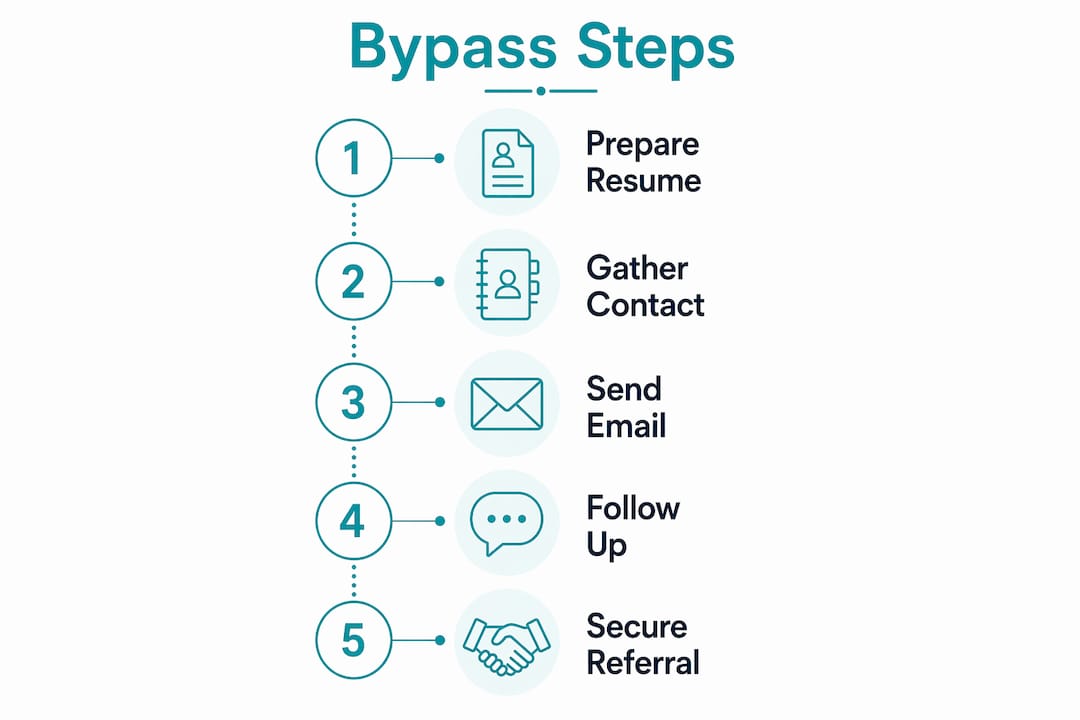
- Submit through the portal if required. Many companies mandate portal applications for legal and HR compliance. Submitting there checks the box without relying on it to get you noticed.
- Find the hiring manager’s direct contact. Use DearHiringManager.io with the job listing URL, or search LinkedIn for the team lead or department head overseeing the role.
- Send a personalized outreach email. Reference the specific role, name one achievement relevant to the job, and ask a low-pressure question. Keep it under 150 words.
- Send a follow-up “double-tap” email. Following up after portal submission increases the chance your profile gets reviewed despite automated filtering. Send it 48 to 72 hours after your initial message if you receive no reply.
- Activate your network for referrals. A referral from a current employee bypasses the portal entirely in many organizations. Career experts confirm that direct human contact is one of the most reliable paths to having your resume actually read.
| Approach | ATS exposure | Human contact | Typical response rate |
|---|---|---|---|
| Portal only | Full ATS filtering | None until shortlist | Low |
| Portal plus direct outreach | Filtered, but supplemented | Yes, direct to hiring manager | Moderate to high |
| Referral only | Minimal or none | Yes, through trusted contact | High |
The referral path is the most powerful. A warm introduction from a current employee signals credibility before the hiring manager reads a single word of your resume.
What mistakes and ethical lines should you avoid?
Direct outreach works when it is professional and targeted. It fails, and can damage your reputation, when it crosses into spam or desperation.
The biggest misconception in the hack online application process conversation is that volume equals results. Focused direct emails to hiring managers yield better results than mass applications. Sending the same generic email to 40 hiring managers is not outreach. It is noise, and recipients recognize it immediately.
Technical shortcuts carry serious risks. In april 2026, researchers demonstrated exploiting race conditions in job portals to submit multiple records for a single candidate. That approach required manual HR cleanup and would disqualify any real applicant who tried it. Similarly, automated application bots face reCAPTCHA Enterprise systems that are extremely difficult to bypass reliably, and bot-based approaches can trigger account banning.
“The goal is to get a human to read your resume and consider you for the role. Anything that makes you look desperate, dishonest, or automated works directly against that goal. Professionalism is not just courtesy. It is strategy.”
Dos and don’ts for ethical bypass outreach:
- Do personalize every email with the recipient’s name and the specific role
- Do follow up once after 48 to 72 hours with no reply
- Do respect a “no” or silence after two attempts
- Don’t use automated bots or scripts to submit applications at scale
- Don’t exploit technical vulnerabilities in application portals
- Don’t contact multiple people at the same company simultaneously
- Don’t send attachments in a cold first email without permission
Key Takeaways
Direct outreach to hiring managers is the single most reliable method to bypass ATS filtering and get your resume in front of a real decision-maker.
| Point | Details |
|---|---|
| ATS filters most candidates | Roughly 75% of applications are rejected before human review, making portal-only strategies unreliable. |
| Format your resume for both audiences | Use .docx with single-column layout for portals; send a polished PDF directly to hiring managers. |
| Find contacts with the right tools | DearHiringManager.io identifies verified hiring manager emails from a job URL in under 60 seconds. |
| Use the double-tap strategy | Submit through the portal for compliance, then email the hiring manager directly within 48 hours. |
| Referrals outperform all other methods | A current employee referral bypasses ATS entirely and signals credibility before the resume is read. |
What I’ve learned after 10 years of watching people apply the wrong way
I have reviewed thousands of job searches over my career, and the pattern is always the same. Job seekers spend 90% of their effort on the portal submission and almost none on what happens after they click “submit.” They treat the application as the finish line when it is actually just the starting point.
The strategies for skipping forms and going directly to hiring managers are not new. Recruiters have always known that a warm introduction or a well-timed direct email moves candidates to the top of the pile. What has changed is that job seekers now have tools like DearHiringManager.io that make contact discovery fast enough to be practical at scale.
The ethical line is clear to me. Exploiting technical vulnerabilities or using bots is not a workaround. It is sabotage of your own candidacy. The methods that actually work, targeted emails, referrals, and the double-tap follow-up, all succeed because they demonstrate exactly the qualities hiring managers want: initiative, clarity, and respect for other people’s time.
My honest advice is to send 10 personalized direct outreach emails this week instead of submitting 50 portal applications. Track your reply rate. Adjust your message based on what gets responses. That feedback loop is something a portal submission never gives you.
Kim
Resumewiz can take your outreach further
Getting past the ATS filter is only half the challenge. Your resume still needs to impress the human who reads it after your outreach lands.

Resumewiz offers ATS-compliant resume development built specifically for executives, managers, and career changers who need their materials to perform in both automated and human review. The platform combines resume writing, LinkedIn profile optimization, and personalized outreach templates into a single, managed process. Kim Taynor and the Resumewiz team work directly with clients to position them for high-fit interviews within defined timeframes. If your current approach is producing silence, a professionally built resume paired with direct outreach is the combination that changes that.
Want a recruiter in your corner for your next senior role? Book a free call with Resume Wiz and we will map out your next move together.
FAQ
What does it mean to bypass online job applications?
Bypassing online job applications means contacting hiring managers directly by email or referral instead of relying solely on portal submissions. This approach avoids ATS filtering, which rejects roughly 75% of applicants before human review.
Is it legal to bypass online application systems?
Ethical bypass methods like direct email outreach and referrals are completely legal and widely practiced. Exploiting technical vulnerabilities in portals, such as race conditions, is not legal and will disqualify you from consideration.
How do I find a hiring manager’s email address?
DearHiringManager.io identifies verified hiring manager contact information from a job listing URL in under 60 seconds. LinkedIn is a strong secondary source for identifying the right person to contact.
What is the double-tap strategy for job applications?
The double-tap strategy means submitting through the company portal for compliance and then sending a direct email to the hiring manager within 48 hours. Follow-up emails after portal submission increase the odds that your profile gets reviewed despite automated filtering.
Does applying to more jobs increase your chances?
Applying to more jobs through portals does not increase your odds if ATS filters reject all submissions. Focused, personalized direct outreach to hiring managers produces better results than high-volume portal applications.
