
How to Get a Higher Paying Job at Senior Level
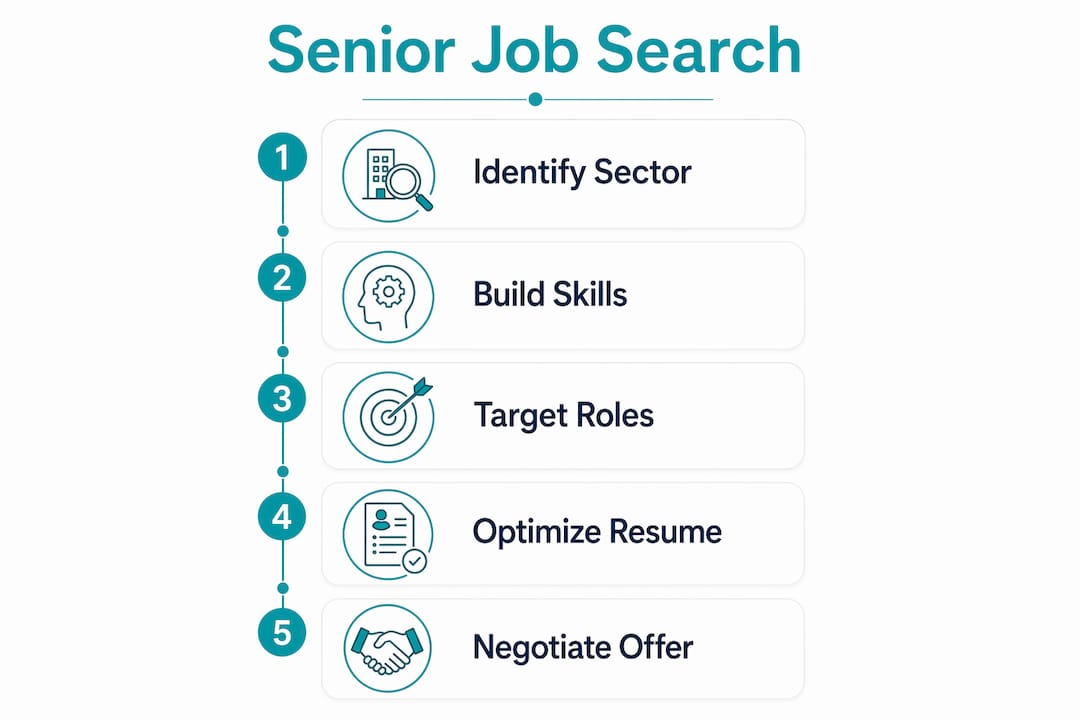
Securing a higher paying job at senior level is defined by three factors: the skills you build, the roles you target, and how well you negotiate the final offer. Professionals who treat these three elements as a connected system consistently outperform those who rely on tenure alone. The Harvard Program on Negotiation confirms that treating compensation as a multi-issue package, not a single salary number, produces materially better outcomes. Resumewiz works with senior executives daily on exactly this process, from positioning to offer acceptance.
How to get a higher paying senior-level job: skills that command top pay
The fastest path to higher compensation at senior level runs through specialized, high-demand skills in sectors where talent is scarce. Leadership credentials matter, but sector alignment matters more. Sector choice impacts pay more than title differences at the senior level, which means a VP of Engineering at an AI startup will typically out-earn the same title at a legacy manufacturer by a wide margin.
Certifications in areas like AI product management, financial risk, or enterprise data governance signal current relevance to hiring committees. Executive education programs from institutions like Wharton, MIT Sloan, or the Kellogg School of Management carry weight in C-suite searches because they demonstrate deliberate investment in leadership capacity. Measurable outcomes on your record matter just as much. Hiring managers at the senior level want to see revenue generated, costs reduced, or teams scaled, with specific numbers attached.
The 2026 compensation landscape rewards this specificity. C-suite and board-adjacent roles saw pay increases of 6.4 to 6.6% this year, while Director-level pay actually declined 0.6%. That gap is not random. It reflects the premium placed on executives who can demonstrate enterprise-wide impact rather than departmental management.
Key skills that drive senior-level pay increases:
- AI and data fluency: Executives who can direct AI-driven initiatives command a measurable premium across industries.
- P&L ownership: Direct profit-and-loss responsibility signals readiness for C-suite roles.
- Cross-functional leadership: Managing across sales, product, and operations signals enterprise scope.
- Board communication: The ability to present to and influence boards is rare and highly compensated.
- Change management: Proven experience leading restructuring or post-merger integration adds significant value.
Pro Tip: Quantify every achievement on your resume with a dollar figure, percentage, or headcount number. Vague claims like “led growth initiatives” lose to specific ones like “grew ARR from $12M to $31M in 18 months.”
How do you target the right senior roles for maximum pay?
Targeting the right roles is not about applying broadly. It is about building a precise profile of the company type, industry, geography, and stage where your skills command the highest price.
A broad job search at the senior level wastes time and dilutes your positioning. A targeted search focuses your energy on companies in growth sectors with genuine talent scarcity, where your specific background solves a real problem. Performance-vesting equity grants have grown from under 5% of senior offers in 2022 to roughly 19% in 2025, which means the total compensation potential at growth-stage companies now far exceeds what base salary comparisons reveal.
| Approach | Broad job search | Targeted job search |
|---|---|---|
| Role fit | Generic titles across sectors | Specific titles in defined industries |
| Company stage | Any size, any stage | Growth-stage or high-margin incumbents |
| Outreach method | Job boards, mass applications | Direct recruiter contact, warm introductions |
| Compensation outcome | Market average | Above-market with equity upside |
| Time to offer | Longer, lower conversion | Shorter, higher conversion |
Geography also affects net outcome. Relocating to lower-tax secondary markets can improve net disposable income for senior executives even when gross pay is nominally lower. A $300,000 package in Austin or Nashville often delivers more take-home than $340,000 in New York or San Francisco.
Build your target list around three criteria: the sector is growing, the company has a talent gap your background fills, and the role reports to the CEO or board. That combination produces the highest offer levels and the most negotiating room.
What job search assets do senior executives actually need?
Your resume, LinkedIn profile, and outreach messages are not administrative tasks. They are sales documents, and they need to be treated that way.
Achievement-oriented resumes consistently produce higher initial salary offers and stronger negotiation positioning. The mechanism is straightforward: when a hiring committee reads a resume full of outcomes, they anchor their offer to a higher perceived value. A resume that lists responsibilities instead of results does the opposite.
Your LinkedIn headline should function as a value proposition, not a job title. “CFO | Scaled SaaS companies from Series B to IPO | $500M+ in capital raised” outperforms “Chief Financial Officer at [Company]” in both search visibility and recruiter response rates. Your executive bio should be three to four sentences that answer one question: why are you the person who solves this specific problem?
A structured outreach plan produces better results than sporadic applications. Follow this sequence:
- Map your first-degree network for warm introductions to target companies. These connections convert at the highest rate.
- Engage two to three executive recruiters who specialize in your sector. Provide them with a one-page target brief, not just your resume.
- Send personalized outreach to second-degree connections at target companies, referencing a shared contact or a specific company initiative.
- Apply directly to posted roles only after exhausting warm channels. Cold applications at the senior level have a low conversion rate.
- Follow up systematically every seven to ten days with value-added touchpoints, not just “checking in” messages.
Senior-level job searches typically take about 90 days from start to offer acceptance. That timeline requires a weekly cadence of outreach, follow-up, and pipeline review to stay on track.
Pro Tip: Build a simple spreadsheet to track every target company, contact, outreach date, and next action. Treat your job search like a sales pipeline with conversion stages.
How to negotiate your compensation package beyond base salary
Salary negotiation at the senior level is not a single conversation about a number. It is a structured process across multiple compensation elements, and the professionals who understand that distinction earn significantly more.
Never negotiate before you hold a written offer. Requesting time to review the offer before responding is standard practice and signals professionalism, not hesitation. Use that time to research market data and build your counter.
Executives who negotiate with at least one competing offer receive 18 to 22% more in total compensation on average. That is not a small difference. It represents the single highest-leverage action available to a senior candidate.
Most candidates focus 80% of their negotiation energy on base salary, which is often the least flexible element of a senior package. The highest leverage sits in equity structuring, severance terms, and change-of-control provisions. A well-structured equity grant or a strong severance clause can add hundreds of thousands of dollars in expected value that never appears in the base salary line.
| Compensation element | Negotiation leverage | Notes |
|---|---|---|
| Base salary | Moderate | Often constrained by internal pay bands |
| Annual bonus target | Moderate to high | Push for a strong first-year bonus |
| Equity grant | High | Negotiate vesting schedule and cliff period |
| Signing bonus | High | Compensates for unvested equity left behind |
| Severance terms | Very high | 12 to 18 months is achievable at C-suite level |
| Remote work / PTO | Moderate | Often easier to move than cash |
Negotiating up to 25% above the initial offer is reasonable for senior and specialized roles when backed by objective market data. Anchor your request with a specific, non-round number derived from research. Saying “I’m targeting $287,000 based on comparable roles in this market” is more credible than “I was thinking around $300,000.” Precision signals preparation.
Never accept an offer on the spot. Get every agreed term in writing before you resign from your current role.
What mistakes derail senior professionals from higher-paying roles?
The most common mistake senior professionals make is being generic. A generic pitch, a generic resume, and a generic target list produce generic results. Specificity at every stage is what separates candidates who receive top-tier offers from those who settle.
- Accepting the first offer: Companies expect negotiation at the senior level. Accepting immediately signals you undervalue yourself.
- Ignoring equity complexity: Equity vesting schedules, severance provisions, and change-of-control clauses can add hundreds of thousands in expected value. Most candidates never ask about them.
- Neglecting pipeline management: A single active opportunity is not a pipeline. You need three to five concurrent conversations to create real negotiating leverage.
- Anchoring to your current salary: Market data, not your current pay, should anchor every negotiation. Your current salary is irrelevant to what the role is worth.
- Skipping the written confirmation: Verbal agreements at the senior level are not binding. Every negotiated term must appear in the written offer letter.
“The best negotiation results come from making defensible requests based on researched market data and emphasizing overall value, not just salary numbers. Treat the package as a set of interconnected issues, not a zero-sum contest over a single figure.” Harvard Program on Negotiation
The 2026 market rewards executives who understand sector selection. AI, life sciences, and defense technology are producing the strongest compensation growth. Choosing the right sector before you start your search is a higher-leverage decision than any single negotiation tactic.
Key Takeaways
Professionals who secure higher-paying senior roles combine precise targeting, outcome-focused positioning, and multi-issue negotiation to outperform peers who rely on tenure or title alone.
| Point | Details |
|---|---|
| Sector choice drives pay | Targeting AI, life sciences, or high-growth sectors yields more than chasing titles in flat industries. |
| Equity beats base salary | Negotiating vesting schedules and severance terms adds more long-term value than pushing base salary alone. |
| Competing offers raise pay | Executives with at least one competing offer receive 18 to 22% more in total compensation on average. |
| Achievement resumes anchor higher offers | Resumes built around measurable outcomes produce higher initial offers and stronger negotiating positions. |
| Pipeline discipline wins | A structured weekly outreach cadence over 2 to 3 months consistently produces senior-level offers faster than reactive searching. |
What I’ve learned about senior pay after a decade in recruiting
After more than ten years placing executives and reviewing thousands of compensation packages, the pattern I see most often is this: the professionals who earn the most are not always the most qualified. They are the most prepared.
The bifurcation in 2026 senior pay is real and growing. C-suite roles are pulling away from Director-level pay at an accelerating rate. That gap is not closing. Professionals who position themselves for board-adjacent and C-suite roles, even if they are currently one level below, will capture disproportionate gains over the next three to five years.
The negotiation insight I share most often is this: stop treating the offer conversation as a confrontation. The best outcomes I have seen come from candidates who approach negotiation as a collaborative problem, using market data as the shared reference point. When you anchor to research rather than personal need, the conversation shifts from “what do you want” to “what does the market support.” That shift changes everything.
Combine that mindset with a well-built resume, a focused target list, and a real pipeline of opportunities, and you are not hoping for a better offer. You are engineering one.
Kim
How Resumewiz supports senior professionals targeting higher pay
Senior executives who work with Resumewiz enter the market with a clear advantage. The team builds ATS-compliant executive resumes that lead with measurable outcomes, not job descriptions, so hiring committees see your value before the first interview.

Resumewiz also provides LinkedIn profile optimization, personalized outreach templates, and interview coaching calibrated to 2026 compensation trends. Kim Taynor’s recruiting background means the team understands what hiring managers and boards actually look for, not just what looks good on paper. If you are serious about landing a higher-paying senior role with confidence in every negotiation conversation, Resumewiz delivers the assets and strategy to get you there.
Want a recruiter in your corner for your next senior role? Book a free call with Resume Wiz and we will map out your next move together.
FAQ
What is the fastest way to increase salary at senior level?
The fastest path is to generate a competing offer while in active negotiation. Executives with at least one competing offer receive 18 to 22% more in total compensation on average.
How much can you negotiate above a senior-level job offer?
Negotiating up to 25% above the initial offer is reasonable for senior and specialized roles when supported by objective market data.
What parts of a senior compensation package have the most negotiation room?
Equity structuring, severance terms, and change-of-control clauses carry the highest leverage. Base salary is often the least flexible element of a senior package.
How long does a senior-level job search typically take?
Senior-level job searches typically take about 90 days from start to offer acceptance, requiring a structured weekly outreach and pipeline management cadence.
Does sector choice really affect senior pay more than title?
Yes. The sector and company stage often have a greater impact on senior compensation than title alone, which is why targeting high-growth industries like AI or life sciences produces materially higher offers.
