How to Land a Director Level Role in 2026
A director-level role is defined by cross-functional leadership, strategic ownership, and measurable business impact across an organization. Getting promoted to director is not simply the next step after senior manager. It requires a fundamental shift in how you think, communicate, and position yourself. The professionals who succeed at this transition understand that hiring managers are not looking for the best operator in the room. They are looking for someone who can own outcomes, influence stakeholders, and reduce organizational risk. This article gives you the exact steps to make that case.
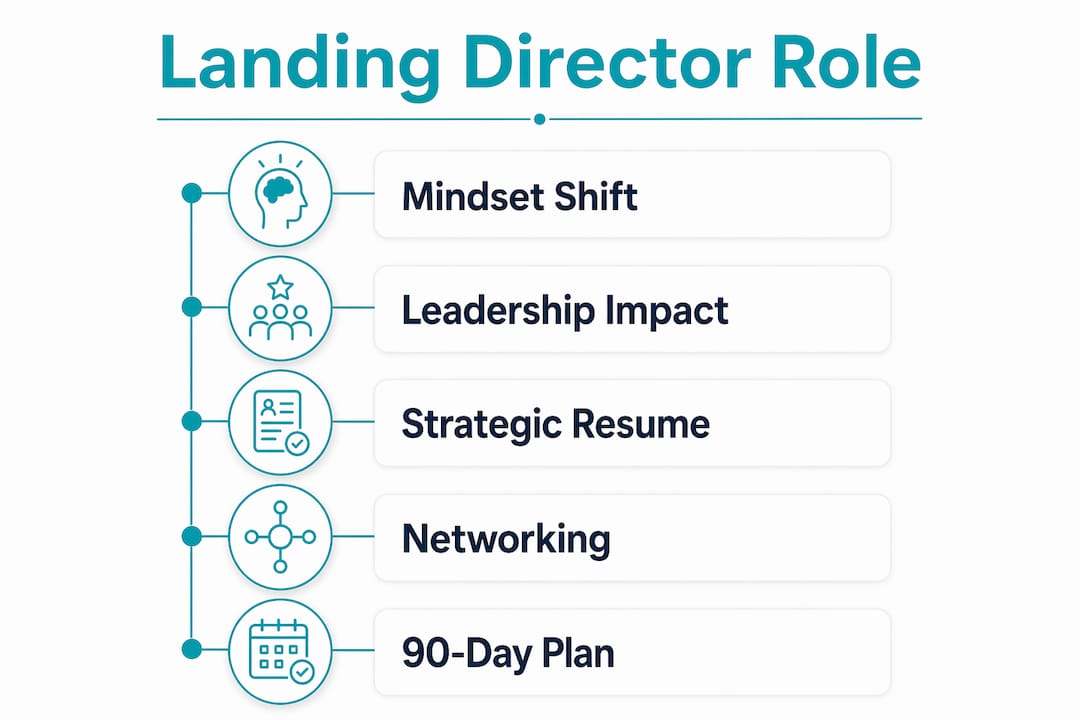
How to land a director level role: the mindset shift that matters most
The single biggest mistake candidates make is treating a director search like a senior manager search. Director-level readiness is defined by owning outcomes across departments, not just managing output within one team.
The core competencies hiring managers evaluate include:
- Stakeholder influence: Can you align executives, peers, and external partners around a shared goal without direct authority?
- Budget management: Have you owned a P&L, managed a departmental budget, or driven cost savings with measurable results?
- Cross-department collaboration: Have you led cross-functional teams to deliver outcomes like a $250K savings through a digital overhaul?
- Strategic decision-making: Can you assess risk, weigh trade-offs, and commit to a direction under uncertainty?
Developing these skills before you apply matters. Volunteer for cross-functional projects at your current company. Raise your hand for budget oversight. Seek out initiatives where you must influence without authority. These experiences become the evidence base for your application.
Governance literacy is also a growing requirement, especially for professionals with board-level aspirations. Nonprofit board service and formal governance education programs signal strategic readiness in ways that operational achievements alone cannot.
Pro Tip: When you catch yourself focusing on how a task gets done rather than why it matters to the business, you have slipped back into operator mode. Redirect your thinking to outcomes, risk, and organizational impact.
What does a strong director-level resume actually look like?
Your resume must communicate strategic leadership, not task completion. Quantifying leadership impact with precise metrics is the single most effective way to separate yourself from other candidates.
Every bullet point on your resume should answer one question: what changed because of your leadership? Replace “managed a team of 12” with “led a 12-person team that reduced customer churn by 18% in two quarters.” Replace “oversaw marketing budget” with “managed a $2M marketing budget and delivered a 3x return on paid acquisition.”
Tailoring each application to mirror the specific job description substantially increases your response rate. Generic resumes signal generic thinking. Candidates who customize their materials for each role show they understand the company’s specific challenges.
Your LinkedIn profile carries equal weight. Recruiters focus on your most recent 10 to 15 years of experience and scan your headline first. A headline like “Director-Level Leader | Revenue Growth Expert” outperforms a generic job title. Your summary should open with your biggest measurable win, not a career narrative.
| Resume element | LinkedIn profile highlight |
|---|---|
| Quantified achievements with dollar or percentage impact | Headline with keywords and leadership identity |
| Tailored bullets mirroring job description language | Summary opening with top measurable result |
| Cross-functional project leadership examples | Featured section with thought leadership posts |
| Budget and P&L ownership statements | Skills section aligned to director-level competencies |
| Recent 10 to 15 years prioritized, older roles condensed | Recommendations from senior stakeholders |
Building thought leadership on LinkedIn accelerates visibility. Post short takes on industry trends, share lessons from leadership challenges, and comment meaningfully on content from people in your target companies. Recruiters notice consistent, credible voices.
How do you build a network that opens director-level doors?
Most professionals network reactively. Director-level candidates network with intention. Effective networks consist of three distinct spheres: 7 to 10 decision-makers who can hire or refer you, 15 to 25 access points who can introduce you to decision-makers, and 50 to 75 intelligence sources who keep you informed about market movement and open roles.
Building this network takes months, not weeks. Successful director-level professionals cultivate relationships consistently before any opportunity arises. The professionals who get referred to unadvertised roles are the ones who showed up, added value, and stayed in contact.
The most effective networking tactics at this level include:
- Congratulating connections on promotions, funding announcements, or published work before asking for anything
- Sharing a relevant article or insight with a specific person rather than broadcasting to your whole network
- Offering to make an introduction that benefits someone else, with no immediate return expected
- Attending industry events with a goal of deepening two or three existing relationships rather than collecting new contacts
Pro Tip: Follow up within 48 hours of any meaningful conversation. Reference something specific from the exchange. Consistency and specificity are what separate genuine relationship-building from forgettable small talk.
Peer referrals carry significant weight at the director level. A warm introduction from a trusted colleague inside the target company bypasses the ATS entirely and puts your name directly in front of a hiring manager.
How should you prepare for director-level interviews?
Director-level interviews evaluate diagnostic capability and strategic judgment, not just past performance. The interviewer is asking one core question: will this person reduce my risk or create more of it?
The most powerful tool you can bring to a director-level interview is a detailed 90-day plan. Presenting a 90-day plan shifts the evaluator's mindset from risk to opportunity. It shows you have already thought through how you will diagnose organizational challenges, build credibility with stakeholders, and deliver early wins without overreaching.
A strong 90-day plan covers three phases. The first 30 days focus on listening, learning the culture, and mapping stakeholder relationships. Days 31 to 60 shift to identifying the highest-priority problems and building alignment around solutions. Days 61 to 90 move into early execution with clear metrics attached.
| Manager-level interview focus | Director-level interview focus |
|---|---|
| How did you manage your team day to day? | How did you align multiple teams around a shared goal? |
| What processes did you improve? | What organizational risks did you identify and address? |
| How did you hit your targets? | How did you influence outcomes you did not directly control? |
| What was your team's output? | What was the business impact of your leadership decisions? |
Slipping into operational details during an interview signals a manager mindset. Stay at the level of judgment, influence, and organizational impact throughout every answer.
What mistakes derail director-level candidates?
The most common mistakes are predictable and avoidable. Knowing them in advance gives you a real edge.
- Defaulting to operational stories: Describing how you executed a project in detail signals you are still thinking like a manager. Frame every story around the strategic decision you made and the business outcome it produced.
- Sending generic applications: Hiring managers at the director level read dozens of resumes from qualified candidates. A resume that does not mirror the specific language and priorities of the job description gets filtered out, often before a human reads it.
- Ignoring governance signals: Candidates who want to move into board-adjacent or senior director roles and who skip governance education programs miss a credibility signal that competitors will have.
- Neglecting cultural fit: Director roles require you to shape culture, not just work within it. Failing to research and articulate why you fit the company’s values and direction is a fast path to rejection.
- Emphasizing quick wins over sustainable outcomes: Hiring managers want directors who build durable capability, not ones who sprint for 90 days and burn out the team.
Each of these mistakes shares a root cause. The candidate is presenting themselves as a great manager rather than a future director. The fix is consistent: reframe every element of your search around strategic impact, organizational influence, and long-term outcomes.
Key Takeaways
Landing a director-level role requires a deliberate shift from demonstrating competence to proving you can own outcomes, reduce organizational risk, and lead across functions with measurable impact.
| Point | Details |
|---|---|
| Mindset shift is non-negotiable | Move from managing tasks to owning cross-functional outcomes before you apply. |
| Metrics drive resume results | Quantify every leadership achievement with dollar amounts, percentages, or business outcomes. |
| Network with intention | Build three spheres of contacts: decision-makers, access points, and intelligence sources. |
| 90-day plans win interviews | A detailed 90-day plan shifts evaluators from risk to opportunity and makes you memorable. |
| Avoid the operator trap | Defaulting to operational details in interviews signals you are not ready for director-level decisions. |
What I’ve learned after a decade of placing director-level candidates
The professionals who land director roles fastest are rarely the most technically qualified. They are the ones who understand that the hiring process at this level is fundamentally about risk reduction. Every resume, every LinkedIn post, every networking conversation, and every interview answer is an opportunity to show a hiring manager that choosing you is the lower-risk decision.
I have seen candidates with exceptional track records lose director roles to less experienced professionals who simply told a clearer story. The difference was preparation. The winning candidates knew their numbers cold, had a 90-day plan ready before the first interview, and had built genuine relationships inside the target company months before the role was posted.
The mindset shift is the hardest part. Most professionals spend years being rewarded for doing things well. At the director level, the reward goes to the person who decides what to do and why. That transition takes deliberate practice, not just ambition. Start building cross-functional experience now. Start quantifying your impact now. Start showing up in your network as someone who adds value before asking for anything. The role you want is on the other side of that work.
Kim
Resumewiz helps director-level candidates get noticed
Positioning yourself for a director role takes more than a polished resume. It takes a complete professional brand that speaks the language hiring managers use at that level.

Resumewiz specializes in director-level career support for professionals who are ready to make the move but need their materials to reflect that readiness. From ATS-compliant resumes built around measurable leadership impact to LinkedIn optimization and interview coaching focused on governance and strategic storytelling, Resumewiz gives you the tools and guidance to compete at the highest level. Kim Taynor brings over 10 years of recruiting experience to every engagement, so your application reaches the right decision-makers with the right message.
Want a recruiter in your corner for your next senior role? Book a free call with Resume Wiz and we will map out your next move together.
FAQ
What are the core requirements for a director-level role?
Director-level roles require cross-functional leadership, budget ownership, stakeholder influence, and the ability to drive measurable business outcomes. Governance literacy is increasingly expected for senior director and board-adjacent positions.
How do I get promoted to director from a senior manager role?
Build a track record of leading cross-functional initiatives with quantifiable results, then make that evidence visible through a tailored resume, an optimized LinkedIn profile, and a strong internal or external network.
What should a director-level resume focus on?
A director-level resume should lead with measurable outcomes, mirror the language of each specific job description, and prioritize the most recent 10 to 15 years of leadership experience over earlier career details.
How do 90-day plans help in director-level interviews?
A 90-day plan demonstrates diagnostic capability and strategic judgment by showing interviewers exactly how you will build credibility and address organizational challenges from day one.
How important is networking for landing a director role?
Networking is critical at the director level. Many roles are filled through referrals before they are publicly posted, and a warm introduction from a trusted contact carries far more weight than a cold application.
