How to Position Yourself for Executive Roles in 2026
Positioning yourself for executive roles means demonstrating enterprise-level leadership before you hold the title. The gap between senior manager and executive is not a matter of tenure. It is a deliberate shift in how you think, communicate, and build influence across an organization. Research in 2026 confirms that transitioning to executive roles requires moving from technical mastery to cross-functional insight, strategic influence, risk tolerance, and leadership presence. This guide gives you a concrete framework to build those capabilities, earn sponsorship, and perform at the highest level when the opportunity arrives.
How to position yourself for executive roles: the core shift
The most common mistake senior managers make is assuming executive readiness is about doing their current job better. It is not. Executive career advancement requires a fundamental change in how you operate, not just an upgrade in output.
From expert to architect
At the manager level, your value comes from what you know and what you can execute. At the executive level, your value comes from what you can see across the entire organization and how you shape decisions that others execute. This is the shift from expert to architect. You stop solving problems directly and start designing the conditions in which problems get solved.
To develop this capability now, volunteer for cross-functional projects outside your department. Take on assignments that require you to influence peers without formal authority. When you present to senior leaders, frame your work in terms of revenue impact, competitive positioning, or organizational risk rather than task completion.
The four capabilities that define executive readiness
- Enterprise thinking: You see how your function connects to the broader business model. You can speak credibly about finance, operations, and market dynamics even if they are not your specialty.
- Strategic influence: You shape decisions through data, narrative, and relationship capital rather than positional authority. The ability to lead through influence, not authority, is what separates executives from managers.
- Risk tolerance: Executives make decisions under ambiguity with incomplete information. Practice this by taking calculated positions in your current role and documenting your reasoning process.
- Executive presence: This combines communication, composure, and credibility under pressure. It is how you project confidence in high-stakes moments when the room is watching.
Pro Tip: Record yourself presenting a business update. Watch it back with the sound off. Your body language, eye contact, and composure tell a story before you say a word.
How to build strategic visibility and sponsorship
Most professionals wait to be noticed. Executives in the making create the conditions to be seen. Executive career advancement requires visible, high-impact work tied directly to organizational strategy and a clear communication of your career goals to the people who matter.
Mentorship vs. sponsorship: know the difference
A mentor gives you advice. A sponsor gives you opportunities. Sponsors actively advocate for your advancement in rooms you are not in. They put your name forward for stretch assignments, board presentations, and executive searches. Mentorship is valuable. Sponsorship is what actually moves careers.
To build sponsorship, follow these steps:
- Identify two or three senior leaders whose work intersects with your career goals and who have direct influence over promotion decisions.
- Create visible value for them first. Solve a problem they care about. Contribute meaningfully to a project they own. Sponsors advocate for people who have already demonstrated results.
- State your ambitions clearly. Most professionals assume their boss knows they want to move up. Research confirms that most professionals incorrectly expect their employer to manage their advancement without any active input from them. Say it directly: “My goal is to move into a VP role within the next two years. I would value your perspective on what I need to demonstrate.”
- Increase your organizational footprint. Present at leadership offsites. Publish thought leadership on LinkedIn. Speak at industry events. Visibility outside your immediate team signals readiness for a broader platform.
- Track your promotability. Use a framework like the Promotability Index® to measure your progress across five dimensions: performance, potential, relationships, visibility, and readiness. Executives who own their career metrics advance faster than those who wait for annual reviews.
Pro Tip: Ask a trusted senior colleague this exact question: “If my name came up for a VP role tomorrow, what would be the hesitation?” That answer is your development plan.
What does executive interview preparation actually require?
Executive interviews are not longer versions of manager interviews. They operate on a different logic entirely. Judgment and strategic decision-making carry more weight than operational execution details. Hiring committees want to see how you think, not just what you have done.
Craft your narrative around business impact
Every story you tell in an executive interview must compress to a business outcome. Not “I led a team of 12” but “I restructured the go-to-market function, which reduced customer acquisition cost by 18% in two quarters.” The rehearsed narrative compression that focuses on business impact is what separates credible executive candidates from strong managers.
Prepare three to five core stories that each demonstrate a different dimension of executive capability: a decision made under ambiguity, a time you influenced a skeptical stakeholder, a moment you managed significant organizational risk, a strategic pivot you led, and a failure you owned and learned from.
What hiring committees actually evaluate
- Risk calibration: Can you articulate the tradeoffs in a major decision? Committees want to see that you weigh downside scenarios, not just upside potential.
- Stakeholder complexity: Have you navigated boards, investors, regulators, or cross-functional executives? Name them specifically in your answers.
- Strategic credibility: Do your answers reflect an understanding of the business model, competitive dynamics, and market context? Generic answers signal a manager. Specific, contextual answers signal an executive.
- Composure under pressure: Expect curveball questions. The point is not the answer. The point is how you handle not knowing the answer immediately.
“Executive interviews prioritize judgment calls, risk calibration, and strategic influence over simple success stories, requiring a deeper preparation approach.” (Executive interview preparation)
For internal candidates, tailored presentations for boards addressing the first 90 days or a specific business challenge are now standard. Hiring committees view a well-rehearsed, customized presentation as evidence of both preparation and strategic depth. Build one even if you are not asked. Offer it.
What tools and frameworks accelerate your executive readiness?
Self-assessment is not optional at the executive level. You need a structured way to identify gaps, track progress, and prioritize development. Several frameworks exist for this purpose, and the best ones force you to look at your readiness from multiple angles.
The Promotability Index® and 360 feedback
The Promotability Index® measures five elements: performance consistency, leadership potential, relationship capital, organizational visibility, and role readiness. Rate yourself honestly on each dimension, then ask two or three trusted colleagues to rate you independently. The gaps between your self-assessment and their input are your highest-priority development areas.
360-degree feedback tools, available through platforms like Qualtrics, Culture Amp, and Lattice, provide structured, anonymous input from peers, direct reports, and supervisors. The value is not in the positive feedback. The value is in the patterns of critical feedback that appear across multiple respondents.
Mapping your path with a 5-year framework
A typical 5-year executive path moves through four stages: operational mastery, cross-functional leadership, strategic influence, and P&L responsibility. Each stage has specific milestones. Knowing which stage you are in tells you exactly what to prioritize next.
| Framework | Primary focus | Best used for |
|---|---|---|
| Promotability Index® | Self-assessment across five dimensions | Tracking readiness gaps quarterly |
| 360 Feedback (Qualtrics, Lattice) | Stakeholder perception audit | Identifying blind spots in leadership style |
| 5-Year Executive Path | Career stage mapping | Setting milestone-based development goals |
| Executive coaching | Personalized capability build | Accelerating presence and strategic thinking |
The executive consulting support available through specialized firms can also accelerate your development by providing an outside perspective on your enterprise-wide thinking and cross-functional credibility. An external coach or advisor sees patterns in your behavior that internal colleagues often miss or will not say aloud.
Key takeaways
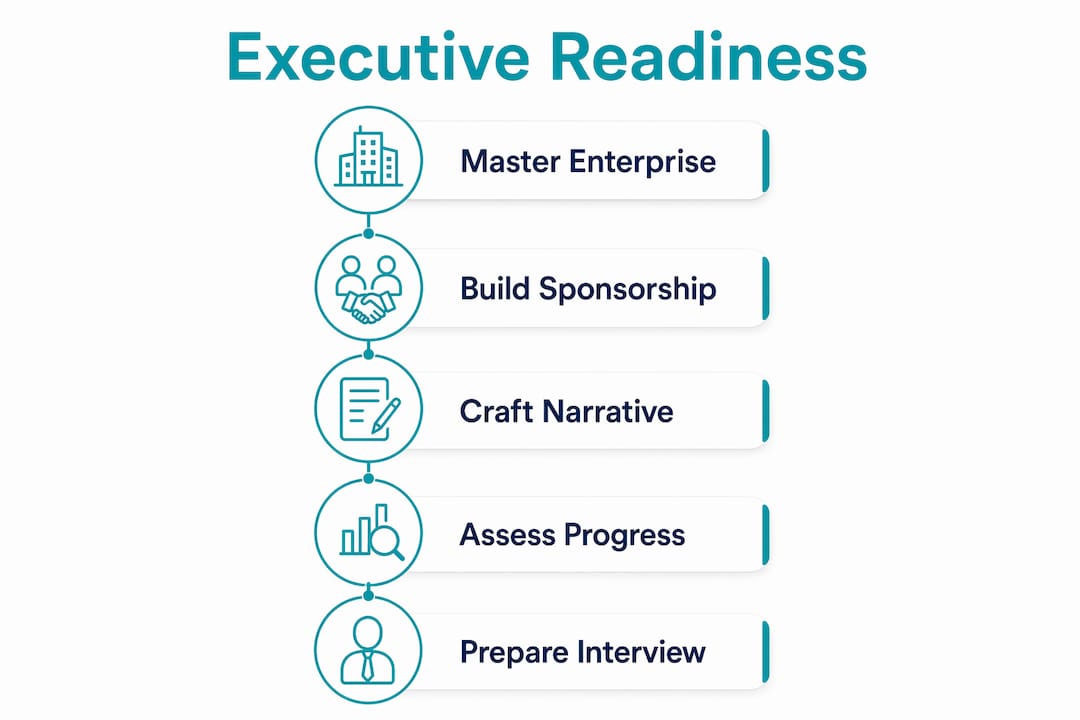
Positioning yourself for executive roles requires mastering enterprise thinking, building sponsor relationships, and preparing for interviews that test judgment and strategic credibility above all else.
| Point | Details |
|---|---|
| Shift from expert to architect | Stop solving problems directly and start designing conditions for others to solve them. |
| Build sponsorship, not just mentorship | Sponsors advocate for you in rooms you are not in; identify and cultivate two or three strategically. |
| Own your promotability metrics | Use the Promotability Index® to track readiness across five dimensions rather than waiting for annual reviews. |
| Prepare interview narratives around business impact | Compress every story to a measurable outcome and demonstrate risk calibration, not just execution. |
| Map your career stage deliberately | Know whether you are in operational mastery, cross-functional leadership, or strategic influence to prioritize correctly. |
What I have learned after a decade of watching executives get hired and passed over
After more than 10 years of recruiting and working directly with executive candidates, I can tell you the pattern is consistent. The professionals who land executive roles are almost never the most technically brilliant people in the room. They are the ones who started acting like executives before anyone gave them the title.
The biggest misconception I see is that visibility is somehow self-promotional or uncomfortable. Professionals who hold back from presenting at leadership forums, publishing their thinking, or stating their ambitions directly are not being humble. They are being invisible. Hiring committees cannot advocate for someone they do not know.
The second thing I have learned is that most candidates dramatically underprepare for executive interviews because they treat them like senior manager interviews with harder questions. They are not. The entire frame is different. When you walk into an executive interview, you are being evaluated as a peer, not a candidate. The committee wants to know if they can trust your judgment in a crisis. That requires a completely different preparation approach than rehearsing your greatest accomplishments.
My honest advice: start building your executive narrative now, not when a role opens up. The professionals who get promoted to executive are the ones who have been telling a consistent, credible leadership story for the 18 months before the opportunity appears.
Kim
How Resumewiz helps you land executive roles faster
Knowing what to do is one thing. Translating it into a resume, LinkedIn profile, and interview strategy that actually gets you in front of the right people is another challenge entirely.
Resumewiz specializes in exactly this. Kim Taynor and the Resumewiz team bring over 10 years of recruiting experience to every engagement, building executive career materials that reflect your leadership brand, showcase your business impact, and pass ATS filters at the companies you are targeting. From ATS-compliant resume formatting to LinkedIn optimization, personalized outreach templates, and interview coaching, Resumewiz delivers a fully managed process with tailored applications and outreach. If you are serious about your next executive move, start with a strategy built by people who know how hiring decisions actually get made.
Want a recruiter in your corner for your next senior role? Book a free call with Resume Wiz and we will map out your next move together.
FAQ
What is the most important skill for executive roles?
Enterprise thinking is the defining skill. Executives must demonstrate cross-functional insight, strategic influence, and the ability to make decisions under ambiguity rather than relying on technical expertise alone.
How do I build executive presence before I have an executive title?
Practice communicating with composure and credibility in high-stakes settings. Volunteer to present to senior leadership, take on cross-functional projects, and seek feedback specifically on how you are perceived under pressure.
How is an executive interview different from a senior manager interview?
Executive interviews test judgment, risk calibration, and strategic credibility rather than operational execution. Hiring committees evaluate whether they can trust your decision-making in complex, ambiguous situations.
What is the Promotability Index® and how do I use it?
The Promotability Index® is a self-assessment framework that measures readiness across five dimensions: performance, potential, relationships, visibility, and role readiness. Rate yourself quarterly and compare your scores against trusted colleagues’ input to identify priority gaps.
How long does it take to prepare for an executive role?
A structured 5-year executive path moves through operational mastery, cross-functional leadership, strategic influence, and P&L responsibility. Most professionals who reach the C-suite begin building their executive narrative and sponsor relationships 18 to 24 months before a target role opens.
