How to Translate Experience Into an Impact Resume
A resume is a marketing document designed to prove you are a low-risk, high-ROI hire, not a list of tasks you completed. Knowing how to translate experience into an impact resume is the single skill that separates candidates who get interviews from those who get ignored. Recruiters scan resumes for just 6 to 7 seconds, and 90% of candidates describe duties instead of proving results. This guide gives you the frameworks, examples, and step-by-step methods to close that gap and make every bullet count in 2026.
What does it mean to translate experience into resume impact?
Translating experience into impact means converting what you did into proof of what changed because of you. The industry term for this practice is outcome framing, and it is the foundation of every effective resume strategy in 2026. A duty says “managed a team.” An impact statement says “led a 12-person team that cut project delivery time by 30%.” The difference is evidence.
CEO priorities in 2026 center on AI adoption, economic uncertainty, and talent efficiency. That means hiring managers are looking for candidates who frame themselves as solutions to real business problems. Your resume must speak that language directly. Generic descriptions of responsibilities no longer clear the bar.
The three frameworks that make this translation possible are the R.I.M. formula (Result, Impact, Metric), the STAR method (Situation, Task, Action, Result), and the Verb + Context + Metric structure. Each one forces you to move from passive description to active proof. You do not need all three at once. Pick one and apply it consistently across every role.
What tools and prep work do you need first?
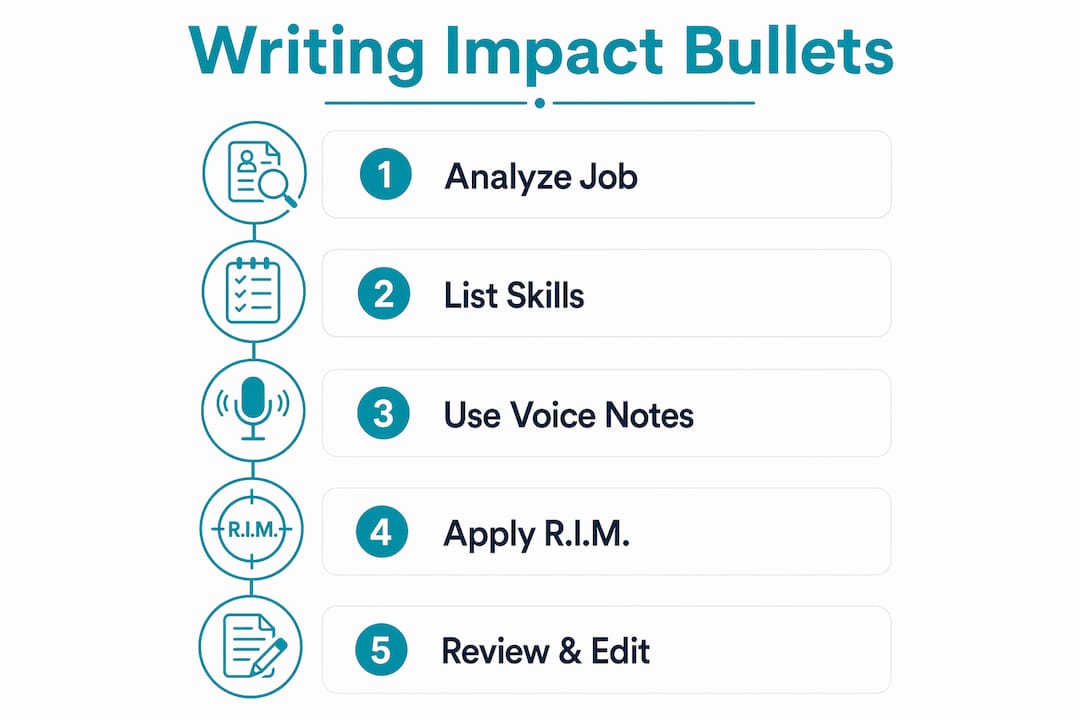
Effective outcome framing starts before you write a single word. You need three things in place: a clear picture of the target role, a map of your transferable skills, and raw material from your own memory.
Analyze the job description first
Mapping your experience to target job description vocabulary is critical. ATS systems auto-reject resumes that miss keyword matches, regardless of how qualified you are. Print the job posting and highlight every skill, tool, and outcome the employer mentions. Those words become your translation targets.
Build a transferable skills matrix
A Transferable Skills Matrix is a simple two-column table. On the left, list your current skills and experience. On the right, write the equivalent language from the job description. “Managed vendor relationships” becomes “led third-party procurement partnerships.” The skill is identical. The language is aligned.
Use voice notes to surface real impact
Voice note exercises help you surface authentic tension and impact stories before you write. Set a timer for two minutes and speak out loud about a project. Describe the problem, what you did, and what happened. Transcribe it. You will find specific details in that transcript that you would never type directly into a resume builder.
Pro Tip: Use Grammarly or Hemingway Editor to clean up your transcribed voice notes. Both tools flag passive voice and overly complex sentences, which are the two biggest killers of resume clarity.
Here is a summary of the core tools that support this preparation phase:
| Tool | Function |
|---|---|
| Transferable Skills Matrix | Maps old experience to new role language |
| Voice note exercise | Surfaces authentic impact stories and specific details |
| Grammarly | Flags passive voice and improves sentence clarity |
| ATS resume builder | Checks keyword alignment with job descriptions |
| Impact word bank | Replaces weak verbs with strong agency verbs |
How do you write impactful resume bullets step by step?
The Verb + Context + Metric formula is the most direct method for writing results-based bullets. Every bullet starts with a strong action verb, adds the context of what you worked on, and closes with a measurable result. Strong agency verbs like “built,” “negotiated,” and “automated” communicate ownership instantly. Weak verbs like “responsible for” or “assisted with” communicate nothing.
Follow these steps for every bullet point you write:
- Start with a past-tense action verb. Choose from words like “built,” “launched,” “reduced,” “negotiated,” or “automated.” Never start with “responsible for.”
- Add the context. Name the project, team, system, or process you worked on. Be specific enough that a stranger understands the scope.
- Close with a metric or verifiable outcome. Use numbers, percentages, team sizes, or time frames. If you lack exact data, use scope (e.g., “across a 40-person department”).
- Apply the R.I.M. check. Ask: What was the Result? What was the Impact on the business? What Metric proves it? If you cannot answer all three, revise.
- Frame it as a mini-story. Each bullet should carry a tension, action, and outcome structure. The tension is the problem. The action is what you did. The outcome is what changed.
Here is a before-and-after comparison showing the difference outcome framing makes:
| Before (Duty-Focused) | After (Impact-Focused) |
|---|---|
| Responsible for managing social media accounts | Grew LinkedIn following by 42% in six months by launching a weekly thought leadership series |
| Helped with onboarding new employees | Redesigned onboarding program for 60 new hires, cutting ramp-up time from 8 weeks to 5 |
| Worked on cost reduction projects | Identified $180K in annual vendor savings by renegotiating three supplier contracts |
| Assisted the sales team with reporting | Built automated sales dashboard that eliminated 6 hours of weekly manual reporting |
Pro Tip: Research shows 4.42 achievements per role is the optimal number for interview callbacks. Do not pad every bullet with a number. Aim for four strong, honest impact statements per position.
How do career changers translate experience effectively?
Career changers face a specific version of the translation problem. 70% of career changers’ resumes get rejected initially because hiring managers cannot connect the dots between old experience and new role requirements. The fix is not to hide your background. The fix is to translate it explicitly.
A combination resume format works best for career changers. This format leads with a Core Competencies section at the top, listing skills in the language of the new industry, before the chronological work history begins. A hiring manager sees your relevant capabilities before they see your job titles.
The translation matrix exercise is the most practical tool for this process. Map every skill from your old industry to its equivalent in the new one. A military logistics officer translating to supply chain management does not write “managed convoy operations.” They write “directed end-to-end logistics for 200-person operations across three geographic zones.”
Common transferable skills that cross industries without losing value include:
- Project management: Applies to operations, marketing, IT, and consulting roles
- Budget oversight: Relevant in finance, nonprofit, healthcare, and government sectors
- Team leadership: Valued in every management role regardless of industry
- Data analysis: Transferable from academia, research, and government to corporate roles
- Client communication: Moves from legal, healthcare, and education into sales and account management
- Process improvement: Crosses manufacturing, retail, tech, and professional services
When you lack exact numeric data, use verifiable scope or qualitative effects. “Improved cross-team alignment across four departments” is honest and specific. It does not require a percentage to carry weight.
Pro Tip: Before writing your career change resume, read three to five LinkedIn profiles of people already working in your target role. Note the exact language they use to describe their work. That vocabulary is your translation guide.
What mistakes undermine your resume impact statements?
The most common mistake is fabricating metrics. Invented numbers destroy credibility the moment a hiring manager asks about them in an interview. When exact data is unavailable, use verifiable scope, team size, or qualitative outcomes instead of guessing a percentage.
The second major mistake is relying on AI-generated content without personalizing it. 80% of hiring managers now recognize AI-generated resumes, and 49% auto-dismiss them. Generic phrasing like “spearheaded cross-functional initiatives to drive organizational excellence” signals AI immediately. If you use AI tools to draft bullets, rewrite every sentence in your own voice with your specific details. Resources like AI resume writing guides explain how to use these tools without losing authenticity.
Watch for these red flags in your own resume:
- Passive verbs: “Was responsible for,” “was involved in,” “helped with”
- Vague scope: “Various projects,” “multiple stakeholders,” “a number of clients”
- Unsupported superlatives: “Best-performing team,” “top results,” “significant improvement” with no proof
- Duty lists disguised as bullets: Three bullets that all describe the same recurring task
- AI-generic phrases: “Leveraged synergies,” “drove impactful outcomes,” “collaborated cross-functionally”
The troubleshooting fix for weak bullets is a peer review exercise. Share your resume with one person who does not work in your field. If they cannot explain what you accomplished in plain language after reading a bullet, rewrite it. Clarity for a non-expert is the clearest signal that your impact statement is working.
Key takeaways
Translating experience into resume impact requires outcome framing, specific metrics, and language aligned to the target role, not a longer list of duties.
| Point | Details |
|---|---|
| Lead with outcomes, not duties | Use the Verb + Context + Metric formula to prove results in every bullet. |
| Prep before you write | Build a Transferable Skills Matrix and record voice notes to surface real impact stories. |
| Aim for four impact bullets per role | Research shows 4.42 achievements per role produces the highest interview callback rate. |
| Career changers need a combination format | Lead with a Core Competencies section to translate old experience into new industry language. |
| Never fabricate metrics | Use verifiable scope or qualitative outcomes when exact numbers are unavailable. |
What i have learned after 10 years of reading resumes
After more than a decade of recruiting and working with executives, managers, and career changers at Resumewiz, the pattern I see most often is not laziness. It is fear. Professionals are afraid to claim credit for their results. They soften every bullet with “helped,” “assisted,” or “contributed to” because they do not want to sound arrogant.
That instinct costs them interviews. Hiring managers are not looking for humility in a resume. They are looking for evidence. The question every recruiter asks when reading your bullet is: “What would have been different if this person had not been there?” If your bullet does not answer that question, it is not doing its job.
The clients I have seen succeed fastest are the ones who stop writing about what they did and start writing about what changed. Not “managed the marketing budget” but “reallocated $400K in marketing spend that produced a 22% lift in qualified leads.” The numbers do not need to be dramatic. They need to be real and specific.
One more thing I tell every client: your resume is not a confession. You do not need to explain every context or caveat. State the result, name the metric, and move on. Confidence in your own impact is not arrogance. It is the minimum requirement for getting past a 7-second scan.
Kim
How Resumewiz helps you write resumes that get interviews
Writing impact statements from scratch is hard when you are too close to your own experience. Resumewiz was built specifically for professionals who know their work has value but struggle to put it on paper in a way that lands interviews.

At Resumewiz, Kim Taynor and her team apply over 10 years of recruiting expertise to translate your background into ATS-compliant, outcome-focused resumes that speak directly to hiring managers. The process covers everything from impact bullet writing and Core Competencies sections to LinkedIn optimization and interview coaching. If you are ready to stop sending resumes that disappear and start getting responses, Resumewiz delivers a proven, personalized path to get there.
Want a recruiter in your corner for your next senior role? Book a free call with Resume Wiz and we will map out your next move together.
FAQ
What is the r.i.m. framework for resume writing?
R.I.M. stands for Result, Impact, and Metric. It is a three-part check you apply to every resume bullet to confirm it proves business value rather than describing a task.
How do i write impact bullets without exact numbers?
Use verifiable scope, team size, or qualitative outcomes instead of fabricated percentages. Phrases like “across a 50-person department” or “improved cross-team alignment” are honest and specific enough to carry weight.
Why do career changer resumes get rejected so often?
70% of career changers’ resumes are rejected because the connection between old experience and new role requirements is not made explicit. A combination resume with a Core Competencies section fixes this by translating your background upfront.
Can i use AI tools to write my resume?
AI tools can help draft bullets, but 49% of hiring managers auto-dismiss resumes they identify as AI-generated. Always rewrite AI output in your own voice with your specific details and metrics.
How many impact bullets should each job have?
Research shows 4.42 achievements per role produces the highest rate of interview callbacks. Aim for four strong, specific impact statements per position rather than a longer list of duties.
