How to Write a Resume for Leadership Roles That Gets Noticed
A leadership resume is defined by measurable impact and strategic positioning, not a list of job duties. Knowing how to write a resume for leadership roles means shifting your entire frame: recruiters at the executive level want to see what you owned, the scale you operated at, and what changed because you were there. The standard resume format built for individual contributors will actively work against you when you are competing for director, VP, or C-suite positions. This guide gives you the exact structure, language, and tailoring strategy to make your resume read like the business case you are.
What are the essential components of a leadership resume?
A leadership resume follows a distinct architecture that signals executive credibility from the first line. Every section must do specific work, and the order matters as much as the content.
The executive summary
Recruiters want immediate clarity on what you led, the scale you operated at, and the results you produced. Your executive summary delivers that in three to five sentences. State your leadership scope, your functional specialty, and one or two headline results. “Chief Operating Officer with 15 years scaling B2B SaaS companies from Series B to IPO, including a $400M revenue ramp at Salesforce-integrated platforms” is the kind of opening that earns a second read.
Core competencies grid
Place a 12 to 15 leadership skills in a compact grid directly below your summary. This section serves two audiences simultaneously: the applicant tracking system scanning for keywords and the recruiter who spends eight seconds deciding whether to read further. Skills like P&L Management, Cross-Functional Leadership, M&A Integration, and Organizational Transformation belong here. Pull these terms directly from the job description to maximize ATS matching.
Pro Tip: Run your core competencies list against the job posting word for word. If the posting says “change management” and you wrote “organizational transformation,” add both. ATS systems match exact strings, not concepts.
Work experience with scope context
Each role should open with a brief scope statement before your bullet points begin. Include budget responsibility, team size, geographic footprint, and revenue accountability. A two-tier story approach works best: state the context upfront, then follow with outcome-focused bullet points that prove what changed under your leadership. This structure gives recruiters the frame they need to interpret your achievements correctly.
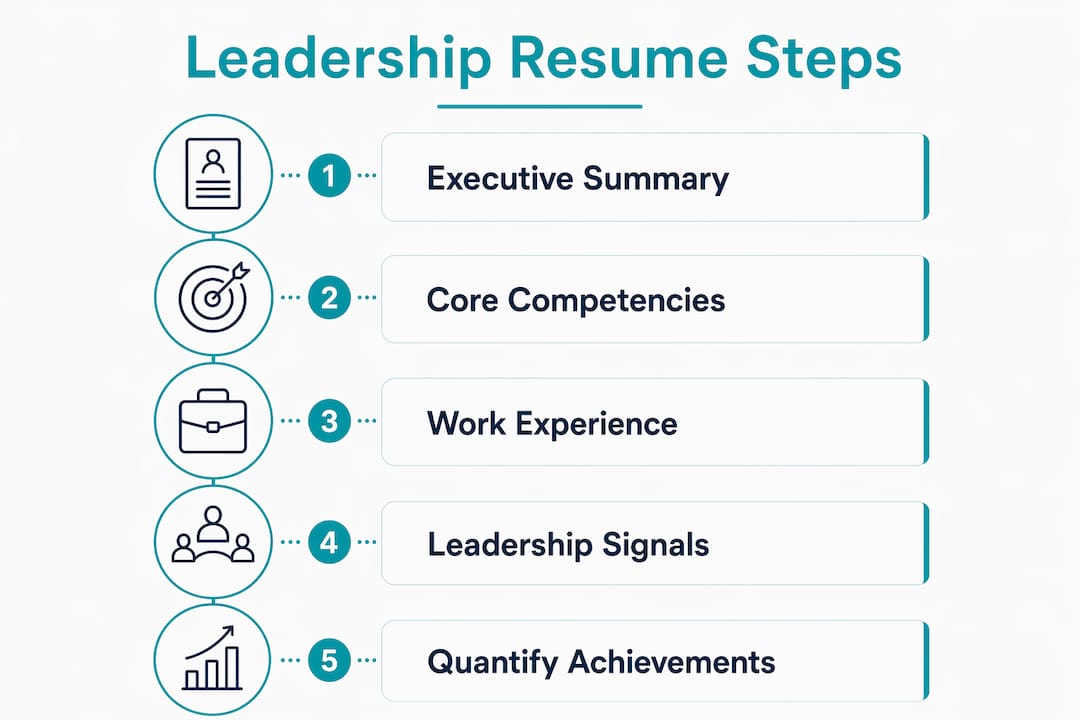
Supporting leadership signals
Beyond work experience, include board memberships, advisory roles, speaking engagements at industry conferences, and publications. These details signal that the market recognizes your expertise, not just your employer. For executives with 20-plus years of experience, executive resumes generally extend to 2 to 3 pages without padding. Cutting your career to one page to look concise will undersell your depth.
| Resume section | What it must communicate |
|---|---|
| Executive summary | Leadership scope, functional specialty, headline results |
| Core competencies | 12 to 15 ATS-matched skills from the job description |
| Work experience | Scope context plus outcome-driven bullets |
| Education and credentials | Degrees, certifications, board roles, speaking history |
| Length | 2 to 3 pages for executives; no filler |
How to quantify and showcase leadership achievements effectively
Activity without measurable results is ignored on a leadership resume. Leadership resumes should read as business cases demonstrating value creation, not operational logs of what you were responsible for.
The most effective leadership bullets follow a three-part structure: baseline, directional change, and timeframe. “Grew North American revenue from $28M to $74M over 36 months by restructuring the enterprise sales team and entering two new verticals” is credible. “Increased revenue significantly” is not. Effective leadership bullets include specific metrics with all three components to validate the claim.
Here is how to build each bullet point with maximum impact:
- Start with a strong action verb. Verbs like led, transformed, negotiated, restructured, launched, and secured signal ownership. Verbs like assisted, supported, or helped signal contribution. Choose accordingly.
- Add scale signals. Include team size, budget, geography, or revenue scope so the recruiter understands the weight of what you managed. “Led a 240-person global engineering organization across six countries” tells a different story than “led engineering.”
- State the business outcome. Connect your action to a financial, operational, or market result. Cost reduction, margin improvement, market share gains, and customer retention rates all qualify.
- Include the timeframe. Results achieved in 90 days carry different weight than results achieved over five years. Timeframe adds credibility and context.
- Prioritize your strongest bullets first. The first two bullet points under each role carry the most recruiter attention. Put your most measurable, most impressive leadership achievement there, not buried in the fourth or fifth line.
Pro Tip: If you cannot find a hard number, use a percentage, a ranking, or a qualitative shift with a named outcome. “Reduced time-to-hire from 67 days to 31 days” is stronger than “improved hiring efficiency,” even if neither carries a dollar figure.
How to tailor your leadership resume for different executive roles and ATS
Crafting a leadership resume that works across every application is a myth. The resume that wins a Chief Revenue Officer role at a growth-stage startup reads differently than the one that wins a VP of Operations role at a Fortune 500 company. Tailoring is not optional at the executive level.
Mirroring job description language improves both ATS compatibility and recruiter assessment of leadership fit. Start every application by reading the job posting three times. On the first pass, note the leadership priorities. On the second, identify the exact language used for skills and outcomes. On the third, map your experience to their stated needs and flag gaps.
Then apply these tailoring steps:
- Rewrite your executive summary to reflect the specific scope and priorities of the target role. A COO summary for a private equity-backed company should mention operational efficiency and EBITDA. A CMO summary for a consumer brand should lead with brand equity and customer acquisition.
- Reorder your core competencies so the skills most relevant to this role appear in the first row of your grid. ATS systems weight early placement, and so do human readers.
- Adjust your bullet points to foreground the achievements most relevant to the employer’s stated challenges. If the posting emphasizes international expansion, lead with your global experience.
- Use their exact terminology. If the posting says “talent development,” do not substitute “people leadership.” ATS systems match strings, not synonyms.
- Check section headers. ATS systems can fail to parse creative section titles. Use standard labels: Work Experience, Education, Core Competencies. Avoid stylized alternatives.
Early visibility of leadership fit in the first third of page one is critical for recruiter attention. If a recruiter cannot confirm you are qualified within the first ten seconds, your resume moves to the no pile regardless of what appears on page two.
| Generic resume approach | Tailored leadership resume approach |
|---|---|
| Same summary for every role | Rewritten summary per posting |
| Fixed competencies list | Reordered to match role priorities |
| All achievements listed equally | Relevant achievements foregrounded |
| Standard action verbs | Mirrors employer’s own language |
Common mistakes to avoid when writing a leadership resume
Most leadership resumes fail before a recruiter finishes the first page. The errors are predictable, and fixing them is straightforward once you know what to look for.
- Listing responsibilities instead of outcomes. “Responsible for managing a team of 50 engineers” tells a recruiter nothing about your leadership quality. “Rebuilt a 50-person engineering team, reducing attrition from 34% to 11% in 18 months” tells them everything.
- Vague quantification. Phrases like “significantly improved” or “drove growth” without numbers are the most common credibility killers on executive resumes. Most leadership resumes fail by featuring vague quantifications; including baseline data, directional change, and timeframe is what separates credible claims from noise.
- Ignoring length discipline. Going beyond three pages without substance, or cramming 25 years of experience onto one page, both signal poor judgment. Two to three pages is the accepted standard for executive-level candidates.
- Including irrelevant early-career roles. A CFO with 22 years of experience does not need to list their first accounting analyst position from 2002. Cut anything that does not reinforce your current leadership positioning.
- Submitting an executive resume for a board position. Board resumes require a distinct format emphasizing strategic oversight and governance rather than operational achievements. They are typically written in third person and highlight committee roles and strategic judgment, not P&L ownership.
Pro Tip: Before you submit, read your resume out loud and ask: “Does every sentence tell the reader what changed because I was in this role?” If the answer is no, rewrite that line.
Key takeaways
A leadership resume wins by proving measurable impact at scale, not by cataloging responsibilities across a career.
| Point | Details |
|---|---|
| Lead with your executive summary | State leadership scope, specialty, and headline results in the first five sentences. |
| Quantify with three-part bullets | Include baseline, directional change, and timeframe for every major achievement. |
| Tailor for every application | Rewrite your summary, reorder competencies, and mirror job description language each time. |
| Prioritize your strongest bullets | Place your most measurable achievement first under each role for maximum recruiter impact. |
| Separate executive and board resumes | Board resumes require a governance-focused, third-person format distinct from operational resumes. |
What I have learned from 10 years of reviewing leadership resumes
The most common mistake I see from senior professionals is treating their resume as a career archive rather than a leadership argument. They list every role, every responsibility, and every initiative, and then wonder why they are not getting callbacks. A recruiter is not reading your resume to understand your history. They are reading it to answer one question: “Can this person solve the specific problem we are hiring for?”
The executives who get the most traction share one habit. They write their resume backward. They start with the job description, identify the three or four problems the company is trying to solve, and then build their resume around proof that they have solved those exact problems before. That approach sounds obvious, but fewer than one in ten candidates actually do it.
I also see professionals underestimate the power of the scope statement. Recruiters at the VP and C-suite level are comparing candidates who all have impressive titles. What differentiates you is the weight of what you managed. A VP of Sales who owned a $200M quota in 12 countries is a different candidate than a VP of Sales who owned a $12M quota in one region, even if both titles look identical on paper. Put the numbers in the context line above your bullets, not buried inside them.
Finally, do not wait until you are actively job searching to update your resume. The executives I work with who land the fastest are the ones who keep a running document of their wins, updated quarterly. When the right opportunity appears, they are 80% ready. Everyone else spends three weeks trying to remember what they accomplished two years ago.
Kim
Ready to build a leadership resume that opens doors?
Writing a resume for executive roles takes more than good formatting. It takes a clear leadership narrative, precise quantification, and ATS-ready structure that puts your strongest credentials in front of the right people.

Resumewiz was built specifically for professionals at the director, VP, and C-suite level who need more than a template. The platform combines expert-designed executive resume tools with personalized guidance from Kim Taynor, a recruiter with over 10 years of experience placing high-level professionals. Whether you are targeting your next VP role or making a full executive transition, Resumewiz gives you the structure, language, and strategy to compete at the top of the market.
Want a recruiter in your corner for your next senior role? Book a free call with Resume Wiz and we will map out your next move together.
FAQ
What is the ideal length for a leadership resume?
Executive resumes generally run 2 to 3 pages and focus on substance rather than padding. One-page resumes consistently undersell the depth of experience that executive recruiters expect to see.
How do I highlight leadership skills without sounding generic?
Replace vague claims with quantified leadership achievements that include team size, budget, timeframe, and business outcome. Specificity is what separates a credible leadership resume from a generic one.
Should I use the same resume for every executive application?
No. Tailoring your resume to the specific job description improves both ATS compatibility and recruiter assessment of fit. Rewrite your summary and reorder your competencies for each role you target.
What is the difference between an executive resume and a board resume?
Board resumes emphasize governance and strategic judgment rather than operational metrics. They are typically written in third person and highlight committee experience, not P&L ownership.
How many core competencies should a leadership resume include?
Aim for 12 to 15 skills in your competencies grid, pulled directly from the target job description. This number balances ATS keyword coverage with readability for the human reviewer.
