Compute Your Interview Coaching Budget and When to Buy a Package
Interview coaching typically runs $150 to $500 per session, with executive packages climbing to $2,000 or more. A single session makes sense for urgent, last-minute prep. Most job seekers get better value from a short package of two to three sessions, especially for mid-level roles or higher, where feedback needs time to sink in before the real interview.
Key Takeaways:
- Investing in two to three coaching sessions provides better value for most candidates, especially those at mid-level or aiming for higher roles.
- Mid-career coaches typically charge between $150 and $350 per session, often offering packages that can range from $600 to $1,500 for multiple sessions.
- Essential coaching elements include live mock interviews, real-time feedback, and answer structuring, with additional features like resume review and negotiation prep increasing value.
- For urgent interviews within 48 hours, a single quick session suffices, while complex or executive searches benefit from extended coaching packages up to $5,000.
- Combining AI practice with one or two human coaching sessions yields the most cost-effective preparation for most job seekers.
Table of Contents
- How Much Does Interview Coaching Cost Per Session?
- What Should Be Included in an Interview Coaching Session?
- Should You Book One Session or a Package?
- Human Coaching vs. AI Practice: What’s Worth Paying For?
- How Do You Estimate a Realistic Coaching Budget?
- How Do You Choose the Right Interview Coach?
- Why Resumewiz’s Approach to Interview Prep Holds Up
- What Job Seekers Get Wrong About Paying for Coaching
- Which Resumewiz Package Fits Your Budget?
- Sources
- FAQ
How Much Does Interview Coaching Cost Per Session?
Coaching prices track experience and specialization, not just time on the clock. A newly certified coach and a former Fortune 500 recruiter can charge wildly different rates for what looks, on paper, like the same 60 minutes.
Entry-level and generalist coaches typically charge $75 to $150 per session. These are often career counselors, coaching students, or generalists working across industries. They’re a reasonable fit for early-career candidates practicing basic behavioral questions or building interview confidence for the first time.
Mid-career and certified coaches run $150 to $350 per session, and this is where most working professionals land. These coaches usually hold certifications (ICF or similar), have direct recruiting or hiring experience, and offer packages bundling three to five sessions for $600 to $1,500, according to pricing data from Interviewcoach.
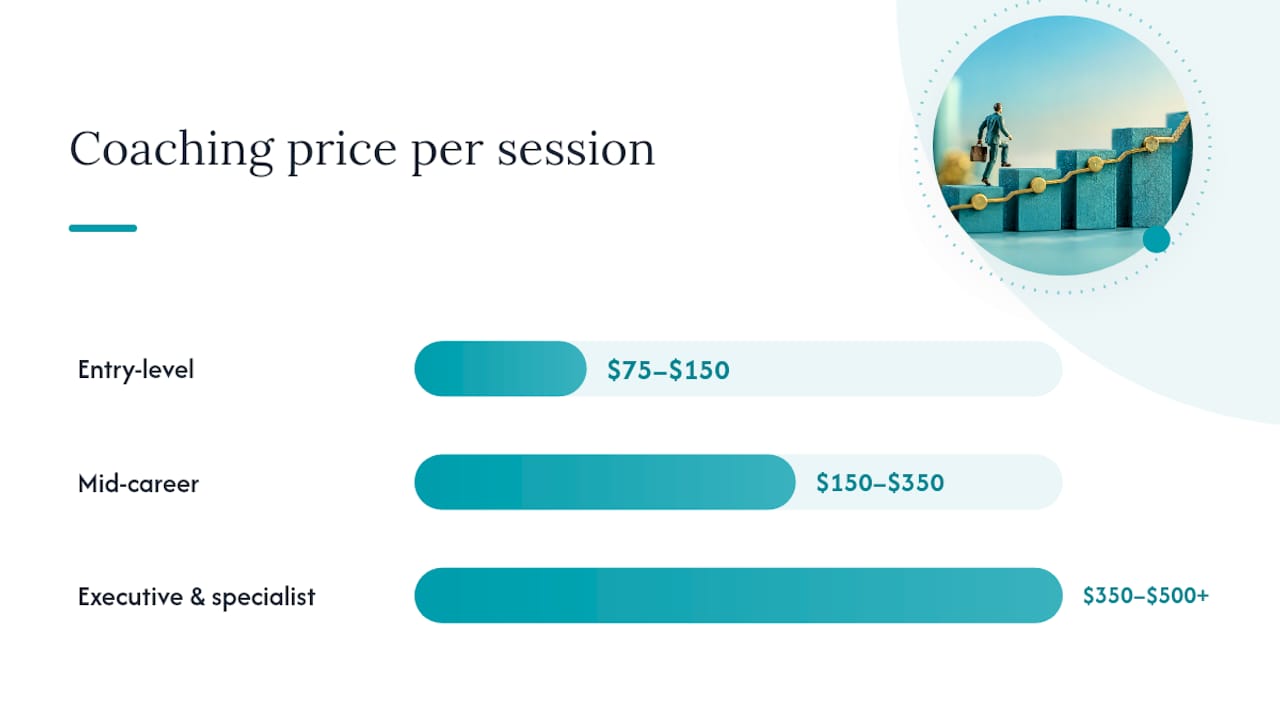
Executive and specialist coaches charge $350 to $500+ per session, with full engagements for director-level and C-suite searches reaching $2,000 to $5,000. At this tier you’re paying for someone who has sat on the other side of the table during real hiring decisions, not someone reading from a script.
Three factors drive most of that price spread:
- Track record. A coach who has placed candidates at companies like the one you’re targeting commands a premium, because they know what that specific hiring committee actually rewards.
- Niche specialization. Coaches focused on FAANG-style technical loops, management consulting cases, or federal government panels often charge more per hour, but the return can be higher for niche hires since generic advice doesn’t map cleanly onto those formats.
- Deliverables and prep time. A coach who reviews your resume and the job description before the call, then writes up detailed notes afterward, is doing an hour of unpaid work around the visible hour you’re paying for. That shows up in the rate.
Location plays a smaller role than most people assume. Coaches working virtually, which is now the norm, price based on their own market and expertise rather than yours. A coach based in a lower cost-of-living city may charge less, but the bigger price swing almost always comes from specialization, not geography.
What Should Be Included in an Interview Coaching Session?
The sticker price on a coaching session means little until you know what’s actually inside it. Two coaches quoting $200 an hour can deliver very different experiences.
Standard elements you should expect at any price point:
- A live mock interview using questions relevant to your target role
- Real-time feedback on your answers, delivery, and body language
- Coaching on structuring answers (STAR method or similar frameworks)
Extras that raise the price, and often the value, include:
- Pre-session review of your resume and the specific job description
- A custom question bank built around your target companies or industry
- A recorded session you can rewatch
- A written scorecard rating your performance across categories
- Text or email support between sessions for quick questions
- Salary negotiation prep tied to the offer stage
Pro Tip: Ask any coach whether prep and written feedback are included in the quoted price or billed separately. A $250 session with a resume review and a scorecard beats a $200 session with neither.
Which inclusions matter most depends on where you are. Early-career candidates benefit most from structured answer coaching and repetition. Mid-career professionals get the most value from a custom question bank tied to their target company. Executives should prioritize coaches who include negotiation prep, since that single conversation often outweighs the cost of the entire package.
Should You Book One Session or a Package?
Session count should match the stakes and timeline of your search, not just your budget. Here’s how to think about it:
- One session works for emergency prep, typically when an interview is scheduled within 48 hours and you need a quick confidence check or a fix for one specific weak spot. Coaches generally treat single sessions this way: useful for triage, limited for lasting improvement.
- Two to three sessions is the sweet spot for most job seekers. It gives you time to get feedback, practice implementing it, and come back for a second pass before the interview that actually matters. Packaged pricing typically covers a moderate range, varying by coach and session count.
- Four or more sessions makes sense for executive searches, career pivots into unfamiliar industries, or anyone facing multiple interview rounds across several weeks. Full packages in this range often land between $600 and $1,500 for five sessions, up to $2,000 to $5,000 for executive-level engagements.
Packages lower your per-session cost. That math only works in your favor if you actually use all the sessions, so check the refund and no-show policy before buying. Some coaches offer partial refunds for unused sessions; others don’t, and a canceled package can end up costing more per session than paying one at a time.
Human Coaching vs. AI Practice: What’s Worth Paying For?
The cost structures here aren’t even close. Human coaches bill per session, typically $150 to $500. AI interview platforms run on subscriptions or flat monthly fees that often cost less than a single human session, and they let you practice as many times as you want.
That difference in cost maps to a difference in what each format is actually good for:
- AI platforms excel at repetition. Run the same behavioral question ten times until your answer is tight, without worrying about wasting anyone’s paid time.
- Human coaches catch things AI still can’t: whether your answer would land in a real room, whether your framing sounds defensive, whether you’re underselling an accomplishment relative to industry norms.
- Group classes and peer practice sit in the middle. They’re cheap or free and expose you to other people’s blind spots along with your own, but feedback quality varies wildly depending on who’s in the room.
- Insider, industry-specific feedback (how to phrase a case answer, what a federal panel actually rewards, current negotiation trends at your seniority level) is where human coaches justify their rate.
The most cost-efficient approach for most job seekers blends both: drill volume and build muscle memory with AI or peer practice, then spend your coaching budget on one or two human sessions right before the interviews that actually decide your next job.
How Do You Estimate a Realistic Coaching Budget?
Rather than guessing at a number, score your situation across six variables and let the total point out a budget range.
- Interview stage. Early screen: 1 point. Mid-round: 2 points. Final round or offer stage: 3 points.
- Role seniority. Entry to mid-level: 1 point. Senior individual contributor or manager: 2 points. Director and above: 3 points.
- Format complexity. Standard behavioral: 1 point. Case, presentation, or technical loop: 2 points. Multi-panel executive format: 3 points.
- Current practice level. Already comfortable, need polish: 1 point. Some experience, inconsistent: 2 points. Little to no recent practice: 3 points.
- Customization need. Generic prep is fine: 1 point. Want company-specific question prep: 2 points. Need niche specialist coaching: 3 points.
- Urgency. Weeks of runway: 1 point. A few days: 2 points. Under 48 hours: 3 points.
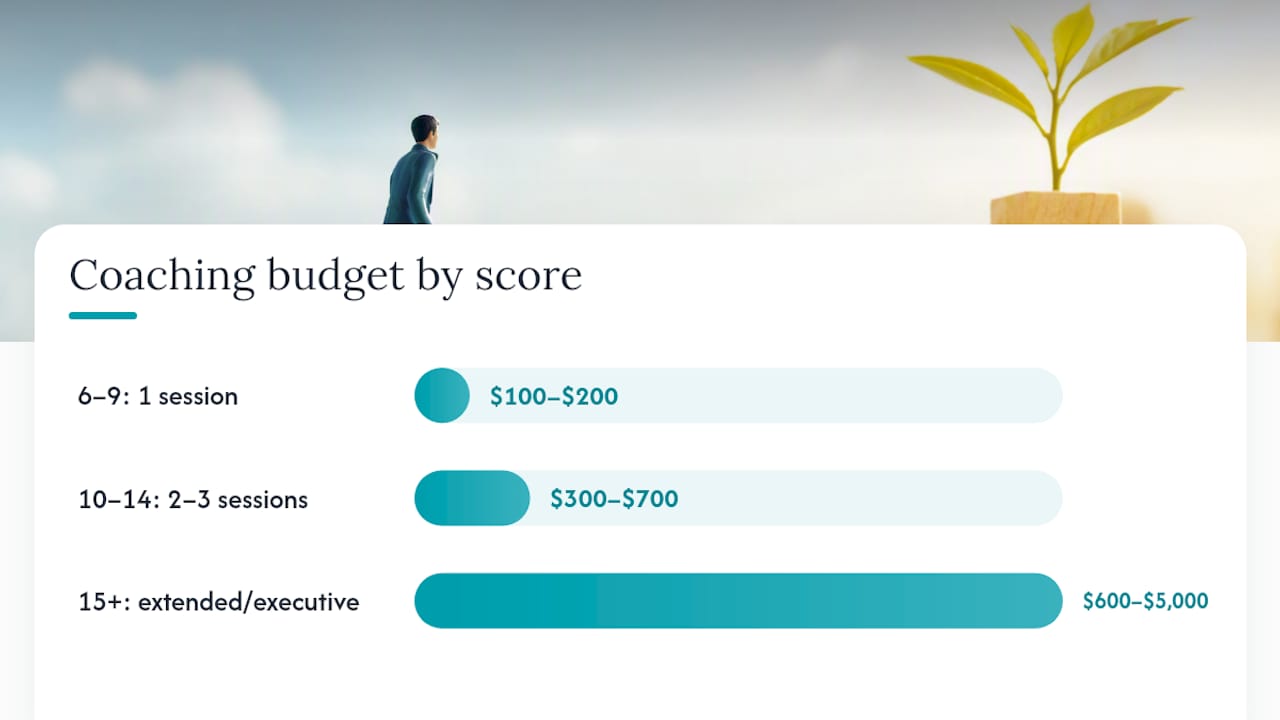
Add up your score. Six to nine points suggests one session in the $100 to $200 range is enough. Ten to fourteen points points toward a two or three-session package, $300 to $700. Fifteen and above signals an extended or executive engagement, often $600 to $5,000 depending on seniority.
Worked example: A mid-level software engineer prepping for a final-round technical loop with decent but rusty practice scores around 11 points (2+1+2+2+1+2, tight timeline), landing squarely in a two to three-session package. A VP-level candidate in a multi-panel executive search with little recent interview experience scores 16 or higher, pointing toward the full executive coaching bracket.
How Do You Choose the Right Interview Coach?
Price alone tells you almost nothing about fit. Run every coach you’re considering through the same checklist before you pay anyone.
- Do they specialize in your industry, function, or interview format?
- Can they point to documented outcomes, not just testimonials?
- Will they let you see a sample session or client review before booking?
- Are prework, feedback, and follow-up notes included in the price, or extra?
- How much prep time do they put in before the actual session?
- What’s their refund or reschedule policy if your interview date moves?
- How flexible is their scheduling if your interview gets moved up?
Ten questions worth asking directly on a discovery call:
- Do you review my resume and the job description before our session?
- Do you provide a written scorecard or just verbal feedback?
- What measurable outcomes do you track across clients?
- Have you coached candidates for this specific type of role or panel?
- What happens if I need to reschedule within 24 hours?
- Is there a refund policy if I only use part of a package?
- Do you offer any support between sessions?
- Can I see an example of your written feedback format?
- How do you tailor sessions for someone at my seniority level?
- What’s included versus billed as an add-on?
Pro Tip: Treat any coach who can’t clearly answer question two or three as a red flag. Vague deliverables and no way to measure progress usually mean a one-size-fits-all script, not real coaching.
Why Resumewiz’s Approach to Interview Prep Holds Up
Resumewiz was built by Kim Taynor on more than a decade of recruiting experience, which shapes how coaching sessions here are structured. Recruiters see hundreds of candidates fail for the same avoidable reasons, and that pattern recognition is what separates useful feedback from generic advice.
Mapped against the estimator above, Resumewiz’s offerings cover a range of budgets and urgency levels. Elevate fits candidates who need focused interview prep. The Elevate packages suit candidates scoring in the mid to high range who need sustained preparation tied to a broader job search strategy rather than a single isolated session.
What Job Seekers Get Wrong About Paying for Coaching
The biggest mistake I see is treating coaching as a one-shot fix instead of measuring it. A good session should produce something concrete: a tighter story bank, calmer delivery, fewer rambling answers. If you walk away from a $250 session with no clearer sense of your own weak spots, that money didn’t do its job.
Before you book, write down your two or three worst answers already. A coach can only sharpen what you bring them. Vague prep gets vague feedback, no matter what you paid.
Kim
Which Resumewiz Package Fits Your Budget?
Resumewiz is the practical alternative to piecing together a coach, a resume writer, and a LinkedIn consultant separately. Instead of paying three different specialists at three different rates, you get one recruiter-built process where the interview prep connects directly to the resume and outreach strategy driving those interviews in the first place.

If you’re facing an interview soon, Elevate is built to deliver focused, fast prep for that window. If you’re earlier in a search and want resume and LinkedIn work, the Evolution package covers that. For a longer runway, the Elevate packages combine coaching with the outreach and application support most candidates end up needing anyway. A first call typically starts with a quick review of where you are in your search and which package actually matches your timeline, not a sales pitch for the most expensive option. Start by picking the package that matches your urgency and book a call through Resumewiz.
Want a recruiter in your corner for your next senior role? Book a free call with Resume Wiz and we will map out your next move together.
Sources
FAQ
How much do interview coaches charge?
Most interview coaches charge $150 to $500 per session, with entry-level coaches starting around $75 and executive specialists reaching $500 or more per hour.
What is the 30-60-90 rule in an interview?
The 30-60-90 rule refers to a plan candidates present for their first 30, 60, and 90 days in a new role, showing hiring managers a clear ramp-up strategy rather than vague intentions. It’s most often used for management and leadership interviews.
What does an interview coach do?
An interview coach runs mock interviews, gives targeted feedback on your answers and delivery, and helps you structure responses using frameworks like STAR. Higher-tier coaches also review your resume and job description beforehand and provide written scorecards afterward, a model some coaching services build directly into their coaching sessions.
