Job Search Burnout: A Guide for Senior Professionals
Job search burnout for senior professionals is a state of emotional disengagement caused by the ambiguous, unresolved nature of modern hiring processes. It is not laziness or weakness. Up to 72% of professionals report mental health impacts from job searching, including symptoms that mirror PTSD. That figure matters because it reframes burnout as a systemic response to a broken feedback loop, not a personal failure. Senior professionals, who have spent decades in environments where effort produces measurable results, are especially vulnerable. The opacity of today’s hiring systems creates a specific kind of suffering: not physical tiredness, but a loss of meaning.
What causes job search burnout specifically for senior professionals?
Senior professionals experience burnout differently from early-career job seekers because their expectations are shaped by decades of cause-and-effect success. When a VP-level candidate submits a polished application and hears nothing for three weeks, the silence does not just sting. It creates cognitive dissonance. High performers expect logical outcomes. The modern hiring process does not deliver them.
Several structural factors drive executive job search fatigue:
- AI filtering screens out qualified candidates before a human ever reads the resume, often based on keyword mismatches rather than actual fit.
- Distributed decision-making means hiring committees stall, loop back, or ghost candidates without explanation.
- Signal saturation forces senior professionals to constantly produce output (applications, follow-ups, LinkedIn updates) while receiving almost no useful feedback.
- Interview stalls leave candidates in prolonged uncertainty, which research links to chronic unresolved cognitive loops.
The emotional result is not tiredness. It is disengagement. A senior professional who once led teams of 200 people now cannot get a recruiter to return a call. That gap between past identity and present experience is where burnout lives.
Pro Tip: Watch for subtle early signs: dreading opening your email, writing applications on autopilot, or feeling indifferent about roles you once found exciting. These signal burnout before it becomes paralysis.
How can emotional intelligence help manage career transition stress?
Emotional intelligence, often abbreviated as EI, is the ability to recognize, understand, and regulate your own emotions while reading the emotional states of others. In a job search context, EI is the difference between a rejection email that derails your week and one that you process and move past by afternoon.
2026 research from HEC Liège shows that emotional intelligence correlates directly with better decision-making and reduced frustration during career changes. Professionals with strong emotion regulation maintain confidence and proactive behavior even in uncertain conditions. That is not a soft skill. It is a competitive advantage in the senior professional job market.
Building EI during a career transition involves four concrete steps:
- Name the emotion. When you feel a spike of anxiety after a rejection, label it specifically. “I feel humiliated” is more useful than “I feel bad.” Naming activates the prefrontal cortex and reduces the emotional charge.
- Separate the event from the meaning. A hiring freeze is not a verdict on your worth. Practice writing one factual sentence about what happened, then one sentence about what it does not mean.
- Schedule emotional processing. Set aside 20 minutes after difficult interactions to reflect, rather than suppressing feelings until they surface as irritability or withdrawal.
- Practice regulation techniques daily. Box breathing, brief mindfulness sessions, and end-of-day journaling all reduce baseline anxiety over time.
A meta-analysis of 148 studies covering more than 50,000 participants links emotional intelligence to better professional outcomes, including stronger recruiter attractiveness and sharper career decision-making. That scale of evidence makes EI development one of the highest-return investments a senior professional can make during a job search.
Pro Tip: Emotional awareness and emotional regulation are two different skills. Awareness without regulation leaves you flooded. Regulation without awareness leaves you numb. You need both. Start by journaling what you feel, then practice one regulation technique before responding to any difficult message.
What practical strategies reduce job search burnout and improve outcomes?
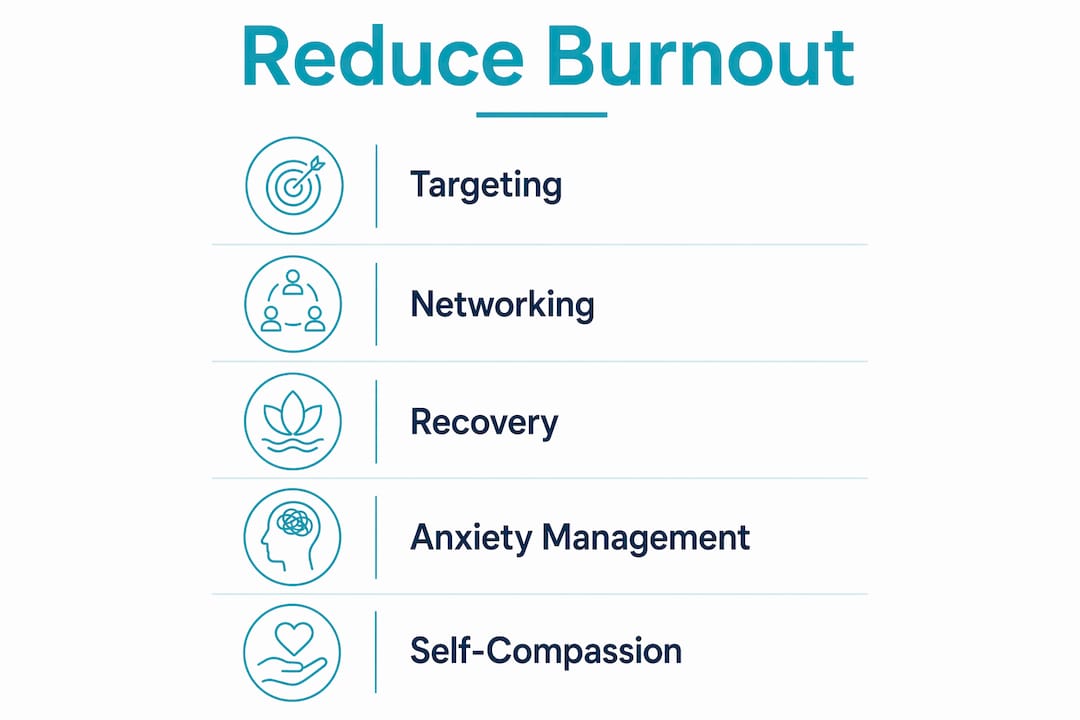
The most damaging myth in the senior professional job market is that more applications equal more opportunities. Monash University research shows that high-volume, untargeted applications produce response rates of 1 to 2%. Applying to 5 to 10 carefully matched roles weekly produces better results and significantly less burnout. Quality targeting is not a consolation strategy. It is the correct one.
Targeting and tailoring
Every application sent to a well-matched role should include a resume tailored to that specific job description. Generic resumes fail ATS filters and signal low effort to human reviewers. Tailoring takes 20 to 30 minutes per application and multiplies the chance of a callback. Pair each application with a direct follow-up to the hiring manager or recruiter within five business days.
Networking as a bypass strategy
Networking referrals bypass applicant tracking systems and increase interview chances significantly. The key shift is asking for a conversation, not a job. Reach out to former colleagues, industry contacts, and LinkedIn connections with a specific, low-pressure request: “I’d value 20 minutes of your perspective on the market.” That approach builds internal advocates without putting anyone in an awkward position.
Structured recovery after rejection
Rejection without a recovery plan compounds burnout. Build a simple protocol: allow yourself 24 hours to feel disappointed, then write three things the process taught you, then return to your target list. This structure prevents the feedback loop where one rejection conditions a tougher emotional response to the next.
The table below contrasts common ineffective approaches with recommended methods:
| Common ineffective approach | Recommended method |
|---|---|
| Apply to 50+ roles weekly | Apply to 5 to 10 well-matched roles weekly |
| Use one generic resume | Tailor each resume to the specific job description |
| Wait passively after applying | Follow up directly with the recruiter within five days |
| Avoid networking to prevent awkwardness | Ask contacts for conversations, not job referrals |
| Suppress anxiety until it peaks | Schedule a daily worry window to contain rumination |
How do you recognize and manage job search anxiety linked to burnout?
Normal job search anxiety is a correct neurological response to uncertainty. It sharpens focus and drives preparation. Chronic anxiety is different. It loops without resolution, disrupts sleep, and conditions increasingly negative emotional responses to ordinary setbacks like a delayed reply or a form rejection.
The distinction matters because the treatment differs. Normal anxiety needs channeling. Chronic anxiety needs structured management and, in some cases, professional support.
Practical tools for managing overcoming job search anxiety include:
- Journaling: Write three sentences each morning about what you control today. This narrows focus and reduces catastrophic thinking.
- Mood tracking: Rate your anxiety on a 1 to 10 scale each evening. Patterns reveal which activities or times of day spike your stress, letting you adjust your schedule.
- Breathing exercises: The physiological sigh (two short inhales through the nose, one long exhale through the mouth) reduces cortisol faster than standard deep breathing.
- Emotional scheduling: Block specific times for job search tasks and specific times for recovery. Mixing the two all day keeps your nervous system in a constant low-grade alert state.
The “worry window” technique allocates 15 minutes a day to anxious thoughts. When a worry surfaces outside that window, you note it and defer it. This transforms anxiety from persistent background noise into a contained, manageable task. Scheduling a strict daily worry window is one of the most evidence-backed tools available for senior professionals managing career transition stress.
Self-compassion is not optional. Reframing a bad interview as data rather than failure is a skill that requires deliberate practice. If anxiety symptoms persist for more than two weeks and interfere with daily functioning, a therapist who specializes in career transitions is the right next step.
Pro Tip: Build your anxiety management routine into your calendar the same way you schedule interviews. A 10-minute breathing session at 8:00 AM and a 15-minute worry window at 5:00 PM takes 25 minutes a day and prevents hours of unproductive rumination.
Key Takeaways
Job search burnout in senior professionals is a systemic response to ambiguous hiring processes, and it requires structured emotional management, targeted application strategies, and deliberate recovery practices to overcome.
| Point | Details |
|---|---|
| Burnout is systemic, not personal | Opaque hiring processes cause emotional disengagement; recognizing this prevents self-blame. |
| Emotional intelligence is a career asset | EI training improves decision-making and resilience during career transitions, per HEC Liège research. |
| Target quality over volume | Applying to 5 to 10 matched roles weekly outperforms high-volume approaches with 1 to 2% response rates. |
| Structure anxiety management | A daily 15-minute worry window contains rumination and keeps focus on productive tasks. |
| Network for conversations, not jobs | Referrals bypass ATS filters; asking for perspective builds advocates without pressure. |
What I’ve learned about burnout that most career advice gets wrong
After more than a decade working in recruiting and career services, I’ve watched hundreds of senior professionals hit the same wall. They do everything right. They update their resume, they apply consistently, they follow up. And then they go quiet. Not because they gave up, but because the process drained something harder to name than energy.
What I’ve come to believe is that the standard advice misdiagnoses the problem. Burnout at the senior level is not about effort. It is about meaning. These are professionals who built careers on the premise that competence produces results. When a hiring process ignores that competence entirely, the wound is existential, not just professional.
The most useful reframe I’ve seen work is this: the hiring system is not a meritocracy, and accepting that is not defeat. It is clarity. Once you stop expecting the process to be fair and start treating it as a system to be navigated, your emotional energy stops leaking into outrage and starts going into strategy.
The professionals I’ve seen recover fastest are the ones who pace themselves deliberately, invest in their emotional regulation, and build a small network of people who actually know their work. They do not apply to everything. They apply to the right things, and they follow up like they mean it.
Burnout management is not a detour from your career transition. It is the work.
Kim
How Resumewiz supports senior professionals through the search
Senior professionals dealing with executive job search fatigue need more than a polished document. They need a process that reduces ambiguity and puts their application in front of the right people.
Resumewiz, founded by Kim Taynor with over 10 years of recruiting experience, offers ATS-compliant resume development, LinkedIn profile optimization, and personalized outreach templates built specifically for executives and career changers. The platform’s managed job search process is designed to cut through the noise that causes burnout, placing clients in high-fit interviews within defined timeframes. If you are ready to stop sending applications into the void and start getting responses, Resumewiz gives you the tools and the guidance to make that shift.
Want a recruiter in your corner for your next senior role? Book a free call with Resume Wiz and we will map out your next move together.
FAQ
What is job search burnout in senior professionals?
Job search burnout is emotional disengagement caused by prolonged exposure to ambiguous, unresolved hiring processes. Senior professionals are especially vulnerable because their career history creates an expectation of logical, merit-based outcomes that modern hiring rarely delivers.
How long does job search burnout typically last?
Duration varies based on how quickly a professional identifies and addresses the root causes. Structured strategies like targeted applications, emotional intelligence development, and daily anxiety management routines can reduce burnout within two to four weeks of consistent practice.
Does emotional intelligence actually help with career transition stress?
Yes. HEC Liège research from 2026 shows that professionals with strong emotion regulation maintain confidence and proactive behavior during career changes, leading to better decisions and faster recovery from setbacks.
How many job applications should a senior professional send per week?
Research points to 5 to 10 carefully matched applications per week as the most effective range. High-volume approaches produce response rates of 1 to 2% and accelerate burnout without improving outcomes.
When should a senior professional seek professional help for job search anxiety?
Seek professional support when anxiety symptoms persist for more than two weeks, disrupt sleep or daily functioning, or produce physical symptoms like chest tightness or persistent fatigue. A therapist who specializes in career transitions can provide targeted tools beyond self-management techniques.
